How to Choose a Sectional Sofa for Apartments


A sectional can look perfect in a showroom and still make an Ann Arbor apartment frustrating to live in. The sofa arrives, the chaise reaches into the kitchen path, the front door can't swing fully open, and the only route to the balcony runs between the coffee table and an armrest. That's why choosing a sectional sofa for apartments isn't just a question of finding the smallest footprint. It's a livability decision.
A well-planned sectional should support comfortable seating without stealing the room's light, sightlines, or circulation. The right choice can define a studio living zone, make an older two-bedroom conversion feel intentional, or give a downtown high-rise a comfortable gathering place. The wrong one can dominate the space, even when its measurements technically fit.
The Apartment Sectional Reality Check
Apartment living demands more from a sectional than a large family room does. In a Southeast Michigan rental, the sofa may need to share space with a work area, dining table, entry path, balcony door, and television. The central question is whether the room still works after the sectional arrives.
A sectional should be tested against four livability anchors:
- Sightlines: Can household members see the television, a window, or the room's main focal point without leaning around a high arm?
- Entry-to-kitchen movement: Does the primary path remain open when someone is carrying groceries or moving between rooms?
- Door swing: Can the front, closet, bathroom, or balcony door open fully without striking the sofa?
- Secondary exits: Is there a clear route to a balcony, hallway, or second exit?
A slightly smaller sectional with the correct chaise orientation usually serves an apartment better than a larger model that only fits on paper. The best layout leaves the center usable and keeps the sofa from becoming an obstacle course.
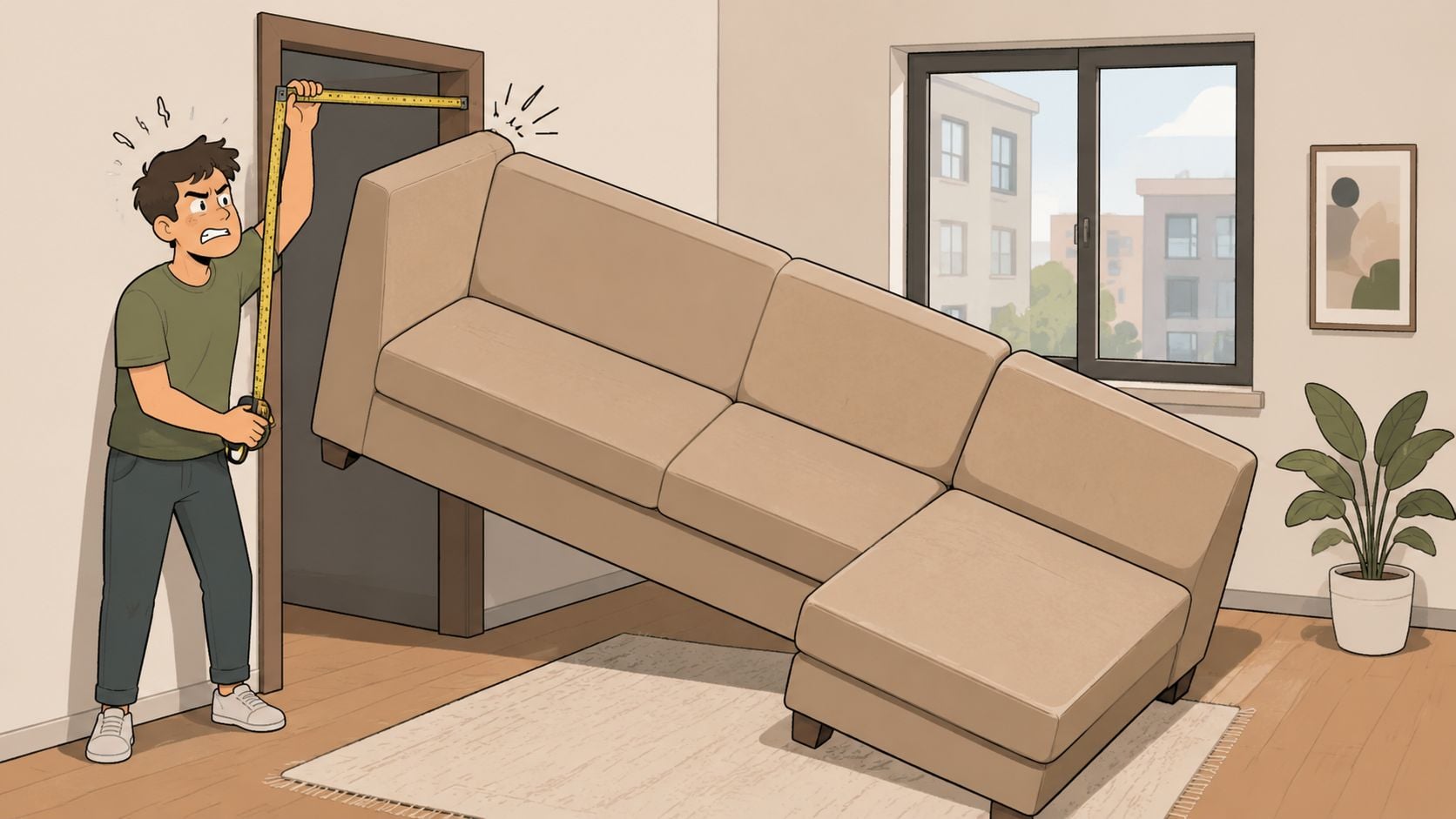
Apartment-size sectionals are commonly described with a long side of about 80 to 110 inches, while some compact L-shaped designs fall around 95 to 110 inches on the long side. Several sizing guides place a practical minimum room footprint near 11 by 13 feet, with at least 36 inches of walking clearance to avoid a cramped arrangement. See this small sofa buying advice for another useful perspective on keeping scale and circulation in balance.
The same principle applies across Ann Arbor's varied apartment stock. Older two-bedroom conversions often have interrupted walls and narrow approaches. Downtown buildings may offer generous elevator access but compact living rooms. Student rentals near campus frequently need furniture that handles changing roommates and future moves. A sectional must fit the way residents enter, work, relax, and host, not merely the wall where it will sit.
For additional ideas about preserving openness, Tyner's guide to making a small room feel big is a helpful companion. The showroom question should always be, “How will this room function at seven in the evening?” not just, “Does this sofa fit?”
Measuring Your Apartment Before You Shop
A sectional can fit the living room and still make the apartment harder to live in. Before visiting a showroom, sketch the room, mark every opening, and replace guesses with measurements. Windows, doorways, traffic paths, and the delivery route matter as much as the longest wall, especially in Ann Arbor apartments where older layouts, campus rentals, and compact downtown rooms create different constraints.
Build the room envelope
Measure the longest usable wall, adjacent wall, ceiling height, window width, sill height, and floor-to-window-top height. Mark radiators, baseboard heaters, air-conditioning vents, outlets, and architectural projections. A sofa over a vent can disrupt comfort, while a back that rises above a sill can block light.
Mark the television or main focal point first. Then draw routes from the entry to the kitchen, kitchen to sofa, and sofa toward the bathroom, hallway, balcony, or second exit. Keep 30 to 36 inches of circulation on open sides, a range supported by sectional sofa size recommendations. In a small apartment, that path determines whether the room feels usable at seven in the evening.
Leave 14 to 18 inches between the sofa and coffee table. This keeps the center comfortable without allowing the table to consume the walking route. Mark the clearance on the sketch instead of judging it from a showroom display.
Measure the delivery route
A sectional can fail before it reaches the living room. Record the front-door width, including the storm-door frame, then measure hallway pinch points, stair turns, elevator depth, elevator diagonal, and clearance around handrails and corners. Photograph each turn from the direction a delivery crew will approach. For Ann Arbor renters planning a future move, keep these measurements with the apartment sketch.
| Measurement | Minimum | Ideal |
|---|---|---|
| Open-side walking clearance | 30 inches | 36 inches |
| Sofa-to-coffee-table clearance | 14 inches | 18 inches |
| Practical apartment room footprint | 11 by 13 feet | More open circulation |
| Compact sectional long side | 80 inches | 95 to 110 inches |
The table follows the ranges and clearance guidance in apartment sectional sofa measurements and sectional sofa sizing guidance. Treat the minimum column as a boundary, not a shopping target.
Before the appointment, write down two limits: the maximum overall footprint and the maximum chaise depth that preserves the main route. A compact chaise may measure 78 to 90 inches wide with 55 to 70 inches of depth, suited to rooms around 8 by 10 to 10 by 12 feet, according to the sectional sofa sizing guide. Bring the sketch, delivery notes, and Tyner's how-to-measure furniture guide to the showroom.
Choosing the Right Sectional Shape for Your Room
In an Ann Arbor apartment, the wrong sectional can make a livable room feel like a hallway. Judge the shape by how it works with windows, doorways, balcony access, television sightlines, and the route from the entry to the kitchen. Room width matters, but circulation decides whether the sofa works every day and still fits after your next move.
An L-shaped sectional suits a long room with one uninterrupted wall. Run the sofa along that wall and aim the return toward the television, while checking that it does not narrow the entry route or cover a window. A chaise sectional works in a corner built around lounging. Set the chaise away from the main entrance, balcony door, and frequently used hallway. Its depth can consume more usable space than its width suggests.
Choose a reversible sectional when the television, desk, or dining area may change position. It also gives renters more flexibility if a future apartment reverses the room orientation. Modular seating offers the most control because separate pieces can be rearranged after a move, during hosting, or when the living room must support work and other activities. Modular sofa trend coverage has reported rising interest in modular arrangements from November 2024 into May 2025.
Skip a U-shaped sectional unless the apartment has open circulation. Typical U-shaped designs need a center span of 96 inches or more. Standard L-shaped sectionals often run 100 to 120 inches per side and measure about 36 to 40 inches deep, according to this sectional sofa size guide. A deep U paired with a full sleeper usually blocks the room's center, interrupts cross-traffic, and adds mechanisms to an already large frame.
| Shape | Best Apartment Scenario | Watch Out For |
|---|---|---|
| L-shaped | Long room with one continuous sofa wall | Return can narrow the entry or television path |
| Chaise | Corner arrangement centered on lounging | Chaise depth can block circulation |
| Reversible | Open-plan room with changing focal points | Check that the mechanism is easy to operate |
| Modular | Renters expecting moves or frequent reconfiguration | Inspect connectors and cushion alignment |
| U-shaped | Open apartment with generous circulation | Center span can consume the room |
Use this compare sectional sofa styles reference to identify shapes, then test each candidate against your floor plan with Tyner's sofa and television placement guide. The rule is direct: if the route from the entry to the far side of the room requires stepping over a chaise, choose another shape.
Picking a Fabric or Leather That Holds Up
Apartment upholstery has to survive concentrated use. One sectional may handle daily lounging, remote work, pets, meals, and guests in the same compact zone. The right material should be selected for cleaning habits, sunlight, and how the surface will age, not just for the first impression under showroom lighting.
Performance fabric is usually the practical starting point for households with pets, children, or frequent entertaining. A tightly woven surface with a strong abrasion rating can resist everyday wear, while removable covers make maintenance more manageable. One guide cites a 50,000 double-rub weave with a removable, washable cover as a combination that can outperform bonded leather in daily use (sofa upholstery fabric guidance). That figure applies only to the referenced example, so shoppers should ask for the actual rating of each fabric under consideration.
Woven upholstery offers texture and warmth, but its performance depends on the weave. A shedding dog, red wine during a watch party, or claws catching loose threads can change the decision. A south-facing window also makes fade resistance important, especially when the sectional sits directly in the light.
Top-grain or full-grain leather brings a buttery feel, easy surface cleaning, and a cool-touch first impression. It can suit allergy-sensitive households because dust and surface debris are easier to remove than from a deep textile. Leather still needs protection from sharp claws and direct sunlight, and its character changes over time through patina rather than remaining visually unchanged.
| Upholstery Type | Durability | Cleaning and Stains | Pet and Kid Friendly | 10-Year Aging |
|---|---|---|---|---|
| Performance fabric | Strong when tightly woven and properly rated | Best when covers are removable | Practical for active homes | Can soften and show lived-in texture |
| Woven upholstery | Depends heavily on weave construction | Spot cleaning varies by finish | Less forgiving of claws and spills | Texture may become a defining visual feature |
| Top-grain or full-grain leather | Durable with proper care | Surface spills are easier to address | Good for shedding, less ideal for claws | Develops patina and tactile character |
The decision rule is direct. Choose performance fabric for the busiest household, leather for easy surface maintenance and a refined aging pattern, and woven upholstery when texture matters enough to justify more careful use. Tyner's ability to discuss fabrics, top-grain leathers, finishes, and made-to-order configurations makes the showroom sit test more useful than judging a swatch online.
Sleeper and Storage Options Worth the Space
A sleeper sectional earns its bulk only when overnight guests are a regular reality. In a studio or one-bedroom apartment, it can turn the living room into a guest zone without requiring a separate room, but the mechanism changes the furniture's depth, weight, and delivery demands.
Pull-out systems commonly use innerspring, memory foam, or air-over-coil sleeping surfaces. Innerspring designs can feel familiar and supportive, memory foam provides a more continuous surface, and air-over-coil systems can offer a different balance of cushioning and structure. The adult sleeping surface matters more than the label, so the mattress should be opened and tested whenever possible.
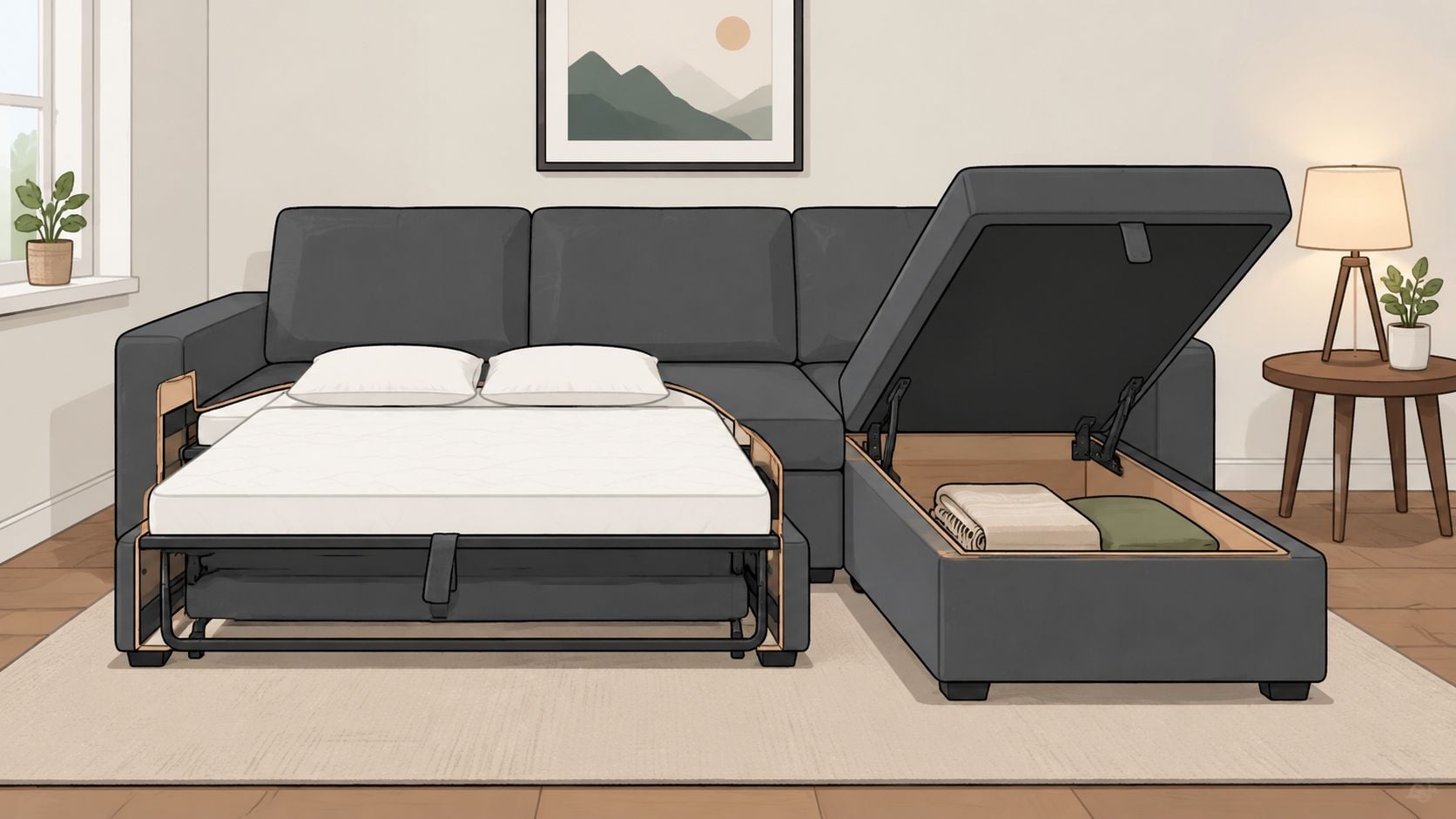
A sleeper can add 4 to 6 inches to overall frame depth, making the open bed a second floor-plan problem. The room needs enough space for the bed to extend without blocking the entry, kitchen route, or balcony. Frequent hosts should prioritize a smooth mechanism, a usable adult sleeping surface, and a configuration that leaves circulation intact when the bed is closed.
Storage can solve the quieter problem
A storage chaise is often the better choice for a tight studio. It can hold bedding, board games, luggage, and seasonal items while keeping visible clutter under control. Because it doesn't require an extended sleeping surface, the room maintains more flexibility for everyday use.
A hybrid sleeper-storage sectional suits a multipurpose living room that doubles as a guest space. The trade-off is added weight and complexity, so connectors, access panels, and the path to the storage compartment deserve inspection. A storage lid that barely opens against a coffee table won't help in practice.
The right choice depends on use:
- Frequent overnight guests: Select a sleeper, provided the opened bed preserves the primary route.
- Tight studio storage: Choose a storage chaise and protect the room's open center.
- Multipurpose living room: Consider a sleeper-storage hybrid only after taping both the closed and open layouts.
- Rare guests: A comfortable sectional with a flexible ottoman may provide better everyday value.
For more ideas on combining functions without overcrowding a room, consult Tyner's guide to multifunctional furniture for modern homes. Function should justify every added inch.
Built to Order, Built to Last
A sectional's value is easier to judge through cost per year than through the ticket price alone. The comparison often used in furniture planning is a $2,400 sectional lasting 12 years versus a $900 sectional lasting 3 years, which works out to $200 per year in the first example and $300 per year in the second. Those figures are simple arithmetic based on the stated purchase prices and service lives, not a promise about any specific product.
Construction determines whether that logic holds. A kiln-dried hardwood frame generally offers a more substantial structural foundation than particleboard, while eight-way hand-tied springs provide a different support approach from sinuous wire. Cushion-core density affects how the seat feels today and how it responds to repeated use. Shoppers should ask to see and feel these components rather than relying on a label such as “premium.”
| Build Feature | Lower-Construction Approach | Made-to-Order Sectional | Impact on Lifespan |
|---|---|---|---|
| Frame | Particleboard or mixed engineered components | Kiln-dried hardwood options | Better structural integrity can support longer service |
| Suspension | Sinuous wire | Eight-way hand-tied springs where specified | Changes support feel and recovery |
| Cushion core | Basic foam specification | Higher-density core options | Helps manage compression from repeated sitting |
| Configuration | Fixed selection | Arm height, chaise orientation, legs, and fabric can be selected | Improves fit and reduces layout compromises |
| Delivery format | Large fixed pieces may be difficult to maneuver | Modular or disassemblable formats may simplify moves | Helps the sectional adapt to future apartments |
These construction choices matter especially in apartments because moving is part of the furniture's life. A made-to-order sectional can be configured around a doorway, elevator, stair turn, arm height, chaise direction, leg finish, and selected fabric. Modular connectors should feel secure, and any removable or reconfigurable parts should be practical rather than decorative promises.
Cost-per-year rule: A sectional that lasts longer, fits the room better, and can move with the household may deliver stronger value than a lower initial price that leads to an earlier replacement.
Tyner Furniture, serving the Southeast Michigan community since 1957, offers made-to-order upholstery alongside brands such as Canadel and Stressless. Canadel supports bespoke finish and configuration choices, while Stressless provides ergonomic seating in Small, Medium, and Large sizing. Special Financing, subject to approval, and a Low Price Promise can make an heirloom-quality purchase easier to plan without treating longevity as an afterthought.
The same material standard applies elsewhere in a home. For bedroom and dining furniture, Tyner's Amish hand-crafted solid wood pieces contrast with mass-produced alternatives through material integrity and joinery, including dovetail and mortise-and-tenon construction. The weight of solid cherry, oak, or maple feels different in the hand, and that craftsmanship supports the broader idea of furnishing an apartment with sustainable, enduring pieces rather than replacements.
Your Next Steps Toward the Right Sectional
The final decision should happen with evidence in hand. Confirm the room dimensions, maximum footprint, chaise depth, delivery route, window clearances, and door swings one last time. Then photograph the room from the entry, kitchen, hallway, balcony, and television angles so a designer can see the sightlines that a flat measurement misses.

Bring the photographs and floor plan to the South State St. showroom. A proper sit test should include at least three modular configurations at full depth and around ten minutes of real sitting. The test should cover:
- Back support: Sit with the back against the frame rather than perching on the front edge.
- Lounging posture: Extend the legs and confirm the chaise supports the preferred position.
- Laptop posture: Test whether the seat depth works for reading or working without forcing the shoulders forward.
- Household fit: Have each regular user sit down, stand up, and move around the configuration.
- Sightlines: Check the television, windows, entry, and room exits from seated eye level.
Ask for Quick Specs that document depth, arm height, clearance requirements, weight, configuration details, and delivery format. Those details can prevent a surprise at the elevator, stair turn, or apartment doorway. Special Financing can also spread a made-to-order sectional across the years it is expected to serve, which keeps the payment conversation tied to durability and cost per year rather than the sticker alone.
Tyner Furniture covers more than living rooms, with selections for the Home Office, bedroom, dining room, entertainment areas, and Outdoor Spaces. Its local legacy and interior design guidance give Ann Arbor renters and homeowners a place to compare comfort, craftsmanship, upholstery, and configuration in person.
Book a design consultation at the Ann Arbor showroom, request fabric and leather swatches, and schedule an in-home delivery walk-through before signing for a sectional. Visit Tyner Furniture for the sit test, documented Quick Specs, special-order options, Special Financing details, and a Low Price Promise that supports a durable choice for apartment living.