Dining Room Tables with Hidden Leaves: A Buyer’s Guide

A dining room often has to do two jobs that pull in opposite directions. On ordinary weekdays, people want open walkways, comfortable chair movement, and a room that doesn't feel crowded. Then a holiday meal, birthday dinner, or last-minute gathering arrives, and suddenly the table that felt just right seems too small.
That's where dining room tables with hidden leaves earn their place. They solve a familiar household problem without asking the room to live in “company mode” all year long. For homeowners and renters around Ann Arbor and Southeast Michigan, that kind of flexibility matters. A dining table isn't just a surface. It's where family routines, celebrations, homework, and long conversations all meet.
Since 1957, Tyner Furniture has built a local legacy by helping shoppers think past the quick purchase and toward the piece they'll still respect years from now. That matters with an extension table, because the value isn't only in the mechanism. It's in the craftsmanship, the durability of the wood, and the way the table keeps working gracefully through changing seasons of life.
Table of Contents
- The Secret to a Dining Room That's Always Ready
- What Exactly Is a Hidden Leaf Dining Table
- How Hidden Leaf Mechanisms and Materials Work
- The Pros and Cons of a Hidden Leaf Table
- How to Choose the Right Size and Style for Your Home
- Find Your Forever Table at Tyner Furniture
The Secret to a Dining Room That's Always Ready
A common scene plays out every year. Extra chairs get borrowed from the office, someone squeezes into a corner seat, and the host wonders why the dining room has to feel cramped during gatherings or oversized the rest of the year. The better answer is usually not “buy the biggest table that fits.” It's “buy the table that adapts.”

Dining room tables with hidden leaves have a clean kind of practicality. Closed, they preserve breathing room and visual calm. Open, they make room for guests without looking like a backup plan. That balance is one reason extendable tables have lasted so long. Furniture histories trace table-leaf solutions back to around the 1500s, and by the late 16th century the idea of adding surface area only when needed was already established in furniture design, as described in this history of table leaves.
That long history matters because it confirms something shoppers still discover in the showroom. This isn't a trend piece. It's a time-tested answer to a real household need.
Practical rule: The best dining table doesn't dominate the room every day. It serves the room you actually live in, then rises to the occasion when people gather.
A hidden-leaf table also supports the details that make a meal feel finished. Once the right size is in place, table settings, runners, and placemats become easier to plan. For readers thinking ahead to those finishing touches, this guide to selecting exquisite dining textiles is a useful companion.
A well-planned dining room never relies on the table alone, either. Chairs, lighting, storage, and serving pieces all affect how the room functions. That broader view is why many shoppers also benefit from these dining room accessories that go beyond the table.
What Exactly Is a Hidden Leaf Dining Table
A hidden leaf dining table is an extension table that keeps its leaf or leaves inside the table itself, rather than requiring a separate storage spot in a closet, guest room, or basement. That single difference changes the ownership experience more than most buyers expect.
With a traditional removable leaf, the table expands only if someone remembers where the leaf was stored, carries it out, and fits it into place. That works, but it also creates friction. Hidden-leaf designs reduce that hassle because the extension component stays with the table.
The everyday difference
The appeal is immediately evident the first time one is used. Instead of treating expansion like a project, they treat it like an option. A weeknight dinner can stay compact. A holiday meal can expand without a search party for missing parts.
That convenience has deep roots in furniture design. Hidden or disguised expansion mechanisms became especially inventive during the Depression era, when makers were trying to maximize utility in smaller homes. Antique furniture histories describe designs from the 1930s and 1940s that used slide systems and split pedestal structures, and note that some tables could open as much as five or six feet on sliders to become full-length dining tables, as detailed in this look at expanding antique tables.
Those older designs make an important point. Hidden-leaf tables were never just about novelty. They were practical responses to rooms that had to work harder.
What buyers should look for
A hidden leaf table usually appeals to shoppers who care about three things:
- A clean silhouette that doesn't advertise its engineering.
- Fast flexibility for everyday meals and occasional hosting.
- Less storage hassle because the leaf stays with the table.
The category is broad, though. Some hidden-leaf tables disappear their extension so neatly that guests won't notice it until the table opens. Others show more visible seams but still deliver the same functional advantage.
For anyone comparing formats, it helps to understand the broader relationship between shape, room size, and extension style. This guide to picking the right dining room table is a useful next step before narrowing down a final design.
A hidden leaf isn't “better” in every room. It's better when the mechanism, the footprint, and the household's habits all line up.
How Hidden Leaf Mechanisms and Materials Work
The mechanism inside an extension table should feel almost boring in the best way. It should open smoothly, align cleanly, and close without argument. When that doesn't happen, buyers usually discover that the problem wasn't only the hardware. It was the whole build quality around it.
Where the leaf actually lives
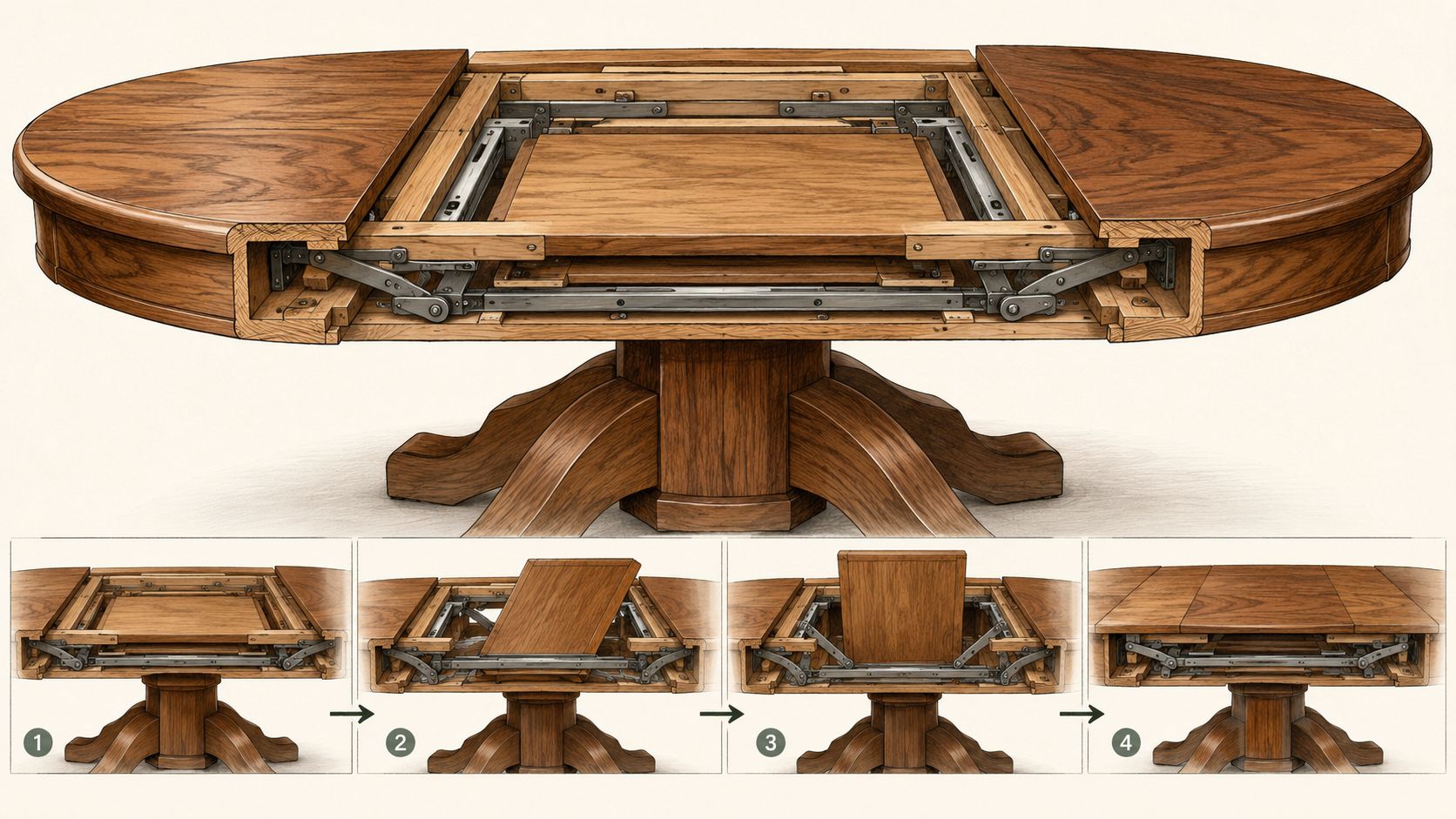
Self-storing or hidden-leaf dining tables house their leaves within the structure of the table, often beneath the top or inside the apron, so the leaves can slide out on tracks and lock into place. That integrated storage is what makes the design convenient, but it also creates an engineering limit. One industry source notes that self-storage is available on select solid-hardwood tables with 4 or fewer leaves, while tables with 5 or more leaves can't self-store any leaves because of internal space constraints, as explained in these self-store leaf options for solid hardwood tables.
That helps explain why some very large extension tables rely on removable leaves instead of hidden ones. There's only so much room inside the frame.
Here's a simple view of the most common approaches.
Common Hidden Leaf Mechanisms at a Glance
| Mechanism Type | How It Works | Best For |
|---|---|---|
| Butterfly leaf | The table opens and a folded leaf unfolds from inside the center | Buyers who want fast setup and integrated storage |
| Self-storing slide leaf | The top sections separate and a stored leaf slides into position from within the table structure | Homes that want a cleaner profile with no separate leaf storage |
| End-stored hidden extension | A concealed section pulls from one end or from within the frame, depending on the design | Rooms where one-sided access works better than opening from the middle |
Why material quality changes the feel
A hidden-leaf mechanism doesn't operate in isolation. It depends on stable wood, accurate joinery, and a table base that stays square over time. In these respects, mass-market construction often starts to feel different from hand-crafted solid wood.
In a well-made solid cherry, oak, or maple table, the movement tends to feel controlled and substantial. There's weight in the top. There's less rattle in the action. The table doesn't feel like two separate pieces trying to meet in the middle. It feels like one piece designed to shift shape.
By contrast, lower-integrity builds can feel light in the wrong places and strained in the joints. Over time, that often shows up as uneven seams, awkward alignment, or hardware that no longer feels precise.
Smooth extension is a craftsmanship issue, not just a hardware issue.
For shoppers who want to compare build quality more carefully, this overview of American-made dining tables is worth reading before making a long-term purchase.
A practical buying checklist helps here:
- Check the opening motion. The table should move without jerking or twisting.
- Inspect the seam line. When closed, the top should look intentional, not patched together.
- Feel the wood itself. Solid wood has a density and temperature that's different from lighter, thinner-feeling substitutes.
- Look under the top. Apron construction and joinery tell the truth about how the piece was built.
- Ask how the leaf stores. Hidden storage is convenient, but only if the mechanism is easy enough that people will use it.
The Pros and Cons of a Hidden Leaf Table
A balanced view is important here, because hidden-leaf tables are excellent for some homes and less convincing in others. Buyers make better decisions when the trade-offs are clear.
Where hidden leaves shine
The strongest advantage is convenience. The leaf is already with the table, so expanding the surface is easier and more likely to happen. That matters in real life. Families don't always plan every guest count far in advance.
There's also an aesthetic benefit. Dining room tables with hidden leaves tend to preserve a more unified look when closed. The room feels composed instead of visibly waiting for an add-on piece.
Another plus is lifestyle flexibility. A compact footprint on ordinary days can support better traffic flow, easier chair movement, and a less crowded visual field. Then the table shifts when hosting calls for it.
Where buyers should slow down
The first drawback is usually the initial investment. A strong hidden-leaf mechanism, especially in solid wood, requires more engineering and better construction. That pushes the purchase into “investment piece” territory.
The second is mechanical complexity. Any moving furniture part asks more of the build than a fixed top does. That doesn't make hidden leaves fragile by definition, but it does mean cheap construction shows up faster.
A third concern is fit within the room. Some households assume a hidden-leaf table automatically saves space. It can, but only if the room allows the table to open without major disruption.
A useful way to think about the cost is cost-per-year rather than sticker shock. A hand-crafted, heirloom-minded table that works well for years often delivers better value than replacing a lesser piece after frustration sets in. That's especially true in dining rooms, where one table often becomes the visual and functional center of the home.
Buyers rarely regret paying for stronger joinery and better wood. They often regret paying twice.
For many homes, the right answer isn't the least expensive table or the most elaborate one. It's the table whose mechanism, material, and daily use are in proportion.
How to Choose the Right Size and Style for Your Home
A hidden leaf table should fit the room in two different conditions. Closed, it needs to support daily life. Open, it still needs to let people move, sit, and serve comfortably. That's the part many shoppers underestimate.
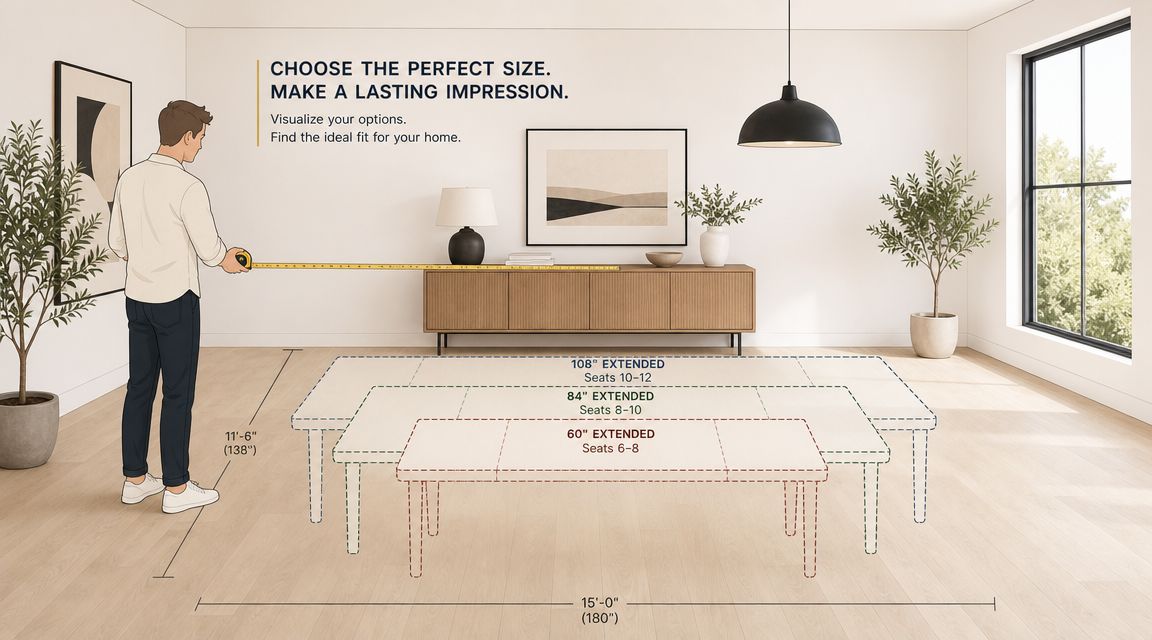
A key caution from current design discussions is that hidden leaves aren't automatically the smartest answer for compact homes. The room has to accommodate not just the final extended size, but also the clearance needed for the pull-out motion itself, as noted in this discussion of space planning for hidden leaf tables.
Measure the room in two states
A practical measuring routine keeps buyers out of trouble.
- Mark the everyday footprint. Tape out the table in its closed size on the floor.
- Mark the hosting footprint. Tape out the fully extended size as well.
- Test the opening path. Make sure the table can expand without moving multiple pieces around the room.
- Add the chair zone. A table that fits on paper can still feel cramped once chairs are occupied.
- Walk the room. Simulate the path to the kitchen, doorway, and nearby storage while the table is open.
For shoppers who want a visual planning aid, this guide to select perfect dining table size can help translate rough ideas into a more accurate floor plan.
Pro-Tip
Leave about 36 inches from the table edge to the wall when possible so chairs can move and people can pass comfortably. If the room can't support that in the expanded position, the table may be technically open but awkward to use.
That chair clearance matters as much as the tabletop dimensions. A dining room should feel usable, not merely full.
Match the style to daily life
Once the measurements work, style decisions become much easier. Shape, base design, and finish should support how the room is used.
- Round or oval forms often soften a smaller room and improve movement around corners.
- Rectangular tables usually suit longer rooms and households that entertain more formally.
- Pedestal and trestle-inspired support styles can improve legroom compared with bulky corner legs.
- Finish selection should reflect the room's lighting, adjoining flooring, and the amount of visible grain the homeowner wants.
This is also where bespoke options become valuable. Not every room in Ann Arbor or Southeast Michigan fits a standard template, and that's why made-to-order dining can be more practical than it first appears. Canadel gives buyers room to tailor finish, edge profile, dimensions, and configuration instead of settling for “close enough,” while Stressless represents the same philosophy of ergonomic customization in other parts of the home.
One factual example in this category is that Tyner Furniture offers a table with two self-storing 18-inch leaves, which shows how some extension designs can combine compact daily use with built-in flexibility. In-stock options are only the beginning. Custom finish and configuration choices often make the bigger difference over the life of the piece.
Find Your Forever Table at Tyner Furniture
The right hidden-leaf table isn't just a clever mechanism. It's a long-term decision about how a home will function through ordinary dinners, holiday hosting, and the quieter years in between. That's why build quality matters so much. A table should open smoothly, close cleanly, and still feel worthy of the room when the occasion is over.
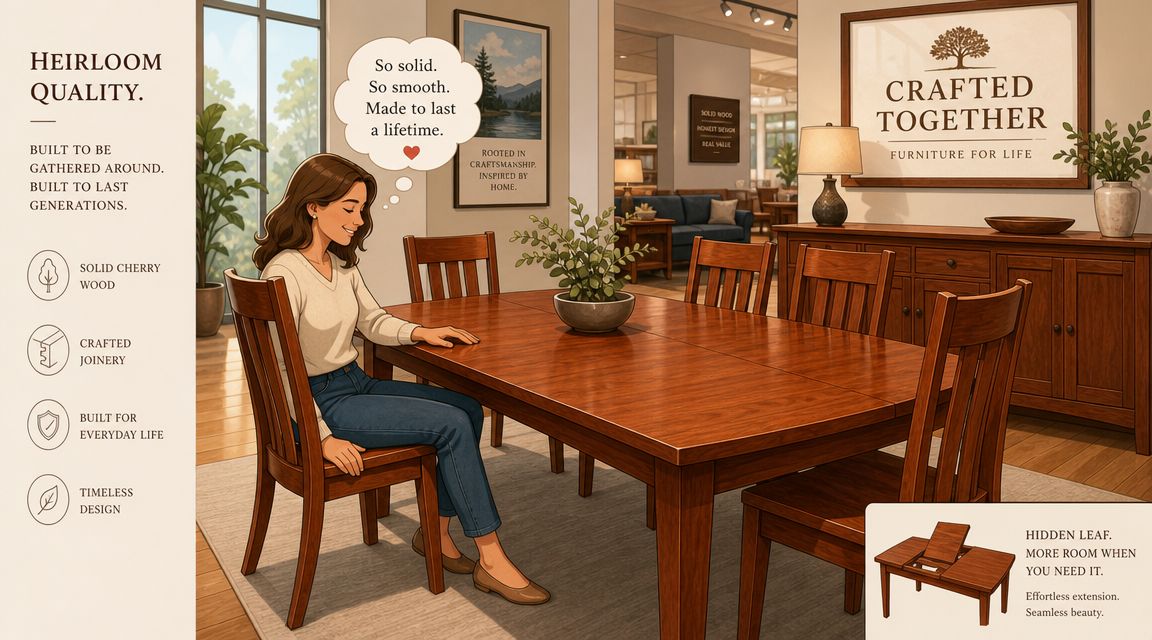
For shoppers who care about heirloom value, Amish hand-crafted solid wood remains the benchmark. The weight of solid cherry wood, the steadiness of a well-built base, and the integrity of traditional joinery all communicate something that a quick online listing can't. They communicate permanence. That same value mindset applies across the home, from the dining room to the home office, bedroom, living room, and even outdoor spaces.
Customization also changes the experience. Bespoke dining through Canadel lets a buyer adjust the piece to the room instead of adjusting the room to the piece. That's often the difference between a table that works for now and one that still feels right years later. For buyers exploring that route, these custom solid wood dining table options are a useful starting point.
The practical side matters too. Furniture shopping can feel overwhelming, especially when the purchase is meant to last. Special Financing and a Low Price Promise help reduce the barrier to investing in quality, whether the choice is in stock or made to order. The goal isn't a rushed sale. It's a durable, sustainable choice that respects both the room and the budget over time.
A visit to Tyner Furniture gives Southeast Michigan shoppers a chance to do what online photos can't provide. Sit at the table. Feel the top. Open the leaf. Visit the South State St. Ann Arbor showroom for a true sit test, or browse the online Quick Specs to start comparing special-order possibilities with confidence.