Solid Oak Bedroom Furniture: A Buyer’s Guide


A bedroom set can look convincing under showroom lighting and still feel flimsy after a few seasons. Many Ann Arbor shoppers eventually face the same choice: replace a worn dresser and unstable bed again, or invest in solid oak bedroom furniture that's built around real wood, repairable construction, and a finish that can mature with the home.
The higher price deserves scrutiny, not automatic approval. The right question is how the furniture performs across years of nightly use, moves, changing interiors, and ordinary household wear. Solid oak is an investment in durability, indoor comfort, and long-term value, but only when the material and construction are solid.
Why Solid Oak Bedroom Furniture Is a Different Kind of Purchase
You are comparing two bedroom sets in an Ann Arbor showroom. Both have a warm wood appearance, and both may include a bed, dresser, and nightstand. One has a printed grain over a composite core. The other has hardwood weight, smoother drawer movement, and joints built to handle repeated stress. The difference becomes clear when you touch, open, and inspect the pieces.
That distinction makes solid oak a cost-per-year decision, not a style choice. Solid wood furniture commonly lasts 20 to 50 or more years with basic care, while high-quality hardwood can last 100 years or longer when properly maintained, according to durability guidance for solid wood furniture. Oak can also be repaired and refinished after scratches, dents, or an outdated stain, rather than discarded.
Cost per year is the honest comparison
Spread a solid oak purchase across its useful life, and the annual cost can make more sense than repeatedly replacing lower-priced furniture. Beds and dressers earn that calculation because families use them every day, move them between homes, and keep them through changing stages of life.
Hand-crafted Amish construction makes the difference easier to verify in person. Look for mortise-and-tenon or dovetail joinery, solid drawer boxes, properly fitted runners, and a finish that follows the wood instead of hiding it. Open the drawers, inspect the underside, and ask how the builder handles seasonal movement. Small gaps or slight changes across the grain can reflect normal wood shrinkage. Peeling surfaces, swollen edges, loose joints, and a hollow feel point to mass-produced veneer or composite construction.
A broad market analysis describes oak furniture as a substantial, continuing category rather than a passing preference. The estimates differ sharply because their methods differ, so use that information as context, not as a reason to buy. Your hands, eyes, and the construction details in front of you provide better evidence for a bedroom purchase.
Practical rule: Judge a bedroom piece by cost per year, repairability, daily comfort, and joinery, not by the checkout price alone.
Disposable construction creates costs beyond the receipt. Replacements use more materials, interrupt the room, and can leave owners with pieces that wobble, peel, or lose function before the bedroom itself needs changing. A stable bed and dresser also support indoor wellness by helping create a calm, dependable sleep environment.
Local customization strengthens the investment. You can choose dimensions, storage arrangements, wood character, and finish details that suit the room instead of forcing the room around a standardized set. That matters because furniture purchases require careful consideration. Sit on the bed, open every drawer, run a hand across the finish, and compare hardwood weight with hollow composite construction. Style belongs in the decision, but material integrity, repairability, and longevity come first.
What Solid Oak Actually Means
Solid oak means oak lumber forms the piece's structural material, rather than a decorative oak surface covering another core. White oak and red oak are common choices. Every board shows its own growth pattern, pores, knots, and tonal variation, giving the furniture depth that printed finishes cannot reproduce consistently.
Veneer uses a thin layer of real oak over plywood, MDF, or particleboard. That construction can work well where dimensional stability matters, but an oak surface is not the same as an entirely solid oak structure. Engineered wood can contain wood fibers, particles, or layers without using solid oak throughout. Review this guide to solid wood versus engineered wood for a fuller material comparison.
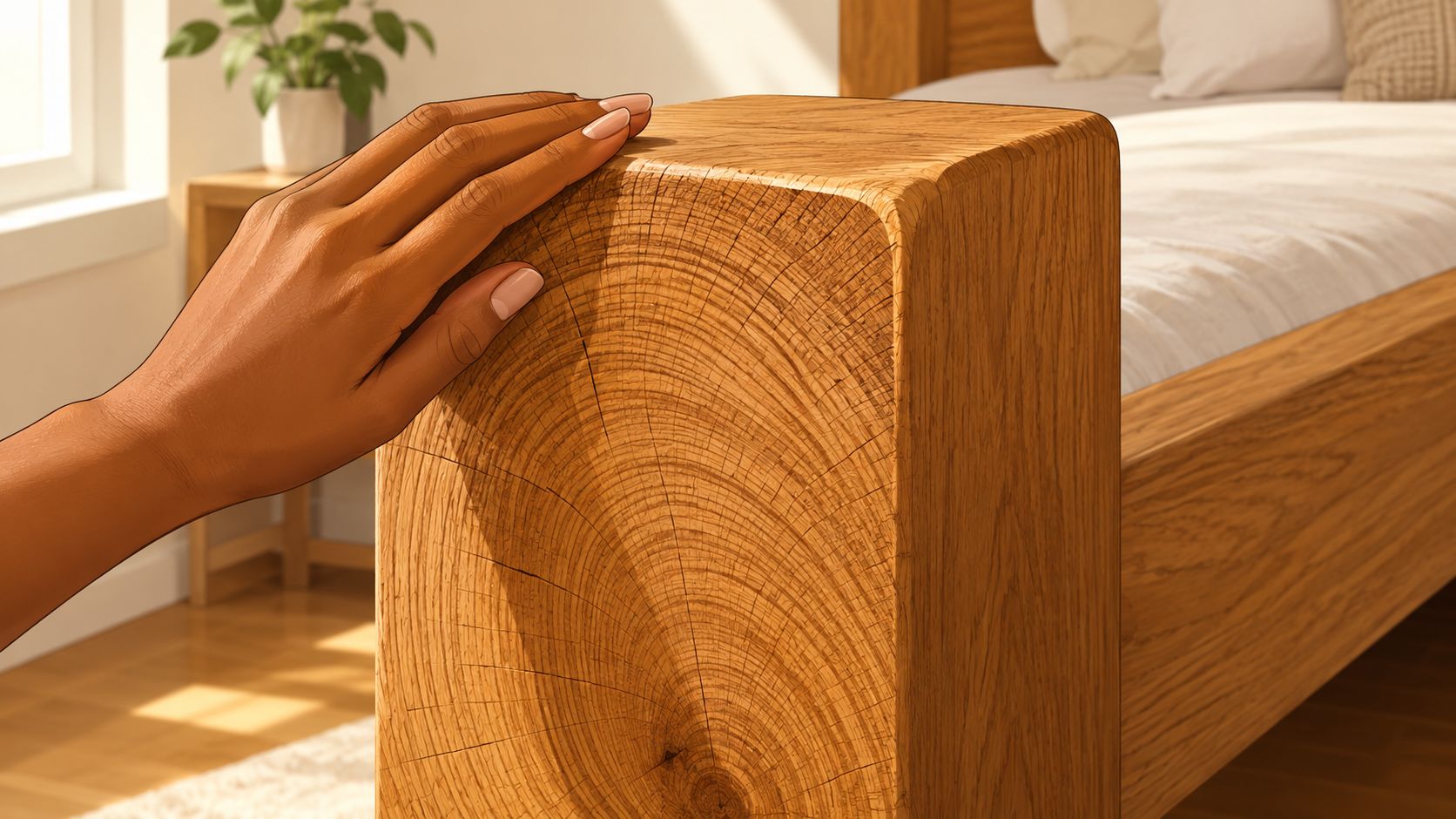
Three showroom tests reveal a lot
Inspect an exposed edge first. End grain should continue the board's growth structure, not show a thin decorative layer over another substrate. Drawer fronts, unfinished undersides, and removable components often reveal the material clearly.
Test the weight next. Solid oak has a substantial feel because its air-dry density commonly falls around 0.65 to 0.80 g/cm³, according to wood furniture standards guidance. Weight alone does not prove quality, but a dense nightstand feels different from a hollow case.
Open every drawer and inspect the interior. Check the sides, back, bottom, and cabinet interior. Matching material and a consistent finish indicate stronger material integrity. A sharply different interior can point to veneer or composite construction.
A grain pattern can be imitated. The way a drawer box, cabinet side, and bed rail carry weight is harder to fake.
Solid oak's cellular structure gives it strength and leaves room for repair. Oak can still move, dent, or suffer finish damage. A well-built piece, however, can often be sanded, refinished, tightened, or repaired instead of replaced. That repair potential matters when you calculate cost per year and compare heirloom construction with disposable alternatives.
The label solid oak still requires verification. A product description may identify a solid oak front while using veneer or engineered material elsewhere. Ask where solid wood appears, how the drawers are built, and what supports the bed frame. Those answers turn a vague label into a useful buying decision. A local showroom should let you examine these details in person before you commit.
How to Judge Construction Quality Before You Buy
A solid oak bedroom piece earns its cost over years, not at checkout. Joinery determines how that material behaves under stress, how well the furniture handles daily use, and how easily it can be repaired instead of replaced. Inspect the construction before you judge the stain or style.
Start with the drawers. Interlocking dovetails create a mechanical connection that resists being pulled apart, while a carefully fitted drawer box should sit squarely and move without rubbing. Open each drawer, lift it gently, and check whether the corners flex, the gaps stay even, and the bottom feels substantial. A smooth exterior can hide weak assembly.
What the buyer can inspect
Bedposts and rails deserve close attention. Mortise-and-tenon connections create a deep mechanical relationship between these parts, helping the frame resist side-to-side movement. A frame held mainly by screws, glued dowels, or staples may feel firm in a showroom yet offer less structural depth for long-term use. Review this guide to mortise-and-tenon construction before examining a bed in person.
Wide oak panels also need room to respond to changes in indoor humidity. Oak's tangential shrinkage is roughly 4.0 to 6.1%, while radial shrinkage is about 2.3 to 3.1%, according to seasonal wood movement guidance. Quality casegoods may account for that movement with floating panels, slotted screw holes, figure-eight fasteners, and finish applied to all faces.
A small seasonal change is not automatically a defect. A drawer may move slightly differently during a dry winter than during a humid summer, which reflects natural wood behavior. Bubbling, peeling, or delamination on a veneered component signals separation between the surface and its core. Ask the salesperson to explain how the panel is supported and where solid wood is used.
Construction Quality Markers at a Glance
| Construction Element | Heirloom-Grade Oak | Mass-Produced Oak-Look |
|---|---|---|
| Drawer corners | Interlocking dovetails or carefully fitted joinery | Staples, simple rabbets, or adhesive-only assembly |
| Bed rails and posts | Mortise-and-tenon or strong mechanical fastening | Screws or glued dowels with limited structural depth |
| Wide panels | Floating construction that accommodates movement | Rigid attachment that can stress the panel |
| Case corners | Corner blocks and reinforced connections | Minimal reinforcement or thin composite supports |
| Drawer movement | Smooth, aligned travel with repairable components | Rubbing, racking, or uneven gaps |
| Back and bottom panels | Substantial material fitted to the case | Thin stapled board or lightweight composite |
Before ordering, photograph the drawer joints, underside, back panel, bed hardware, and visible corner blocks. Record what you inspected and ask for clear answers about materials, supports, and repair options. That evidence keeps the decision focused on construction rather than finish color, and helps distinguish hand-crafted Amish joinery from mass-produced veneer in a showroom.
Pieces, Styles, and Finish Choices for an Oak Bedroom Set
A couple may enter a showroom wanting a complete oak bedroom set, then discover that the largest package does not fit how they live. Start with the pieces that solve real needs: the bed, dresser, nightstand, and armoire or wardrobe. Each should justify its space and contribute to a cost-per-year investment, not fill an empty room.
The bed anchors the room and carries the greatest visual weight. A panel bed gives the space a composed architectural look. A poster bed adds height and presence, while a storage bed can reduce the need for separate case pieces. The dresser earns its place through smooth, aligned drawers and a useful top surface. A nightstand should hold a lamp, books, and charging items without crowding the mattress. An armoire provides vertical storage where a wide dresser cannot fit.
Choose a style that can change with the room
Oak suits traditional, farmhouse, transitional, and contemporary interiors because its grain supplies character without requiring an elaborate shape. Choose a straightforward profile and a finish that can live with new bedding, rugs, lighting, and wall color. Aggressive distressing and highly specific ornament can date the room faster than the oak itself.
Finish choice also affects how the furniture wears visually. Natural and honey tones show the grain clearly. Deeper stains create a more formal atmosphere and can give red oak a richer appearance. For an Ann Arbor bedroom that should remain useful through several decorating changes, I recommend a finish with visible natural variation. Small everyday marks are less conspicuous when the surface does not look perfectly uniform.
Finish advice: The darkest color is not automatically the most durable-looking choice. A finish that shows oak's natural variation usually hides ordinary wear more effectively.
Put health and maintenance into the decision
A bedroom is close to your breathing space for hours at a time, so ask about finish ingredients, construction materials, and sourcing before you order. Information about non-toxic oak bedroom sets can help organize those questions for households that treat indoor wellness as part of furniture selection.
Customization makes the set more useful when standard dimensions or stains fall short. Ask about wood tones, hardware, drawer configurations, and finish options before accepting an in-stock piece. Tyner's custom wood finishes provide one example of the finish discussion to have before settling on a standard stain.
A hand-crafted Amish bedroom set can support an heirloom approach throughout the home, including the Home Office to Outdoor Spaces. That broader selection helps a household coordinate materials and craftsmanship instead of pairing one carefully built bedroom with disposable alternatives.
Sizing and Layout Tips That Prevent Buyer's Remorse
A solid oak set needs more than a room with an empty wall. It needs a route into the room, enough clearance for doors and drawers, and proportions that leave the bedroom comfortable rather than crowded.
Begin with the room itself. Measure wall lengths, ceiling height, windows, outlets, radiators, vents, and door swings. Then measure the path from the driveway or delivery entrance through hallways, stairways, and interior doors. A dresser that fits the bedroom can still fail at a narrow turn.
Plan around how the room works
The bed should leave practical walking space on the sides and at the foot. Nightstands need enough room for drawers to open without striking the bed or adjacent wall. A dresser shouldn't block a closet door, and an armoire needs clearance for its doors or drawers to operate fully.
Use painter's tape on the floor to mark the planned footprint. That simple outline helps reveal whether the set feels balanced before delivery. It also makes the difference between a visually appealing arrangement and an ergonomic one easier to judge.
Bring a basic sketch to the showroom. The furniture measuring guide can help organize the dimensions a buyer should record before visiting. Ann Arbor homes vary widely, from newer open layouts to older properties with tighter staircases and cased openings, so local guidance can prevent an expensive mismatch.
Pro tip: Measure the delivery route before falling in love with a tall armoire. The most beautiful piece is useless if it can't safely reach the bedroom.
Customization provides another solution when a standard size almost works. A dresser can be ordered narrower, a nightstand can be adjusted for mattress height, and a bed can be selected with storage that reduces the need for additional casegoods. Those changes protect circulation and preserve the calm feeling a bedroom should have.
Red Oak vs White Oak vs Mixed-Wood Finishes
Choose oak species by the room's light, the desired mood, and how the furniture will be used. Red oak and white oak are both durable furniture hardwoods, yet their grain, undertone, and response to stain create noticeably different bedroom settings. The better choice is the one that supports the room for years, not the sample that looks most impressive under showroom lighting.
Red Oak
Red oak usually has a more pronounced grain and warmer undertone. That character gives a bedroom a grounded, traditional feel, especially with a medium or deeper stain. Its natural variation can also make small marks less conspicuous on dresser tops and nightstands that hold lamps, books, jewelry, and daily essentials.
Ask to see a full drawer front or door panel, not only a small finish chip. On a larger surface, red oak's grain pattern becomes easier to judge against flooring, wall color, and morning light.
White Oak
White oak generally presents a calmer, more restrained grain while retaining clear natural character. It suits transitional and contemporary bedrooms, particularly when the finish stays close to the wood's original tone. Choose it for a lighter, refined room that still needs visible texture and warmth.
White oak does not make weak furniture stronger. Sound kiln-dried stock, well-fitted joints, and a finish appropriate for household use matter more than the species label alone.
Mixed-Wood Finishes
Mixed-wood designs pair oak with another material or use contrasting tones within the same bedroom set. They can add depth, but they require closer inspection. Different surfaces may age at different rates, reflect light differently, or respond differently to cleaning.
View the complete set together under the bedroom's actual lighting before ordering. A combination that looks balanced in a bright showroom may feel mismatched beside warm bulbs, dark flooring, or strong daylight.
| Attribute | Red Oak | White Oak | Mixed-Wood Finish |
|---|---|---|---|
| Grain visibility | Strong and expressive | Clear but often more restrained | Varies by species and finish |
| Mark concealment | Variation can help hide small marks | Uniform tones may show contrast more clearly | Depends on the lightest or most delicate surface |
| Room character | Warm and grounded | Natural and adaptable | Layered and design-forward |
| Maintenance | Straightforward with consistent care | Straightforward with consistent care | Requires attention to multiple surfaces |
| Best fit | Traditional, relaxed, richly stained rooms | Transitional and contemporary bedrooms | Coordinated interiors with varied materials |
For a long-term bedroom investment, prioritize construction first, then species, then color. The strongest choice combines properly dried wood, dependable joinery, and a finish that fits the household. Red oak brings warmth, white oak brings quieter versatility, and mixed woods bring contrast with added care. No finish can compensate for poorly built furniture.
Care and Maintenance That Protects the Investment
Solid oak doesn't need complicated rituals. It needs consistent conditions and gentle handling. A soft, barely damp microfiber cloth removes dust without loading the finish with unnecessary residue, while prompt attention to spills keeps moisture and oils from darkening the grain.
Keep the room's relative humidity between 35% and 55%, as recommended in the provided care guidance. A small hygrometer can show whether winter air is too dry or summer air is too damp. Stable indoor conditions reduce unnecessary stress on panels and joints.
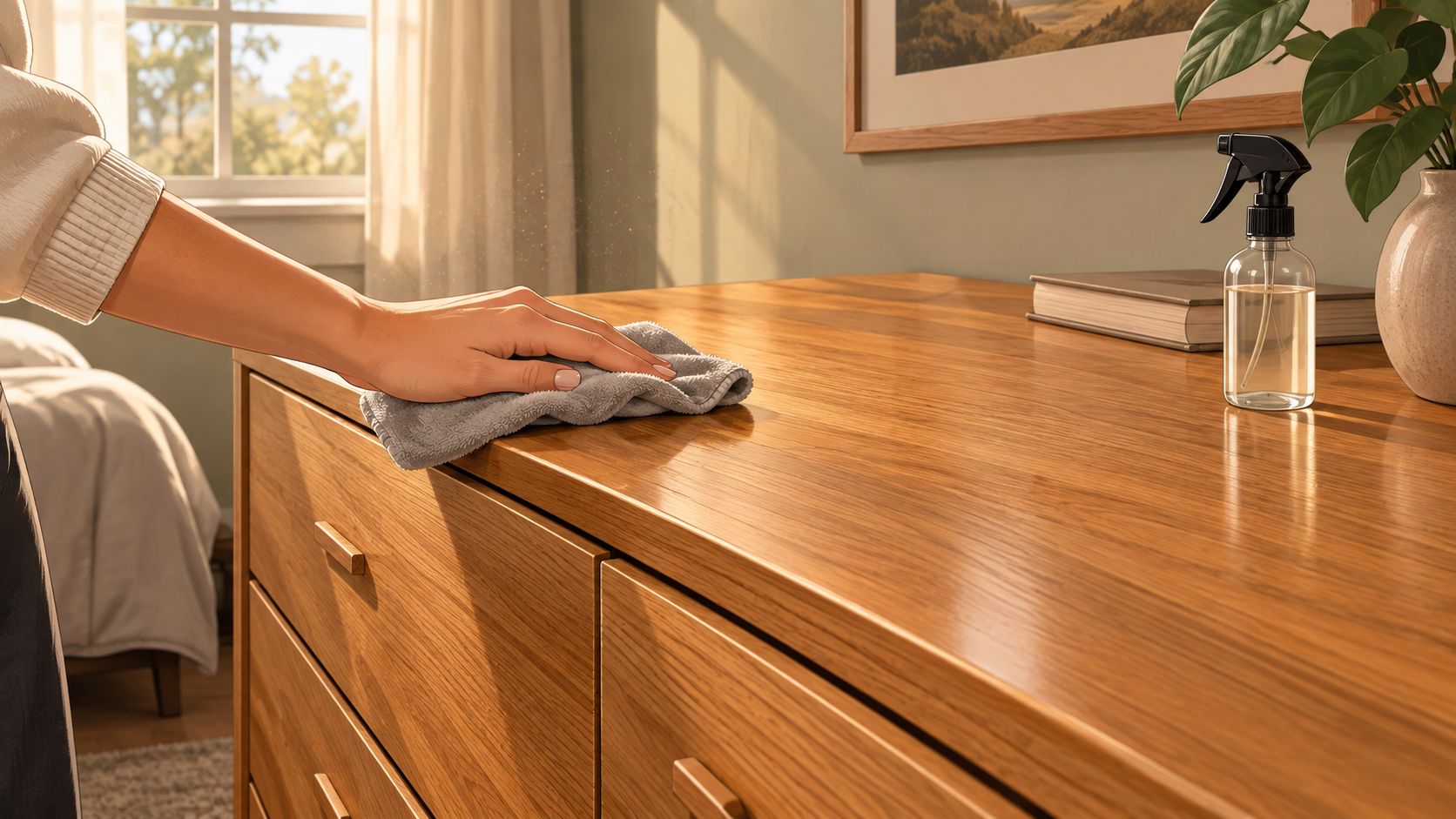
Small habits protect the finish
- Dust gently: Use a soft cloth instead of abrasive pads or aggressive sprays.
- Blot spills quickly: Don't leave water, oil, or cosmetics sitting on the surface overnight.
- Protect contact points: Felt pads under lamps, clocks, and accessories help limit micro-scratches.
- Manage sunlight: Rotate or reposition small pieces periodically so one side doesn't receive all the exposure.
- Control heat: Keep furniture away from heating vents and avoid placing it against uninsulated exterior walls.
- Refresh thoughtfully: A light buff-and-oil treatment can revive color when the finish and manufacturer's instructions permit it.
Wood movement is natural. Cupping, cracking, and joint gaps become more likely when furniture experiences sharp environmental swings, so location and humidity deserve as much attention as cleaning.
A solid oak piece can also be refinished when the household's taste changes or a surface needs restoration. That repairability is a central part of its sustainable value. The furniture doesn't have to leave the home because the finish has aged.
Customization, Financing, and Buying Local in Ann Arbor
Buying locally lets you inspect the oak, test drawer movement, and settle details that online listings leave unclear. In-stock is just the beginning. A made-to-order discussion can address finish, hardware, width, storage layout, and room constraints, turning a bedroom set into a cost-per-year investment rather than a short-lived style choice.
Tyner Furniture has served Southeast Michigan since 1957. Its Ann Arbor showroom on South State St. lets shoppers assess material, joinery, comfort, and finish in person. Ask how drawers are joined, how panels are allowed to move with seasonal humidity, and whether the construction is solid oak throughout rather than mass-produced veneer. Those signals are easier to verify at a showroom than on a product page.
Customization should solve real household problems
Specify a dresser that clears the doorway, a nightstand that fits charging needs, or storage sized for the household's routine. Compare finish samples with flooring, trim, and heirlooms before ordering. Local advice also helps match pieces across a coordinated bedroom without forcing every item into one identical style.
Financing can make a durable purchase easier to plan, but read the terms carefully. Promotions may offer deferred-interest periods of 12, 18, 24, or 36 months. If the balance is not paid in full by the deadline, interest may be charged from the purchase date. Confirm the offer, payment schedule, and deadline before signing.
The Low Price Promise gives shoppers another checkpoint when comparing pricing. Local purchasing keeps delivery questions, service discussions, and customization follow-up close to home. For broader context on community purchasing, see Fillaree on shopping local.
Tyner Furniture offers solid wood bedroom pieces, custom finishes, made-to-order configurations, Special Financing, and a Low Price Promise for Southeast Michigan households. Visit Tyner Furniture in Ann Arbor for a proper sit test and hands-on inspection, or review the online Quick Specs before requesting a special order.