How to Build Your Own Dining Table the Right Way

Most advice about a dining table build starts in the wrong place. It talks about the weekend project, the tools, the bargain lumber, and the paint color, then acts surprised when the table rocks, splits, or starts looking tired after a few seasons. The better question is simpler, and a lot more honest, how long should this table serve the home, and what level of craftsmanship does that answer require?
That shift matters in Ann Arbor, in Southeast Michigan, and in any house where the dining room does real work. A table can be a room-filler, or it can be an heirloom that takes abuse, anchors the space, and still looks right years later. The difference starts with joinery, solid wood, and a sober look at whether build your own dining table is the right move, or whether a made-to-order piece is the smarter investment.
Why Building a Dining Table Is Really a Longevity Decision
A dining table is not just a surface, it's a load-bearing decision about daily life. If the goal is a piece that survives family meals, homework, holiday serving trays, and the occasional elbow slam, then the key metric isn't the sticker price, it's cost-per-year. A table that feels affordable up front can become expensive if it racks, loosens, or needs to be replaced long before the room does.
The frame should follow the life span you want
The strongest build choices always point back to the same idea, material integrity matters more than visual bulk. Solid hardwood, sound joinery, and a finish that protects the surface all work together to extend the table's useful life. That's why old-school furniture methods still matter, and why an Amish-style solid wood piece feels closer to a long-term investment than a temporary furnishing.
Practical rule: If the table has to survive more than one move, one season, and one round of growing kids, joinery quality stops being a detail and becomes the whole story.
That same standard is exactly why Tyner's American-made solid wood furniture belongs in the discussion. The point isn't to romanticize one approach over another, it's to recognize that both a careful shop-built table and a hand-crafted dining piece are judged by the same basics, wood choice, fastening method, and how well the structure handles time.
DIY stops making sense when the build becomes a hidden custom job
A homeowner can absolutely build a solid table, but there's a threshold where the project stops being a savings move and becomes a labor-intensive custom commission done at home. Once the design calls for exact sizing, specialty joinery, refined edges, and a finish that has to match the rest of the home, the job starts resembling bespoke furniture work. At that point, a showroom order isn't a compromise, it's a cleaner path to the same durability goal.
The honest way to think about it is this, a weekend build is fine if the table is meant to be practical and short-term. If it's meant to become part of the home's story, every decision after this point has to support longevity, not just assembly.
Planning the Right Size, Height, and Seating Math
A table that fits the room badly will annoy everyone long before the finish wears out. The planning work is boring, but it's where a table either behaves like furniture or like an obstacle. Dining-height tables are typically built around a standard height, and the layout has to leave enough edge space for people to sit comfortably without knees colliding under the apron or chairs scraping walls.
Start with the room, then size the table to the room
The simplest way to avoid regret is to measure the room first, then decide what the table can safely occupy. Leave room for chair pull-out, walking paths, and door swing before you ever cut a board. A dining table should feel centered and intentional, not wedged into place because the cut list looked good on paper.
For seating, the practical rule is that each diner needs about 24 inches of edge space. That's the number that keeps elbows from fighting and lets the setting feel usable instead of cramped. For a long rectangular table, that math becomes the backbone of the cut list.
A useful planning aid for event-style layouts is wedding and event table capacity. It's not a dining-room blueprint, but it does reinforce the same principle, people need real space, not wishful thinking.
A seven-board top is a real-world example, not a theory
One mainstream guide uses seven 1" × 6" × 8' oak boards, cut to 72 inches, to create a dining-scale top. That's a clean example of how dimensional lumber becomes a finished tabletop without mystery or guesswork. The important lesson isn't the exact board count, it's that the top starts as a panel, then gets trimmed to the room and the seating plan.
If the room is smaller, shorten the span. If the room is larger, widen the top only after confirming that the chairs and walkways still work. A good dining table should leave the room looking calmer, not tighter.
The easiest way to keep the plan honest is to sketch the table footprint on the floor with painter's tape, then test chair clearance. If the tape feels awkward, the table will too. That's the point where the numbers need adjusting, not the room.
Choosing Wood and Joinery for the Lifespan You Want
A dining table lives or dies on what is underneath the top. The stain, sheen, and edge profile get attention, but the structure decides whether the table stays square, stays tight, and stays useful after years of dinner traffic. Pocket-hole construction, mortise-and-tenon joints, and dovetailing each serve a different level of ambition. A homeowner does not need to speak like a cabinetmaker to make the right call. The primary question is how much strength, skill, and long-term stability the table needs.
Match the joinery to the job
A leg-and-apron build with pocket holes is straightforward and realistic for a careful home shop. It gets a clean, serviceable result without forcing you into specialized tooling or complicated layout. That makes sense for a table that will be used normally and built with patience. A mortise-and-tenon build is stronger, more traditional, and better suited to a table meant to stay in the family. For a closer look at the mechanics, see our guide to mortise-and-tenon construction. Through-dovetail construction sits in a more specialized category, the kind of joinery you expect from serious furniture craft, not casual assembly.
| Joinery Type | Tool Skill Needed | Best For | Typical Lifespan |
|---|---|---|---|
| Pocket-hole leg-and-apron | Moderate | Straightforward home builds | Good if built and fastened well |
| Mortise-and-tenon | Higher | Heirloom tables and long-term use | Excellent over decades |
| Through-dovetail | High | Advanced furniture work | Excellent, especially in refined builds |
The right choice depends on how you plan to use the table. If it is for everyday meals, homework, and guests, pocket-hole joinery can hold up when the rest of the build is done carefully. If you want a table that feels permanent, the stronger joint is the better standard. That is the same reason solid custom work from an Amish shop or a made-to-order program carries weight. The structure is doing the primary work, and the joinery has to match the expectation.
Wood species changes the feel of the whole piece
Oak, maple, and cherry do more than change color. They change the way the table reads in the room and the way it feels in use. Oak looks grounded and solid. Maple gives the table a cleaner, lighter visual. Cherry brings warmth and a more formal presence as it ages. Once the joinery choice is settled, the species should follow the room's style and the amount of use the table will take.
The wood and the joinery should be chosen together. Strong legs on weak joints are still weak furniture.
That is the same logic behind a well-built solid-wood dining table from an Amish shop or a made-to-order program. Decorative detail does not matter if the structure is thin or the joints are weak. Mortise-and-tenon construction, solid hardwood, and careful finishing set the baseline when the goal is a table that gets used hard and still belongs in the room years later.
Tools, Materials, and the Cut List in Real Order
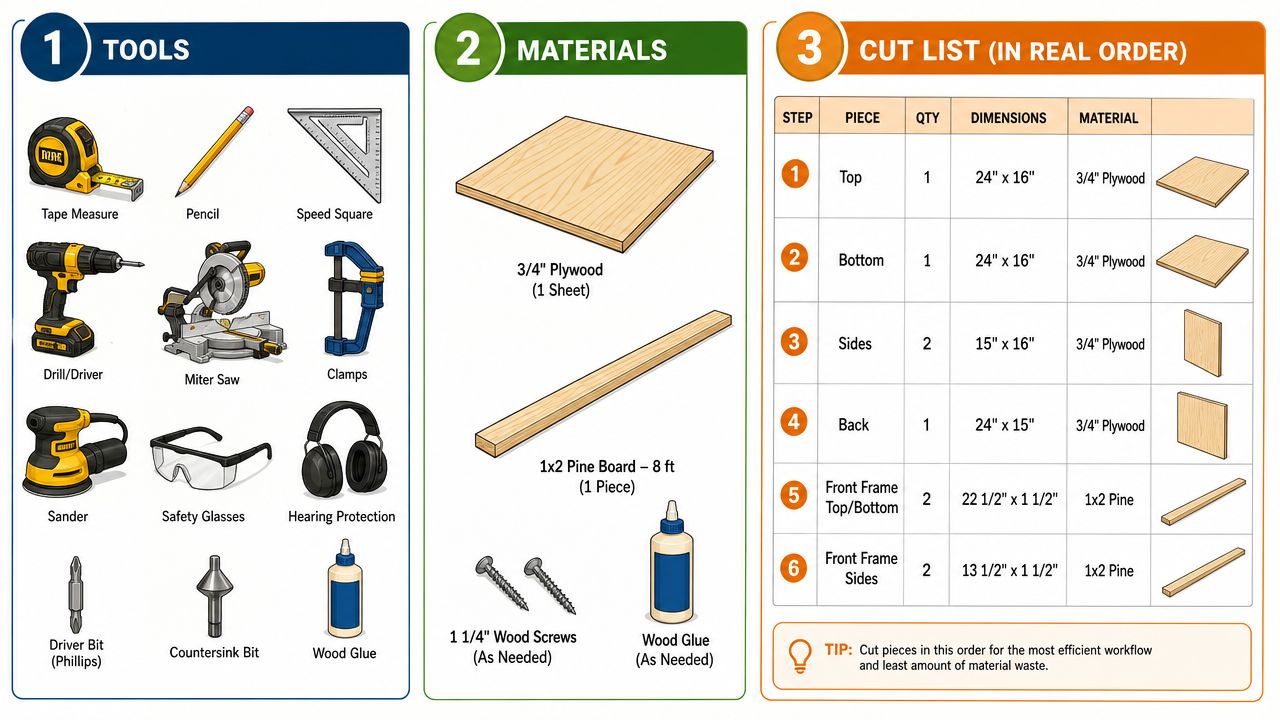
A good shop list keeps the project calm. A bad one creates pauses, extra trips, and bad shortcuts when the glue is already open. The table build only moves smoothly when the materials, the tools, and the assembly sequence are all lined up before the first cut.
What belongs on the bench
A practical materials list usually includes lumber, glue, pocket-hole screws, slotted fasteners, sandpaper, and finish. The tool side is equally direct, a table saw, miter saw, drill, pocket-hole jig, sander, tape measure, square, and a brad nailer if the design calls for temporary positioning. Nothing fancy is required, but the tools have to be accurate.
Specs to have ready before cutting:
- Lumber: Enough for the top, aprons, legs, and any center supports
- Fasteners: Pocket-hole screws or structural screws, plus slotted hardware where movement must be allowed
- Glue and clamp setup: Enough clamps to keep the tabletop flat during glue-up
- Sandpaper: Coarse through fine grits for shaping and finish prep
- Finish: Wipe-on finish or polyurethane, depending on the look and use case
The build-your-own dining table workflow should begin with milling the lumber, not with assembly. Square the edges, cut the top boards to length, dry-fit the panel, then glue and clamp it on a flat surface. The panel should cure for at least 24 hours before the base goes on. That waiting period saves more rework than almost any other decision in the shop.
Put the steps in the right order
The tabletop gets priority because it sets the whole geometry of the piece. Once the panel is flat and dry, the apron, legs, and supports can be cut and fitted against a known surface. If the base gets built first, the chances of mismatch rise fast, and the finished table starts carrying tiny errors everywhere it goes.
A detailed build guide also emphasizes square corners and aligned joints during glue-up, because the table only looks straight if the panel stays flat while it dries as shown in a step-by-step dining table build guide. That's not glamorous advice, but it's the kind that keeps a table from coming apart in the living room later.
Shop floor rule: Dry-fit first, glue second, and never rush the cure just because the frame looks ready.
For a homeowner who wants a smoother finish path later, Tyner's custom wood finishes show how surface choice changes the final read of a piece. On the shop side, the same principle applies, the finish should support the wood, not rescue it.
Finishing, Wood Movement, and Stopping the Table from Failing Later
The table is not done when the base goes on. That is when the durability work starts. Solid wood moves across the grain as humidity changes, and if the top is clamped down like a rigid panel, it will split, cup, or work the joints loose over time.
Let the top move where it wants to move
Use an attachment method that holds the base steady and lets the top move naturally. Many farmhouse-style builds use slotted holes so the fasteners can shift with the panel instead of fighting it. Z clips and figure-8 fasteners do the same job from underneath while keeping the hardware out of sight. That hidden movement is what separates a table that ages cleanly from one that tears itself apart with the seasons.
A solid-wood guide also recommends fastening the base in a way that avoids over-constraining the panel, and it warns against rigid attachment through the wrong axis as noted in a farmhouse table build guide. Follow that rule. The top needs room to move.
Uneven floors need a leveling plan
Many homes, especially older ones, do not have level floors. A table can be square on the bench and still rock in the dining room, which is why adjustable feet or shims matter. If the table wobbles, check the base geometry and the floor before blaming the top.
Finish strategy matters just as much on a high-use surface. A solid-wood top should get thin, controlled coats, not one heavy pass. One guide recommends three coats of wipe-on finish with light sanding between coats, while another says two or three polyurethane coats are enough for a durable result. For a different kind of durable finish, see how a durable car protection at home kit applies similar coating principles. For the surface itself, Tyner's custom wood finishes show how finish choice changes the way the piece reads in a room.
A separate concrete-table workflow makes the same point in a different material, with a 50, 100, 200, 400 grit progression for grinding and smoothing the cured top for grit progression on concrete table surfaces. The sequence matters because surface quality is built step by step, not sprayed on at the end.
When a Custom Heirloom Piece Outperforms a DIY Build
There's a point where the smartest choice is to stop building and order the table. That's not surrender, it's judgment. If the project needs precise dimensions, a distinctive edge profile, a custom base, and a finish that has to coordinate with the rest of the house, custom furniture often delivers a cleaner result with less risk.
The math changes when time and rework get counted
A table that costs less in materials can still cost more in practice if the builder has to buy tools, correct mistakes, and live with an imperfect result. A solid-wood heirloom piece may look more expensive at first, but the cost-per-year story changes if it lasts through decades of use instead of a handful of seasons. That's the actual comparison homeowners should make, not just purchase price versus lumber receipt.
Tyner's custom solid wood dining tables fit that logic because the build starts with the room, the wood, and the use case. Canadel custom work allows a homeowner to choose leg style, edge profile, finish, and distress level without giving up the durability conversation. Amish hand-crafted work brings the same seriousness through solid hardwood and traditional joinery.
What custom gives that a home shop usually can't
Custom work solves the part of the equation that most home builds struggle with, exact personalization. That includes the way a table reads under the lights, how the edge feels at the hand, and whether the proportions suit the room instead of just fitting through the door. It also gives the buyer a clean path to coordinated design, which matters in homes where the dining room has to speak to the rest of the interior design.
Good threshold: Build when the goal is practical and the room can accept a simpler result. Buy when the table has to become the room's anchor.
That's also where the broader Tyner mix matters. The showroom covers more than dining rooms, from the Home Office to Outdoor Spaces, so a table can be chosen in the context of the whole house instead of as a one-off purchase. Add Special Financing and the Low Price Promise, and the barrier to choosing a longer-lasting table drops without forcing a shortcut on quality.
Your Decision Framework and What to Do Next
The cleanest decision rule is this, if the table is for a rental, a short stay, or a space that will change soon, a careful home build makes sense. If the table is for a forever home, a family gathering point, or a room that deserves a true centerpiece, custom heirloom furniture wins. The table should match the life planned for the room, not the other way around.
A practical cost-per-year check makes the choice clearer. A lower-cost table that needs replacement sooner can become a poor value, while a more substantial piece that lasts for years may be the stronger investment. That's why the key question isn't whether a table is handmade, it's whether it's built to outlast the season it's bought in.
Use this threshold before spending another hour in the shop
- Build it when: the design is simple, the tools are already on hand, and the table doesn't need exact customization.
- Buy it when: the room needs a specific size, the finish has to coordinate with existing pieces, or the table needs heirloom-level durability.
- Buy it when: the builder wants solid wood, refined joinery, and a made-to-order result without the rework cycle.
- Build it when: the project is part learning exercise and part furniture solution, not a forever-room commitment.
That framework works in Ann Arbor and across Southeast Michigan because it respects both the homeowner's budget and the home's long-term needs. A table can be a weekend win, or it can be a legacy piece. The wrong choice is pretending those two things are the same.
Bring the measurements, the rough sketch, and the room photos to the Ann Arbor showroom for a sit test, or browse the online Quick Specs for special orders if the right answer is a made-to-order dining table. Tyner Furniture has served Southeast Michigan since 1957, and the value of that local legacy is simple, they help homeowners choose furniture that fits the room, the use, and the years ahead.
Tyner Furniture helps homeowners compare the difference between a home-built table and an heirloom-quality piece, with solid wood dining options, custom Canadel ordering, and hand-crafted Amish construction. Visit Tyner Furniture to bring your measurements, check the Quick Specs for special orders, and plan a dining table that fits your home for the long haul.