What Is Kiln Dried Hardwood? Buying Guide 2026


Kiln-dried hardwood is lumber dried in a controlled kiln to a moisture content suited to its use, typically 6% to 8% for indoor furniture. That figure, not the hangtag, is what keeps a solid table tight after it leaves the shop.
If a sticker only says kiln dried, does that mean a dining top will stay square for decades? Not by itself. The label tells you a chamber was used. It does not tell you the final moisture, whether drying stress was relieved, or whether the boards sat in the air of the room where they will live. Those three things decide whether drawers still slide and panels still sit flush years from now.
Shopping for a forever table in Southeast Michigan can feel loud. Species, stains, and price tags pile up before anyone mentions water still hiding in the wood. A calmer path is to learn what the kiln changes, then ask for the number behind the label. The heft of solid cherry is easy to feel. The moisture inside it is not, until a meter or a careful maker puts a figure on it.
What Kiln Drying Does to Hardwood
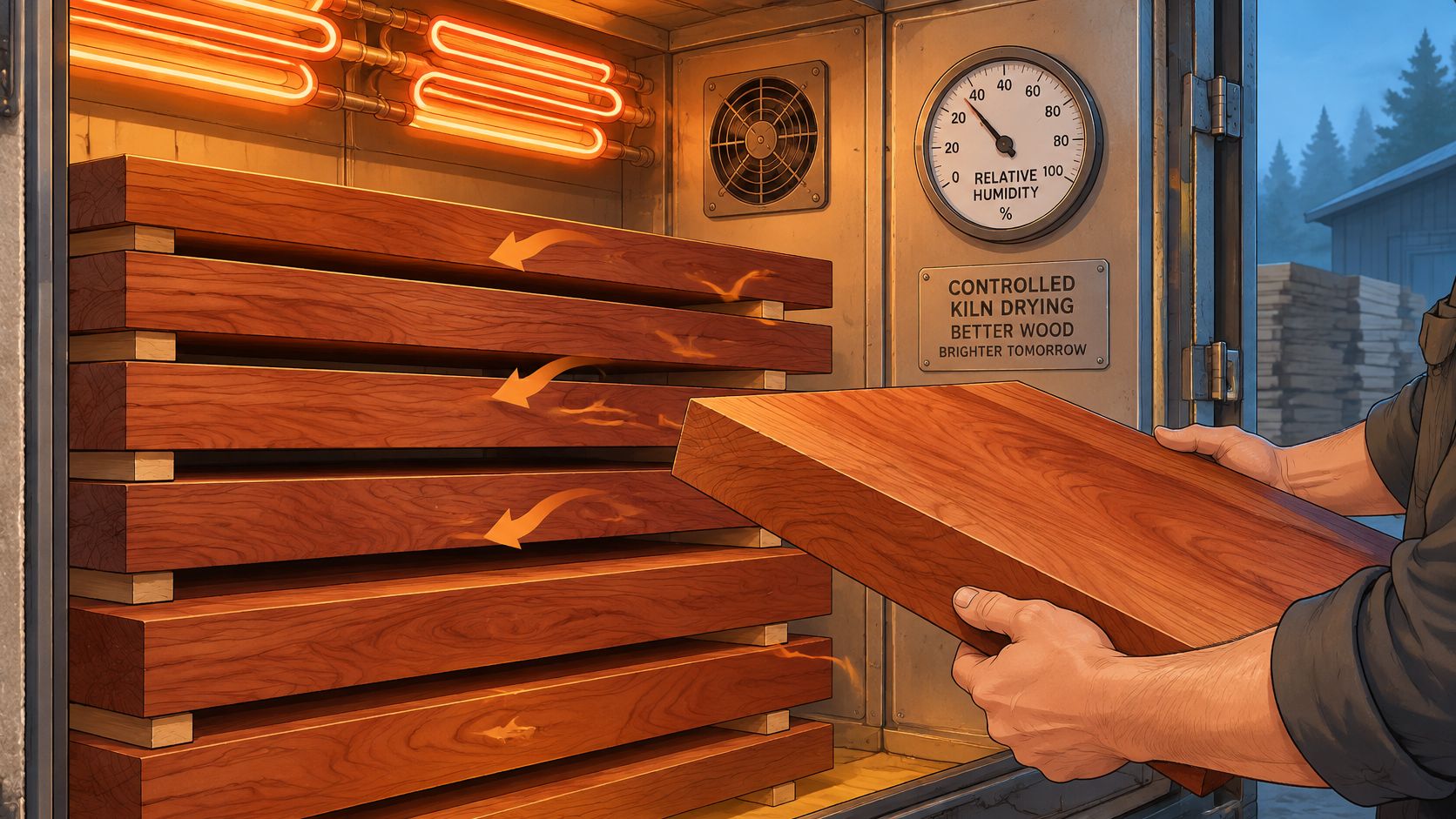
Kiln-dried hardwood is lumber placed in a controlled drying chamber, rather than left to air-dry, while temperature, relative humidity, and airflow are adjusted as the wood's moisture content falls. The USDA Forest Products Laboratory defines “kiln dry” as drying lumber in a kiln or by another specialized method until it reaches an average moisture content suitable for its intended use.
That last phrase is easy to skip, and it is the part that matters in a living room. Furniture, cabinetry, and millwork are typically brought to about 6% to 8% moisture content. Hardwood used in construction framing is generally dried to an average of 15%, with a maximum of 19%. Same phrase on a invoice. Very different boards.
| Lumber end use | Target moisture content | Why it matters |
|---|---|---|
| Furniture, cabinetry and millwork | 6% to 8% | Matches the moisture of heated indoor air so boards stay stable |
| Construction framing | Average 15%, maximum 19% | Structural framing tolerates more moisture |
A sponge in a heated room
Fresh-cut green wood behaves like a sponge still full of water. A heated living room is the dry air that keeps wringing it out. If a dining top or a bedroom dresser is built while that sponge is still wet, the wood keeps shrinking after the piece is in the house. A drawer that fit in the shop starts to rattle. A panel pulls away from its frame. A seam that looked tight in July shows a dark line in January.
Producers watch moisture and change the schedule as boards get drier. Kiln drying is a manufacturing step and a quality-control step at the same time. The result is hardwood conditioned for indoor pieces, where small movement changes fit, finish, and joints. North American hardwoods used for heirloom tables and dressers are chosen with that indoor target in mind, not a framing target.
Air-dried stock settles wherever the local climate leaves it. A kiln is aimed at a set target, so the kiln-dried label means moisture was managed rather than left to the weather. It still does not name the target. When a seller says kiln dried, ask for the final moisture figure and whether that figure is meant for indoor furniture.
Pro-Tip: Write down the moisture number before you fall for the grain. A pretty cherry top at framing moisture will keep moving after it meets heated indoor air.
How the Kiln Schedule Changes as Wood Dries
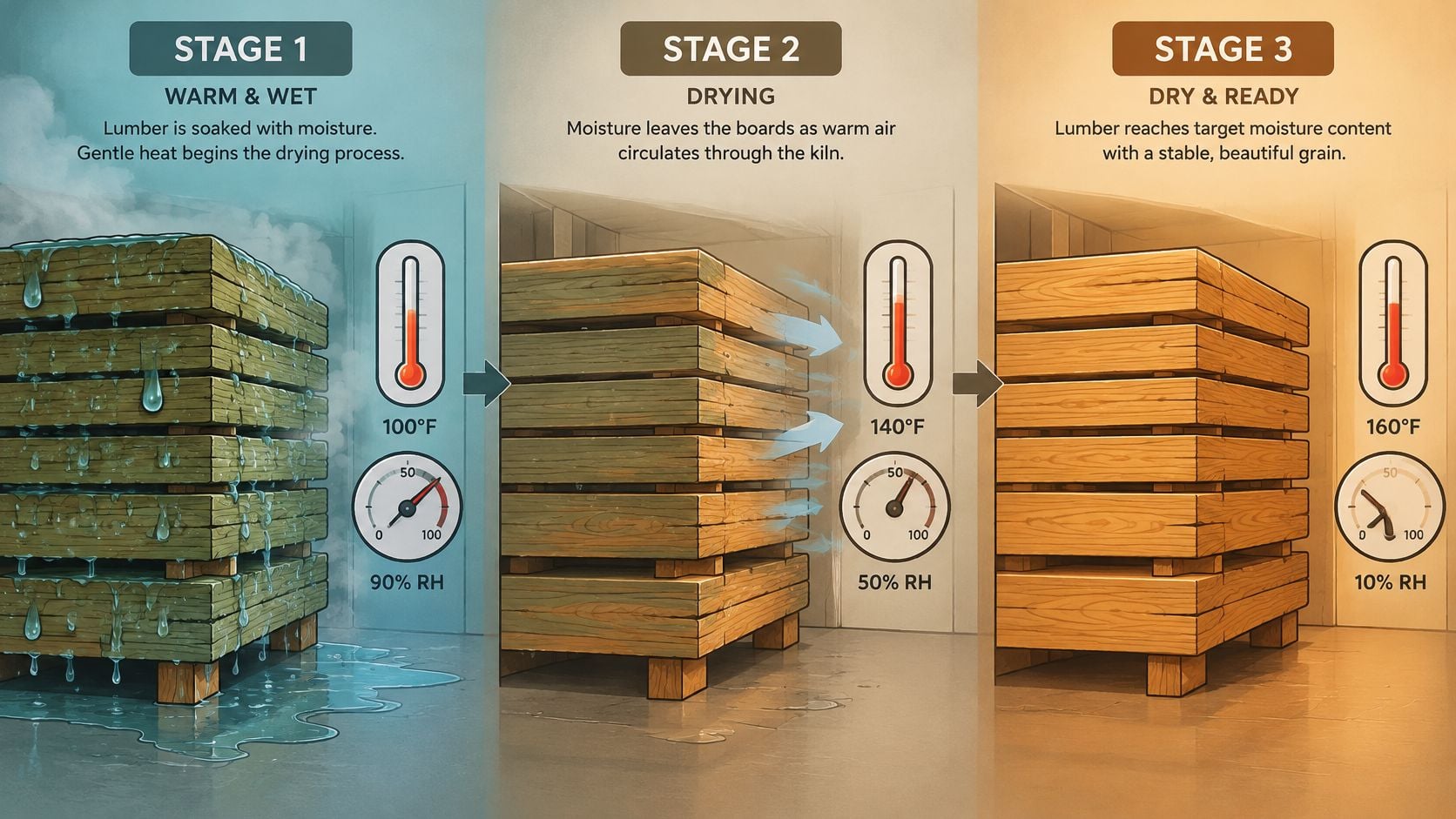
A kiln does not blast one temperature from the first hour to the last. Hardwood is dried on a moisture-content schedule. Heat and humidity step up and down as the boards give up water. Rush that curve and the outside dries into a hard shell while the core is still wet. Checks, warp, honeycombing, and locked-in stress follow.
Oklahoma State University describes a typical hardwood schedule that starts around 110°F to 120°F with relative humidity near 70% to 80% while the lumber is green. One example moves from 110°F above 50% moisture content, to 120°F at 25% to 30%, to 140°F at 15% to 20%, and higher in the final stage. Humidity is lowered in stages. It is not stripped out all at once.
| Drying stage | Lumber moisture content | Kiln temperature | Relative humidity |
|---|---|---|---|
| Green lumber | Above 50% | 110°F to 120°F (43°C to 49°C) | 70% to 80% |
| Early drying | 25% to 30% | 120°F (49°C) | Reduced in stages |
| Middle drying | 15% to 20% | 140°F (60°C) | Reduced in stages |
| Final stage | 10% to 15% | 170°F to 180°F (77°C to 82°C) | Reduced in stages |
Why the clock is not one number
Walk the stages in order and the logic is plain. Green lumber, still above 50% moisture, stays relatively cool and humid so the faces do not crust over. As moisture falls into the 25% to 30% band, the kiln edges up to about 120°F. In the middle band, 15% to 20%, it reaches about 140°F. Near the end, with moisture around 10% to 15%, temperatures climb toward 170°F to 180°F. Each step trades speed against damage. Schedules are picked for species, thickness, and the moisture the lumber is supposed to hit.
Duration follows the wood, not a calendar slogan. A USDA Forest Products Laboratory study of red oak looked at common thicknesses from 4/4 to 8/4. 4/4 means roughly 1 inch before surfacing. 8/4 means roughly 2 inches. Drying times ran from 6.6 days for 4/4 red oak taken from 30% to 7% moisture, to 55.7 days for 8/4 material taken from 80% to 7%. A thick, soaking board is not a thin, partly dry board with extra patience. It is a different job.
The same research found that thickness differences of about 3/32 to 4/32 inch changed energy use by about 3% to 6%. Sawing accuracy is part of careful drying, not a side note. Separate USDA work found an accelerated oak schedule could reach about 6% moisture in 9 to 12 days, about half the time of conventional schedules, with a net energy reduction of roughly 10% to 15% under the tested conditions. Faster can be responsible when the schedule is still matched to the wood. Faster with the humidity yanked out on day one is how boards crack.
A slow, staged schedule is a sign of careful drying, not a delay to dodge. Ask how the heat was stepped, not only how many days the load sat in the kiln.
Why Kiln Drying Makes Furniture More Stable
Wood changes size when it gains or loses moisture below the fiber-saturation point. The USDA explains that wood shrinks when bound water leaves the cell walls and swells when that water returns. Free water sitting in the cell openings can leave without much size change. Bound water in the walls is the water that moves the board.
Movement is not equal in every direction. Shrinkage is greatest tangentially, along the curvature of the annual growth rings. It is about half as great radially, across the rings. Longitudinally, parallel to the grain, it is generally only 0.1% to 0.2%. Those differences are why a flat panel cups while a table leg barely shortens.
| Direction | Relative shrinkage | What it does to furniture |
|---|---|---|
| Tangential (along the growth rings) | Greatest | Cups tabletops and distorts flat panels |
| Radial (across the growth rings) | About half of tangential | Opens joints and shifts panels in their frames |
| Longitudinal (along the grain) | 0.1% to 0.2% | Minimal movement for most furniture parts |
What you have already felt at home
Think about a table you have lived with. The top is mostly tangential and radial movement. In a dry winter the surface can cup a little, or a glue line can show a faint shadow when you run a hand across it. A door panel cut with the rings running the wrong way rattles in its groove by February and feels tight again in August. A drawer side that swells across the grain sticks in July and gaps in January. The legs, running with the grain, barely change length. The trouble is almost never “the wood moved everywhere.” It is that one face moved more than the face next to it.
Drying furniture lumber to approximately 6% to 8%, then storing and building it under suitable conditions, cuts how much moisture-driven movement is left after construction. The piece can still respond to a very dry week or a humid week. It should not keep shrinking as if it were green lumber dumped into a furnace-heated house.
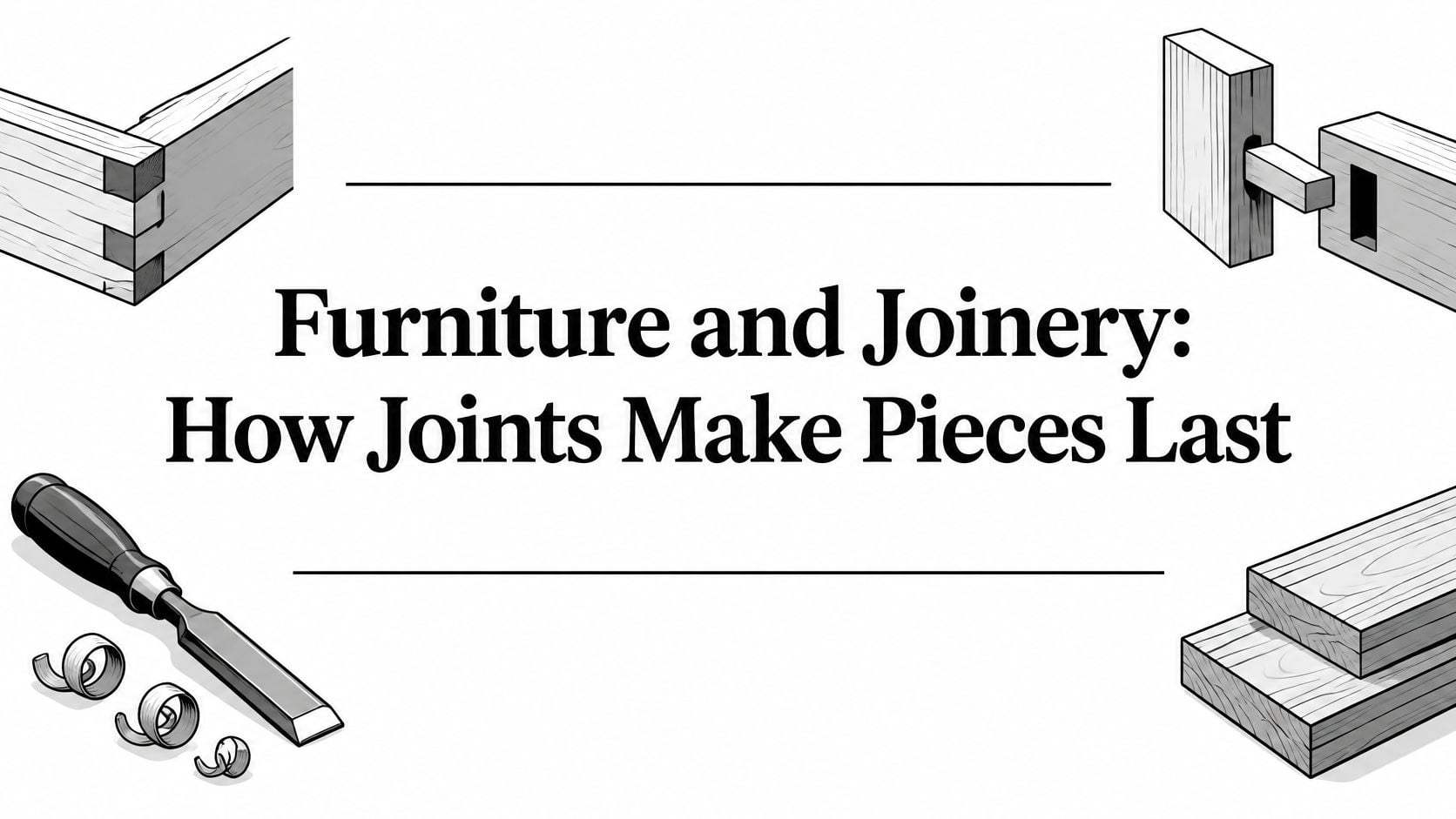
Joinery has to respect that leftover movement. A mortise and tenon holds a rail to a leg through seasonal change better than a fastener that only bites the surface. Craftsmanship here is not decoration. It is the hardware of stability, paired with lumber that was already brought near the moisture of a heated interior.
Stable wood means fewer seasonal fit problems for the life of the piece. Run a palm over a finished top in deep winter. A faint seam is a climate story. A seam that widens every year is a moisture story that started before the finish went on.
Where Kiln Drying Can Still Go Wrong
Kiln drying does not automatically guarantee defect-free lumber. Purdue Extension notes that hardwood dried to 6% to 8% for indoor products can still develop casehardening, a condition in which drying stresses remain in the board. The USDA treats equalizing moisture content and conditioning the lumber as part of real moisture control, not an optional extra.
The common assumption is simple. If it went through a kiln, it is ready to mill. Stress left in the board says otherwise. The outside of a board often dries and shrinks before the core does. Those two zones pull against each other. The board can look flat on the rack and still be loaded like a spring.
If that spring is not relaxed through equalizing and conditioning, machining is what sets it off.
- Casehardening is locked-in drying stress. The faces are in one state of tension and the core is in another. The board can look quiet until a saw opens it.
- Cup curves a board across its width. A top that was flat in the rough can rock on a bench after it is surfaced.
- Crook bows a board along its length. A rail cut from that board fights the square of the frame.
- Planer splits open while the board is milled. The knives do not cause the stress. They reveal it.
- End checking shows as cracks at the board ends, where moisture leaves fastest.
- A schedule that dries too fast can also leave surface checking, internal honeycombing, or collapse. Those are not “character.” They are damage from heat and humidity that got ahead of the wood.
A flat board that bows after the rip
Say a wide board looks true on the sticker stack. A maker rips it into rails for a table apron. Minutes later one rail bows. Nothing in the room changed. The saw cut released stress that equalizing and conditioning should have relaxed first. Equalizing pulls the moisture gradient across the thickness into a tighter band. Conditioning then lets the internal stress ease before joinery starts.
Quality kiln drying means hitting the target percentage and managing the gradient and the stress, so boards stay workable through milling and less likely to move or split in later indoor use. That is also why solid wood and a thin face over a different core do not behave the same way once a house changes seasons. The comparison in solid wood versus engineered wood is easier to judge once you know stress can hide inside a board that already reads “dry.”
A straight sticker and a kiln receipt are not the same thing as a conditioned board. If the maker cannot say the load was equalized, the flat stack is only a guess.
What to Check When Buying Kiln-Dried Solid Wood
The performance benefit of kiln drying is moisture control, not a promise that wood will never move again. Purdue Extension guidance puts it plainly. Wood exchanges moisture with the air around it until it nears an equilibrium moisture content. Build from lumber that is too wet, then set the piece in a heated home, and the wood keeps losing moisture. Shrinkage, opened joints, splits, or distortion follow. That guidance identifies 6% to 8% as a typical target for hardwood meant for indoor furniture, because the range sits near what many temperature-controlled interiors expect.
Kiln-dried lumber can regain moisture in storage or in a truck. Measuring with a calibrated meter, then letting the lumber acclimate before joinery and finishing, is how a careful shop keeps seasonal gaps smaller. Boards stored well inside a controlled residence generally change size only a little. The same boards in an unconditioned garage, a damp basement, or a house that swings hard with the seasons can still move.
A checklist you can use in any showroom
- Confirm the final moisture. For indoor furniture, look for 6% to 8%, and ask that the figure match the room the piece will live in.
- Ask about stress relief. Equalizing and conditioning should have happened before milling, not only a trip through a heated chamber.
- Check acclimation. A good maker meters the wood and lets it settle before joinery and finish, because transport can put water back in.
- Look at the joinery. Dovetails and mortise-and-tenon joints hold solid parts through movement. Stapled or surface-glued corners do not carry the same load for decades.
- Name the wood. Cherry, oak, or maple should be identified, and you should know whether you are buying solid wood or a veneer over something else.
Lift a drawer box if the piece allows it. Solid cherry has a dense, quiet weight in the hand. A lighter veneer case can look similar across the room and feel hollow when you pull the corner. That heft is not a party trick. It is material integrity you can sense before you read a spec sheet.
Tyner Furniture sells Amish furniture that is hand-crafted from solid wood and fully customizable, so species and stain can be matched to the rest of the house instead of whatever color happened to be on the floor. Hand-cut joints and solid North American hardwoods are the durability side of that choice. A made-to-order finish is the interior design side. Together they are an investment measured in cost per year, not in how fast a carton leaves a warehouse.
Reading a product page with the same checklist keeps the showroom conversation honest. How to read furniture product descriptions is worth a pass before you special-order a top, so “solid” and “kiln dried” are not doing all the talking.
Buying note: Request the moisture figure in writing before you order. A sentence on the order is easier to trust than a memory of what someone said beside a pretty display.
Confirm Kiln-Dried Quality at the Ann Arbor Showroom
Since 1957, Tyner Furniture has been part of the local legacy of Southeast Michigan, with a showroom on South State Street in Ann Arbor. That span is useful when you are judging wood you cannot see inside. A shop that has explained joinery and finishes to neighbors for decades is a practical place to slow down. Furniture shopping is overwhelming when every tag uses the same three words. Standing next to the piece, with someone who will walk the checklist, is simpler.
Run a hand along a solid cherry top. Feel the weight when a drawer comes forward. Ask the moisture question and the conditioning question out loud. Staff can connect those answers to the joint you are looking at, which is the part a photo never quite proves. White glove delivery and storage are available when the timing of a project does not match the day the piece is ready, and each piece is blanket wrapped, with upholstery covered in plastic, before it leaves.
In-stock is only the start
The floor runs from the home office to outdoor spaces, so a dining piece does not have to be chosen in isolation from the rest of the house. Bespoke options cover finishes, fabrics, and configurations. Canadel dining can be built around leg style, edge, and finish. Stressless seating is sized for an ergonomic fit, which matters if the chair is where you sit every night. The buttery feel of top-grain leather is something to test with your own hands, not from a swatch photo alone. Sustainable choices start with solid hardwood that is dried for indoor life and built to be repaired, not replaced.
Furnishing a home is a real investment. Special Financing spreads that cost into monthly payments, subject to credit approval, so a hand-crafted piece does not have to wait on a single lump sum. The Low Price Promise keeps the conversation on value and competitive pricing, which is the right frame for something meant to stay in the family. Heirloom durability is the point. A table that stays square is worth more per year than a lighter case you replace when the joints tire.
Book a sit test at the Ann Arbor showroom and bring the moisture and joinery questions with you. Or browse the online Quick Specs and start a made-to-order request when you already know the size, the species, and the stain. Amish solid wood furniture in that collection is the practical place to see what careful drying and real joinery look like side by side.
Tyner Furniture helps Ann Arbor and Southeast Michigan households choose solid hardwood that was dried for indoor life, then built with joints meant to stay tight. A sit test on South State Street lets you feel the weight of cherry and ask the moisture questions in person, and Quick Specs online are there when you want a made-to-order piece sized for your room. Visit Tyner Furniture to book that visit or to start the order with the checklist in hand.