Home Interior Companies: A SE Michigan Buyer’s Guide


You’re standing in a room that needs to work harder than it does now. Maybe it’s a dining room that still feels unfinished. Maybe it’s a living room with a sofa that looked fine online but never felt right in person. Maybe you’re trying to furnish a whole home in Ann Arbor or elsewhere in Southeast Michigan and every option seems to fall into one of two buckets: too generic or too complicated.
That’s where many homeowners get stuck. They search for home interior companies, and suddenly they’re sorting through designers, retailers, contractors, custom shops, online platforms, and showrooms that all sound similar but operate very differently.
Since 1957, we’ve seen that confusion up close. People don’t just want furniture. They want clarity. They want to know who helps with layout, who explains construction, who can customize a piece, and who will still be there after delivery if a question comes up. That’s especially important when you’re furnishing spaces that need to last, from the home office to outdoor spaces.
A little context helps. The U.S. interior design market generated USD 35,010.3 million in 2024 and is projected to grow at a CAGR of 3.2% through 2030, which reflects steady demand for professional home interior services homeowners are actively seeking, including in markets like Southeast Michigan, according to Grand View Research on the U.S. interior design market.
If you’re early in the process, this guide on understanding the furniture buying journey from first research to final decision can help frame what comes next.

Table of Contents
- Navigating the World of Home Furnishings
- The Four Main Types of Home Interior Companies
- Evaluating Quality Beyond the Price Tag
- Unlocking Your Style with Custom-Order Programs
- Essential Questions for Any Interior Partner
- Planning Your Budget and Project Timeline
- Why Your Local Partner Matters for a Home That Lasts
Navigating the World of Home Furnishings
An empty room can feel full of pressure. You know what you want the space to do. Host family dinners. Support long workdays. Give your back a break at night. Look settled and personal. But when you start shopping, every company seems to promise style, convenience, and value in the same vague language.
That’s why the phrase home interior companies can be misleading. It sounds like one category, but it isn’t. Some firms sell products. Some manage full design projects. Some build cabinetry and renovate walls. Some guide you through fabric, finish, and fit without taking over your whole home.
For homeowners in Ann Arbor and across Southeast Michigan, that difference matters because the wrong model can make a simple furnishing decision feel heavier than it needs to be.
Why the labels matter
A young couple might only need a better sectional, a dining set, and a more ergonomic recliner. They don’t need a full-service design firm with layered project management. A family reworking a first floor during a remodel may need coordination across furniture, finishes, and construction. A retiree furnishing a forever home may care less about trends and more about seat depth, solid wood, and how a table finish will age over time.
Practical rule: Don’t start by asking, “Who has the nicest furniture?” Start by asking, “What kind of help do I actually need?”
Once you answer that, the situation becomes much easier to understand.
A side by side way to think about them
Some companies are built for high-touch design. Others are built for fast selection. The most useful middle ground for many households is a hybrid model that combines curated selection, customization, and practical design guidance without requiring a full-service design contract.
That hybrid approach tends to serve real households well because clients typically don’t need someone to control every decision. They need a knowledgeable partner who can help them avoid expensive mistakes, compare materials transparently, and translate a room plan into pieces that fit both the space and the way they live.
The Four Main Types of Home Interior Companies
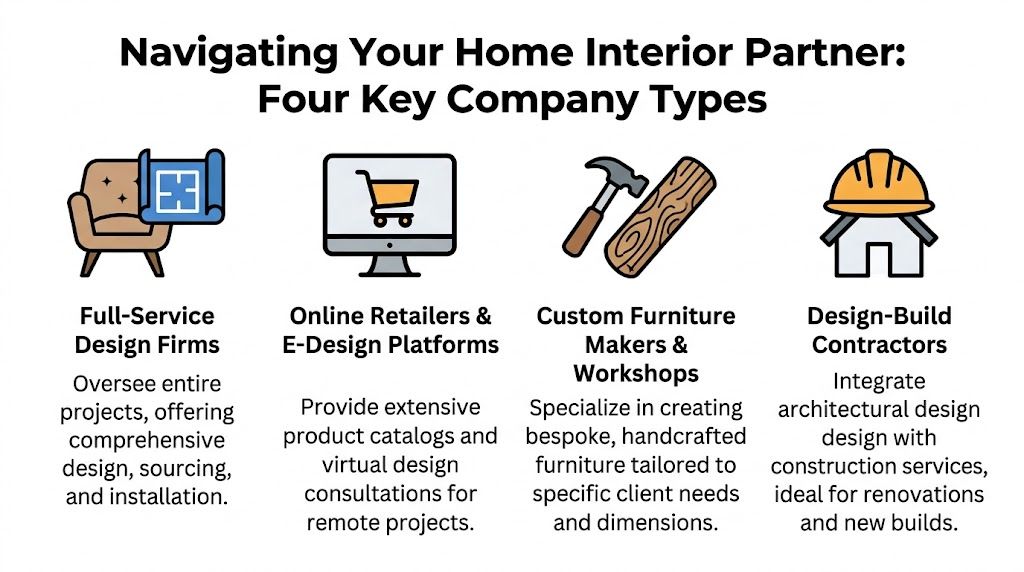
The easiest way to sort the market is to think about how each company gets work done. Not all home interior companies sell the same thing, even when they use similar words.
Why the labels matter
One group handles entire projects from concept to install. Another group gives you a broad product catalog and leaves most decisions to you. Another can build a one-off piece beautifully but may not help much with whole-room planning. Another focuses on renovations where walls, millwork, and construction schedules drive everything.
The high-end end of the field is substantial. The top 100 interior design giants reported a record $6.3 billion in fees in 2025 and handled over 83,000 projects, according to Interior Design’s 2025 Top 100 Giants research. That helps explain why full-service firms can be a major investment. They’re often managing far more than furniture.
A side by side way to think about them
| Company type | What they usually do | Good fit for | Common drawback |
|---|---|---|---|
| Full-service design firms | Plan the look, source pieces, coordinate orders, oversee install | Homeowners wanting a hands-off process | Higher fees and less flexibility for smaller projects |
| Traditional furniture retailers | Sell floor models and special orders | Shoppers who know what they want | Guidance may stop at the product level |
| Custom makers and workshops | Build bespoke pieces to your dimensions and finishes | Buyers with specific size or material needs | Limited whole-home support |
| Design-build firms | Combine renovation planning with construction execution | Remodels and structural changes | Furniture selection may be secondary |
That leaves a fourth model that many shoppers don’t have a name for, even if it’s what they need most.
The retailer design hub model
This is the hybrid. A retailer-design hub sits between a pure showroom and a full-service design firm. You can see, touch, sit, compare, and customize products in person. You also get guidance on room function, finish choices, dimensions, and comfort, but you’re not required to hand over the whole project.
That can be especially helpful when you’re comparing upholstery, dining, bedroom, entertainment, home office, or outdoor spaces and want one place to tie the decisions together.
For example, a shopper looking at Hickory Craft furniture may need help deciding whether a made-to-order sofa should prioritize arm shape, seat depth, or fabric durability first. That’s a different service model than hiring a designer to furnish an entire home from scratch.
Some homeowners want a conductor for the whole orchestra. Others want a skilled guide at the music stand. Those are different services, and choosing the right one saves frustration.
Evaluating Quality Beyond the Price Tag
Price is easy to spot. Quality takes a closer look.
A lot of confusion starts when two dining tables appear similar in a photo. They may share a shape, a stain tone, and a style label. But one can feel light, hollow, and short-lived in person, while the other has the weight, grain, and joinery that tell you it was built to be used for years.

What your hands can tell you
Start with touch and movement.
A solid wood table has a different presence than a lookalike surface over engineered core materials. You notice it when you rest your hand on the edge. You notice it when you pull out a drawer. You notice it when the piece doesn’t wobble under normal use. The weight of solid cherry wood feels grounded. The grain pattern looks less repetitive. The edges feel more integral, less applied.
Construction matters just as much as species. Look for dovetail drawers, mortise-and-tenon joinery, sturdy back construction, and well-fitted doors. These aren’t old-fashioned talking points. They’re the mechanics of longevity.
If you want a deeper primer on species and wear characteristics, this guide to choosing the right hardwood for longevity and style is a useful starting point.
The cost per year mindset
The better question isn’t always “What does it cost today?” It’s “How long will this serve my home well?”
That’s the cost-per-year mindset. An heirloom bedroom or dining piece often asks for more upfront because it gives more back over time. It stays structurally sound. It takes refinishing better. It ages with character instead of fatigue. It’s also easier to live with emotionally. You’re not replacing it every time a surface chips, a drawer binds, or a veneer edge starts lifting.
Consider these quality markers when you compare pieces:
- Material integrity means the visible surface and the structure beneath it belong together, rather than mimicking something more substantial.
- Joinery quality tells you whether the piece was assembled for repeated use or for easy shipment.
- Finish depth affects how the furniture will wear, clean, and mature in daily life.
- Repairability matters more than many buyers realize. A well-built piece can often be serviced, refinished, or reupholstered.
Better furniture doesn’t just look different in year one. It behaves differently in year ten.
For dining rooms and bedrooms especially, that’s where Amish hand-crafted solid wood stands apart. The craftsmanship is visible, but its functionality is a primary benefit.
Unlocking Your Style with Custom-Order Programs
You find a dining table that looks right in the showroom. Then you bring the measurements home and realize the chairs will crowd the walkway, the finish fights the floor, and the shape does nothing for the way your family really gathers. That is the moment many homeowners learn the difference between buying a piece and choosing one.
Custom order programs help close that gap. Instead of asking your home to adjust to a floor sample, you begin with the room, the traffic flow, your comfort preferences, and the way you live day to day.
What made-to-order means
A made-to-order program lets you choose the details that change how a piece fits and functions in your home. That may include dimensions, wood species, finish color, fabric, leather, cushion feel, seat height, or layout.
For dining furniture, Canadel is a good example. You can often select table size, leg style, edge profile, finish, and chair pairing. That matters more than many shoppers expect. A breakfast nook needs enough scale to feel welcoming without making the room feel crowded. A formal dining room may call for a deeper finish, a heavier visual weight, or seating that supports longer meals.
For seating, Stressless shows a different side of customization. Here, the key question is often body fit. A recliner in Small, Medium, and Large works much like properly fitted shoes. The color matters, but the support matters more if you use the chair every evening.
Custom upholstery follows the same logic. The frame on the showroom floor is only the starting point. The final result is shaped by arm style, seat depth, cushion construction, fabric or leather, and sectional configuration. For homeowners who want a clearer picture of that process, getting started with custom order at Tyner Furniture explains the basics in plain language.
Why custom feels easier with the right kind of company
Custom order used to feel intimidating because shoppers had to make a chain of decisions without enough context. That is still a problem with some company models. A pure designer may offer strong vision but little ability to compare products in person. A large retailer may offer floor samples but limited guidance once the choices become more specific.
A retailer-design hub solves that problem by bringing the pieces together in one place. You can sit in the chair, study the wood sample, compare fabrics under real lighting, and talk through tradeoffs with someone who does this every day. It works like using both a map and a local guide. One shows the options. The other helps you choose the route that fits your home.
That hybrid model is where Tyner Furniture stands apart for many Ann Arbor area homeowners. Since 1957, we have helped families compare in-stock pieces, special orders, and custom possibilities without requiring a full-service design contract. The result is more control than a typical retailer offers, more product access than a design studio often provides, and more day-to-day practicality than trend-driven shopping usually delivers.
Good custom ordering is not about making the process fancy. It is about making your investment fit your home for years to come.
Essential Questions for Any Interior Partner
A good conversation reveals more than a polished showroom ever will. The right questions help you understand whether a company is built for short-term selling or long-term support.
Questions that reveal more than price
Bring these questions with you when you visit any showroom, design studio, or custom shop:
What is this piece made of
Ask whether it’s solid wood, veneer over another core, or a mix of materials. Ask what parts matter structurally.How is it joined and built
For dining and bedroom furniture, ask about dovetails, mortise-and-tenon construction, drawer glides, and hardware.What can I customize
Don’t assume the floor model is the only version. Ask about finishes, fabrics, leather choices, seat firmness, dimensions, and configuration.Who helps if there’s a problem after delivery
A local service department and a clear process matter more than many buyers realize.How does this company handle comfort fitting
This is especially important for recliners, mattresses, office seating, and everyday sofas.Can you accommodate specific sensory or lifestyle needs
That question has become more important as more families look for quieter textures, calmer palettes, gentler lighting, and easier-to-regulate environments. The design community has identified support for neurodiverse clients and sensory sensitivities as an underserved need, as discussed in Business of Home’s coverage of neurodiverse clients in design.
A pro tip on fit
Pro tip: Ask, “How do you guide someone who likes quality but doesn’t want to overbuy?” The answer tells you a lot about a company’s design philosophy.
A trustworthy partner won’t rush you toward the biggest project. They’ll help you sort what matters now, what can wait, and what should be coordinated so the room feels intentional.
Planning Your Budget and Project Timeline
Good projects don’t stay calm by accident. They stay calm when expectations are set early.
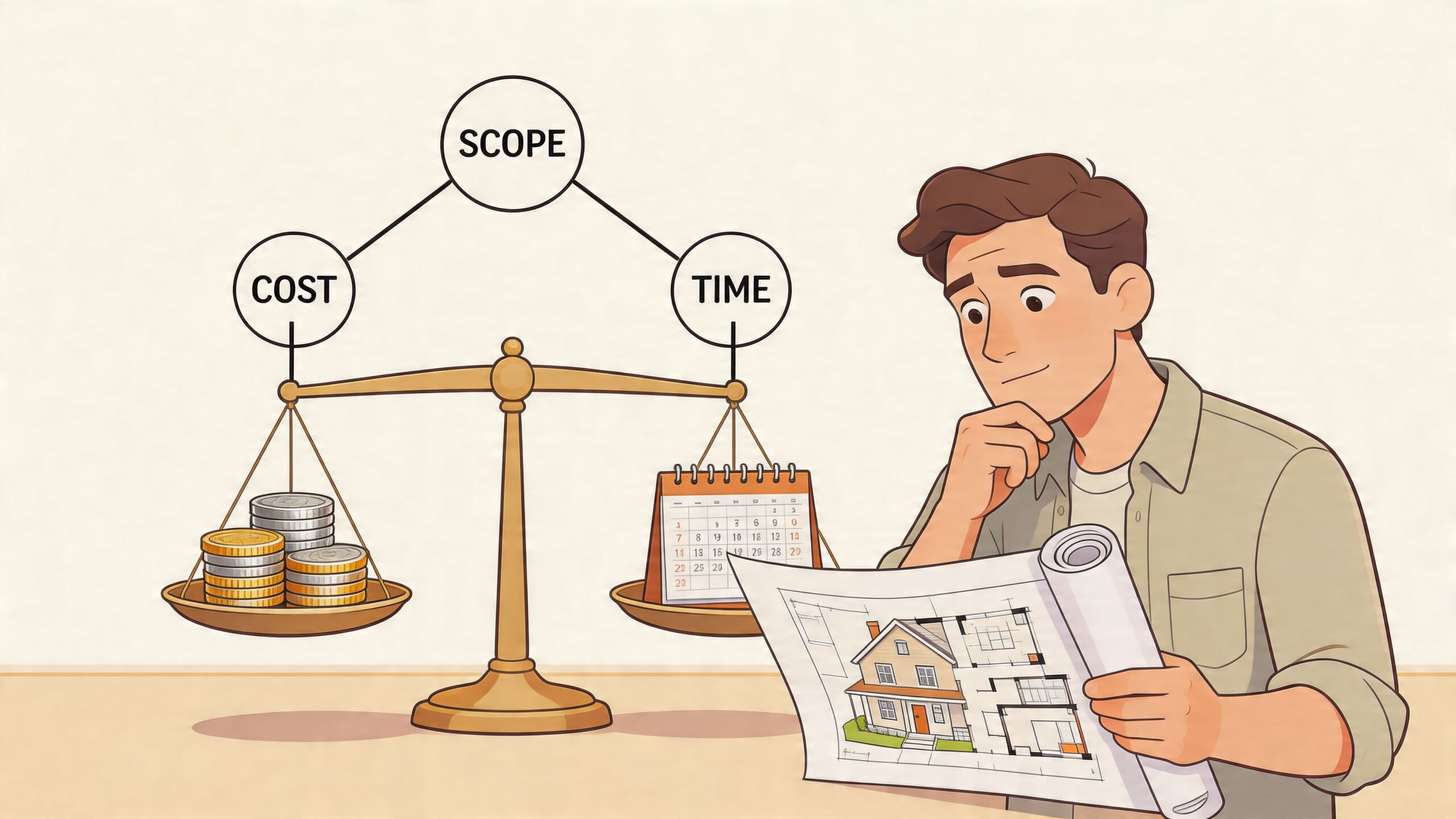
The iron triangle in plain English
Every furnishing project lives inside the same three-part tension: cost, time, and scope.
If you expand scope, adding more rooms, more customization, or more one-of-a-kind details, something else usually shifts. Maybe the timeline extends. Maybe the budget rises. If you need the project finished faster, that may limit options or require compromises in selection.
That framework matters because industry data shows 80% of furnishing projects exceed their budget due to poor expectation-setting around the Iron Triangle of cost, time, and scope, according to this discussion of budget overruns and project expectations.
How to keep your project calmer
Use a simple planning checklist before you place orders:
Set your priorities first
Decide what matters most: comfort, solid wood construction, custom size, a certain finish, or a target completion window.Separate investment pieces from supporting pieces
A recliner you use nightly, a dining table for daily meals, or a mattress for long-term health deserve a different budget lens than occasional accents.Ask for honest lead-time guidance
Special orders often reward patience. They’re built for fit, not speed.Use financing intentionally
If you’re investing in higher-grade furniture, spreading payments can make sense when it protects quality rather than lowering it.
For households still furnishing a smaller space or trying to phase purchases wisely, a practical outside resource is this guide on decorate your apartment on a budget. It’s helpful for thinking in layers instead of trying to do everything at once.
For buyers comparing payment options on furniture purchases, special financing information can help you understand how monthly planning may support a longer-term investment.
A rushed purchase can feel cheaper in the moment and cost more over time if it needs replacing long before the room itself does.
Why Your Local Partner Matters for a Home That Lasts
A home comes together through a long series of decisions. Measurements. Fabrics. Wood tones. Comfort tests. Delivery details. Follow-up questions. That’s why the partner you choose matters almost as much as the furniture itself.
What local support changes
A local partner can do things a distant platform usually can’t do as smoothly. You can sit in the chair before you commit. You can compare the buttery feel of top-grain leather to a woven performance fabric in the same visit. You can see whether a cherry finish turns too red in your light or whether an oak finish feels more natural with your flooring.
That kind of in-person clarity matters in Southeast Michigan homes, where one purchase often needs to connect with another across living rooms, dining rooms, bedrooms, entertainment spaces, home offices, and outdoor spaces.
If you’re also coordinating finishes beyond furniture, local comparison shopping helps there too. Homeowners often look at multiple trades in parallel, and regional roundups like these top local flooring companies show how useful it can be to compare service models, not just product samples.
A better long term investment
The best home interior companies don’t just sell a look. They help you make decisions you’ll still respect years from now.
That means guiding you toward craftsmanship instead of novelty. It means explaining when custom order is worth it and when an in-stock option is enough. It means recognizing that a forever home deserves a different standard than a quick placeholder. And it means being available after the sale, not disappearing once the invoice is paid.
In Ann Arbor, that local legacy still matters. A business that has served the community since 1957 has seen styles come and go. Durability, comfort, honest guidance, and well-made furniture have never gone out of style.
If you’re ready to make your next furniture decision with more confidence, visit Tyner Furniture in Ann Arbor for a no-pressure sit test on South State St., or browse the online Quick Specs for special orders to compare dimensions, materials, and customization options before you visit.