Round Stone Top Dining Table Buying Guide for 2026


A couple in Ann Arbor can stand in the showroom, look at a 47-inch round stone top and a 59-inch one, and still feel stuck. The smaller one looks sensible for a tight nook, the larger one looks better for hosting, and neither choice feels trivial when the room is only so wide and every chair pull matters. That's the right moment to slow down and choose with measurements, not vibes.
A round stone top dining table changes the room fast. The curve softens sightlines, nobody gets the head-of-table seat, and the stone surface becomes one clear focal point instead of a heavy rectangle parked in the middle of the floor. Round dining forms also have deep roots, from a surviving 15th-century table at Winchester Castle to French dining rooms in the late 1600s and later, so this isn't a fad shape, it's a durable design type with real staying power (Britannica).
For Southeast Michigan homes, that matters. Buyers aren't just choosing a top, they're choosing how dinner conversations feel, how easily chairs slide, and how much the room still breathes once the table lands. The right stone round can feel formal without being stiff, practical without looking plain, and substantial without turning the dining area into an obstacle course. If the rest of the house is getting furnished too, Tyner's wider selection runs from the Home Office to Outdoor Spaces, so the dining room doesn't have to be solved in isolation.
Why a Round Stone Top Changes How a Dining Room Feels
Stand a round stone table in a dining room and the room changes fast. The hard part for buyers is not whether it looks good, it is whether it will make the space feel open or boxed in, whether anyone gets trapped at the end of the table, and whether the stone will fight the warmth of wood floors. A round stone top answers those questions cleanly. It removes hierarchy, and the material gives the room one strong visual anchor.
Social layout matters more than people admit
Rectangular tables create edges and ends. That works in some rooms, but it puts more pressure on the room to look formal and it gives the end seats more status than the others. A round top flattens that structure, which is why the form keeps showing up in dining traditions across centuries and settings, including elite European interiors and later prosperous households.
That symmetry is the draw. Conversation feels more even, sightlines stay open, and a stone surface adds presence without the visual clutter of heavy aprons or long rails. In a compact Ann Arbor dining nook, that difference is easy to feel. The room looks arranged instead of blocked.
Practical rule: if the table has to live near a wall, a doorway, or a kitchen pass-through, the round shape usually buys back more usable space than buyers expect.
Buyer taste still matters, but the layout decides first. A round stone top works best for people who want a room to feel collected rather than crowded, and the stone adds weight in the design sense without making the space feel busy. If you are sorting out the rest of the room too, Tyner's dining room style guide gives a clean read on which dining style fits the house.
The shape and the footprint have to agree
The table can only work if the base supports the top without getting in the way. A round stone top looks balanced when the base footprint lands at roughly 60 to 70 percent of the top diameter, because that gives the table enough visual and physical support without crowding the legs. Go too small and the table looks tippy. Go too wide and you lose the airy feel that makes round tables attractive in the first place.
That is the measurement buyers should remember. A round top changes the room because it softens the center of the space, but the base decides whether that softness feels stable or awkward. Stone adds visual mass, so the base needs to feel anchored, not undersized or decorative for its own sake.
The same logic applies to seating. A round table should fit the room before it tries to fit the chairs, and the table should fit the chairs before it tries to impress anyone. If the base footprint is right, the room feels settled. If it is off, every chair pull and every walk-around step exposes the mistake.
Stone also changes the emotional read of the room. A wood round table can feel casual, even light. A stone round top feels settled, solid, and more deliberate. That is why it works in dining rooms that need one piece to carry the whole composition without making the room feel heavy. For buyers who want a clearer sense of what a dining table is doing in the room, the real cost of kitchen countertops is a useful reference point for why stone surfaces carry more weight, visually and financially, than plain tops.
Marble, Granite, Quartz, and Porcelain Compared
Stone is not one category, and buyers who treat it like one usually end up disappointed. The surface you can live with every day depends on how the room is used, how much maintenance feels realistic, and whether the table needs to act more like a showpiece or a work surface. The right move is to match the material to the household, not to the photo.
Pick the stone for the life you actually live
Marble has the softest visual appeal. The veining reads elegant and cool to the eye, and that's exactly why it keeps getting chosen for dining rooms that want a more formal, collected look. The trade-off is maintenance discipline, because marble asks more of the household than the harder surfaces do.
Granite brings density and a heavier visual feel. It suits homes that want a grounded, sturdy look and don't mind a surface that feels less delicate than marble. In practical terms, it can be the better call when the table needs to feel substantial and self-contained.
Quartz is the neatest-looking choice. The color tends to read consistent, which helps in rooms that want a calm, controlled finish instead of pronounced natural movement. It's the sensible pick for buyers who want a dependable look with less fuss.
Porcelain, including sintered-stone styles, is the most modern-feeling option in this mix. The thin profile keeps the table visually lighter, and the surface is suited to low-upkeep households that want an easier daily rhythm. That's why it works so well in contemporary dining rooms where the table has to look clean all the time.
| Material | Feel and Look | Maintenance | Best Fit |
|---|---|---|---|
| Marble | Cool, veined, formal | More attentive care | A room that wants elegance first |
| Granite | Dense, grounded, substantial | Moderate care | A table that should feel sturdy |
| Quartz | Uniform, calm, consistent | Easier routine care | Buyers who want visual predictability |
| Porcelain | Thin, modern, crisp | Low upkeep | Daily dining with a cleaner profile |
For shoppers comparing stone costs more broadly, the real cost of kitchen countertops can be a useful context check, even though a dining table is a different purchase. The main point is simple, the material choice changes not just the look, but the upkeep burden and the life the table can reasonably support.
Sizing Your Round Stone Top for Real Rooms
A round stone top only earns its place when the diameter fits the room, the chairs, and the walking paths around it. Start with the room first, because the table has to live with the walls and the seating, not with a catalog photo. In small dining rooms under about 130 square feet, a 47-inch round sintered-stone top is the cleanest fit, and it usually supports 4 everyday seats in a 10′ × 10′ minimum room. That sizing is consistent with recent buying guides on round stone tables, and it gives you a workable baseline before you start pushing the diameter larger.
Use the diameter as the first filter
Measure the room, mark the footprint, then test the table against the chairs that will stay with it. That order keeps you from buying a top that looks right in theory and crowds the room in practice. If the room is under roughly 130 square feet, the 47-inch size is usually the right answer. If the room can give a little more, 51 inches shifts to 4 to 5 seats and calls for an 11′ × 11′ minimum room.
The next step is to match diameter to seating without guessing. A practical seating guide for round tables puts 51 to 53 inches at 5 to 6 seats, and 59 inches at 6 seats. A 47-inch table also works as a practical size for 4 people in small-space planning, which is why it stays the safest starting point for compact rooms. A 72-inch round stone table belongs in a much larger room, not in a tight apartment dining nook.
A room that feels open on paper can still fail once the chairs are real.
Shop-floor rule: if the chairs are upholstered or have arms, count fewer seats than the listing suggests. Width eats capacity fast.
Check clearance before the sit test
Chair width is the detail buyers miss. Armless chairs compress better, upholstered ones do not, and armchairs take even more room at the edge. Leave roughly 36 inches behind each chair for pull-out and circulation, because that is the gap between a room that works and one that only looks right when nobody is seated.
The fastest home check is simple. Measure the room, subtract the walking space behind the chairs, then tape the table footprint on the floor. A round top that feels right in the showroom can feel oversized once the chair backs and wall clearances show up. That is why a sit test at the South State St. showroom helps, but only after the tape measure says the room is realistic.
For buyers who want a second check on room math, use the plan dining room layout tool. For more shape and seating thinking, the guide on table shapes and seating arrangements gives a useful way to compare round tables with other layouts before you order.
Base Stability, Weight, and Tipping Safety
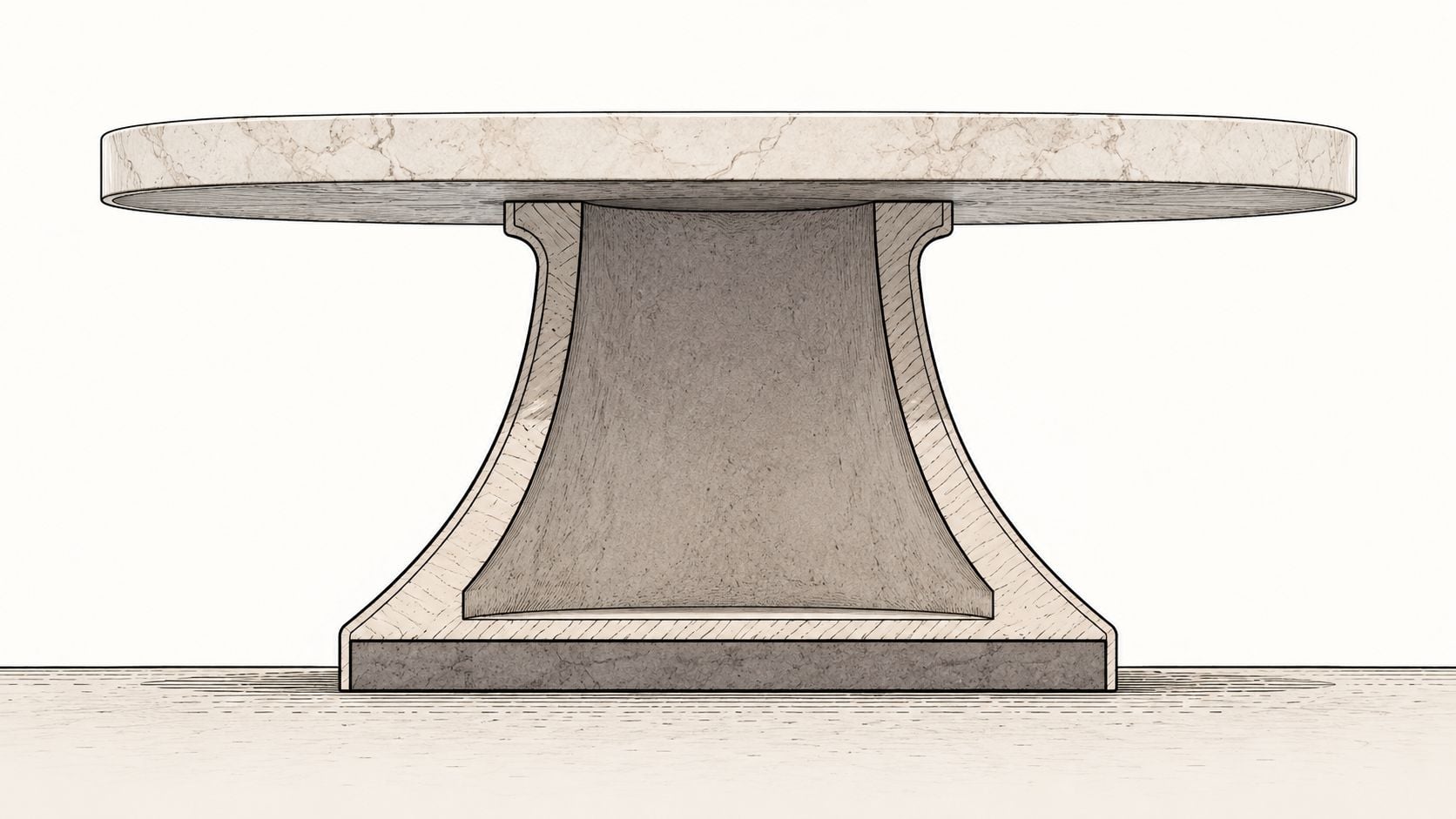
Most buyers stop at diameter. That misses the part that keeps the table upright. With stone, the base is not a detail, it is the support system, and you should judge it as part of the table from the start. For everyday use, the base should be at least half the top diameter, and 60 percent to 70 percent of the tabletop diameter is the safer target for stability (Tyner Furniture round dining table base guide).
Weight changes the whole conversation
Two round stone tops can look close in size and still behave very differently. A listed 47.25-inch round table with an 11 mm top shows 108.19 lb net weight and 135.85 lb gross weight, while a listed 59-inch design with a 12 mm top shows 272.27 lb total weight. That spread matters for moving, floor loading, and assembly, because the base and reinforcement carry most of the load path. A heavier top needs a base that is built for it, not just one that looks proportional.
Overhang geometry matters too. A round stone table in the 54/60/72-inch range keeps a constant 30-inch height, with 28.75-inch leg height and side overhangs of 14, 15.5, and 18.5 inches as the diameter grows. More diameter can improve knee clearance, but it also changes how much force the top puts on the base. A wide pedestal usually handles stone better than a narrow one. A four-leg layout can feel steady in one size and awkward in another if the legs crowd the chairs.
A showroom checklist that actually helps
- Base footprint: confirm the base lands in the 60 percent to 70 percent range of the top diameter for regular use.
- Floor contact: check that the base sits flat and does not rock when pushed from the edge.
- Anti-tip hardware: ask whether it is included or recommended for that specific build.
- Upper-floor loading: treat heavier stone tables as a serious load, especially in condos and older homes.
- Legroom: sit down and check whether the overhang lets knees clear without leaning back.
A buyer should also look at the pedestal shape, not just the material. A broad, centered pedestal gives a round stone top a better chance of staying planted during normal use, especially when people lean in, slide chairs, or set weight near the edge. If you want a clear starting point, use the round dining table base guide and compare the footprint against the tabletop before you commit.
Stone looks calm in a room. The safety conversation is not calm, and it should not be. A visually balanced table can still be unstable if the footprint is too small, so the base needs the same attention as the top.
Pairing Stone Tops With Bases and Surrounding Furniture
A stone top should not land in the room like a stand-alone object. It needs a base that understands the material, and the chairs around it need to either echo or deliberately soften the look. That's where the difference between a good table and an heirloom-feeling dining setup shows up.
Metal pedestal or wood legs, the choice sets the tone
A pedestal metal base works well under porcelain or other cool-toned stone tops because it keeps the profile sharp and modern. The visual line stays clean, the floor reads open, and the table feels deliberate rather than busy. A four-leg solid wood base does something different, it adds warmth and helps the stone read less severe.
That warmth matters in real homes. A cherry or oak base can soften the cooler look of marble, especially when the dining room already has hard surfaces nearby. Matching chair wood to the base wood gives the whole set an heirloom read, which is exactly what shoppers want when they're trying to avoid the flat, showroom-only look.
Tyner's Amish solid wood pieces are built around joinery and material integrity, not just surface appearance. That means the wood component can hold its own visually and structurally next to stone, instead of looking like a placeholder beneath it. For shoppers who want a more customized result, the Canadel line allows made-to-order choices in leg style, edge profile, finish, and configuration, which is where the customization edge becomes practical rather than decorative.
Good pairing rule: cool stone wants one warm element nearby, usually the base, the chairs, or both.
Match the base to the room, not the catalog photo
If the room already has strong wood tones, a stone top with a restrained base keeps the dining set from feeling heavy. If the room is sparse and modern, a black steel pedestal can sharpen the composition and make the top feel even more sculptural. In either case, the base should look like it belongs to the tabletop, not like it was borrowed from another piece.
That's the advantage of a made-to-order route. In-stock is just the beginning. A buyer can adjust finishes, fabrics, and configurations so the table works with the rest of the house instead of fighting it, and that's where a dining room starts to feel planned.
Daily Care, Long-Term Maintenance, and Lifespan
Stone care gets easier when it's treated like a routine, not a rescue mission. A round stone top will last longer, look better, and cost less per year of ownership if the household sticks to a few habits and avoids the mistakes that shorten the finish or the seal. That's the whole value case for an heirloom piece, durability is a schedule, not a slogan.
Keep the routine simple
Wipe the table daily with a soft cloth. Use a pH-neutral cleaner weekly, and be stricter with porous materials that need extra respect. Marble and some granites need sealing on a seasonal basis, while quartz and porcelain usually don't ask for that same ongoing attention.
The three habits that do the most damage are easy to spot. Acidic cleaners eat away at finishes, hot pans push the surface harder than it should be pushed, and gritty placemats can drag microscopic abrasion across the top. Those aren't dramatic mistakes, but they stack up.
For households already thinking in terms of durability, the maintenance guide at Tyner's care and maintenance page is the right internal reference point. A table that's cleaned correctly doesn't need fussing, it just needs consistency.
Treat each surface by its needs
Marble is the most attentive material in the group, so a buyer choosing it should be comfortable with a more deliberate care pattern. Granite is tougher in daily use, but it still benefits from routine care and periodic sealing when the piece calls for it. Quartz and porcelain are simpler to live with, which is part of why they fit busier households so well.
For a practical granite-cleaning routine, the guide from Sunny Day Pro Services on granite care can help frame safe habits without turning the process into a chore. The point isn't to baby the table. The point is to protect the finish so the table still looks like a purchase worth keeping ten years from now.
Customization, Pricing, and What You Actually Pay For
Stone table pricing makes sense when the buyer understands the parts inside the piece. The surface material matters, but so do the base construction, the edge profile, the joinery, and whether the order is in-stock or made-to-order. A higher quote is not automatically a stretch if the table is built to carry more weight, last longer, and fit the room better.
Pay for structure, not just appearance
The cheapest-looking part of a stone table is often the least important one. The top may be the visible star, but the base, reinforcement, and finishing details are what determine how the table behaves in daily use. That's why cost should be judged as cost-per-year, not just by the sticker on delivery day.
Tyner's Low Price Promise and Special Financing help lower the barrier to a high-end piece without making the shopper settle for a weaker build. Those tools matter because a dining table is one of the few purchases that gets used constantly and judged from every angle. When the table is expected to anchor family meals, homework, and guests for years, value should include longevity, not just the first impression.
Customization also changes the math. A stone top with a more refined edge, a stronger base, or a better-fitting chair pull-out path may cost more up front, but it often saves frustration later. That's especially true when the room has awkward dimensions and the standard version would have been “close enough,” which usually means not close enough.
Use the showroom for fit, not fantasy
The point of a showroom visit is to verify the piece in person. Stone changes in person, bases read different at floor level, and chair spacing is much easier to judge when someone sits down. That is where the value conversation becomes concrete.
In Ann Arbor, the South State St. showroom gives buyers a place to compare materials, check the edge feel, and decide whether the room should be solved with in-stock inventory or a more customized Canadel order. For a piece this permanent, that extra step is not indulgence, it's common sense.
Styling, Delivery, and the Next Step in Ann Arbor
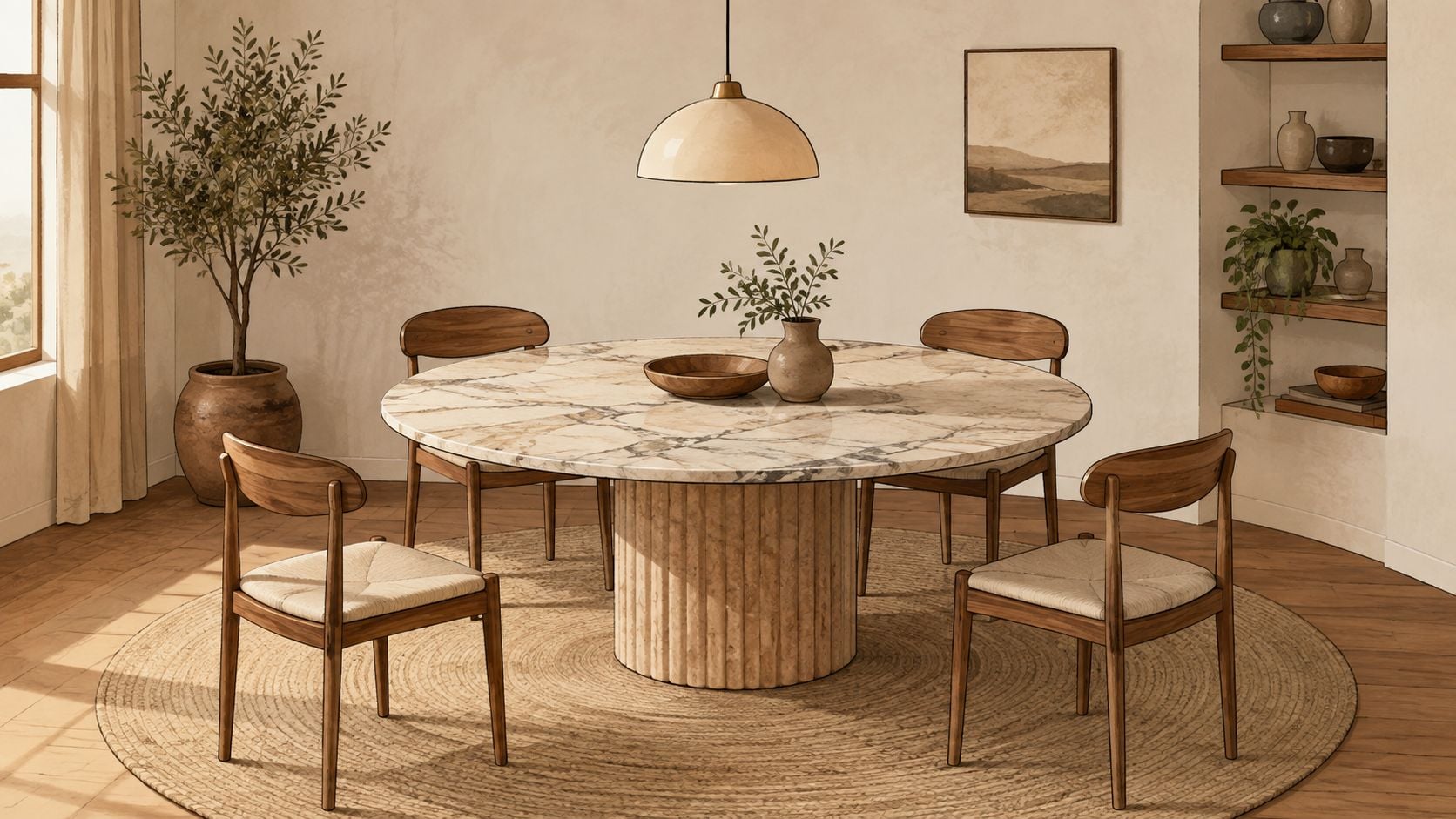
A round stone top only finishes the room if the room is already set up for it. The rug should mark the dining zone without crowding the floor, the light should hang low enough to feel deliberate, and the chairs need enough clearance so people can pull in and out without catching the base. Those are the details that decide whether the table feels right once it leaves the showroom.
Don't underestimate the logistics
Stone tables are heavy, awkward, and unforgiving in tight entries, especially in a townhouse, condo, or older Southeast Michigan home. That makes a white-glove delivery service the smart move for this kind of purchase, because the piece needs careful handling from the truck to the final placement. The delivery crew needs clear access, the floors need protection, and the room needs to be ready before the box shows up.
Once the table is in place, the room still has to work. A dining area that looks good but blocks traffic will frustrate you every day, especially in homes where the dining room also serves as homework space or a casual work zone. The table should support daily life, not get in the way of it.
Tyner Furniture's coverage from the Home Office to Outdoor Spaces makes it easier to coordinate the dining room with the rest of the house, and the South State St. showroom gives buyers a place to compare finishes in daylight instead of guessing from a screen. That matters when the room is close and the decision needs one last real-world check.
Special Financing and the Low Price Promise make the purchase easier to move on, but the fit still has to be right. A sit test with material samples shows quickly whether the scale works, and a Quick Specs review helps with special orders when the room needs a custom answer.
Visit the Ann Arbor showroom on South State St. for a sit test, compare stone samples, and check the base footprint against your chairs before you order. For special orders and a faster fit check, browse Tyner Furniture online and use the Quick Specs to narrow the right round stone top dining table with confidence.