A Guide to Your Round Dining Table Base

You’re probably here because you’ve found a round dining tabletop you love, or you know a round table would fit your room better, but the base is where things get murky. Most shoppers focus on finish, diameter, and chair count first. Then they realize the base controls how the table sits, how chairs slide in, how knees fit underneath, and whether the whole piece feels steady for years or slightly annoying from day one.
That’s why the round dining table base matters more than people expect. In homes across Ann Arbor and Southeast Michigan, we see the same pattern. A table can look beautiful in a photo, but if the base is undersized, awkwardly placed, or built with shortcuts, it won’t feel like a long-term investment. Since 1957, good furniture stores have had to help customers sort through those details with patience, not pressure.
A dining table also carries more responsibility than most pieces in the home. It hosts quick breakfasts, homework, holidays, and the everyday moments that make a house feel settled. The right base supports all of that steadily, which is exactly why it deserves a closer look.
Table of Contents
- The Unsung Hero Your Dining Table's Foundation
- Pedestal Versus Legs The Great Debate for Round Tables
- Choosing Your Material From Solid Wood to Sleek Metal
- Sizing for Stability A Practical Measurement Guide
- The Art of Customization Bespoke Bases and Tabletops
- Installation and Long-Term Care for Your Investment
- Frequently Asked Questions About Round Dining Table Bases
The Unsung Hero Your Dining Table's Foundation
A round table often becomes the social center of a room without trying too hard. It softens corners, improves movement around the space, and invites conversation because no one gets pushed to the “end” seat. But the part that makes all of that work is the base under it.
I’ve seen shoppers fall in love with a top first, especially when they run a hand across solid cherry wood or notice the visual warmth of a matte oak finish. Then they sit down and discover the base is either exactly right or immediately frustrating. A badly chosen base interrupts legroom, crowds chairs, and makes a table feel less welcoming than it looked on the sales floor.
That’s why it helps to think of the base as the table’s foundation, not its accessory. If you’ve been comparing styles online, browsing examples of general table bases can help you notice how much support design changes the function of the whole table. And if you’re still sorting out top shape, room size, and daily use, this guide on how to pick the right dining room table is a practical companion.
A round table should feel easy to live with. If you notice the base every time you sit down, something is off.
What people usually miss
Most confusion comes from treating all round bases as interchangeable. They aren’t. The base affects:
- Chair placement: Some designs let you pull up a chair almost anywhere. Others create “assigned seating” because the supports get in the way.
- Visual weight: A thick central pedestal feels grounded. Thin legs can look lighter, but they change how the table occupies the room.
- Long-term confidence: A table used every day needs more than a nice silhouette. It needs structure you can trust year after year.
For a lot of households, that difference separates a purchase you tolerate from an heirloom you keep.
Pedestal Versus Legs The Great Debate for Round Tables
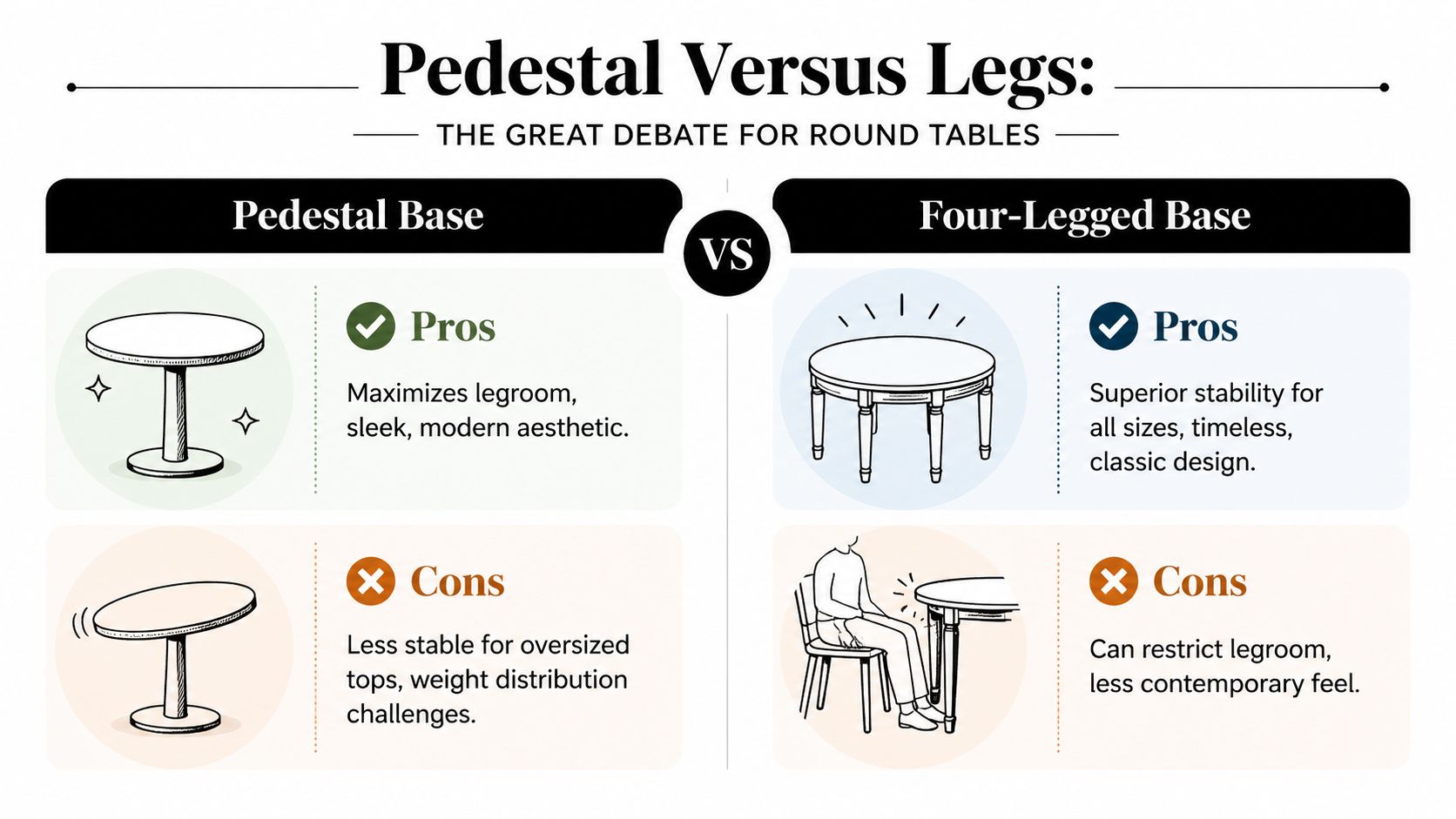
The first real fork in the road is simple. Do you want a pedestal base or a four-legged base?
Both can work well. The better choice depends on how you use the table, how much room you have around it, and whether your priority is open legroom or a more traditional planted feel.
Why pedestal bases became so popular
The pedestal base has deep roots. Historical records place the four-legged table base in ancient Egypt around 3000 BCE, and later furniture development led to the pedestal form that became especially popular in the 18th century for its space-saving support system, as described in this history of the modern table base. That same source notes that pedestal designs can reduce the base footprint by 40-50% compared to four-legged alternatives, which helps preserve legroom around a round top.
That practical benefit is still the reason many people choose a pedestal today. When chairs glide in without bumping a corner leg, the whole table feels more generous.
Side by side in real life
| Base type | What it feels like in use | Where it tends to fit best |
|---|---|---|
| Pedestal | Open center area, easier chair placement, cleaner sightlines | Breakfast nooks, condos, smaller dining rooms, modern interiors |
| Four-legged | Grounded feel, familiar look, strong visual symmetry | Traditional dining rooms, larger tops, rooms where classic styling matters |
A pedestal usually wins when room flow matters most. In a tighter space, that open center can make the difference between “we can fit one more chair” and “someone has to sit awkwardly.”
A four-legged base often appeals to people who want the classic profile of a table with visible legs at the perimeter. Some homeowners prefer that look. It feels established and architectural in a different way.
The trade-offs are real
Pedestals aren’t automatically better. They ask more from the engineering because the support is concentrated in the center. Four-legged tables spread support outward, which can feel reassuring, especially with larger tops.
Practical rule: If your biggest annoyance is knees hitting table legs, start by looking at pedestal designs.
Pedestals also suit homes where dining areas do more than host dinner. In many Southeast Michigan homes, the dining table doubles as a work zone, school project station, or game-night hub. Open legroom matters more in those settings because people shift seats, rotate chairs, and use the table from multiple angles.
If you’re trying to weigh shape and seating together, this guide on maximizing your dining space with the right table shape and seating arrangement helps connect those room-planning decisions.
A quick way to decide
Choose a pedestal if you want:
- More flexible seating: Chairs can usually be placed more freely around the top.
- A lighter visual footprint: The room looks less crowded underneath the table.
- A custom aesthetic: Many homeowners associate pedestal forms with custom, interior design-driven spaces.
Choose four legs if you want:
- A classic furniture profile: It’s familiar and timeless.
- A more visibly distributed support system: Some buyers just prefer seeing support near the edge.
- An easy stylistic match with traditional case goods: Buffets, hutches, and classic wood chairs often pair naturally with it.
Neither choice is wrong. The better one is the one that matches your room flow and how your family sits.
Choosing Your Material From Solid Wood to Sleek Metal
Once the shape of the base makes sense, the next question is what it’s made of. The choice of material is particularly revealing in furniture shopping, because materials don’t just change the look. They change the weight, the feel, the repairability, and the table’s cost-per-year over time.
Why solid wood still sets the standard
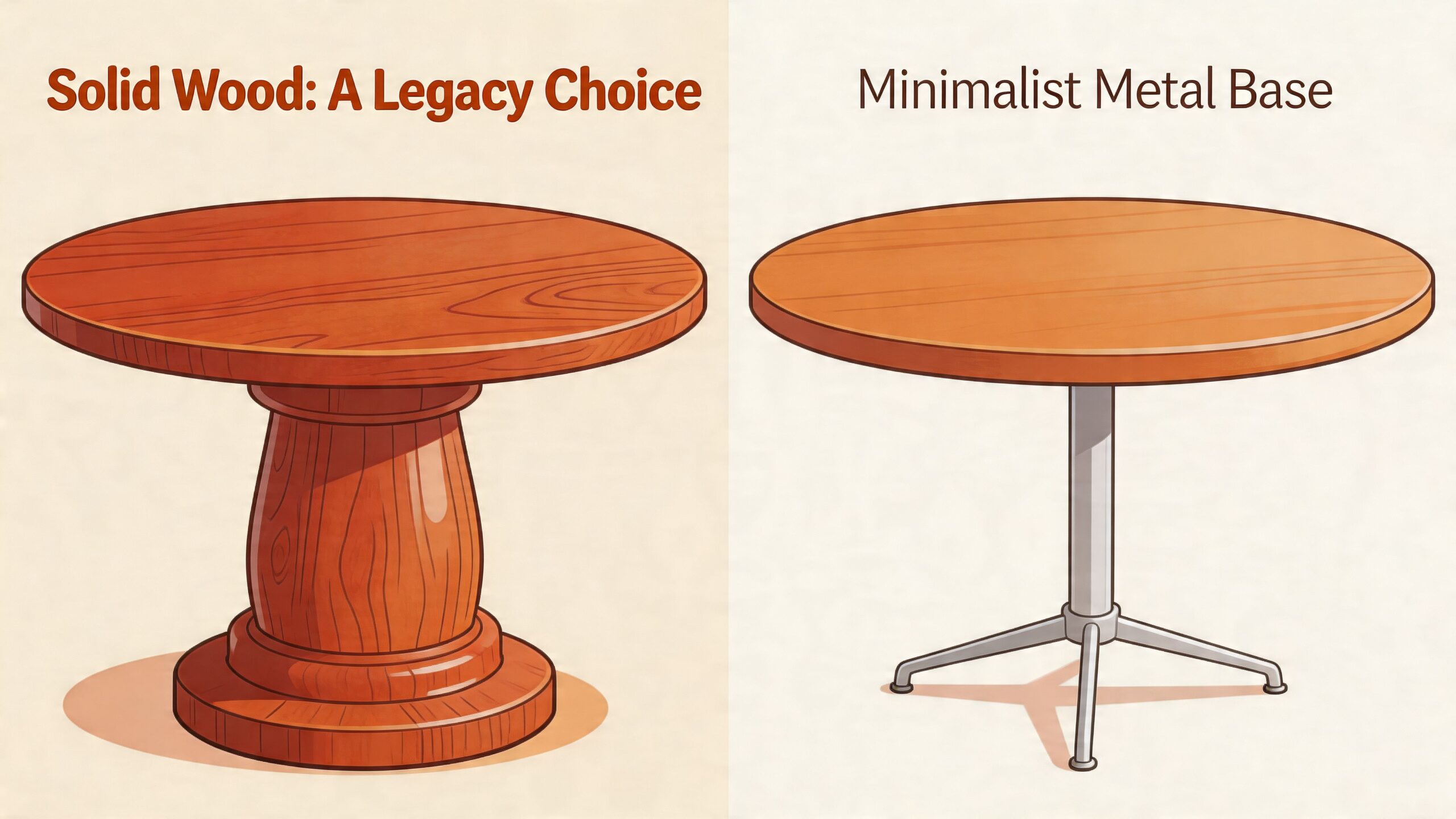
For a dining table you plan to keep, solid wood remains the benchmark. Not because it’s trendy. Because it has substance. You can feel the difference when you touch a hand-crafted base in oak, cherry, or maple. There’s weight in it. There’s grain that isn’t pretending to be grain. There’s structure you can inspect instead of a thin decorative skin over a weaker core.
One of the biggest gaps in online furniture advice is durability. This overview of the durability gap in table base guidance points out that many sources celebrate aesthetics but don’t explain how joinery such as dovetailing and mortise-and-tenon contributes to a multi-decade lifespan in solid wood construction.
That matters. A dining table base isn’t static. People lean on it, shift it, drag chairs against it, and ask it to stay tight through years of seasonal changes indoors.
Solid wood versus engineered alternatives
Here’s the plain-language version.
- Solid wood ages with character. Small marks often blend into the life of the piece, and the finish can be refreshed.
- Engineered or veneer-heavy construction can look good upfront. But if the structure underneath is light-duty, long-term stress tends to reveal that.
- Joinery is the hidden story. A base held together with sturdy wood joints behaves differently over time than one built primarily for quick production.
The base is where craftsmanship stops being romantic language and starts becoming structural value.
This is why Amish hand-crafted furniture continues to matter in dining rooms. The visible beauty is only part of it. The unseen integrity is the fundamental aspect.
If you’d like a closer look at how different hardwoods behave in furniture, this guide to choosing the right hardwood for longevity and style is worth reading before you commit to a finish.
When metal makes sense
Metal bases have a valid place, especially in modern interiors. They can create a crisp profile under a wood, glass, or stone top, and they often suit rooms with cleaner lines or mixed materials.
A steel base can also be the right partner for a heavy top, depending on the design and rating. The look is different from wood. Colder, sleeker, more architectural. Some homeowners love that contrast.
The trade-off is emotional as much as structural. Metal can feel more contemporary and spare. Solid wood tends to feel warmer and more grounded. In a room where people gather for hours, that difference isn’t trivial.
Think in cost per year
A lower upfront price can be misleading if the table base loosens, chips beyond repair, or dates quickly. A better base often costs more because it contains more labor, more material, and more thought.
That’s why heirloom furniture is less about luxury language and more about staying power. A well-built round dining table base isn’t just holding up a top. It’s carrying years of ordinary use without asking to be replaced.
Sizing for Stability A Practical Measurement Guide
A family sits down for Sunday dinner, someone braces a hand on the table edge to stand up, and the whole top gives a small, unsettling shift. That moment usually starts with sizing, not style. The base under a round table has one job before any other. It must keep the top steady through real daily use.
A good way to read base size is to compare it to the tabletop the way you would judge the footing under a ladder. If the support is too narrow for what sits above it, the piece may still look fine in a photo and feel wrong in a home.
Start with the tabletop, then size the base
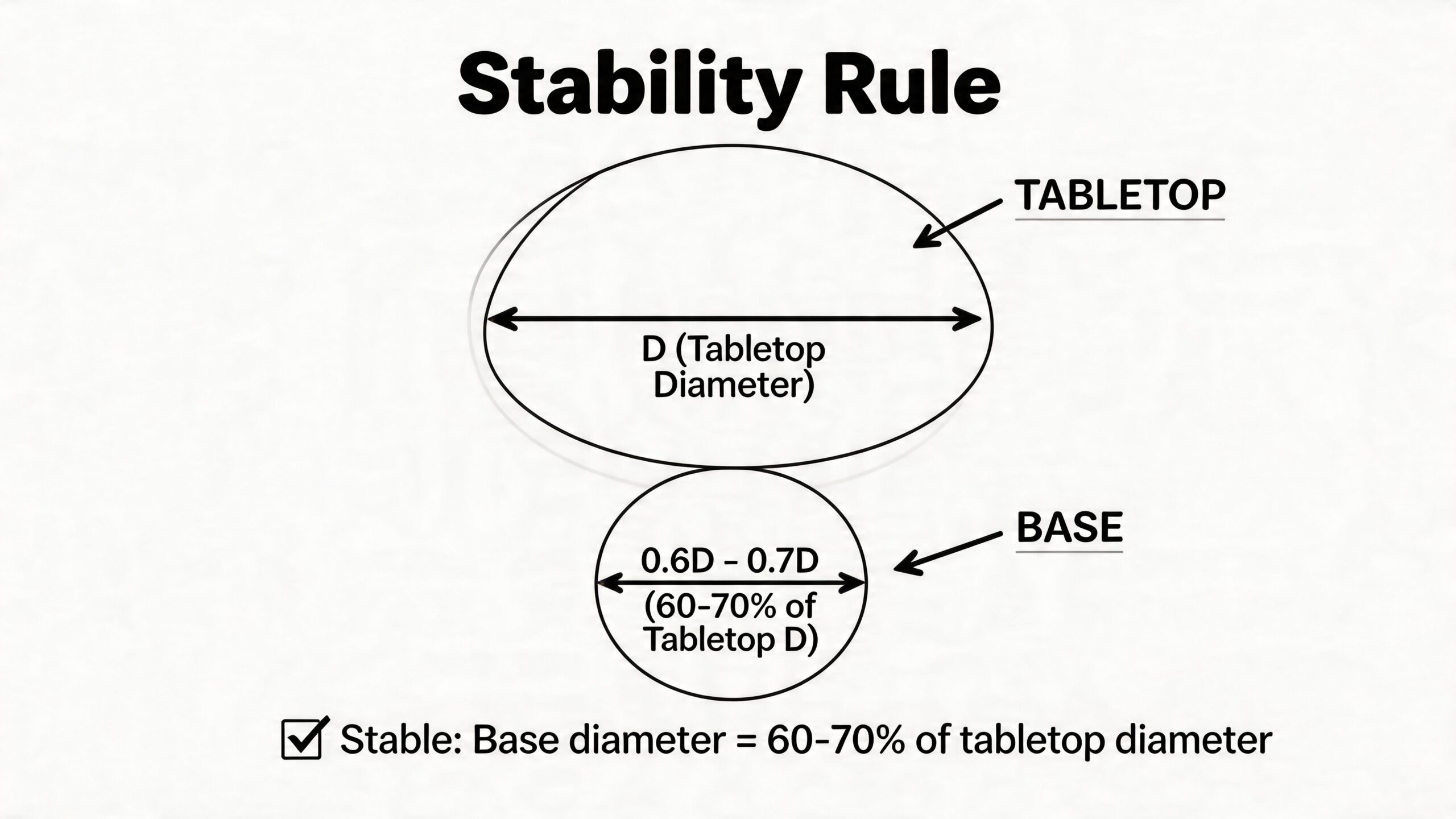
For a round table, the simplest working rule is this: the base diameter should be at least half the diameter of the top. For better day-to-day stability, a base that lands closer to 60 to 70 percent of the tabletop diameter is usually a safer target, as discussed in this forum thread on round dining table dimensions and tipping behavior.
Here is the practical takeaway. A 48-inch round top can technically sit on a 24-inch base, but that is the lower limit. In many homes, especially ones with children, heavier serving pieces, or frequent guests, a base in the upper part of the range will feel more settled.
That distinction matters more than shoppers expect.
How to measure at home without guessing
Use a tape measure and check these points in order:
- Measure the tabletop diameter straight across the center, edge to edge.
- Multiply by 0.6 and 0.7 to find a stronger target range for the base.
- Measure the true footprint at the floor. The decorative center column is not the number that matters most. The part contacting the floor is what resists tipping.
- Factor in the top material. A thick wood top behaves differently from glass or stone.
- Consider how your household uses the table. Leaning, scooting, and setting heavy dishes near the edge all increase the demand on the base.
A table should pass more than the showroom glance test. It should stay calm when life gets a little messy.
A quick reference point
| Tabletop diameter | Minimum base at 50% | Recommended base at 60-70% |
|---|---|---|
| 48 inches | 24 inches | 29-34 inches |
One example can clarify the whole subject. If a broad round top is paired with a base that looks undersized, your eye is often catching a structural truth before you name it.
Stability is also about weight and use
Top weight changes the calculation. So does the way the weight is distributed. A thick solid wood top, a stone veneer top, and a glass top can all call for different base designs even when the diameter is identical.
That is one place local guidance has real value. In our experience since 1957, shoppers often come in focused on diameter alone, but the better question is how the base, the top material, and the household will work together over the next 10 or 20 years. That is also why Amish and Canadel options are so useful. They let you match the engineering to the room instead of forcing a stock base to do a custom job.
Common sizing mistakes
- Buying for appearance first: A narrow pedestal may look refined and still be too small for the top.
- Measuring the column instead of the floor contact points: Stability comes from the footprint.
- Treating every top material the same: Heavier tops need more careful base selection.
- Ignoring real chair movement: Knees, feet, and chair legs all interact with the base.
- Skipping height checks: A stable table also has to fit chairs and allow comfortable seating.
Height and stability work together. If you are checking apron clearance, dining chair fit, and overall proportion at the same time, this guide to standard dining table heights and how to measure them will make the process easier.
Room scale matters above the table as well as below it. If you want the chandelier or pendant to look properly sized over a round top, this guide can help you determine the right size for a light fixture in your dining room.
The Art of Customization Bespoke Bases and Tabletops
You find a round table that looks right from across the showroom. Then you sit down and notice your chair legs bump the base, the stain fights the floor color, or the top feels too formal for everyday use. That is usually the moment people realize a dining table is not one decision. It is a set of connected choices.
Customization solves that problem in a practical way. It lets you build the table from the ground up so the base, top, finish, and daily use all work together.
Why a custom program changes the outcome
A round dining table works like a well-built porch. What you notice first may be the visible surface, but the lasting comfort comes from what is supporting it and how well each part fits the house. Stock tables can work well in simple situations. They are less helpful when your room has tight traffic paths, specific chair sizes, or finishes that need to coordinate with older woodwork.
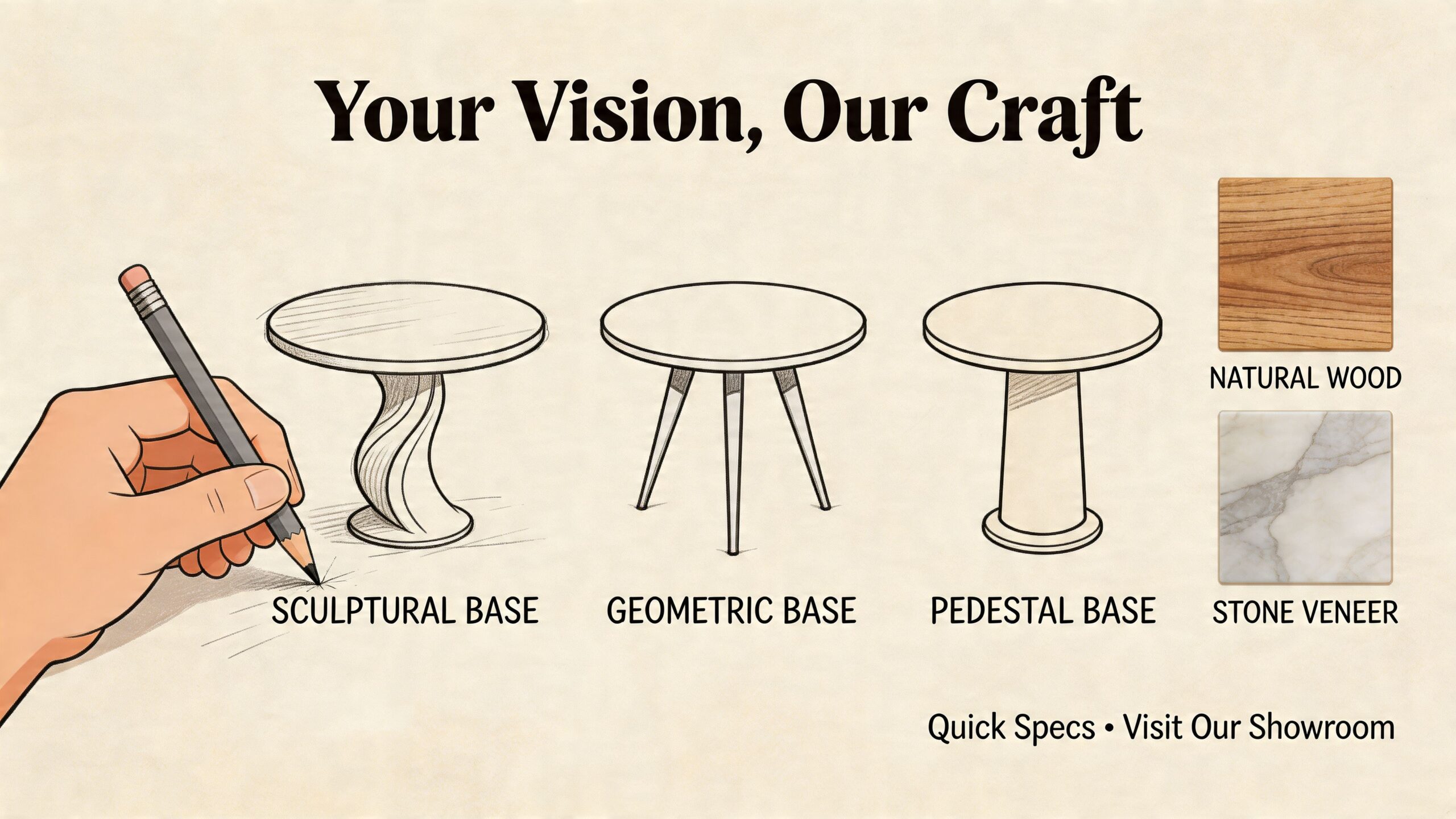
That is where local custom options stand apart from national blogs and big-box assortments. Instead of asking you to settle for the closest match, Amish makers and Canadel programs let you choose from base forms, wood species, dimensions, edge profiles, and finishes in combinations that make sense for your room.
A clear way to choose
Start with use, not appearance.
- How will the table live day to day? A family that slides chairs in and out all evening may prefer a pedestal with open legroom.
- What should draw the eye? If the base has shape and weight, keep the top quieter. If the wood top has beautiful grain, a simpler base often gives it room to shine.
- What needs to coordinate nearby? Chair style, floor tone, trim color, and even the light fixture all affect which combination feels settled in the room.
- What kind of life do you expect from it? A made-to-order table is often a better long-term piece because the decisions are based on your home, not a warehouse inventory list.
This step matters more than many shoppers expect. A base that is suited to the room saves you from small annoyances that show up every week.
What custom really lets you change
The biggest advantage is not having more choices for the sake of variety. The advantage is being able to solve several practical problems at once.
With Canadel, you can sort through combinations of size, finish, base shape, and top design in a structured way. With Amish-built solid wood furniture, you often gain even more control over wood species, construction details, and the overall feel of the piece. One route may suit a painted, more transitional room. The other may be right for a natural wood table meant to stay in the family for years.
After helping families furnish homes since 1957, we have seen the same pattern again and again. People are happiest with a dining table when the engineering and the appearance were chosen together, not separately.
Bespoke can still be straightforward
The word "bespoke" can sound fussy, but the process is usually quite grounded. You are deciding on a footprint that supports the top well, a material that fits the way your household uses the table, and a finish that will still look right when the room changes around it.
In Southeast Michigan, many dining rooms have to do more than one job. Dinner table, homework station, holiday hub, puzzle table. A custom piece handles that reality better because you are not forcing one stock solution to cover every need.
If you choose a solid wood top, long-term care should be part of the conversation from the start. This guide to protecting wood furniture from scratches and stains is a useful reference as you compare finishes and wood species.
The best custom table decisions usually feel simple in hindsight. The room, the chairs, the base, and the top finally agree with each other.
Installation and Long-Term Care for Your Investment
A strong round dining table base still needs proper setup and care. That doesn’t mean constant maintenance. It means a few smart habits that protect the piece so it keeps earning its place year after year.
What to check after delivery
When your table is installed, pay attention to how it feels, not just how it looks.
- Check for levelness: Press lightly at different points on the top. You’re looking for confidence, not rocking.
- Look at chair movement: Pull chairs in from several angles to confirm the base clears knees and feet comfortably.
- Inspect hardware points if applicable: Some bases include concealed hardware that may need an occasional check after the piece settles into the room.
How to care for wood and mixed-material bases
Solid wood likes consistency. Keep spills from sitting on the finish, use protection under hot serving pieces, and clean with products appropriate for finished wood. If your table includes wood, this guide to protecting wood furniture from scratches and stains is a good reference.
For homes with seasonal indoor air swings, try to avoid placing the table right against a heat source or in intense direct sun for long stretches. A stable environment helps preserve both the finish and the joinery.
A dining table ages best when people use it normally and care for it consistently.
Long-term value also comes from buying at a pace that fits your household. Special Financing and a Low Price Promise can make a more durable, made-to-order piece easier to plan for without settling for something you’ll want to replace too soon.
Frequently Asked Questions About Round Dining Table Bases
Can I buy a base separately for an existing tabletop
Yes, in many cases you can. The match has to be precise.
A round top and its base work like a good foundation under a front porch. If the footprint is too small, the top can feel uneasy. If the attachment points do not line up properly, even a beautiful top may never feel fully secure. Bring the tabletop measurements, material details, and photos of the underside before you order. In our showroom, that simple homework often saves a customer from an expensive mismatch.
What base is best for a heavy glass or stone top
Choose a base built specifically for the weight and the shape of that top. Heavy materials ask more from the center column, the feet, and the connection point under the table.
For stone or thick glass, metal is often the safer starting point because it can provide a compact footprint with strong support. A well-built custom wood base can also do the job, but only if the joinery and proportions are designed for that load. That is one reason locally made options matter. Amish and Canadel programs give you more than a style choice. They let you pair the top and base as a system, which is how heirloom tables are planned to last.
Is a pedestal always better for legroom
Often, yes, but not automatically.
A pedestal usually removes the problem of four corner legs, which helps with chair placement around a round top. Still, some pedestal bases flare wide at the floor or use sculptural shapes that take up more foot space than customers expect. The best answer is to check how the base widens near the bottom, not just how open it looks from across the room.
How do I know if a base feels right before ordering
Sit at it the way you live.
Pull in the chairs you would use. Cross your legs. Turn slightly as if you are passing a bowl or helping a child. Those small movements reveal more than a catalog photo ever can. This is especially helpful when you are choosing among custom options locally, because the right base is not just about style. It is about getting the engineering, comfort, and craftsmanship aligned before the table is built.
If you'd like help choosing a round dining table base that fits your room, your style, and your long-term plans, visit Tyner Furniture in Ann Arbor for a sit test at the South State St. showroom, or browse the online Quick Specs for special-order options. Since 1957, we've helped Southeast Michigan shoppers compare craftsmanship across the whole home, from dining and bedroom pieces to home office, comfort seating, and outdoor spaces, with a focus on durable value, custom possibilities, and furniture that's meant to stay.