Discover High Quality Furniture Brands: Your 2026 Guide


A shopper in Southeast Michigan often starts the same way. Tabs pile up. Sofas look plush on a phone screen, dining tables look identical in filtered photos, and every product description seems to promise “premium” quality. Then the piece arrives, feels lighter than expected, sounds hollow when tapped, or loses comfort far sooner than hoped.
That's where furniture shopping shifts from simple browsing to careful decision-making. A sofa, bed, or dining set isn't just another household purchase. It shapes daily routines, comfort, and how a home feels for years. That's also why furniture purchases are high-consideration decisions. The cost is visible on the tag, but the actual value shows up later in how the piece ages, performs, and fits a household's life.
For families building a forever home, for professionals upgrading a home office, and for anyone furnishing a living room, bedroom, dining room, or outdoor space, the better question isn't “What's the lowest price today?” It's “What will still feel right years from now?” Since 1957, that local-legacy mindset has helped guide Ann Arbor shoppers toward furniture that earns its place over time.
Table of Contents
- Your Search for Furniture That Truly Lasts
- What Defines a High-Quality Furniture Brand
- The Anatomy of a Well-Made Furniture Piece
- Beyond the Build Ergonomics and Sustainability
- Smart Shopping Strategies for Your Forever Home
- Common Red Flags of Low-Quality Furniture
- Calculating the Lifetime Value of Your Investment
- Your Ann Arbor Partner in Heirloom Quality Since 1957
Your Search for Furniture That Truly Lasts
A couple walks into a showroom after replacing the same sofa twice in eight years. The first one looked stylish online but sagged within months. The second cost less up front, yet the cushions flattened, the fabric pilled, and the frame started to creak. By the time they shop for a third, the question has changed. They are no longer asking, “What's the sale price?” They are asking, “How do we buy this once and buy it well?”
That is what many households are seeking. They want a sectional that still supports movie night after years of use. They want a dining table that can handle weeknight meals, holiday gatherings, and homework without feeling worn out before its time. They want a bedroom set with the steady feel of real substance, the kind of piece that settles into family life instead of counting down to replacement.
The hard part is sorting through a crowded market where photos can make very different furniture look nearly the same. A polished image cannot show whether a seat will keep its shape, whether drawers will keep gliding smoothly, or whether a table will still feel solid after years of daily use. That is why furniture deserves the same mindset people use for a roof, a mattress, or a car. The sticker price matters, but the cost per year matters more.
A furniture purchase feels expensive on delivery day. A poor furniture purchase keeps costing money through repairs, discomfort, and early replacement.
At Tyner Furniture, that distinction has mattered for generations. Since 1957, families have come in looking for pieces that fit real homes and real routines, not showroom impressions alone. That is also why furniture purchases are high-consideration decisions for most households. People live with these choices every day, often for a decade or longer.
A well-made piece earns its keep slowly and steadily. It sits level. It feels supportive. It ages with dignity. And when you start judging furniture by how many good years it gives back, the difference between “expensive” and “worth it” becomes much easier to see.
What Defines a High-Quality Furniture Brand
A high-quality furniture brand earns trust the same way a well-built house does. It starts with sound materials, puts them together with care, and designs the finished piece to keep serving the people who use it every day.

That matters because furniture quality is rarely one thing. A sofa can have a strong frame but weak cushions. A dining set can use attractive wood on the surface and cut corners where daily stress hits hardest. Brand quality comes from the full system working together, not from a label, a trend, or a dramatic showroom floor presentation.
A simple way to judge a brand is to look for three pillars shoppers can check for themselves.
Materials
Materials set the ceiling for how long a piece can last. Solid wood, stable framing, resilient seat cores, and durable upholstery give furniture a stronger starting point. If the raw ingredients are thin, brittle, or quick to break down, the piece may look good at first and still age poorly.
Construction
Construction decides whether those materials hold up under daily life. Joinery, reinforcement at stress points, drawer fit, spring support, and the way weight is distributed all matter. Furniture works like a chain. One weak link can shorten the life of the whole piece.
Enduring design
Enduring design goes beyond appearance. Good proportion, lasting comfort, and parts that can be maintained or serviced over time all add value. A piece with staying power should still feel right in the room and in the body years after the purchase.
Practical rule: Read the specifications with the same care you give the finish and color.
That approach is especially useful for case goods and dining furniture, where construction differences are often hidden in plain sight. Shoppers comparing solid wood furniture brands by build quality usually find that the visible surface tells only part of the story. The better question is how the piece will perform after years of opening, closing, leaning, lifting, and living with it.
At Tyner Furniture, that conversation has been part of the job since 1957. Families often come in asking which brand is "good," but the more useful question is why it is good. Once a shopper learns to check the wood species, ask how the joints are made, and compare cushion and support systems, the price tag starts to make more sense in cost-per-year terms.
A genuine high-quality brand does not ask shoppers to guess. It gives them clear signs of quality they can see, touch, test, and verify.
The Anatomy of a Well-Made Furniture Piece
Walk into a showroom and two dressers can look equally polished from six feet away. Open the drawers, press on the top, and check the back panel, and the difference often becomes clear in less than a minute. That is how quality works. The full picture is usually inside the piece, under it, and in the parts that do the daily work.
Materials that set the ceiling
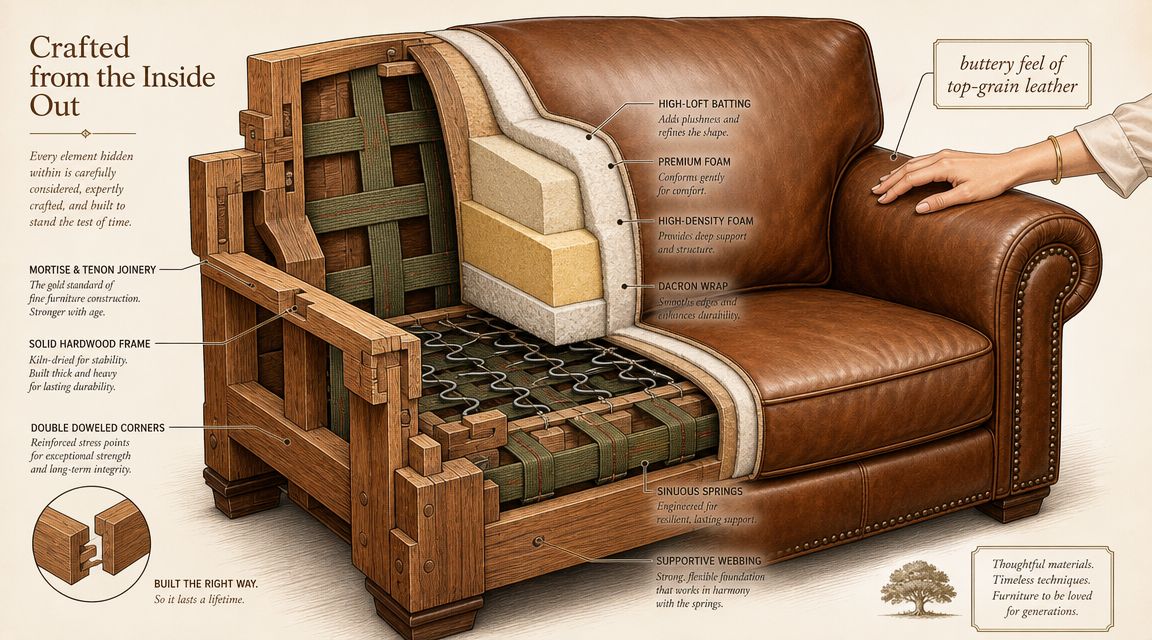
Materials set the upper limit for how well a piece can age. Strong construction cannot fully make up for weak core materials, just as a good foundation matters in a house. A dresser built from solid cherry, maple, or oak usually feels steadier, sounds denser when lightly tapped, and carries weight differently than a hollow-feeling substitute.
Wood choice also affects cost-per-year value. A piece that keeps its shape, holds hardware securely, and can be refinished years later often earns back its higher purchase price through longer service. Shoppers who want a clearer way to compare species can review this guide on choosing the right hardwood for longevity and style.
Joinery that holds under daily use
Joinery is the furniture maker's handshake. It tells you whether the piece was built for years of use or for a quick sale. Dovetailed drawers, well-fitted mortise-and-tenon joints, and securely fastened corner blocks usually hold alignment better under daily stress.
That matters because furniture rarely fails all at once. It loosens little by little. A chair starts with a slight wobble. A drawer begins to rub. A table shifts when someone leans on it. Those small signs are like hairline cracks in a sidewalk. They point to pressure building where the structure is weakest.
Shoppers can check a surprising amount on their own.
| Feature | Stronger sign | Common shortcut |
|---|---|---|
| Drawer construction | Tight joinery, square fit | Staples, loose alignment |
| Back panels and bottoms | Thick and secure | Thin, flimsy inserts |
| Table and chair joints | Firm, rigid connection | Movement at stress points |
| Overall feel | Quiet and steady | Creaks, sway, or flex |
At Tyner Furniture, this is often the moment when price starts to make more sense. A family compares two similar-looking pieces, tests the drawers, feels the weight, and sees that one is built to spread years of use over a longer life. The higher ticket often becomes the lower annual cost.
Upholstery and finish details that matter
Upholstery quality shows up in support, recovery, and surface wear. Seat cushions should regain shape after pressure instead of staying compressed. Fabric should feel appropriate for the room and household, and the tailoring should look clean at the seams, corners, and welts. On wood furniture, the finish should feel smooth and even, with consistent color and neat transitions around edges and carvings.
A sofa works like a layered system. The fabric is the outer skin, the cushion is the comfort core, and the frame carries the load underneath. If one layer is weak, the whole piece tends to age faster.
What to check on an upholstered piece
- Seat recovery: Press down and watch how the cushion returns.
- Tailoring: Look for straight seams, smooth pattern matching, and tidy welting.
- Support underneath: Sit in more than one spot and notice whether support feels even.
- Leather or fabric hand: Better coverings usually feel natural, not slick or overly stiff.
- Finish quality on exposed wood: Check for smooth surfaces and clean edges, especially where hands regularly touch.
Shoppers who care about long-term ownership often apply some of the same principles for reducing waste to furniture buying. Buy fewer pieces. Buy better ones. Choose construction that can stay in the home, not cycle out after a few short years.
The best-made furniture usually feels calm. Drawers glide smoothly. Frames stay quiet. Cushions recover. That kind of performance is easy to miss in a five-minute browse, but it is exactly what turns a purchase into value over the years.
Beyond the Build Ergonomics and Sustainability
A sofa can be built with solid materials and still miss the mark if it does not support the way your family lives. A dining chair can look beautiful at the table and still leave people shifting after twenty minutes. Real quality shows up in daily use. It supports the body, fits the room, and stays serviceable long enough to make the purchase worthwhile year after year.

Comfort that supports the body
Ergonomics means fit.
A well-designed chair supports your back where your body needs it. A sofa seat should let your legs rest naturally instead of leaving your knees too high or your feet dangling. In a recliner, the headrest, footrest, and seat angle should work together so your body can settle in without strain. Comfort is not fluff. It is part of the structure, much like good alignment in a car makes every mile easier on the driver.
Discomfort has a cost. If a sectional is too deep, family members stack pillows just to sit upright. If dining chairs sit too low, meals feel longer than they should. If an office chair forces awkward posture, the piece may stay in the room for years but never serve its purpose. A lower price loses its appeal when the furniture does not get used the way you hoped.
At Tyner Furniture, families often discover that a custom order solves problems they assumed they had to live with. Seat depth, arm height, table scale, fabric choice, and configuration all affect how a piece performs over time. That kind of fit improves cost per year because a comfortable, well-sized piece is far more likely to stay in daily use for the long haul.
Sustainability that holds up in real life
Sustainability in furniture starts with a practical question. Will this piece stay useful, repairable, and wanted in the home long enough to avoid replacement?
That is why serviceability matters so much. Cushions wear. Fabric ages. Reclining mechanisms may eventually need attention. Hardware can loosen. A quality piece gives you a path to maintain it instead of pushing you toward the curbside pile. For shoppers trying to apply broader principles for reducing waste, furniture follows the same common-sense rule. Buy fewer pieces, choose them with care, and keep them working as long as possible.
Solid wood is a good example. A dresser made from better materials can often be refinished, repaired, or passed down. Veneer over weak composite usually offers fewer second chances. Shoppers comparing American-made solid wood furniture often find that material transparency and repair potential tell them more than a sales tag ever could.
Questions that reveal lasting value
Ask a few plain questions before you buy. They can save years of frustration.
- Can this piece be repaired or reupholstered? A yes often means the maker expects the furniture to stay in service.
- Are replacement parts or hardware available? That matters for motion furniture, beds, and case goods with moving components.
- Does the size fit the people who will use it most? Daily comfort affects whether the piece earns its keep.
- Will the style and scale still work if the room changes later? Flexible design tends to stay useful longer.
- Does the expected lifespan justify the price? A higher upfront cost can be the better value if the cost per year ends up lower.
That is the heart of this section. Quality is not only what a piece is made of. Quality is what it lets you avoid. Premature replacement, daily discomfort, and waste that could have been prevented with better materials, better fit, and a piece built to stay in the family longer.
Smart Shopping Strategies for Your Forever Home
Online shopping is convenient, but furniture still asks for physical judgment. Screens flatten too much. They hide seat resilience, wood weight, drawer alignment, and the subtle details that determine whether a piece feels reassuring or flimsy.

Why the sit test still matters
A sit test does more than confirm softness. It reveals support. A good seat should feel stable when weight shifts. The cushion should recover well when the shopper stands. Arms should feel secure under pressure. On dining chairs, posture should feel natural rather than forced. On bedroom furniture, drawers should open squarely and close cleanly.
For many households in Ann Arbor, visiting a South State St. showroom can prevent the most common online mistake. Buying furniture that photographs well but doesn't fit the body, the room, or the routine.
If a piece can't pass a five-minute sit test, it won't improve with five years of ownership.
A practical shopping checklist helps:
- Sit how the household lives: Lean back, cross legs, shift sideways, and test real posture.
- Use the drawers and doors: Open them fully and check for alignment.
- Look underneath: Frames, supports, and workmanship often tell the truth.
- Ask for Quick Specs: The details should be available, not hidden behind vague sales language.
Shoppers who want a broader buying framework can review this smart furniture shopping guide.
How bespoke ordering becomes practical
Customization sounds complicated until it's broken into choices that matter. Dining is a good example. A family may need a specific width, a softer stain, a different leg shape, or a finish that works with existing floors. That's where made-to-order programs become useful instead of intimidating.
Tyner Furniture offers custom ordering that lets shoppers move beyond floor samples into broader choices for upholstery, dining, ergonomic seating, home office pieces, and outdoor spaces. In practical terms, that can include bespoke dining options through Canadel and sizing-focused comfort through Stressless. The point isn't endless choice for its own sake. It's better fit.
Custom options that often improve long-term satisfaction
- Fabrics and leathers: Better suited to pets, children, sunlight, and daily use.
- Finishes: More likely to coordinate with existing cabinetry or flooring.
- Configurations: Sectionals can fit the room instead of forcing the room to fit them.
- Sizing: Ergonomic seating works better when scale matches the user.
For a forever home, custom doesn't mean extravagant. It usually means fewer compromises.
Common Red Flags of Low-Quality Furniture
Low-quality furniture often announces itself in small ways. The trick is noticing those signs before the receipt is final and the piece is living in the home.
Language that hides the real build
Vague wording is a warning sign. If a listing leans heavily on style adjectives but says little about frame material, wood species, foam, or upholstery performance, the shopper may be looking at marketing without substance.
A few examples stand out:
- Unclear materials: Terms like “engineered wood” or “wood products” may hide a very different build from solid hardwood.
- Soft focus descriptions: Phrases like “premium comfort” don't explain cushion density, support, or longevity.
- Pressure language: Heavy final-sale pressure can make it harder for shoppers to pause and verify details.
Physical clues on the showroom floor
The body often notices red flags before the brain names them. A sofa that feels too light for its size, a chair that wiggles under normal movement, or a drawer that racks when opened all suggest cost was cut where it counts.
A few visible clues help:
- Visible staples or excess glue: These can point to rushed or shortcut assembly.
- Loose fabric or uneven stitching: Upholstery details often reveal the care level of the whole piece.
- Rough finish transitions: Sharp edges, inconsistent stain, or thin-feeling topcoats can signal weaker finishing standards.
- Uneven seat recovery: Cushions that stay compressed after a short test deserve scrutiny.
Buyers don't need to be furniture makers. They just need to slow down enough to notice what the piece is already saying.
A trustworthy buying experience usually feels the opposite of evasive. Material answers are clear. Specs are discussable. The customer doesn't have to guess what's under the surface.
Calculating the Lifetime Value of Your Investment
A couple walks into a showroom looking at two sofas. One costs much less today. The other asks for more upfront, but its frame feels steadier, the cushions recover faster, and the fabric is built for years of daily use. The better question is not, "Which one is cheaper?" It is, "What will each one cost us per year of comfortable, dependable service?"
That shift matters because furniture is used a little like flooring or a roof. Its worth becomes evident over time. A sofa that lasts 15 years at a higher purchase price can cost less per year than one that looks tired, sags, or needs replacing in five.
Why cost per year is a better measure
Sticker price is the entry number. Lifetime value is the ownership number.
A simple way to compare pieces is to divide the total cost by the number of years you realistically expect good performance. A $3,000 sofa that serves a household well for 15 years costs about $200 per year. A $1,200 sofa that needs replacing after 4 years costs about $300 per year, before counting the hassle of shopping again, arranging delivery again, and living with declining comfort in the meantime.
That is why experienced furniture buyers ask a different set of questions. They ask how the frame is built, whether cushions can be replaced, whether the fabric suits the household, and whether the piece is likely to age with dignity instead of deteriorating.
| What you measure | Short-term view | Long-term view |
|---|---|---|
| Main number | Purchase price | Cost per year of use |
| Main question | Can we afford it today? | Will it still serve us well years from now? |
| Likely outcome | Lower entry cost | Better value over the life of the piece |
Costs people forget to include
Ownership has side costs. Delivery, moving, temporary storage during a remodel, and transport between homes all affect the true budget. For households planning those logistics, this guide to estimating furniture transport can help you price the practical side before making a purchase.
Serviceability belongs in the math too. A well-made piece often gives you options. Cushions may be replaceable. Wood finishes may be repairable. Upholstery may be worth re-covering because the frame underneath still has years left. That changes the financial picture in a very real way.
A simple way to calculate value in the showroom
At Tyner Furniture, this is often the most useful exercise for shoppers who want to buy once and buy wisely.
- Start with the full purchase cost: Include delivery and any protection or customization you need.
- Estimate honest service life: Base it on construction, cushion quality, fabric grade, and how your household lives.
- Ask what can be repaired or refreshed: Replaceable cushions or refinishable wood can extend useful life.
- Divide total cost by expected years of good use: That number gives you a clearer comparison than price tags alone.
For example, a dining table used every day by a growing family has a different job than a formal table used a few times a year. The daily-use table needs stronger joinery, a tougher finish, and a top that can handle repeated cleaning and contact. If it does that for decades, its annual cost often looks surprisingly reasonable.
Financing can support this approach when used carefully. It does not create quality, but it can make a better-built piece easier to fit into a monthly budget. The goal is not to stretch for status. The goal is to choose a piece whose materials and construction justify its place in your home for many years.
Well-bought furniture rarely feels cheap at the start. It often feels sensible at year ten.
Your Ann Arbor Partner in Heirloom Quality Since 1957
A family walks into a showroom after replacing the same sofa twice in less than ten years. The price tags on those earlier purchases looked reasonable at the time. The total cost of buying again did not.
That is why local guidance still matters. Furniture shopping gets harder when every brand promises quality, every product photo looks polished, and many important details only become obvious after a few years of daily use. Shoppers in Ann Arbor and across Southeast Michigan usually do not need more choices. They need a careful way to judge what they are seeing, touching, and sitting on.
Since 1957, Tyner Furniture has helped customers slow the process down and ask better questions. Does the chair keep its support after twenty minutes, not just two? Does the drawer glide with control and close square? Does the table feel steady on the floor, with joinery that suggests years of family dinners instead of a short run before wobble begins? Those are small showroom moments, but they often reveal the difference between a quick purchase and a piece that earns its keep year after year.
A well-made furniture piece works much like a good set of tools. You notice the confidence in the hand before you know all the technical terms. The weight feels right. The motion feels controlled. The materials respond like they were chosen for a job, not just a price point.
For shoppers who want to move beyond online guesswork, Tyner Furniture offers a practical next step. Visit the Ann Arbor showroom on South State St. for a real sit test, compare materials in person, feel the weight of solid wood, and review online Quick Specs for special orders, bespoke dining options, ergonomic seating, and hand-crafted pieces built for long-term living.
The goal is simple. Buy furniture you can understand, maintain, and live with for a long time. That is how heirloom quality starts. Not with a label, but with honest construction, informed buying, and a lower cost per year over the life of the piece.