Best American Furniture Manufacturers for Lasting Quality


You're probably here because you've had the same experience many furniture shoppers have had. A dresser looks good online, arrives looking fine, and then starts showing its age far too soon. A chair loosens. A drawer sticks. A finish gets tired before the room around it does.
That's usually the moment people start asking better questions. Not just “What style do I like?” but “Who built this?” “What is it made of?” and “Will I still be happy with it years from now?” Those are the right questions. They lead you toward american furniture manufacturers that still build with care, and away from pieces that only look good for the first season.
At our Ann Arbor showroom, we've been helping families sort through those choices since 1957. We've watched furniture trends come and go, but the basics haven't changed. Good furniture feels better, functions better, and keeps earning its place in your home.
Table of Contents
- Why "American Made" Is More Than Just a Label
- Understanding the Landscape of American Furniture Makers
- How to Spot Heirloom Quality from Across the Showroom
- Calculating the True Value The Cost-Per-Year Investment
- Your Guide to the Made-to-Order Furniture Process
- Bringing American Craftsmanship Home to Ann Arbor
- Invest in Furniture That Lasts a Lifetime
Why "American Made" Is More Than Just a Label
When people hear American made, they often think first about patriotism. That's part of the story for some buyers, but it's not the whole story. In furniture, the phrase matters because it usually points you toward questions of build quality, repairability, customization, and service after the sale.
That matters in a market this large. The U.S. furniture market was valued at USD 180.55 billion in 2025 and is projected to reach USD 292.26 billion by 2033, while residential furniture held over 60% of the market, according to Grand View Research's U.S. furniture market report. In plain terms, Americans are still investing heavily in their homes, and most of that demand sits in the spaces people use every day.
Why buyers care about domestic craftsmanship
A well-made American piece often wins on the details you can live with for years:
- Material integrity means the table feels substantial when you lean on it and the bed stays quiet when the house settles at night.
- Serviceability matters when you need a matching chair, a replacement cushion, or help years after delivery.
- Customization lets you choose the finish, fabric, scale, or configuration that fits your room instead of forcing your room to fit the furniture.
- Long-term value shows up when you keep a piece instead of replacing it.
Practical rule: If a piece is meant to anchor your dining room, bedroom, or main seating area, shop for durability first and style second. The style should delight you. The structure has to carry daily life.
For many families in Southeast Michigan, the best furniture purchases aren't impulse buys. They're steady, considered choices. People want bedroom sets that can move with them, dining tables that host holidays for years, and recliners that still feel supportive after the novelty wears off.
Heirloom quality is practical, not precious
“Heirloom” sometimes sounds formal, but the idea is simple. It means the furniture is built to last long enough that you don't think of it as temporary. That's especially relevant in wood furniture, where joinery, finish quality, and wood movement all matter. If you'd like a closer look at that standard, our guide to American-made solid wood furniture is a useful starting point.
Since 1957, that's the lens we've found most helpful for our neighbors around Ann Arbor. Not whether a piece is fashionable this year, but whether it will still feel right in your home after real use.
Understanding the Landscape of American Furniture Makers
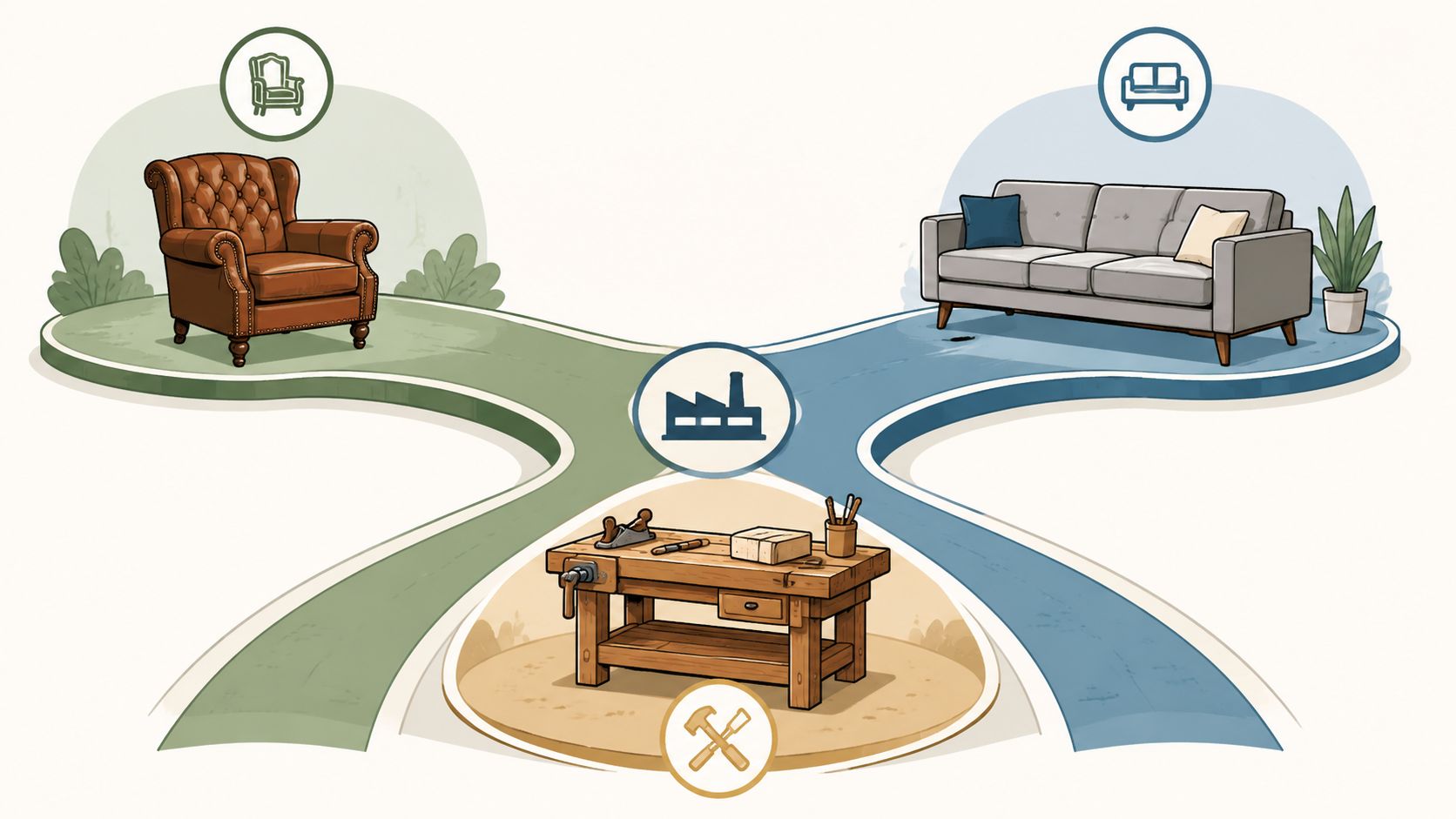
The phrase american furniture manufacturers covers a wide range of companies. Some operate at national scale. Some build in smaller workshops. Others focus almost entirely on made-to-order work. If you don't separate those categories, shopping gets confusing fast.
The industry itself is crowded. In 2026, the U.S. Household Furniture Manufacturing industry comprised 3,656 businesses, and manufacturers had to stand apart through quality, customization, and service rather than price competition, according to IBISWorld's profile of household furniture manufacturing.
National brands with broad reach
Some American manufacturers are known for established collections, recognizable styling, and wide dealer networks. These companies often appeal to shoppers who want a familiar name and a predictable shopping process.
Their strengths usually include:
- Consistent collections that make room planning easier
- Multiple categories such as bedroom, dining, upholstery, and home office
- Wider availability for shoppers comparing options across stores
The tradeoff is that “American brand” doesn't always tell you exactly how one specific piece was built. One collection may feel more substantial than another. One frame may be domestic while another is sourced differently. That's why it helps to compare construction details, not just logos.
Amish and hand-crafted shops
Here, many buyers find the furniture they keep longest. Smaller wood shops, especially Amish makers, tend to focus on solid hardwood, hand-crafted construction, and traditional joinery. You notice the difference when you open a drawer, lift a chair, or run your hand across a table edge.
These pieces often suit shoppers who care about:
- Solid wood construction
- Repairability over time
- Cleaner, more honest materials
- Made-to-order stain and wood choices
Mass-produced alternatives can look similar from ten feet away. Up close, the differences become clearer. Veneer has its place, but it doesn't offer the same weight, edge detail, or long-term refinishing potential as solid hardwood.
If you're shopping bedroom or dining furniture, ask one question early: “Is this solid wood where it matters most?” That single question saves a lot of disappointment later.
For a deeper look at construction-first options, our overview of solid wood furniture brands shows what to compare.
Custom and made-to-order specialists
A third category is the flexible manufacturer. These companies shine when you want choices. That might mean selecting a dining table shape, changing a fabric, adjusting a sectional layout, or choosing the right ergonomic size in a recliner.
Here's a simple comparison:
| Manufacturer type | Best for | Typical strength |
|---|---|---|
| National brand | Whole-home shopping | Broad selection |
| Amish or hand-crafted shop | Dining and bedroom investments | Joinery and material integrity |
| Made-to-order specialist | Personalized fit and finish | Customization |
For many shoppers, names like Canadel and Stressless stand out. The piece on the floor is only the beginning. You may be able to tailor finishes, fabrics, leather, size, or configuration so the final result feels bespoke instead of off-the-rack.
How to Spot Heirloom Quality from Across the Showroom
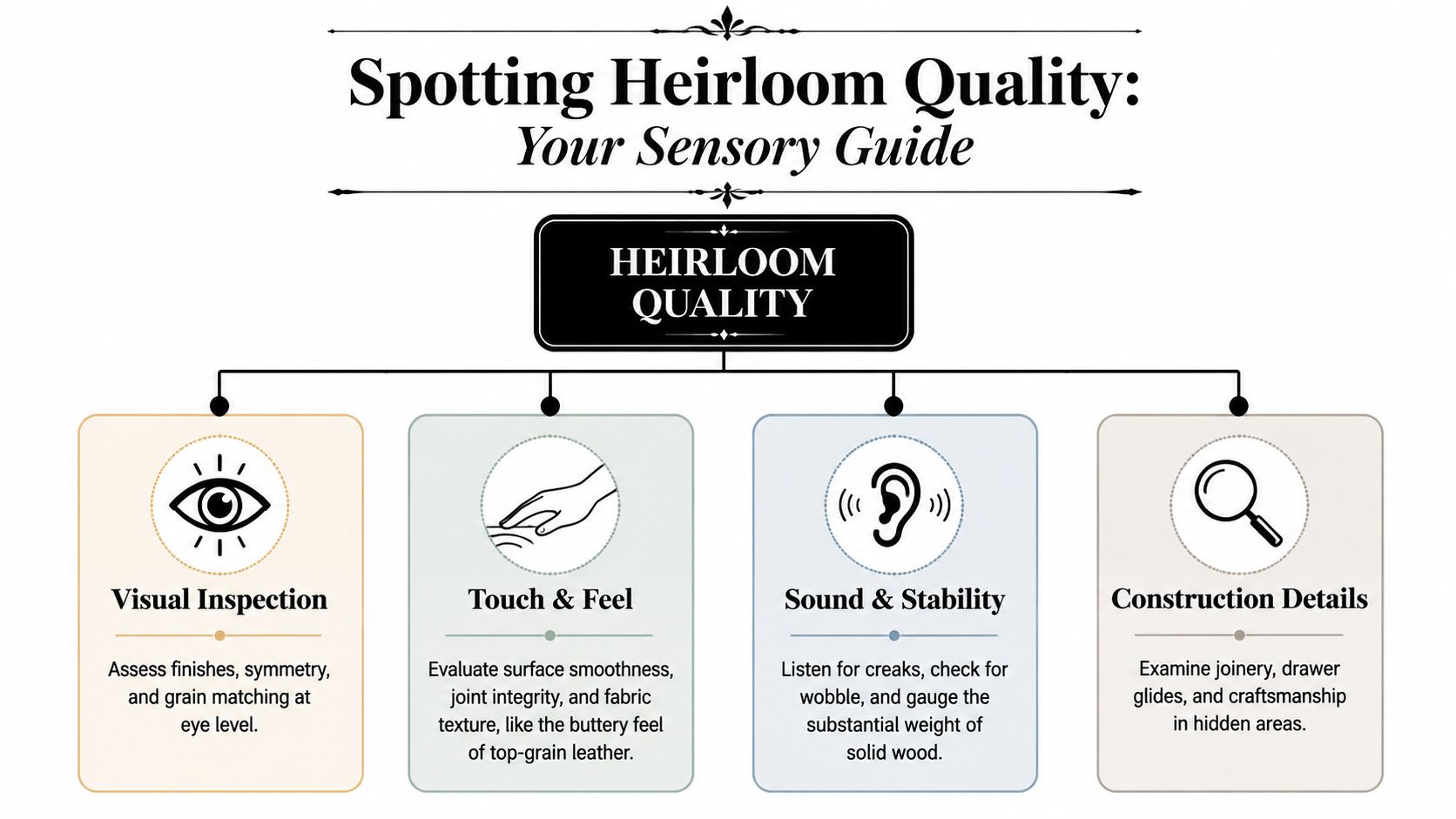
Brand names help, but your eyes and hands tell you more. Good furniture demonstrates its excellence subtly. It looks balanced. It feels settled. It doesn't ask you to ignore weak spots.
The quality of American-made furniture starts with manufacturing processes such as precise cutting, bending, and assembly, and a maker's control over details like wood moisture content affects stability and longevity, as noted by the Bureau of Labor Statistics overview of NAICS 337 manufacturing. That sounds technical, but you can see the results in the showroom.
Start with what your eyes catch
Stand back first. Look at the silhouette, then the symmetry. A good case piece should sit square. Doors should line up. Gaps should look intentional and even, not accidental.
Then move closer.
- Grain matching on wood tops and drawer fronts should look thoughtful.
- Finish consistency should hold across edges, corners, and less visible areas.
- Fabric application should look smooth, with no awkward pulling, sagging, or uneven welting.
On hand-crafted wood pieces, the grain often feels like part of the design instead of a printed effect. That's one reason solid wood has such presence in a room. You don't just see it. You sense its depth.
Use your hands
Touch is one of the fastest ways to separate showroom polish from true craftsmanship. Run your fingers under the table edge, along the back of a chair rail, or inside a drawer.
What you want:
- Smooth transitions where one part meets another
- Drawer movement that feels controlled rather than loose or jerky
- Upholstery texture that feels substantial, whether it's woven fabric or the buttery feel of top-grain leather
- Weight that suggests structure, especially in dining chairs and bedroom pieces
A quality sofa or recliner shouldn't just feel soft. It should feel supportive. Comfort that collapses isn't comfort for long.
If you're comparing upholstery, the construction reputation behind a line matters too. Our page on Hickory Craft furniture gives one example of the kind of craftsmanship-focused upholstery shoppers often look for when they want more than surface appeal.
Check the hidden places
The least visible areas often tell the truth. Open the drawer. Look underneath the table. Check the back of the dresser. If the maker cut corners, those corners usually show up there.
Good furniture stays honest in the places most shoppers forget to inspect.
Look for joinery that suggests care. In solid wood furniture, buyers often value features like dovetails or mortise-and-tenon construction because they signal that the piece was built to hold together through use, movement, and time.
Calculating the True Value The Cost-Per-Year Investment
Sticker price gets too much attention. It's important, of course, but it's only the beginning of the conversation. A better question is this: what will this piece cost you for each year you enjoy using it?
Here's the simple math many shoppers skip. If a piece costs less up front but wears out quickly, its lower price can be misleading. If a more substantial piece lasts much longer and keeps its comfort, stability, and appearance, the annual cost often makes a lot more sense.
A practical way to think about value
Compare two dining tables or two sofas.
- Lower-priced option may seem easier to justify today, but if it needs replacement after a short run, you buy twice.
- Heirloom-quality option asks for more commitment up front, yet it may serve your household through moves, holidays, kids, pets, and redesigns.
That's why we often talk about cost per year, not just purchase price. Furniture is part utility, part daily experience. Its value lies in how long it keeps doing its job well.
What raises long-term value
A piece usually earns its keep when it offers some combination of these traits:
- Durable construction that resists wobble, sag, and drawer problems
- Timeless design that won't feel dated the moment trends shift
- Custom options so the piece suits your room from the start
- Service support if you need help later
If you own older family pieces or you're planning a move with something especially meaningful, it's smart to think about preservation too. A specialist guide on antique movers can be useful when you want to protect heirloom furniture during transport.
The cheapest piece in the store can become the most expensive one in your house if you have to replace it over and over.
For shoppers furnishing a forever home, timing matters too. Some people choose a better piece sooner by using special financing, then enjoy the longer life of that furniture instead of settling and upgrading later. That can be a sensible path when the goal is lasting value, not short-term compromise.
Your Guide to the Made-to-Order Furniture Process
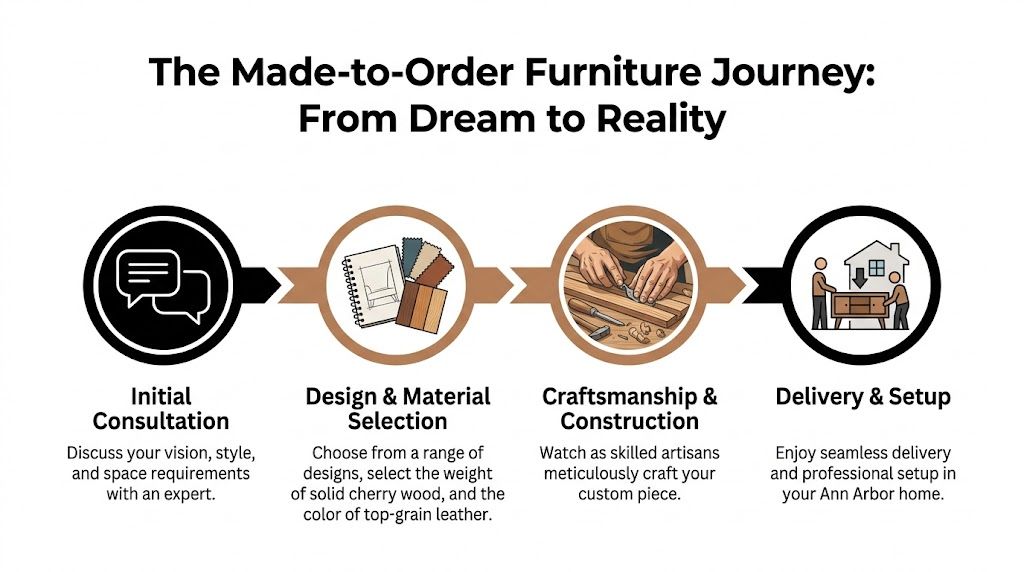
Custom furniture sounds complicated until you see how it works. In most cases, it's a series of straightforward choices. You start with a form you like, then refine the details so the piece fits your room and your routine.
That matters because many buyers struggle to verify Made in the USA claims. Asking direct questions about sourcing and supply chains is one of the best ways to understand what you're ordering, especially as reshoring grows and definitions stay nuanced, according to Trendler's discussion of North American furniture manufacturing.
What the process usually looks like
A made-to-order dining set is a good example. With a line like Canadel, you might begin with table size and shape. Then you move to base style, edge profile, wood tone, chair design, fabric, or seat texture. Step by step, the piece becomes yours.
Custom upholstery follows the same rhythm. You choose the frame first, then the personality of the piece. Fabric changes the mood. Leather changes the feel. Cushioning, scale, and configuration affect how the furniture lives in the room.
At custom solid wood dining tables, you can see how buyers often begin with a basic form and then narrow the details that matter most in daily use.
Questions worth asking before you order
Many shoppers get stuck at this stage. They know what they like, but they aren't sure what to confirm before signing off.
Ask this directly: “Which parts of this piece are built domestically, and which materials or components come from elsewhere?”
A good dealer or manufacturer should be comfortable answering questions like these:
- Origin details Ask where the piece is built, not just where the brand is based.
- Wood and material options Ask whether the top, drawer box, or frame uses solid wood, veneer, engineered material, or a mix.
- Finish samples View the stain or leather in person when possible. Lighting changes everything.
- Lead time expectations Made-to-order work takes patience. Craftsmanship isn't instant.
- Delivery and setup Confirm what happens when the piece arrives and how issues are handled if something needs attention.
A short Pro-Tips box for custom orders
- Bring room measurements Include doorways, stair turns, and wall lengths.
- Bring photos Your existing flooring, wall color, and nearby furniture affect every finish choice.
- Sit before you customize The frame has to feel right before the fabric does.
- Ask for Quick Specs Dimensions, wood species, configuration notes, and care details should be easy to review.
For anyone considering a bespoke dining room, a modular sectional, or an ergonomic recliner, custom order shopping gets easier once you treat it like a guided design conversation instead of a mystery.
Bringing American Craftsmanship Home to Ann Arbor
In Ann Arbor, furniture buying often starts with a practical need. A dining table for a new house. A bedroom set that feels more grown-up than what came before. A recliner that finally supports your back the way it should. Then the search widens, and buyers realize there's a big difference between seeing a product online and living with it every day.
That's where a local showroom still matters. You can feel the weight of solid cherry wood. You can compare stain colors under real light. You can test whether a chair invites you to linger or asks you to get up after ten minutes.

Why Midwest proximity helps
Regional geography matters more than many shoppers realize. The Midwest hosts 28% of U.S. manufacturers, which gives Michigan retailers an advantage when coordinating made-to-order programs and domestic sourcing, according to IndustrySelect's overview of U.S. furniture manufacturing.
For buyers in Southeast Michigan, that can mean a smoother process when ordering from domestic makers. Communication tends to be clearer. Coordination is often easier. For custom and heirloom categories, that matters.
What this looks like on the showroom floor
At our South State St. location, those ideas become tangible. One shopper may come in wanting a dining set and discover the appeal of Amish hand-crafted joinery. Another may arrive looking for comfort and end up comparing the ergonomic fit of Stressless recliners by size. Someone else may begin with “just browsing” and realize that an in-stock piece is only a starting point because fabric, finish, and configuration can all change.
That's also where Amish furniture in Ann Arbor becomes easier to understand. Online, “solid wood” can feel abstract. In person, you notice the depth of the grain, the steadiness of the piece, and the care in the joinery.
One practical advantage of a broad showroom is that the conversation doesn't stop at one room. Buyers often come in for dining and then start thinking about how the same standards apply to the home office, bedroom, or even outdoor spaces. Good furniture buying works that way. Once you know what quality feels like, you start wanting it throughout the house.
For readers looking at local options, Tyner Furniture is one place where shoppers can compare hand-crafted Amish wood furniture, made-to-order Canadel dining, and ergonomic Stressless seating in person while reviewing finish and configuration choices on site.
Invest in Furniture That Lasts a Lifetime
The strongest case for american furniture manufacturers isn't nostalgia. It's usefulness. Well-built furniture solves problems better. It fits your room more thoughtfully, supports your body more comfortably, and holds its shape through years of ordinary living.
That's why quality buying tends to get simpler over time. You stop asking which piece is cheapest today and start asking which piece will still be serving you well years from now. For many households, that shift changes everything.
What lasting furniture gives you
A worthwhile piece usually offers more than one benefit at once:
- Durability that stands up to daily use
- Personal style through bespoke finishes, fabrics, and configurations
- Repairability that keeps a good piece in service longer
- Calmer buying decisions because you're purchasing with intention
There's also a practical side after the sale. If you're relocating or rearranging a home with substantial pieces, good handling matters. This guide on how to protect furniture when moving is a helpful resource for preserving finishes, corners, and upholstery.
Buy for the life you expect to live in the piece, not for the excitement of the first week it arrives.
For many people in Ann Arbor and across Southeast Michigan, the right furniture isn't the piece that shouts the loudest online. It's the one that feels settled in your home, supports your daily routine, and still looks honest after years of use. That could be a solid wood bed, a made-to-order dining set, a leather recliner with ergonomic support, or a home office piece that works hard without looking temporary.
The point isn't to fill your house quickly. It's to furnish it well.
Visit Tyner Furniture in Ann Arbor for a proper sit test, a closer look at hand-crafted solid wood, and guidance on made-to-order options for dining, living room, bedroom, home office, and outdoor spaces. If you'd rather start from home, browse the online Quick Specs for special orders and narrow down the finishes, fabrics, and configurations that fit your space.