Adjustable Bed Base Reviews: A Buyer’s Guide for 2026

Scrolling through adjustable bed base reviews can feel like sorting through a pile of half-finished opinions. One person praises quiet movement, another complains about setup, and a third says the base changed how they sleep without explaining why. For a shopper in Ann Arbor or anywhere in Southeast Michigan, that kind of noise makes a meaningful purchase feel harder than it should.
A better approach starts with the right questions. Which features matter for long-term comfort, how do you separate real quality from flashy extras, and when is it worth stepping away from the screen and testing a base in person at a local showroom that's been serving the community since 1957? Adjustable bases can support more than comfort, too, since objective sleep research found adults using one experienced 21 more minutes of total sleep time, a 5-minute increase in REM sleep, and fewer awakenings (Sleep journal abstract).
| Evaluation lens | What it tells you | What to watch for |
|---|---|---|
| Motor and noise | How the base performs in daily use | Smooth lift, steady motion, quiet operation |
| Ergonomic range | How well it supports body position | Head, foot, lumbar, and preset positions |
| Build quality | Whether it's made to last | Frame strength, weight capacity, fit with your mattress |
| Real-world value | Whether it's a smart investment | Longevity, warranty support, and cost-per-year |
Why Most Adjustable Bed Base Reviews Are Overwhelming
A shopper starts with a simple need, better sleep, a little more comfort, maybe relief from an aching back, then runs into pages full of personal stories, feature lists, and complaints that do not always point in the same direction. That is why adjustable bed base reviews can feel hard to sort through, even when the base itself may be a good match.
A local guide makes the process easier to read. Tyner Furniture has served Southeast Michigan since 1957, so the conversation here is not about chasing hype. It is about helping neighbors make a durable, thoughtful purchase that fits real homes and real routines. The right frame can support an ergonomic, hand-crafted, and heirloom-minded sleep setup, but only if the buyer knows what to compare and what to set aside.
Practical rule: reviews matter most when they describe daily use, not just first impressions.
Consumer-review data from a large aggregation covering 1,750+ consumer reviews reported 87% owner satisfaction overall, with some models reaching 91% to 95% satisfaction on samples of 56 to 320 reviews. That kind of broad feedback helps explain why shoppers often treat the frame as part of their wellness routine rather than just furniture.
A careful search is still worth the time. If a base can improve comfort, support a mattress properly, and make bedtime easier to manage, the purchase becomes a long-term investment instead of a short-term upgrade. For readers who want a closer look at comfort and health benefits, Tyner's guide on the benefits of an adjustable base is a useful starting point.
Decoding Key Features for Lasting Performance
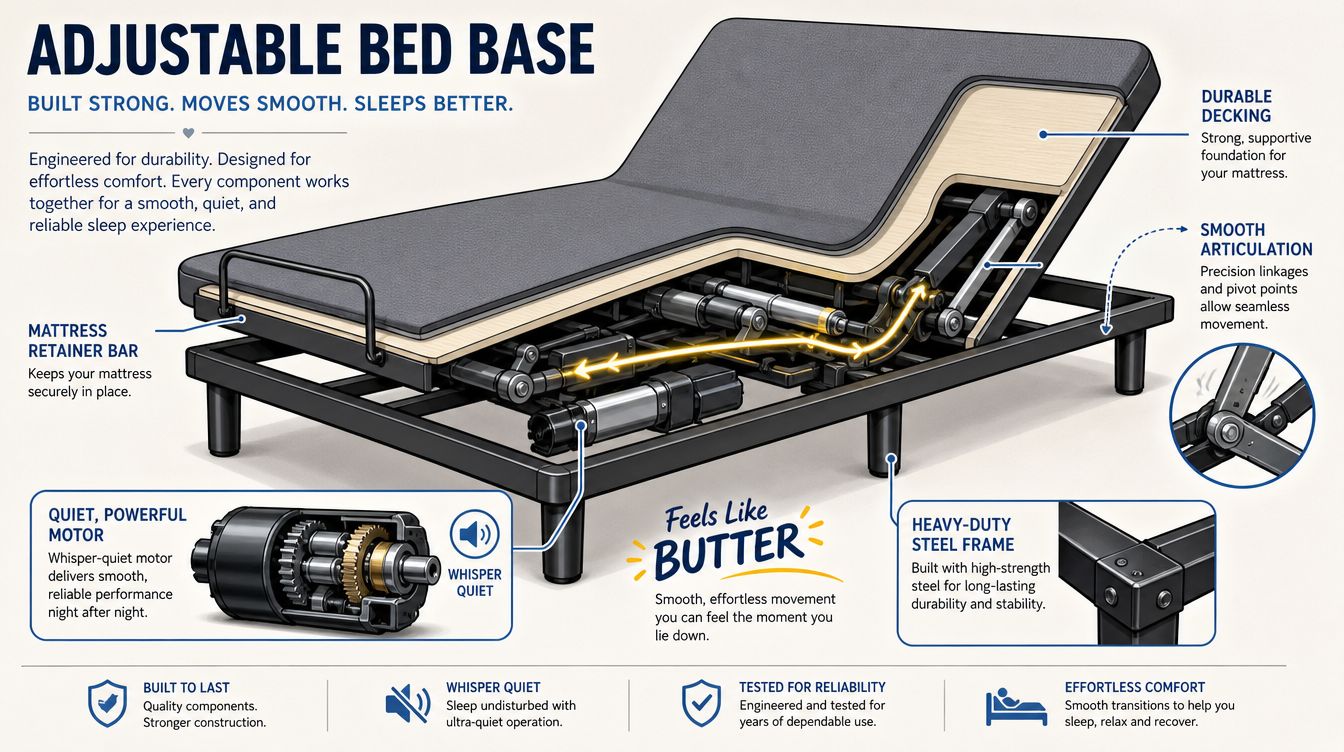
A base often looks simple on the showroom floor, yet the details that shape daily comfort are usually inside the frame. The motor, the remote, the stiffness of the structure, and the way the base changes position all affect how dependable it feels after the first night. A Bespoke, ergonomic system starts to stand apart here, because the mechanics have to work together without drawing attention to themselves.
Start with motion, then listen for quality
Motion tells you a great deal. A base should rise and lower in a controlled way, with no jerking or hesitation, because that is what you will notice every time you adjust for reading, rest, or relief. Reviewers often focus on the motor for that reason, since it affects how the whole frame feels in regular use. Performance notes commonly point to higher-capacity bases in the 700 to 850 lb range.
Sound matters just as much as movement. A soft hum can blend into a bedroom, while a grind, rattle, or pause can become distracting very quickly. Premium models are often built for quieter operation, and that is one reason some owners notice a bigger difference in day-to-day satisfaction than they expected.
Look past articulation alone
The best reviews do more than describe how far the head and foot sections rise. They explain how the rest of the system works together, because comfort depends on the whole setup, not just the lifting angles. Consumer Reports looks at preset positions such as Reading, TV, Anti-Snore, and Zero Gravity, along with lumbar support, massage, under-bed lighting, USB ports, remote usability, app control, and lockout functions. That broader view helps separate a base that provides basic movement from one that feels well planned in real use.
A strong frame should also match the mattress without strain, and that is where material quality begins to matter. A base that stays steady under load, responds smoothly to presets, and supports the mattress cleanly is easier to live with night after night. For readers who want to connect those features to comfort and health, how adjustable bases can help alleviate health concerns gives a clear starting point, and Jack Dellaccio on advanced sleep tech offers another useful perspective on newer sleep features.
A strong frame should feel like it disappears into the night, not like it announces itself every time it moves.
Craftsmanship also shows up in the small details shoppers can overlook at first glance. When the frame feels steady, the movement stays smooth, and the controls make sense without extra effort, the base becomes easier to trust over time. That kind of practical refinement matters more than flashy features that sound impressive but do little in a real bedroom.
The In-Store Test Your Showroom Checklist
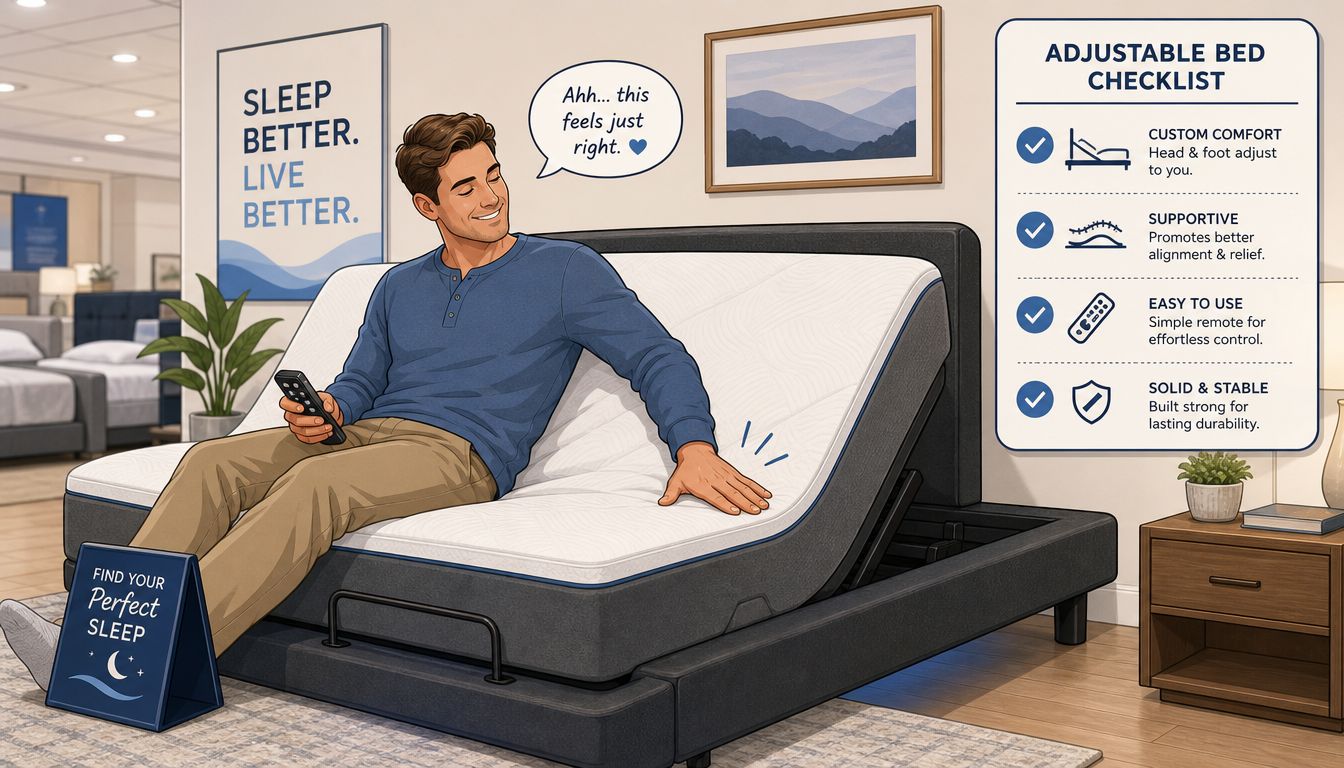
Online photos can only tell part of the story. In a showroom, the body gives faster feedback than the brain does, which is why a careful sit test matters so much in Ann Arbor. The goal isn't to lie down for a minute and leave, it's to check whether the base feels calm, stable, and easy to live with.
What to do during the test
Use the bed the way it will be used. Move through the positions slowly, listen to the motor, and pay attention to whether the transition feels controlled or abrupt. Quality is often easier to feel than to describe.
- Check the sound: A quiet hum is one thing, a distracting grind is another. If the motion is louder than the conversation around it, the base probably won't disappear into a restful routine.
- Test the movement: Raise and lower the bed through several positions. The frame should feel steady, not wobbly or uneven.
- Press the presets: Try any Reading, TV, Anti-Snore, or Zero Gravity settings that are available. These are useful only if they make positioning easier.
- Ask about fit: Mattress compatibility matters, especially with thicker or heavier setups. A strong base should support the mattress without awkward gaps or pressure points.
- Notice the setup footprint: Some bases are easier to place than others, and installation details can matter when a frame is being added to an existing bedroom.
Showroom habit: good testing is slow testing. A few extra minutes in the room can reveal more than a dozen product photos.
This is also where a knowledgeable staff member earns trust. A shopper can ask which mattresses pair cleanly with the frame, how the controls feel in hand, and whether the motion works for a split or king setup. For readers planning a mattress purchase at the same time, Tyner's tips for buying a new mattress can keep the whole process aligned.
A Scoring Framework to Evaluate Any Adjustable Base
A simple scorecard helps turn a confusing category into a fair comparison. The point is to judge each base the same way, whether it's a display model in Ann Arbor or a special order that will live in a home for years. A cost-per-year mindset makes more sense here than chasing the lowest entry number.
| Adjustable Base Evaluation Scorecard | What to Look For | Your Score (1-5) |
|---|---|---|
| Motor and Noise Level | Smooth lift, steady motion, quiet operation | |
| Ergonomic Range and Presets | Head, foot, lumbar, Anti-Snore, Zero Gravity, and remote ease | |
| Build Quality and Durability | Frame stability, weight support, solid construction | |
| Mattress Compatibility | Fit with the mattress type, height, and size already owned | |
| Warranty and Support | Clear coverage, service confidence, and long-term support |
How to use the scorecard
Give each category a score from 1 to 5 after testing more than one base. A 5 means the feature feels strong, intuitive, and well-built. A 1 means the category felt weak, awkward, or hard to trust.
Motor quality deserves special attention because it affects every use. If the movement feels smooth and the noise stays low, that's a sign the base was engineered for everyday living, not just showroom appeal. Build quality matters for the same reason, since a frame that flexes too much can undermine the value of even a good mattress.
Mattress compatibility is often overlooked until a buyer gets home. A base can have impressive features and still be the wrong match if the mattress is too stiff, too heavy, or physically awkward with the frame. That's why a written scorecard is useful, it keeps the comparison grounded in practical needs instead of marketing language.
Scoring tip: if two bases tie on features, choose the one that feels calmer under movement and easier to understand at the remote.
Reading Between the Lines of Online Reviews
A shopper can read three reviews of the same adjustable base and still feel unsure what to believe. One person may complain about delivery damage, another may love the features, and a third may be upset because the base did not match the feel they expected. Careful readers sort those voices by asking which comments describe the product itself and which ones describe the buying experience.
Useful reviews usually talk about what happened after the first night and after regular use. They mention whether the motor kept its calm tone, whether the remote remained easy to understand, and whether the frame held steady over time. A thin review often leans on a single event, such as a rough delivery day, a dented box, or a quick first impression that says little about how the base will hold up in real use.
Owner feedback also deserves a close look because it reveals patterns, not just opinions. In this category, consumer-review data points to strong overall satisfaction, and a meaningful share of owners describe health benefits such as relief from reflux or back pain. That kind of pattern helps explain why negative comments should be read carefully, since they often point to a mismatch between the product and the buyer's needs, or to an isolated quality issue rather than a weak category overall.
What useful reviews usually reveal
- Long-term comfort: A helpful review explains whether the bed still feels supportive after regular use.
- Noise and motion: Strong feedback describes motor behavior in plain language, not just as “good” or “bad.”
- Feature value: If a buyer never used massage or app controls, that tells future shoppers something important about priorities.
- Expectation fit: Honest reviews often show whether the product matched the buyer's sleep habits.
The same careful reading helps with product photos. A polished image can show finish and shape, but it will not tell you how the remote feels in your hand or whether the frame settles without noise. Tyner's guide on using online furniture photos to make smarter buying decisions supports that same habit of comparing what you see online with what you would want to confirm in person.
Investing in Your Rest Warranty and Financing
An adjustable base should be judged like a long-term home investment, not a one-season convenience. That means the warranty matters, because it signals how much confidence the maker has in the frame, the motor, and the controls. Shoppers looking for durability should think in cost-per-year, not just upfront price.
The price range is broad enough that careful comparison matters. Quality queen models often run from $900 to over $2,500, which is why long-term value and feature quality matter more than the entry-level number alone. That range also explains why many buyers prefer to match the purchase with a budget plan instead of settling for a weaker frame that won't hold up as well.
What a smart value conversation sounds like
A solid warranty suggests the base was built with service life in mind. A short, vague promise can leave a buyer guessing about repairs, while a clear one helps frame the purchase as a true investment. The most durable pieces usually feel more like heirloom furniture than temporary setup gear.
For shoppers who want to manage the purchase responsibly, flexible payment options can make a meaningful difference. Tyner's mattress financing options and special financing from Top Mobility both point to the same practical idea, lasting comfort should be reachable without forcing a rushed decision. Tyner's Low Price Promise supports that value mindset, especially for Southeast Michigan households comparing quality levels across a wide range.
The cheapest frame is rarely the most affordable over time if it needs replacing early or never feels right in the bedroom.
Your Next Step The Tyner Furniture Experience
Online research gets a shopper close, but a showroom visit closes the gap between reading and knowing. At the South State St. showroom in Ann Arbor, the best next move is to use the scorecard, listen for the motor, feel the smoothness of the lift, and compare how different bases respond under real pressure. That kind of rest test is where confidence gets built.
Tyner Furniture has been part of the community since 1957, and that local legacy shows up in the way the team talks about comfort, craftsmanship, and long-term value. The selection also reaches far beyond the bedroom, with options for the Home Office and Outdoor Spaces, so it's easier to build a whole home around the same thoughtful standard. For shoppers comparing finishes, fabrics, and configurations, that broader custom order approach matters just as much as the base itself, because in-stock is only the beginning.
Bring the checklist, bring your questions, and take your time. A quiet, stable base should feel reassuring the moment it moves, and the right team should make the process feel simple instead of rushed.
Visit Tyner Furniture in Ann Arbor to try a sit test in person, compare adjustable bases with real guidance, and browse the online Quick Specs for special orders that fit your home and your long-term comfort.