Upholstery Leather Couch: A Buyer’s Guide to Lasting Style


A tape measure is stretched across the living room doorway, two leather swatches are held under afternoon light, and the decision still feels less clear than it did online. One sample feels buttery and natural. The other looks more even and seems easier to live with. Meanwhile, the household needs a couch that can handle daily sitting, pets, spills, changing sunlight, and the occasional move through a narrow hallway.
An upholstery leather couch deserves more scrutiny than its price tag receives. The right choice depends on the hide, finish, frame, suspension, cushions, room conditions, and how the household uses the furniture. A showroom floor model may be comfortable today, but a made-to-order, heirloom-quality couch can deliver better value when its construction and materials match the room.
Since 1957, Tyner Furniture has served Ann Arbor and Southeast Michigan shoppers with guidance across the home, from the Home Office to Outdoor Spaces. The same practical standard applies here: choose for durability, craftsmanship, comfort, and cost-per-year, not for the quickest decision.
Why Choosing an Upholstery Leather Couch Is a Bigger Decision Than It Looks
A leather couch absorbs years of body weight, movement, dust, sunlight, and household activity. The leather gets noticed first, but the hidden structure decides whether the piece still feels supportive after years of use. A strong frame with sound joinery, reliable suspension, and a suitable cushion core matters just as much as the surface under the hand.
Leather upholstery also has a deep furniture heritage. Britannica's history of upholstery notes that early upholsterers used animal skins and dressed leather across rigid frames from early Egyptian times through the beginning of the Renaissance. Historical summaries also identify Egyptian leather chairs dating to about 3100–2686 B.C. and Greek leather couches appearing in the late 7th century B.C. That history doesn't guarantee quality in a modern couch, but it explains why leather remains associated with durability, status, and long service.
The visible surface is only the beginning
A buyer comparing two leather swatches is making only the first decision. The more important questions involve what sits underneath:
- Frame integrity: Is the structure built from durable hardwood or weaker composite material?
- Joinery: Are high-stress corners reinforced with proper blocks, screws, glue, and joinery?
- Suspension: Does the couch use sinuous springs, eight-way hand-tied springs, or webbing alone?
- Cushion support: Will the filling hold its shape, or will the seat develop deep depressions quickly?
- Finish selection: Can the surface tolerate the household's pets, children, sunlight, and cleaning habits?
The trade-offs are straightforward. A lower upfront cost may produce a higher replacement burden. An in-stock couch may solve an immediate need, while customization can solve the doorway, room layout, and comfort problem more precisely. Pure aniline leather offers a remarkable natural feel, but a protected or pigmented finish usually makes more sense in a busy family room.
Practical rule: The most expensive couch isn't automatically the best value. The defensible purchase is the one whose construction, finish, and dimensions fit the household for the longest useful period.
Furniture shopping can overwhelm even experienced homeowners because every visible choice hides another specification. A useful guide to high-consideration furniture purchases helps put the decision in context. A leather couch should be assessed as a daily-use system, not as a color choice with cushions attached.
Leather Grades Explained From Full-Grain to Bonded
Leather grades describe how much of the hide's natural surface remains and how heavily the material has been altered. The label alone isn't enough, because manufacturers may use terms inconsistently. Buyers should ask what covers the seating surfaces, arms, backs, and sides, then inspect the material under good light.
Full-grain leather
Full-grain leather retains the hide's outermost layer. Natural markings remain visible because the surface hasn't been extensively sanded or buffed. That gives it the most authentic grain, a supple hand, and an aging pattern that develops character rather than trying to look identical forever.
A buyer's guide describes full-grain leather as a highly durable sofa material that can develop a patina and last 15–25 years when properly maintained. The guide to sofa materials supports that expectation. Full-grain suits households that appreciate visible variation and want an heirloom surface with personality.
Top-grain leather
Top-grain leather begins with the upper portion of the hide but receives light surface correction to create a more consistent appearance. It generally feels smooth and substantial, with fewer visible markings than full-grain leather. The trade-off is practical. The surface is more uniform, while some of the hide's original character is reduced.
Independent upholstery guidance commonly places full-grain and top-grain leather at the top of the durability ladder, with properly maintained pieces often serving for roughly 10 to 20+ years. This durability comparison also explains why dense leather fibers resist fraying and tearing better than many fabrics. Top-grain is usually the safest recommendation for a heavily used living room when the buyer wants a natural leather feel without the vulnerability of pure aniline.
Corrected-grain leather
Corrected-grain leather has been more heavily buffed, then embossed or finished to create an even appearance. It can offer a predictable color and a more accessible entry point, but it shows less of the hide's original grain. Buyers should expect a more manufactured feel and a shorter service horizon than full-grain or top-grain leather.
A corrected surface can work in a lightly used room or for a shopper prioritizing consistent appearance. It isn't the first recommendation for a household seeking a generation-spanning couch.
Split leather
Split leather comes from a lower layer of the hide after the strongest outer grain has been separated. It can be finished to resemble a more premium surface and is often used on sides or backs rather than the primary seating area. Buyers should ask whether a couch combines top-grain seating surfaces with split leather elsewhere, because that construction affects the overall specification.
Bonded leather
Bonded leather combines leather scraps with polyurethane. It may look smooth and consistent when new, but the reconstituted structure and synthetic surface can lead to peeling or cracking sooner than genuine top-grain or full-grain upholstery. A buyer comparing options should read the material description carefully rather than accepting the word “leather” on its own.
For a clearer distinction between durable top-grain upholstery and bonded material, consult Tyner's top-grain and bonded leather comparison. The central recommendation is simple: choose full-grain for natural character, top-grain for the strongest balance of refinement and practical use, and lower tiers only when the room and expected service level justify the compromise.
What Makes the Frame Springs and Cushions Last
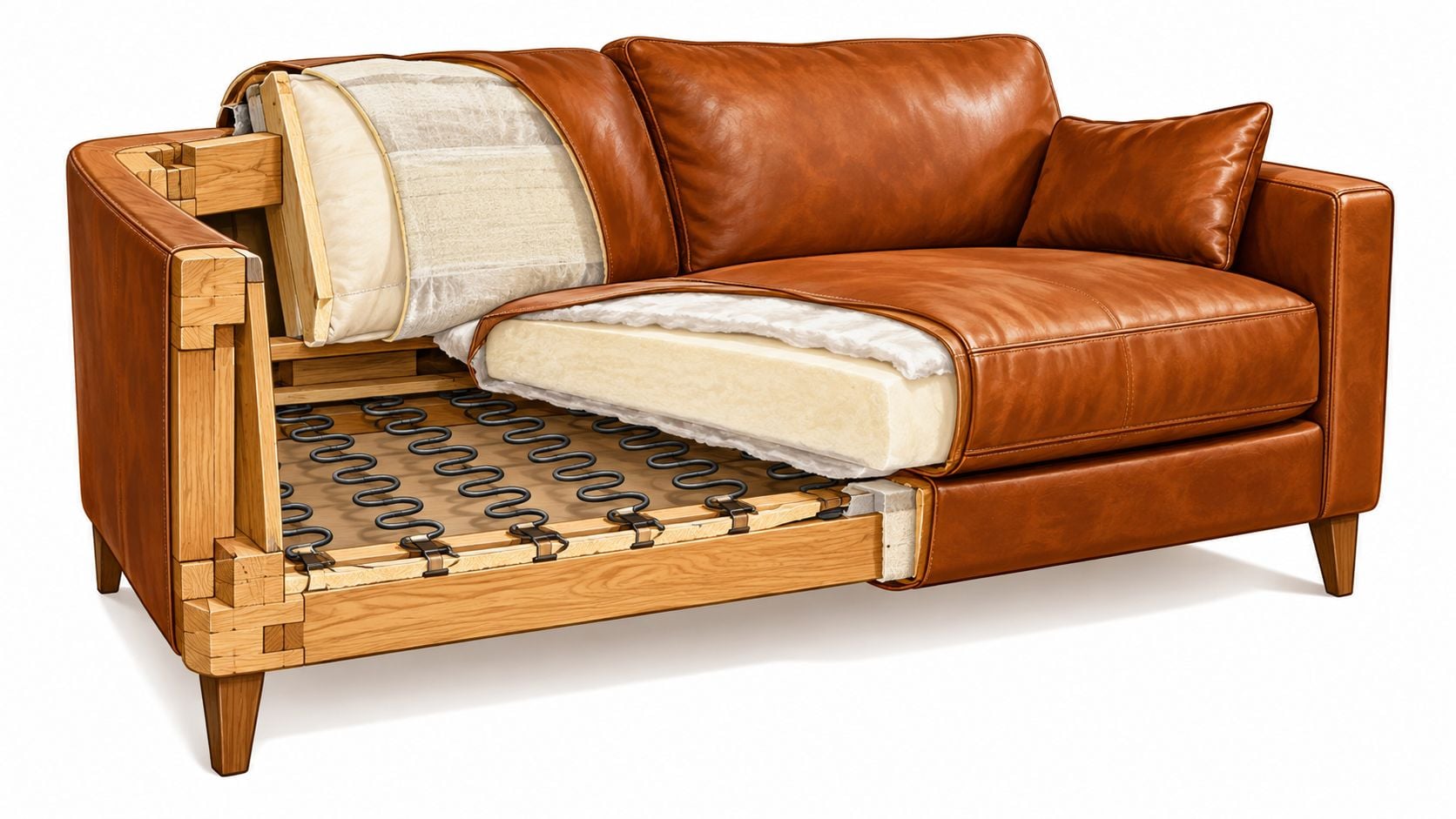
A leather surface can remain attractive while the couch underneath becomes uncomfortable. The frame, joinery, suspension, and cushions determine whether the seat supports the body evenly or develops sagging, noise, and uneven pressure.
Start with the frame
A lasting frame typically uses kiln-dried hardwood such as oak, maple, or beech. Drying stabilizes the wood and reduces the risk of movement that can loosen joints over time. Mortise-and-tenon joints, doweled and glued connections, and reinforced corner blocks are stronger signals than a heavy appearance alone.
At stress points, corner blocks should be securely screwed and glued rather than relying only on staples. Plywood and particleboard can be useful in some furniture applications, but a buyer seeking heirloom durability should treat a predominantly composite frame as a significant compromise.
Suspension changes the sitting experience
The suspension supports the cushions and distributes weight across the frame.
- Eight-way hand-tied springs flex in multiple directions and can provide a responsive, body-following sit when built correctly.
- Sinuous springs create a firmer feel and can be a sound choice when properly attached and spaced.
- Webbing-only suspension deserves careful questioning because it can offer less long-term resilience than a properly engineered spring system.
The eight-way hand-tied sofa guide gives shoppers a useful way to understand why suspension matters. A couch shouldn't be judged only by the first few minutes of comfort. The support underneath should remain consistent after repeated daily use.
Cushion filling sets the maintenance rhythm
High-resilience foam wrapped in down or fiber creates a softer, more relaxed feel, but it requires regular fluffing and rotation. All-foam cushions usually hold their shape more consistently and provide a cleaner, firmer sit. Down-only envelopes deliver softness but demand the most maintenance and aren't ideal for households that want a low-effort routine.
A showroom sit test should include upright sitting, lounging, rising from the edge, and settling into the corner. The right cushion should support the household's preferred posture without forcing everyone into one position.
Matching Leather Finish to Real Household Life
Leather grade and leather finish answer different questions. The grade describes the hide and its surface preparation. The finish describes the protective treatment applied over that surface. Buyers who separate those two decisions can choose more intelligently.
Four finishes with four different personalities
Pure aniline leather has dye throughout the hide and little or no protective topcoat. It offers exceptional grain visibility and a naturally warm hand, but spills, body oils, and sunlight leave marks more readily. It belongs in a lower-traffic room where visible patina is part of the appeal.
Protected aniline adds a light protective layer while retaining much of the natural look and feel. Semi-aniline leather sits in the same broad middle ground, with additional pigment for more consistent color and improved resistance. For many households, this category provides the most sensible balance.
Fully pigmented leather uses a more opaque surface coating. It tends to resist scuffs, spills, and fading better than minimally finished leather, making it the practical choice for children, pets, and high-use family rooms. The surface looks more consistent, but it won't display the hide's natural variation as openly.
| Finish | Feel & Look | Spill & Fade Resistance | Aging Pattern | Maintenance | Best Fit |
|---|---|---|---|---|---|
| Pure aniline | Soft, natural, visibly varied | Lowest | Rich patina and visible marks | Careful, finish-approved products | Adults-only or low-traffic rooms |
| Protected aniline | Natural feel with light protection | Moderate | Patina with more even color | Regular, gentle care | Flexible everyday use |
| Semi-aniline | Smooth with added color consistency | Moderate to good | Controlled aging | Finish-specific routine | Family rooms with considered use |
| Pigmented | Even, consistent, more coated | Highest among these finishes | More uniform wear | Simplest, still not maintenance-free | Kids, pets, and heavy traffic |
A household with pets should also consider durable furniture guidance for pet owners. The recommendation is direct: pure aniline is a design choice, protected or semi-aniline is a balanced household choice, and pigmented leather is the safest practical surface for demanding rooms.
Care and Conditioning That Protect the Finish
Leather care works only when it matches the finish. Generic advice can create problems, especially when a cleaner strips a protective coating or a conditioner leaves residue on a surface that doesn't need it.
A practical maintenance rhythm
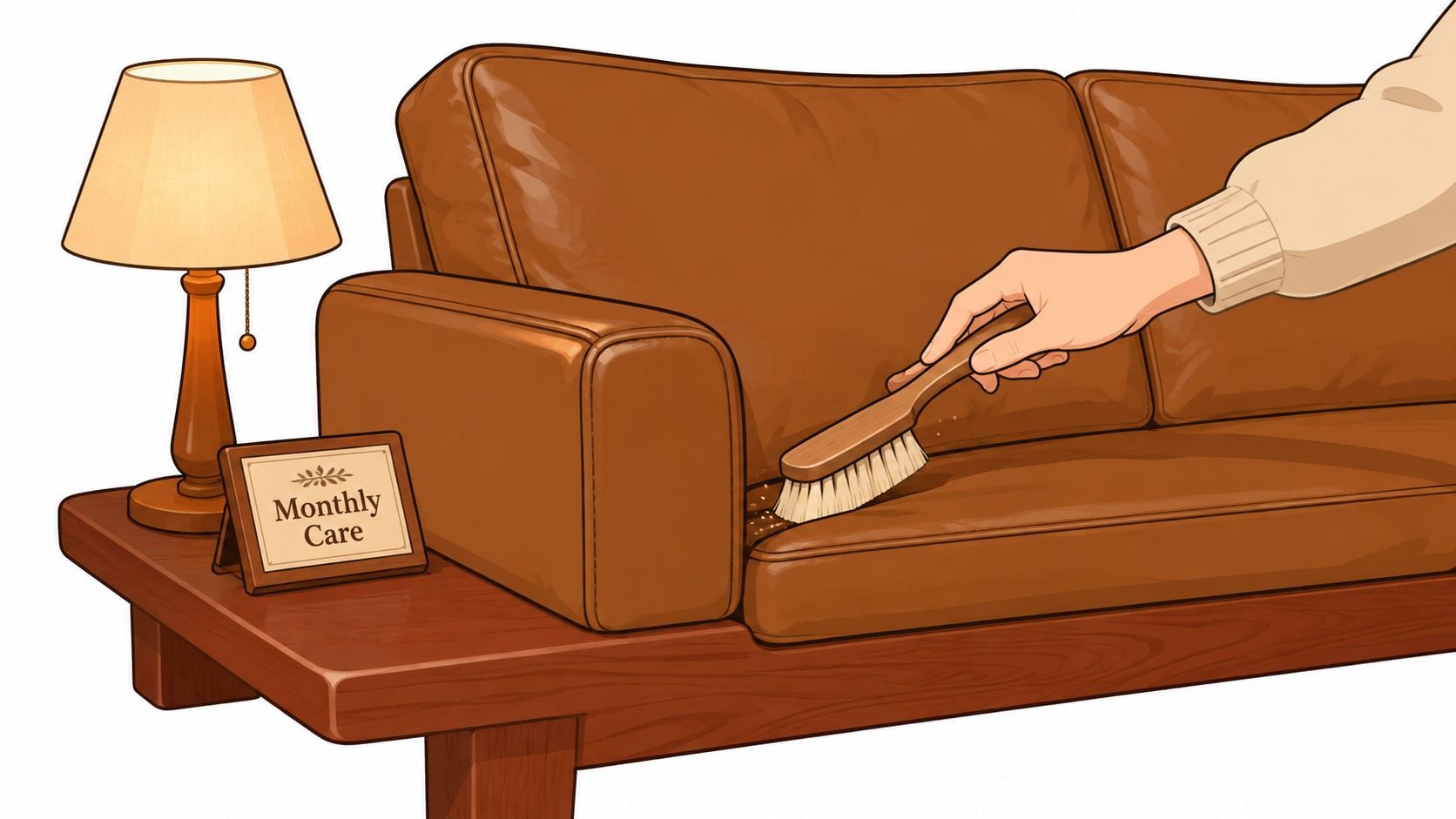
Monthly care should remove grit before it becomes an abrasive. Dust the surface, vacuum seams with a soft brush, and blot spills promptly rather than rubbing them deeper into the grain. A lightly damp microfiber cloth is generally appropriate for protected or pigmented surfaces, but the cloth shouldn't leave the leather wet.
Seasonal care requires the manufacturer's instructions. Some independent guides recommend a pH-balanced cleaner and conditioner once or twice a year, while others advise against soap or detergent and recommend approved products only. That disagreement is precisely why the finish must be identified before treatment.
Annual inspection should include cushion rotation, seam and leg checks, and a review of fading near windows. Direct sunlight, heat sources, and over-wetting create avoidable stress. A recent care guide also recommends keeping room humidity around 40% to 60% to reduce excessive dryness. This leather-care guidance also discusses the way material quality affects shape retention and maintenance outcomes.
Care rule: Test any product on a hidden area first, follow the furniture maker's instructions, and never assume that a product safe for one finish belongs on another.
Mistakes that shorten service life
Avoid all-purpose household cleaners, baby wipes, silicone sprays, soaked cloths, direct sunlight, fireplaces, and heating vents. Pure aniline may benefit from a light conditioner every three to four months, but pigmented leather often doesn't need that treatment. Product frequency should follow the finish, not a calendar copied from another couch.
Households protecting a couch during a move, renovation, or temporary room change can also find stretch sofa covers sized for furniture protection. For a finish-specific routine and warranty-aware care plan, Tyner's leather furniture protection guide is a useful reference.
Cost-Per-Year and the Value of Made-to-Order Customization
A $3,500 leather couch used for 15 years costs about $233 per year. A $1,400 couch replaced after six years also costs roughly $233 per year. The cheaper purchase still brings another round of shopping, delivery, disposal, and adjustment to a different seat.
These figures use supplied cost assumptions, not a market average. They show why the purchase price alone cannot measure ownership cost. A stronger frame, suitable leather, and replaceable or durable cushioning can make a higher initial price sensible when the couch serves the household longer.
A simple value comparison
| Tier | Approx. Price | Expected Lifespan | 5-Yr Cost/Yr | 10-Yr Cost/Yr | 15-Yr Cost/Yr |
|---|---|---|---|---|---|
| Higher-quality leather example | $3,500 | 15 years | $700 | $350 | $233 |
| Lower-priced replacement example | $1,400 | 6 years | $280 | $233* | $187* |
*The five-year and fifteen-year figures in the lower-priced row are arithmetic comparisons, not claims that the same couch lasts those periods. At its stated six-year life, the annualized cost is about $233.
Well-maintained full-grain and top-grain couches commonly serve 10 to 20+ years, and some high-quality top-grain pieces exceed 25 years. The table shows how a longer service life changes the annualized cost.
Customization protects the investment
A made-to-order couch lets you specify the parts that determine whether the piece works for your household:
- Dimensions: Set the size around the doorway, wall, and walking paths.
- Leather selection: Choose full-grain, top-grain, or a protected finish according to use and maintenance expectations.
- Cushion core: Select a firmer all-foam build or a plusher wrapped core, knowing that feel and upkeep will differ.
- Configuration: Choose a sofa, sectional, sleeper, or recliner arrangement that suits the room's traffic.
- Color and legs: Coordinate the couch with the room instead of adapting the room to a floor model.
Tyner Furniture's custom upholstery options let shoppers specify leather, dimensions, cushions, and legs, so the couch fits the room and the intended years of use. Access to Canadel supports bespoke dining customization, while Stressless provides ergonomic seating options for shoppers prioritizing that function.
Special Financing, subject to credit approval, and a Low Price Promise can reduce the immediate payment barrier without changing the selected construction. Promotional financing may use deferred-interest terms, so read the repayment conditions before signing. The right customization is the one that prevents an early replacement, not the one that adds features you will never use.
Your Next Step at the Ann Arbor Showroom
A useful showroom visit starts before the car leaves the driveway. The shopper should bring room measurements, doorway dimensions, photographs of the space, paint chips, and a clear description of who uses the couch. A home with pets and children needs a different finish from a formal sitting room, even when both rooms favor the same brown leather.
The sit test should cover at least three frames or seating designs. Each candidate deserves more than a quick perch:
- Posture check: Sit upright, recline, and rest against the corner.
- Edge check: Rise from the front edge and note whether it collapses or supports the movement.
- Cushion check: Press the seat and back to assess recovery and density.
- Reach check: Confirm that depth supports the household without forcing shorter users to perch.
- Room check: Compare the swatches with the actual paint, flooring, daylight, and nearby wood tones.
Build the couch in the right order
The strongest made-to-order process begins with the structure, not the color. The frame and suspension establish the foundation. Cushion fill determines the everyday feel. Leather grade narrows the durability and character options. Finish and color complete the decision.
That sequence prevents a common mistake: choosing a beautiful leather first, then discovering that the couch is too deep, too soft, too large for the doorway, or poorly suited to the household's traffic. It also creates space for a bespoke configuration instead of a compromise made under showroom pressure.
Tyner's in-house design team can guide shoppers through Stressless ergonomic recliners, sectionals, and sleeper configurations, along with leather upholstery choices. Delivery scheduling can be coordinated for Ann Arbor and surrounding Southeast Michigan communities. Buyers should request transparent lead times in writing, confirm protection-plan terms for the selected leather grade, and ask whether trade-in credit is available when an older heirloom piece is part of the upgrade.
Special Financing options may allow approved shoppers to spread payments over 12 to 60 months, depending on the plan. That convenience should support a sound purchase, not justify a weaker frame or unsuitable leather. A relaxed sit test, swatch review against paint chips, written order details, and a follow-up call before delivery create a much better experience than choosing from a screen alone.
Tyner's local legacy extends beyond living rooms. The selection covers the Home Office, bedroom, dining spaces, entertainment areas, mattresses, sleep systems, and Outdoor Spaces, including Amish hand-crafted solid wood furniture. For bedroom or dining pieces, shoppers should compare the weight of solid cherry, oak, or maple with mass-produced alternatives and ask about dovetailing, mortise-and-tenon joinery, and material integrity. Those details matter for an heirloom in the same way frame construction matters for an upholstery leather couch.
Tyner Furniture offers made-to-order leather upholstery, ergonomic Stressless seating, Canadel customization, and heirloom-quality furnishings for homes across Ann Arbor and Southeast Michigan. Visit Tyner Furniture for a relaxed sit test at the South State St. showroom, or browse the online Quick Specs before arranging a special order.