Large Outdoor Coffee Table: Your 2026 Buying Guide


A lot of Southeast Michigan homeowners reach the same point every spring. The seating is in place, the patio starts to feel usable again, and then one missing piece becomes obvious. There's nowhere central to set a tray, rest a book, or gather a few drinks when friends stop by.
That's where a large outdoor coffee table earns its keep.
For many households in Ann Arbor and across Southeast Michigan, this isn't a throwaway patio accessory. It's the visual anchor of the outdoor seating area and one of the hardest-working surfaces in the yard. It also has to survive humid summers, wet leaves, temperature swings, and a long winter that tests every finish and fastener. A table that looks good online can feel too bulky in person, too flimsy after one season, or too high-maintenance once real weather moves in.
Since 1957, local furniture shoppers have leaned on trusted guidance when a purchase feels important. That matters here. A large outdoor coffee table should be chosen with the same care as a living room centerpiece, because in a well-planned outdoor room, that's exactly what it becomes.
Table of Contents
- Finding the Perfect Scale for Your Outdoor Space
- Choosing Materials Built for Michigan Weather
- Beyond Material The Craft of a Weatherproof Finish
- Maintaining Your Investment Through the Seasons
- Styling Your Outdoor Living Room
- The Tyner Advantage Customization and Confidence
- Begin Your Outdoor Transformation Today
Finding the Perfect Scale for Your Outdoor Space

A large outdoor coffee table should be sized to the seating run, not picked in isolation. That single decision fixes most layout problems before they start. When the table is proportional to the sofa or sectional, the whole patio feels calmer, easier to use, and more finished.
Start with the seating, not the table
If the main sofa is about 72 to 84 inches long, a table in the 42 to 56 inch range is commonly recommended for balance and usable clearance, according to this outdoor coffee table size guide. That guideline is especially helpful for larger patios, where buyers often assume bigger is automatically better.
It usually isn't.
A table that runs too long starts to interrupt movement. Knees catch corners. Guests angle around it instead of walking naturally through the seating area. On the other hand, a table that's too small can look adrift, especially in front of a deep outdoor sofa or modular arrangement.
Practical rule: Measure the front width of the main seating piece first. Then shop for a table that looks related to that span, not one that simply fills empty patio space.
For households planning a broader backyard layout, this guide to Austin outdoor living offers useful ideas on how different patio zones can work together. The regional climate is different, but the planning principle still applies. A coffee table should support circulation, not compete with it.
A simple way to check proportion
A good test is to stand where the table will go and map the footprint with painter's tape, flattened boxes, or outdoor cushions. That quick step often reveals what product photos can't.
Use this sequence:
- Measure the sofa or sectional run. Focus on the seating span that faces the table.
- Mark the table footprint on the patio. This makes width and depth easier to judge.
- Walk the perimeter. If movement feels awkward before the table is even there, the piece is too ambitious.
- Check reach from each seat. Drinks, plates, and serving trays should feel easy to access from the primary seats.
A practical benchmark helps too. One common build example finishes at 44.5 inches wide, 22 inches deep, and 16.5 inches high, using 2x3s and a 2×2 support piece, which makes it a useful reference for what a well-proportioned large table can look like in a real seating group, as shown in these outdoor coffee table plans.
For anyone unsure where to start, this furniture measuring guide is a practical companion before visiting a showroom. A few careful measurements at home can prevent the most common sizing mistake, buying for appearance instead of actual use.
Choosing Materials Built for Michigan Weather
Southeast Michigan asks more from outdoor furniture than a mild climate does. Summer brings humidity and strong sun. Fall adds sap, leaves, and moisture. Winter brings freeze-thaw cycles, snow load, and long stretches of damp cold. Material choice isn't only about color or style. It's about how much maintenance a household is willing to take on, and how the piece will look after years outdoors.
Retail assortments now show large outdoor coffee tables in materials such as concrete, stone, metal, wicker, and acacia wood, with features like storage, slatted construction, and all-weather positioning on major retail listings, as seen in this large outdoor coffee table category overview. That broad mix is useful, but it can also make every option sound equally weather-ready when they aren't equal in real conditions.
Outdoor Coffee Table Material Comparison for Michigan Climate
| Material | Pros for Michigan | Cons for Michigan | Maintenance Level |
|---|---|---|---|
| Teak | Natural weather resistance, stable feel, warm heirloom character | Color changes over time if left untreated, heavier care expectations for owners who want the original tone | Moderate |
| Powder-coated aluminum | Corrosion-resistant, lighter to move, handles seasonal moisture well | Finish damage can expose weak points over time, may feel less substantial than heavier materials | Low |
| All-weather wicker over a sturdy frame | Comfortable visual softness, works well with upholstered seating, lighter profile for patios | Lower-quality weave can age poorly, texture can trap debris and pollen | Low to moderate |
| Concrete | Strong presence, excellent stability in wind, design-forward look | Very heavy, harder to reposition, surface care matters in wet and freezing conditions | Moderate |
| Stainless steel with wood top | Strong structure with a refined mixed-material look | Needs thoughtful care across two material types, quality differences matter | Moderate |
How each material feels in real life
Teak remains a strong long-term choice for homeowners who value craftsmanship and don't mind a little stewardship. It has visual depth that softer wood alternatives often lack. The grain reads rich in morning light, and the table usually feels grounded without looking bulky. In a four-season setting like Ann Arbor, that balance matters.
Powder-coated aluminum suits households that want easier ownership. It doesn't carry the same visual warmth as teak, but it tends to be practical for exposed patios, especially where furniture needs to be moved or covered seasonally. A well-finished aluminum frame usually fits modern and transitional outdoor rooms without asking much in return.
A material can be weather-friendly on paper and still disappoint if the construction underneath it is weak.
All-weather wicker works best when buyers pay close attention to the frame beneath the weave. It softens a patio visually and pairs nicely with cushioned seating, but not all wicker tables are built to the same standard. Better versions feel taut, even, and intentional, not brittle or overly hollow.
Concrete has become popular for larger statement pieces because it gives a patio real permanence. It also carries visual weight that can beautifully anchor a broad sectional. The tradeoff is obvious. Once placed, it usually stays put.
For homeowners pairing a table with lounge seating, this outdoor upholstered furniture collection can help show how material choices interact across the whole seating group. A table shouldn't be judged alone. The surface, frame, and surrounding upholstery all need to make sense together.
Beyond Material The Craft of a Weatherproof Finish
A table's raw material tells only half the story. The more important question is what protects that material after a humid July, a rainy October, and a Michigan winter that won't forgive weak finishing work.
Why finish quality changes everything
A well-built large outdoor coffee table often uses more than one material for a reason. One commercial specification lists a table at 60 inches by 35 inches with a 17-inch height, pairing a stainless-steel frame with a teak top, a combination that shows how structure and surface can work together for outdoor durability in this commercial large coffee table specification. Steel provides rigidity. Teak contributes natural weather resistance.
That pairing illustrates an important point. Good outdoor furniture doesn't depend on a single miracle material. It relies on a system.
For metal, the finish should feel uniform and deliberate, not thin or uneven. Buyers often hear the phrase powder-coated, but what matters in practice is whether the coating was applied cleanly and whether edges, welds, and corners received the same attention as the broad flat surfaces. Moisture usually finds weak spots first.
For wood, the key isn't just species. It's how the top is assembled, how the boards are supported, and whether the hardware is built for outdoor movement. Wood expands and contracts as conditions change. Better craftsmanship plans for that movement instead of fighting it.
Construction details worth checking
A careful buyer should look for these signs:
- Frame integrity means joints feel solid when pressure is applied from the side, not just from above.
- Outdoor-suitable hardware matters because exposed fasteners and connectors take abuse through wet and freezing cycles.
- Thoughtful top support helps larger surfaces stay flatter and more stable over time.
- Clean finishing at corners and undersides often reveals whether the maker treated the table as a lasting piece or just a showroom piece.
The underside of a table often says more about craftsmanship than the top does.
Homeowners comparing finish options may find this resource on selecting durable outdoor furniture finishes helpful for understanding coating categories and maintenance expectations. It's a useful companion when the wording on product tags feels vague.
Wood owners who also want broader care guidance can use this wood furniture protection guide as a starting point for finish awareness. Indoor and outdoor conditions differ, but the underlying lesson is the same. Surface protection only works when craftsmanship underneath it is sound.
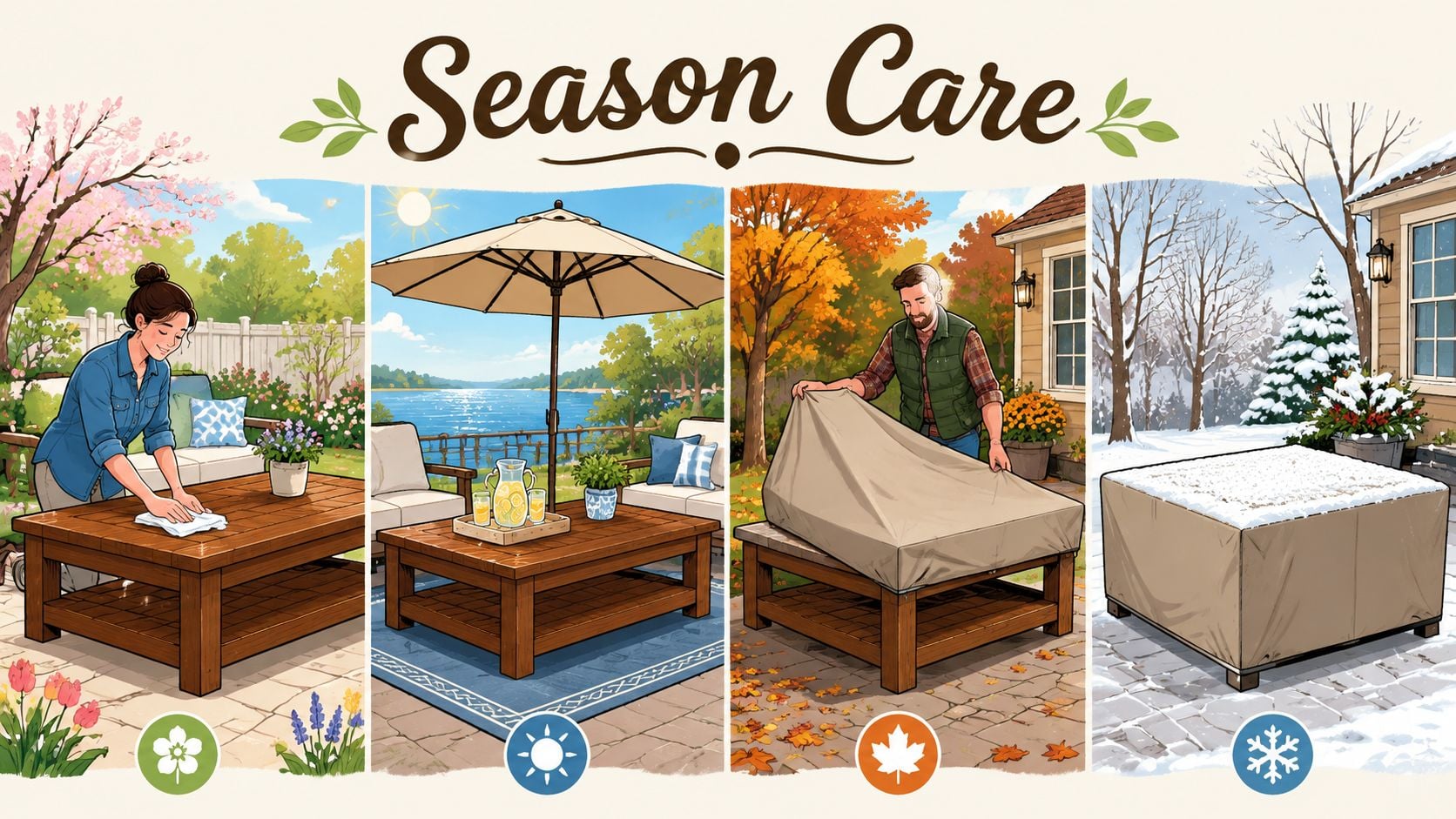
Maintaining Your Investment Through the Seasons
The best outdoor table isn't maintenance-free. It's maintenance-manageable. That's a much more useful standard for a four-season climate.
A practical seasonal rhythm
In spring, the priority is cleanup and inspection. Pollen, grit, and standing moisture from winter can dull a surface before outdoor season even begins. A gentle cleaning and a quick check of feet, fasteners, and finish edges can catch problems early.
In summer, the work is lighter. Keep the top clean enough that airborne grit doesn't act like sandpaper when trays or decor get moved around. Wipe spills promptly, especially food oils or plant water that can sit unnoticed on textured surfaces.
In fall, debris becomes the main issue. Leaves, acorns, and damp organic matter can sit in corners and hold moisture against the finish. This is also the right moment to decide whether the table will be covered in place or moved under shelter before winter starts in earnest.
A ten-minute cleanup in late fall can prevent a much bigger spring restoration.
In winter, consistency matters more than perfection. If the table stays outside, remove heavy accumulation when practical and make sure moisture isn't trapped beneath a poorly fitting cover. If the table moves into storage, keep it in a dry, ventilated spot rather than wrapping it too tightly.
Covering versus storing
Not every large outdoor coffee table is easy to store, especially concrete or oversized mixed-material pieces. In many Southeast Michigan homes, a fitted breathable cover is the realistic option. The cover should stay secure without pressing trapped moisture against the surface for months at a time.
For metal-specific finish concerns, this article on choosing metal protective coatings gives helpful background on why coating quality and upkeep matter so much in wet conditions.
A good seasonal routine usually looks like this:
- For teak or other wood surfaces: Keep them clean and free of trapped debris.
- For metal frames: Watch for chips or scratches that break the protective finish.
- For wicker styles: Clear leaves and dust from crevices before covering.
- For heavier statement tables: Confirm the patio surface drains well so the table doesn't sit in repeated standing moisture.
Households that like a calendar-based approach can use this fall furniture maintenance checklist to organize seasonal care before temperatures drop.
Styling Your Outdoor Living Room
A large outdoor coffee table does more than hold drinks. It tells everyone where the room begins.
Make the table the center of conversation
On a well-arranged patio, the table gives the seating group a shared center. Without it, even attractive outdoor furniture can feel scattered. With it, the layout starts to act like a real outdoor living room.
A common Ann Arbor setup might include a sofa, two lounge chairs, and a coffee table broad enough to serve everyone seated around it. In that arrangement, the table becomes the place for a tray of iced tea in the afternoon, a lantern at dusk, and a blanket basket nearby once the evening cools off. The goal isn't to crowd the surface. It's to make the table useful at a glance.
Leave some open space on the tabletop. A styled surface still needs room for real life.
That open space matters more with a large table because the temptation is to fill it. A crowded outdoor table quickly becomes decorative instead of functional. The better approach is to give the eye a focal point while preserving landing room for plates, mugs, or a serving board.
What belongs on the surface
A balanced arrangement often includes just a few elements:
- A weather-friendly tray to corral smaller items and keep the composition tidy.
- A low lantern or candleholder that adds evening atmosphere without blocking sightlines.
- A small planter or natural accent that softens the table's hard surface.
- A practical item such as coasters or an outdoor-safe bowl for napkins.
For readers who like a more layered look indoors and want to translate that feeling outside, this coffee table decorating guide offers ideas that can be adapted for patio use with weather-conscious materials.
The strongest outdoor rooms usually echo the interior of the home. If the indoors lean structured and quiet, the patio should feel related. If the home uses warm wood tones and tactile textiles, the outdoor table should support that same language. That's how a backyard starts to feel like part of the house instead of an afterthought.
The Tyner Advantage Customization and Confidence
Buying a large outdoor coffee table can feel straightforward until the details start stacking up. The height has to work with the seating. The finish has to make sense for humid summers and winter freeze-thaw cycles in Southeast Michigan. The size has to suit the space without making the seating group feel crowded. That is usually the point where a generic option starts to fall short.
In-stock is only the starting point
Since 1957, shoppers in Southeast Michigan have relied on local guidance for furniture purchases meant to stay in the home for years. Outdoor furniture deserves that same level of care, especially in a four-season climate where materials and finishes are tested much harder than they are in a mild-weather region.

For many households, in-stock choices are a starting point, not the full answer. A large coffee table often needs to match the seating more precisely than shoppers expect. A table that looks right on a showroom floor can feel too tall, too heavy, or too small once it is placed on a real patio with sectionals, lounge chairs, and foot traffic to consider.
At Tyner Furniture, shoppers can explore outdoor categories alongside a broader showroom selection that spans everything from the home office to outdoor spaces. Storewide made-to-order programs also show a wider commitment to personalized furniture choices in other departments. That matters because it reflects a way of selling furniture that starts with fit, use, and long-term satisfaction instead of rushing a buyer toward whatever happens to be on the floor.
A well-chosen outdoor table works like a good foundation. If the proportions and finish are right, the rest of the space comes together more naturally.
Confidence comes from fit and support
Long-term value usually has more to do with years of use than opening price. A better-built table that still looks appropriate after several Michigan seasons often costs less over time than one that needs early replacement because the finish breaks down or the scale never felt right to begin with.
Support during the purchase matters too.
- Special financing can make a higher-quality piece easier to budget for.
- A Low Price Promise can reduce concern about paying more than necessary for better construction.
- A local showroom on South State St. gives buyers the chance to compare height, texture, and finish in person.
- Knowledge across furniture categories helps when the table needs to coordinate with seating, rugs, lighting, and nearby indoor spaces.
That last point is easy to overlook. Outdoor rooms in Ann Arbor and the surrounding area are often used hard from late spring through fall, then viewed through windows all winter. The coffee table has to function outside, but it also has to look right as part of the home as a whole.
For a significant purchase, clear guidance lowers the risk. Product pages can promise durability all day long. It is much easier to judge proportion, construction, and maintenance expectations when a buyer can see the piece up close and talk through how it will perform in Southeast Michigan conditions.
Begin Your Outdoor Transformation Today
A Saturday in Southeast Michigan often starts the same way. Coffee outside, a quick glance across the patio, and one detail keeps standing out. The table is too small to serve the seating, too fragile for another humid summer, or not built for the kind of use the space gets from May through October.
A well-chosen large outdoor coffee table solves more than one problem at once. It gives the seating area a center of gravity, creates a practical landing spot for drinks and trays, and helps the whole patio feel settled instead of pieced together. In a four-season climate, that choice also needs to hold up through sun, rain, pollen, freeze-thaw cycles, and long stretches of winter storage or exposure.
The smartest purchase starts with a clear standard. The table should fit the conversation area comfortably, leave enough room to walk around it, and use materials and finishes that make sense for Southeast Michigan conditions. A table can look convincing on a screen and still disappoint at home if the height is awkward, the surface shows wear too quickly, or the construction feels light after a season or two of real use.
That is why it helps to shop with the long view in mind.
Ask a few practical questions before committing:
- Will the table still feel proportionate once all the seating is in place?
- Will the material handle humid summers and winter moisture without becoming a maintenance burden?
- Will the finish age in a way that still looks good from the patio and from inside the house?
- Will the piece earn its place year after year?
For homeowners in Ann Arbor and across Southeast Michigan, those questions usually lead to better decisions than chasing a trend or choosing by photo alone. A coffee table is used up close, but it is also part of the view for much of the year. It needs to work like furniture, not just decoration.
For anyone ready to compare scale, materials, and finish quality in person, Tyner Furniture offers a practical next step. Visit the Ann Arbor showroom on South State St. for a sit test and to see how outdoor pieces relate to seating in real space, or browse the online Quick Specs for special-order details if a made-to-order direction makes more sense for the home.