Michigan’s Best Outdoor Upholstered Furniture


A lot of Southeast Michigan homeowners reach the same point at the same time. The patio is poured, the deck is stained, the landscaping is finally taking shape, and the old seating suddenly looks like the weak link. What you want outside isn’t a couple of chairs that survive one or two summers. You want a real outdoor room. A place that feels as comfortable as the family room and looks like it belongs with the rest of your home.
That shift is bigger than one neighborhood trend. The global outdoor furniture market was valued at USD 56.00 billion in 2025 and is projected to reach USD 92.08 billion by 2034, reflecting how many homeowners now treat patios, porches, and decks as true living space, according to Fortune Business Insights' outdoor furniture market analysis.
For buyers in Ann Arbor and across Southeast Michigan, that makes one question more important than ever. What lasts here?
Michigan gives furniture a full test. Sun. Humidity. Pollen. Sudden rain. Freeze and thaw. Snow load. If you buy outdoor upholstered furniture the same way you buy a throw pillow, you usually end up replacing it far sooner than expected.
That’s why investment-grade construction matters. Since 1957, local shoppers have come to Tyner looking for furniture that earns its place year after year, from the Home Office to Outdoor Spaces. If you’re deciding what belongs on your patio, this guide starts with the essentials and then goes deeper into the materials, maintenance, and comfort details that separate a smart long-term purchase from a short-lived one. A good starting point is this overview of essential outdoor furniture pieces.
Table of Contents
- Introduction From Patio to Parlor How to Create Your Outdoor Living Room
- Understanding True Outdoor Upholstered Furniture
- The Anatomy of Durability Frames and Construction
- Decoding Performance Fabrics and Cushion Fills
- Designing Your Outdoor Oasis Layout and Styling Tips
- Protecting Your Investment Maintenance for Michigan Seasons
- Your Outdoor Furniture Buying Checklist
- Common Questions About Outdoor Upholstery
- Can I use outdoor upholstered furniture indoors
- Can I use indoor furniture outside if the porch is covered
- Are covers necessary in Michigan
- How should I handle bird droppings or tree sap
- Why are outdoor cushion materials different from indoor ones
- Is in-stock enough, or should I consider special order
Introduction From Patio to Parlor How to Create Your Outdoor Living Room
A strong outdoor room doesn’t begin with decorating. It begins with deciding that your patio deserves the same thought as your indoor living room.
That means thinking beyond a seasonal setup. Good outdoor upholstered furniture should feel settled, grounded, and inviting. It should support a long dinner that turns into conversation, a quiet coffee on a cool morning, or an afternoon spent reading under a covered porch. The right pieces change how you use your home.
There’s a big difference between furniture that merely sits outside and furniture that’s built to live there. Investment-grade pieces combine comfort, weather-aware engineering, and craftsmanship in a way disposable sets never do. You notice it in the sit, in the fabric hand, and in the frame when you move it.
Outdoor comfort should never feel like an afterthought. If a seat looks inviting but leaves you shifting after ten minutes, it isn’t doing its job.
Around Ann Arbor, that matters because outdoor season isn’t one long stretch of predictable weather. It comes in bursts. Warm weekends, rainy evenings, cool nights, and humid afternoons all ask something from the furniture. The goal isn’t only to buy something attractive. The goal is to buy something you’ll still be glad you chose years from now.
Understanding True Outdoor Upholstered Furniture
A family in Southeast Michigan buys a plush sofa in May, leaves it on a covered patio, and by late September the cushions feel heavier, slower to dry, and less supportive than they did on delivery day. That usually is not a fabric problem alone. It is a product selection problem.
True outdoor upholstered furniture is built as a full weather-exposed seating system. The frame, suspension, cushion interior, fabric, seams, and hardware all have to handle rain, humidity, sun, pollen, and sharp swings between spring dampness and fall chill. In our climate, one weak layer tends to show up fast.
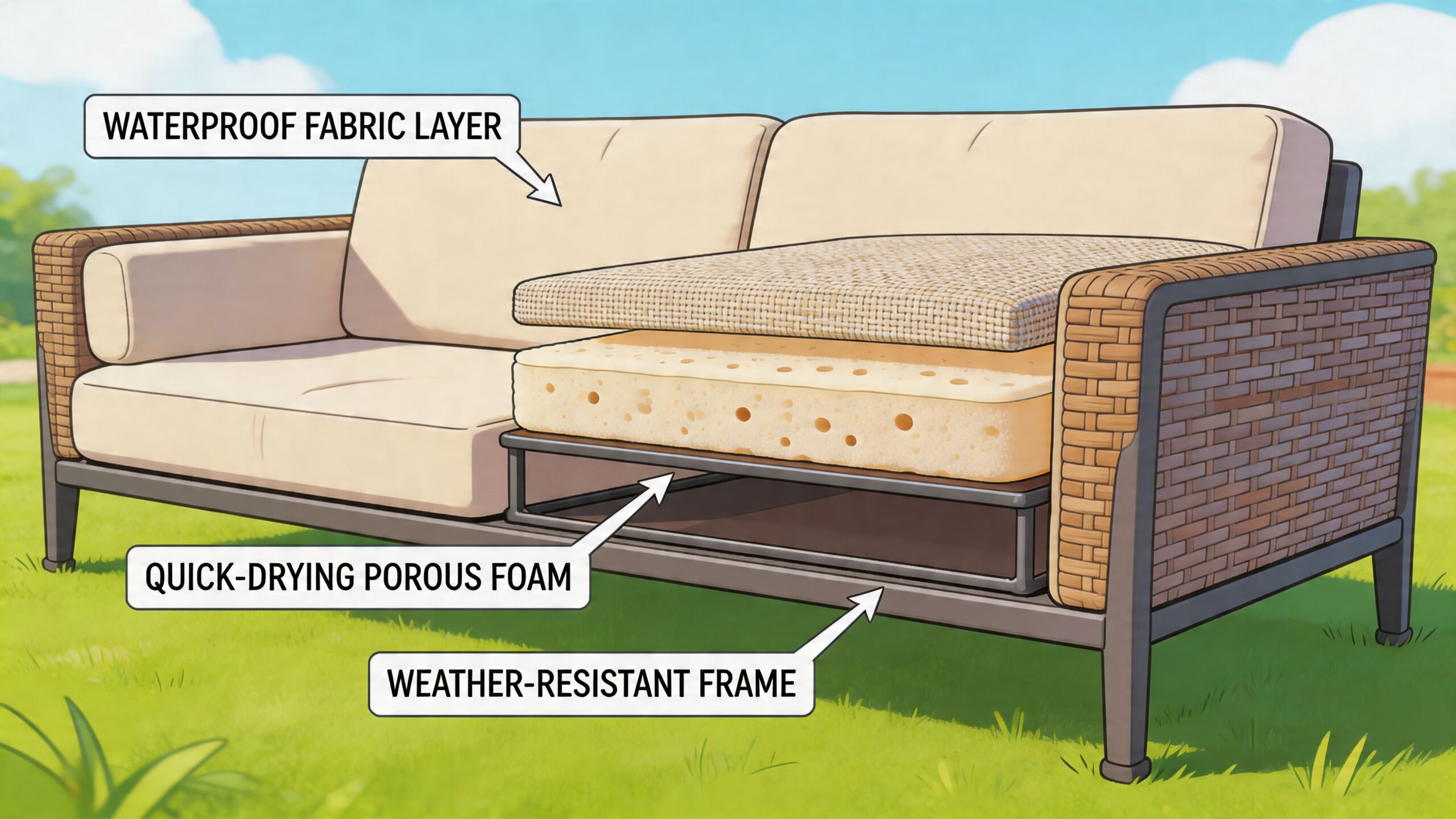
Outdoor upholstery is built around exposure and recovery
The biggest difference is not appearance. It is drying behavior.
Indoor upholstery is designed for stable, climate-controlled rooms. Outdoor upholstery is designed to get wet, dry out, and return to service without holding moisture deep inside the cushion. That single difference affects comfort, odor, mildew resistance, and how long the piece earns its keep year after year.
For buyers who want investment-grade furniture instead of something to replace every few seasons, these are the parts that matter:
- Drainage-minded cushion construction so water passes through instead of staying trapped in the core.
- UV-stable fabrics that keep their color and texture through repeated sun exposure.
- Exterior-rated stitching, zippers, and hardware that hold up outside.
- Supportive cushion designs that keep their shape better after use and weather exposure.
- Frames and suspension built for outdoor conditions so the upholstery package has a solid base.
A well-made piece should feel comfortable on day one, but it also needs to recover well after a summer storm and a humid week. That is the standard that separates heirloom-minded outdoor furniture from fast furniture.
When you look at a piece such as the Reflections outdoor sofa, the visible shape is only part of the value. The hidden materials decide whether the sofa still feels right after several Michigan seasons.
Comfort outside has different rules
Outdoor upholstered seating usually feels a bit more supportive than a deep indoor sofa, and that is often the correct choice. Softer is not always better outside. If the cushion is too dense to drain or too loose to hold its shape, comfort drops quickly after exposure to moisture and regular use.
Good outdoor seating aims for a middle ground. It should feel inviting, but it also needs enough structure to dry faster, resist sagging, and avoid that damp, musty feel that shows up in lower-grade cushions.
Here is the practical difference:
| Element | Indoor upholstery | Outdoor upholstery |
|---|---|---|
| Fabric priority | Hand feel and interior styling | Sun resistance, drying, cleanability |
| Cushion behavior | Holds loft in controlled interiors | Releases water and dries after exposure |
| Construction goal | Plush comfort in stable conditions | Comfort that holds up through weather cycles |
| Best use | Living rooms, bedrooms, offices | Patios, porches, decks, and covered outdoor rooms |
Why this matters more in Southeast Michigan
Outdoor furniture in Southeast Michigan does not face one single condition. It faces a full annual cycle. Early spring moisture, high summer UV, humid stretches, wind-driven rain, falling debris, and cool shoulder-season nights all put stress on upholstery in different ways.
That is why I encourage buyers to judge outdoor upholstery by cost per year, not by the initial sale price alone. A cheaper sofa that needs cushion replacement or fabric disappointment after a short run usually costs more in the long term than a better-built piece that keeps performing. For many households, the smarter purchase is the one that still looks settled and feels supportive several seasons from now.
The Anatomy of Durability Frames and Construction
If upholstery is what you notice first, the frame is what you live with longest.
A beautiful outdoor sofa with weak construction won’t age gracefully. It may wobble, loosen, rack out of square, or show finish failure in the spots buyers never inspect in a showroom. Frame quality is where investment value usually reveals itself.
Powder-coated aluminum, teak, and HDPE each solve a different problem
Powder-coated aluminum is a strong choice for many Michigan patios. It’s lighter to move than heavier metals, resists rust well, and works especially well in clean-lined contemporary settings. On a practical level, it’s helpful if you like rearranging a space for entertaining.
Teak brings a different experience. It has real heft. When you put a hand on a solid teak arm, it feels substantial and calm, not hollow. Many homeowners love the way it weathers and develops character over time, though that look is a design choice. Some prefer to maintain a more uniform appearance.
HDPE lumber, often associated with durable outdoor craftsmanship, appeals to buyers who want solid feel and low fuss. It doesn’t try to feel delicate. It feels planted. In family settings, porches, and high-use patios, that can be a very smart fit.
Construction tells you more than the finish color
Two pieces can look similar online and perform very differently in real life. That’s why I tell shoppers to pay attention to the underside, the joints, and the weight distribution.
A sturdy frame usually shows itself in these ways:
- Clean joinery or well-finished welds instead of rough connection points
- Balanced weight so the piece doesn’t feel top-heavy or flimsy
- Stable legs and level placement on a hard surface
- Thoughtful proportions between seat depth, arm height, and back support
Practical rule: If a piece shifts, rocks, or twists during a sit test on a flat floor, time won’t improve it.
The same mindset behind hand-crafted Amish furniture applies, even though outdoor materials may differ. The standard is still structural integrity. Good furniture starts with how it’s built, not with what the catalog photo hides.
What doesn’t work well
Thin tubular frames can look sharp at first and disappoint later. Lightweight pieces that feel easy to carry in a store sometimes feel less reassuring after a windy season or repeated movement across a patio.
Very ornate frames can create another issue. They may offer visual appeal but trap debris, moisture, and pollen in spots that are hard to clean. In Michigan, easy maintenance is part of durability.
Here’s a quick comparison that helps simplify the frame conversation:
| Frame material | Best fit | Trade-off to consider |
|---|---|---|
| Powder-coated aluminum | Modern patios, flexible layouts | Can feel less substantial than heavier builds |
| Teak | Classic decks, covered porches, design-focused homes | Requires owner comfort with natural aging or added upkeep |
| HDPE lumber | High-use family spaces, low-maintenance setups | Bulkier visual profile in some designs |
Shoppers who already value solid wood dining or bedroom furniture tend to understand this instinctively. The weight of a well-made piece matters. The steadiness matters. Outdoor seating deserves the same scrutiny.
Decoding Performance Fabrics and Cushion Fills
Most buying mistakes in outdoor upholstered furniture happen in the soft goods. The frame may be fine. The styling may be right. Then the fabric fades early or the cushion behaves like a sponge, and the whole purchase feels disappointing.
That’s why fabric and fill should be evaluated together, not separately.
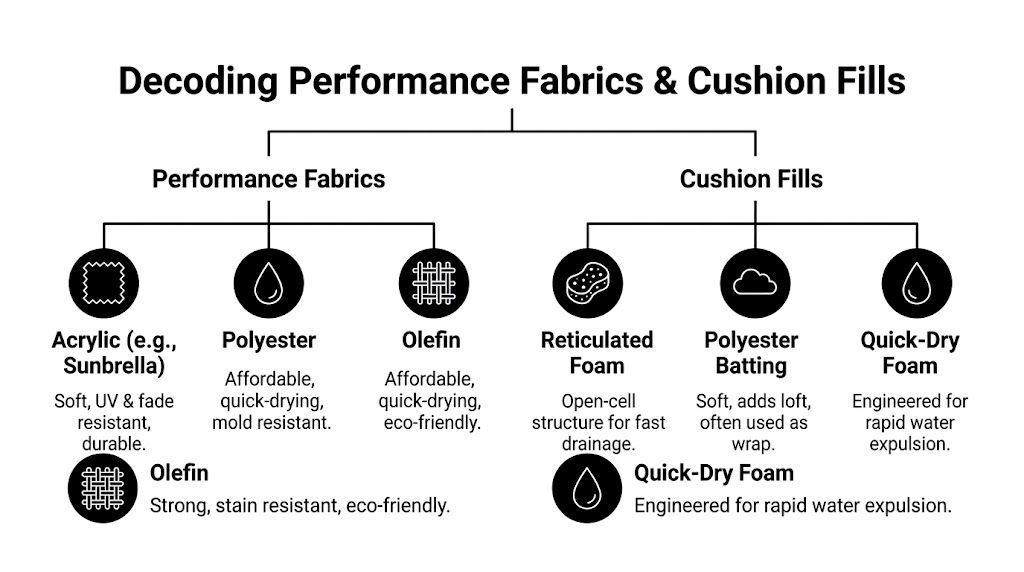
Fabric choice changes the lifespan of the look
Not all “outdoor fabrics” perform equally. Some hold color and texture much better over time, especially where sun exposure is part of daily use.
One benchmark shoppers should know is this: solution-dyed Sunbrella acrylic fabrics retain over 80% of their colorfastness after 1,000 hours of accelerated UV exposure, while standard polyester can fade by 40-60% under the same conditions, according to Sunbrella’s guide to choosing outdoor furniture upholstery fabric.
In plain English, that means the color is built deeper into the fiber rather than sitting closer to the surface. For a Southeast Michigan homeowner, that often translates to a fabric that keeps looking intentional instead of washed out.
For a broader primer on how upholstery materials behave, this overview on upholstery materials is useful before you commit to a custom fabric.
Cushion fills should drain, not trap
The quickest way to understand cushion cores is this:
- A bad outdoor cushion acts like a sponge.
- A good outdoor cushion acts more like a sieve.
Closed, dense fills can hold moisture longer than buyers expect. That doesn’t just affect comfort. It affects odor, mildew risk, and dry-out time after rain or morning dew.
Better outdoor seating usually relies on materials designed for airflow and drainage. You may hear terms like quick-dry foam, porous foam, or reticulated foam. The exact naming can vary by manufacturer, but the principle stays the same. Water needs a path out.
Side-by-side fabric and fill thinking
Buyers often compare fabric brands but forget to compare what’s underneath. The strongest results come from pairing the right surface with the right core.
| Component | Better long-term choice | Why it matters |
|---|---|---|
| Visible fabric | Solution-dyed acrylic | Better color retention and weather tolerance |
| Budget fabric | Polyester | Can be serviceable, but often shows wear sooner |
| Seat core | Quick-dry or reticulated style foam | Helps water move through and out |
| Cushion wrap | Outdoor-rated wrap materials | Adds comfort without trapping excess moisture |
A beautiful outdoor cushion that dries slowly is like a handsome roof with a leak. The problem isn’t obvious until you’ve lived with it.
What to ask before you buy
Ask direct questions. Don’t settle for “weatherproof” as a complete answer.
Use questions like these:
- What is the actual fabric content? “Performance” is a category, not a material.
- How does the seat cushion drain? If the answer is vague, keep asking.
- Are the cushion covers removable? That affects maintenance.
- How does the piece handle repeated exposure versus occasional exposure? Covered porch use and open patio use aren’t the same.
- Will this fabric still look balanced next to masonry, decking, and landscaping after a few seasons? Some colors age more gracefully than others.
The best-performing outdoor upholstered furniture doesn’t just feel good on delivery day. It recovers well after weather, cleans up without drama, and still looks settled in the space after regular use.
Designing Your Outdoor Oasis Layout and Styling Tips
A Southeast Michigan patio has to work in more than one season. It should feel open on a mild June evening, still make sense during a windy fall gathering, and hold up visually after months of rain, pollen, and temperature swings. Good layout decisions help with all of that.
Most local spaces fall into three common setups. A deck usually needs clearer organization. A paver or stone patio often needs softness and visual weight. A covered porch gives you more freedom to create a true outdoor room.
For decks, create purpose before you choose pieces
Decks often get crowded because homeowners shop by set instead of by use. A better approach is to decide what needs to happen in the space first. Morning coffee. Family meals. Two people reading in the evening. A small group around a fire table.
Once those uses are clear, divide the deck into zones with enough walking room between them. That usually means keeping lounge seating on one side, dining on another, and leaving a clean path to the door, grill, or steps. Even a modest deck feels calmer when the circulation is obvious.
Awkward corners, railing posts, and narrow widths can make standard sets look undersized or forced. In those cases, made-to-order sectionals or apartment-scale chairs are often more practical than buying a packaged group and hoping it fits. Homeowners who want layout ideas before they buy can get useful direction from this guide to designing a captivating patio.
For patios, start with the seating circle
Stone and paver patios already bring hardness and structure. Upholstered seating balances that, but the arrangement matters as much as the materials.
Start with the main conversational piece, usually a sofa or a sectional sized to the patio, then place one or two chairs across from it. Add a coffee table or fire table that people can reach from the seats. If the table is too large, the group feels spread out. If it is too small, the area feels temporary.
A simple layout usually includes:
- One primary anchor, such as a sofa or sectional
- Opposing chairs that complete the conversation area
- A central table with enough surface for real use
- Planters, rugs, or lanterns that visually connect the furniture to the patio
Color deserves more discipline than trend articles usually give it. In our market, earthy neutrals, charcoal, muted greens, and soft blues tend to age well against brick, concrete, natural stone, and changing foliage. They also hide everyday dust and pollen better than bright white or very saturated fashion colors.
For porches, design for how people actually spend time
A covered porch can support more comfort, but it still needs restraint. Deep seating feels inviting until the scale blocks entry doors or makes the space hard to move through. I usually recommend measuring for sitting room and walking room separately, because both matter if the porch is used every day.
Porches also reward more personal choices. Higher backs help with reading and longer visits. Smaller-scale swivel chairs work well when homeowners want flexibility without crowding the footprint. A pair of supportive lounge chairs can outperform a large sectional if the goal is quiet use instead of entertaining eight people at once.
Comfort has become a larger part of outdoor buying because people use these spaces longer and for more purposes than they used to. They work outside, eat outside, host outside, and stay out later into the season. That makes supportive seat depth, arm height, and cushion firmness worth evaluating in person, especially on investment-grade pieces meant to last for many Michigan summers.
A good porch layout supports real habits. Coffee in the morning, conversation after dinner, and enough comfort that the furniture gets used instead of admired from the doorway.
Custom-order capability also matters here. In-stock furniture can solve simple layouts, but it does not always solve scale, support, or finish coordination. Buyers who want furniture designed for their space often benefit from comparing dimensions carefully, selecting fabrics with the whole exterior in mind, and choosing seating that fits the way their household lives.
Protecting Your Investment Maintenance for Michigan Seasons
A Southeast Michigan patio can look calm in June and punish furniture by January. Spring pollen works into fabric, summer sun dries surfaces unevenly, fall leaves hold moisture against cushions, and freeze-thaw cycles test every seam, zipper, and cover. Outdoor upholstered furniture lasts longer here when care follows the seasons, not the marketing tag.
That matters more with investment-grade pieces. The goal is not to get one or two decent summers out of a set. The goal is to lower cost per year and keep the furniture comfortable, attractive, and structurally sound for the long haul.
Why routine care matters more than labels
“Weatherproof” is a selling word. It is not a maintenance plan.
Even well-made outdoor upholstery has limits. Performance fabrics resist fading and moisture better than standard indoor textiles, but dirt, sap, bird droppings, and trapped dampness still shorten the life of the fabric and cushion fill. In our climate, neglect usually shows up first as mildew spotting, stiff or musty cushions, uneven fading, or covers that trap condensation instead of preventing it.
For practical warm-weather habits, this local guide on staying cool in style with outdoor furniture tips pairs well with the seasonal routine below.
A simple seasonal rhythm
Spring
Open everything up early. Remove covers, vacuum or brush off pollen, and inspect seams, welting, and zipper areas before regular use starts. Check the underside of cushions and the deck beneath them. Moisture often lingers where people do not look.
Summer
Clean small messes quickly. Tree residue, sunscreen, spilled drinks, and bird droppings are much easier to remove the same day than a week later. If one side of the seating group takes hard afternoon sun, rotate cushions so the wear stays even.
Fall
Leaves are hard on upholstered furniture because they stay wet and stain if they sit too long. Clear them off regularly, then give cushions a proper cleaning before colder weather sets in. This is also the time to decide what gets stored and what remains outside under cover.
Winter
Winter is where expensive mistakes show up. Removable cushions should usually go into a dry, ventilated space, not a damp garage corner wrapped in plastic. Frames can stay outside if they were built for it, but covers need a close fit and enough airflow to avoid holding condensation against the furniture.
Cover or store
The right answer depends on exposure, not just price.
| Situation | Better choice |
|---|---|
| Removable cushions and exposed patio | Store cushions, cover frames if needed |
| Covered porch with limited exposure | Quality covers may be enough for some setups |
| Heavy snow area or wind exposure | Storage is usually the safer long-term option |
Loose covers cause problems. They flap in the wind, rub finish off contact points, collect water in low spots, and hold damp air where it should escape. A good cover fits cleanly, sheds water, and breathes.
Covers protect clean, dry furniture. They do not fix dirt, moisture, or mildew that was sealed in back in October.
The maintenance mindset that saves money
The owners who get heirloom-level life from outdoor upholstery usually follow a plain routine. Brush debris off. Clean spills early. Let cushions dry fully before covering. Store removable components before deep winter arrives.
None of that is glamorous, but it protects the qualities that made the piece worth buying in the first place. Support stays consistent. Fabric keeps a better hand and color. Frames avoid extra stress from trapped moisture and repeated winter abuse. In Southeast Michigan, that steady care is what separates fast furniture from outdoor furniture that still earns its place years from now.
Your Outdoor Furniture Buying Checklist
Buying outdoor upholstered furniture gets easier when you stop looking at it as one decision. It’s a series of smaller decisions that build toward a piece you’ll enjoy for years.
Use this checklist before you buy.
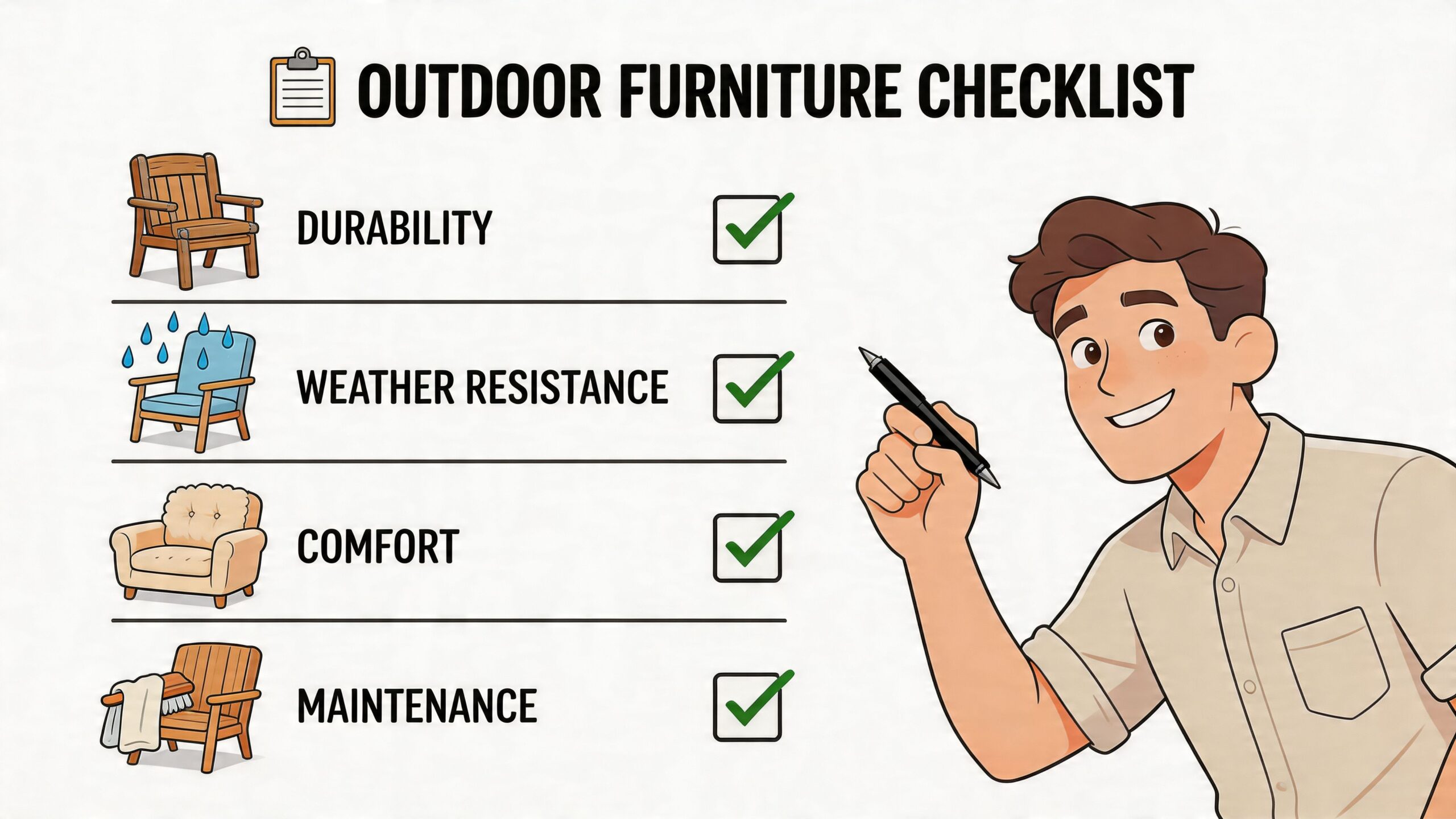
Start with the space, not the catalog
- Measure the footprint: Include room for traffic, not just furniture placement.
- Notice exposure: Full sun, tree cover, open wind, and covered porch conditions lead to different material priorities.
- Think seasonally: Ask how the space works on a bright July afternoon and also on a cool September evening.
Then inspect the build
Check frame stability
Sit down, shift your weight, and notice whether the piece feels planted.Look under the cushions
Ask how water exits the seat. If no one can answer clearly, that’s useful information.Review the fabric tag
The actual fiber content matters more than a vague performance label.
Comfort should be tested, not assumed
A proper sit test tells you more than a product photo ever will.
Pay attention to:
- Seat depth: Deep enough to relax, but not so deep that shorter users lose support
- Back angle: Supportive for conversation, not just lounging
- Arm height: Comfortable for resting without shoulder strain
- Cushion recovery: Notice how the seat responds when you stand up
Customization changes the value equation
Many investment purchases prove sensible. A made-to-order piece can fit your deck line, porch depth, or entertaining style better than a standard set.
Useful customization questions include:
| Decision point | Why it matters |
|---|---|
| Fabric selection | Affects wear, cleaning, and how the piece ages visually |
| Configuration | Helps awkward corners and family seating patterns |
| Finish choice | Connects the patio to the home’s broader design language |
| Comfort profile | Lets you prioritize upright support or deeper lounging |
For shoppers who want to compare options in person, Tyner Furniture offers outdoor sofas and sectionals along with special-order guidance, and its broader made-to-order approach also includes Canadel and Stressless programs indoors. That matters if you’re coordinating outdoor seating with the rest of a whole-home design plan.
Finally, make the investment workable
- Set a cost-per-year mindset: The right question isn’t “What does it cost today?” It’s “How long will I still like and use it?”
- Ask about special financing: That can make a better long-term purchase easier to plan for.
- Use a Low Price Promise wisely: Value includes construction, support, delivery, and fit for the space.
A serious outdoor purchase should feel calm, not rushed. If you’re weighing options around Ann Arbor, bring measurements, photos, and a few notes on how you use the space. That makes the decision much clearer.
Common Questions About Outdoor Upholstery
Can I use outdoor upholstered furniture indoors
Yes. It works especially well in sunrooms, three-season rooms, and high-light spaces where indoor fabrics tend to fade or show wear faster.
The trade-off is comfort and tailoring. Outdoor seating often has a firmer sit, quicker-drying cushion construction, and a more structured look than a living room sofa built only for climate-controlled use.
Can I use indoor furniture outside if the porch is covered
I would not count on it lasting. A covered porch in Southeast Michigan still sees damp spring air, summer humidity, wind-driven rain, pollen, and big temperature swings between seasons.
Indoor frames, cushion cores, and fabrics usually are not built for that cycle. The piece may look fine at first, then soften, stain, mildew, or break down long before an outdoor-grade piece would.
Are covers necessary in Michigan
For most households, yes.
A good cover helps with spring pollen, summer storms, falling leaves, and winter grime. It is not a substitute for maintenance. Covers work best when the furniture is clean and dry before you put them on, and when you still check the pieces during the season instead of leaving everything sealed up for months.
How should I handle bird droppings or tree sap
Deal with it the same day if you can. Lift off solids carefully, blot the area, and follow the fabric maker’s cleaning instructions.
Avoid hard scrubbing. That can rough up the fabric surface or drive the stain deeper into the cushion.
Why are outdoor cushion materials different from indoor ones
Outdoor cushions are built to shed water, dry out, and tolerate sun exposure. Indoor cushions are usually built first for plushness and appearance in a stable environment.
That difference affects what is inside the cushion as much as the fabric on top. As noted earlier, outdoor upholstered furniture follows different material priorities than indoor upholstery, which is one reason true outdoor cushions can drain, dry, and recover in ways indoor cushions usually cannot.
Is in-stock enough, or should I consider special order
In-stock is a good answer if the scale fits your space, the cushion comfort feels right, and the fabric suits how you live. For many patios, that is enough.
Special order earns its keep when you are trying to buy once and keep the piece for years. In Southeast Michigan, that often means choosing a fabric that hides pollen and wet-weather spotting, adjusting depth for a narrower porch, or selecting a frame finish that still looks right as the rest of the house changes around it. That is where cost per year starts to matter more than the opening price tag.
If you’re ready to compare outdoor upholstered furniture in person, visit Tyner Furniture in Ann Arbor for a real sit test and practical guidance. Since 1957, the showroom on South State St. has helped Southeast Michigan shoppers weigh comfort, craftsmanship, customization, and long-term value across the home, from Outdoor Spaces to dining, bedroom, and home office. If you’re still narrowing options, browse the online Quick Specs for special orders, then come in with measurements and questions. That’s usually when the right piece becomes obvious.