
Sectional Leather Sofas with Chaise: A Smart Buyer’s Guide


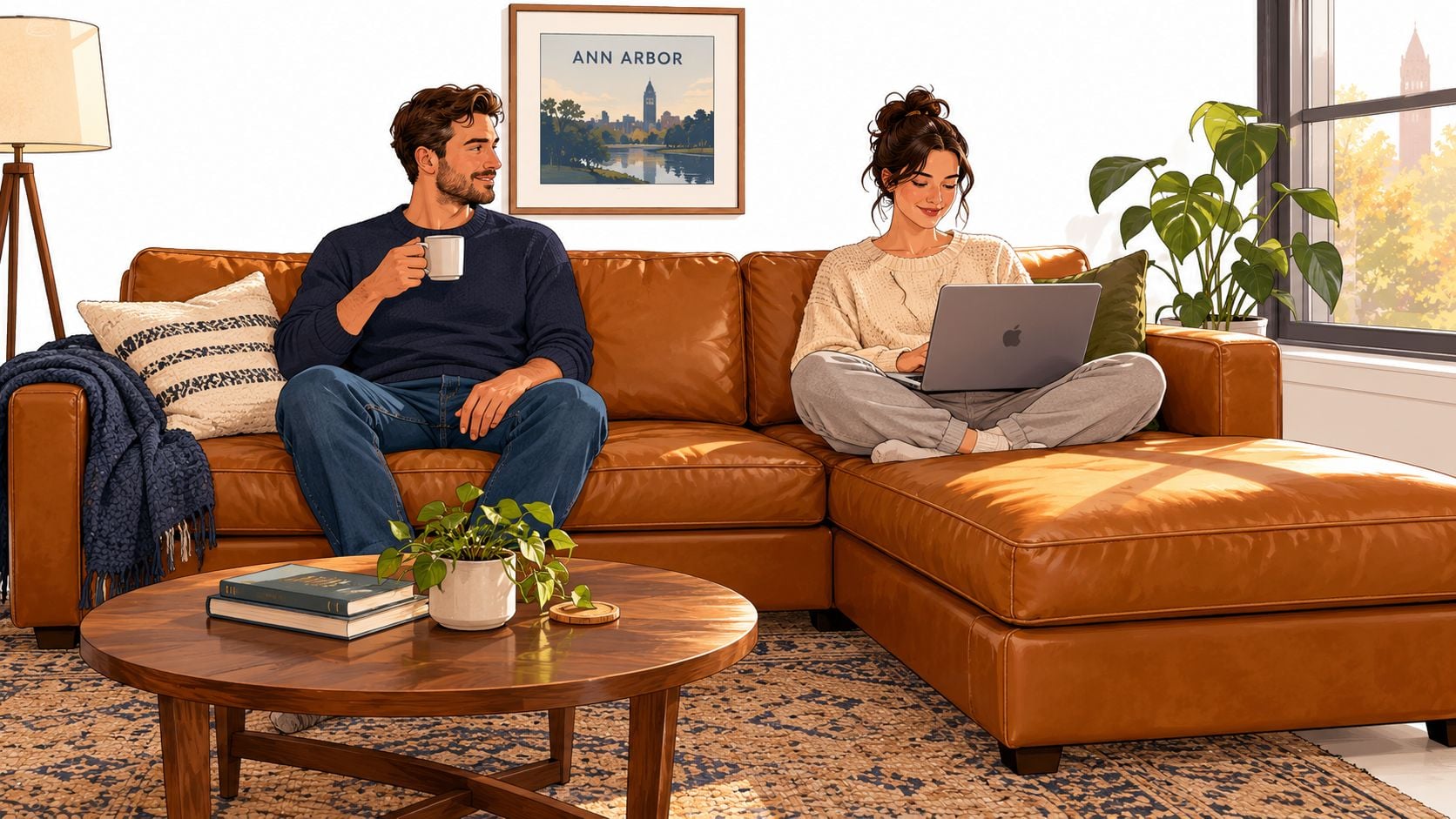
A living room in Ann Arbor often has to do several jobs at once. One person wants to stretch out with a laptop, another wants upright support for conversation, and the family still needs a clear path between the entry, kitchen, and television. Sectional leather sofas with chaise can solve that conflict, but only when the buyer treats the chaise as part of the room's architecture, not as an attractive extra.
The right purchase is an ownership decision. Leather grade, frame construction, cushion serviceability, orientation, delivery access, and future repair all matter more than a showroom photograph. A well-chosen sectional can become an heirloom piece with a beautiful patina. A poorly sized one can dominate the room and frustrate the household every day.
Why a Chaise Sectional Is a Different Kind of Sofa
A conventional sofa asks everyone to sit in roughly the same way. A sectional with chaise divides the experience. Someone can sit upright near the arm, while another person reclines across the extended lounge surface. That makes the piece a hybrid sitting-and-lounging system, not just a longer sofa.
The construction usually combines several upholstered units, such as a sofa, corner, armless chair, and chaise. The chaise extends the seating surface for reclining, while the sectional's modular geometry can define an open-plan living area without building a permanent wall. That functional shift explains why a chaise sectional deserves a more careful evaluation than a standard sofa.
Sofas represented 34.70% of United States upholstered-furniture revenue in 2025, and leather was projected to grow at a 5.78% compound annual growth rate through 2031, reflecting the commercial scale of the category, according to United States upholstered-furniture market data. Those figures don't isolate leather sectionals with chaise, but they show why buyers face a broad range of construction, upholstery, and configuration choices.
The chaise changes the measurement
Wall length is only the beginning. The chaise projection often reaches farther into the room than shoppers expect, and the corner wedge can create an additional maneuvering problem. A sectional that fits one wall may still block the main route to a hallway, cover an HVAC vent, or interfere with a door swing.
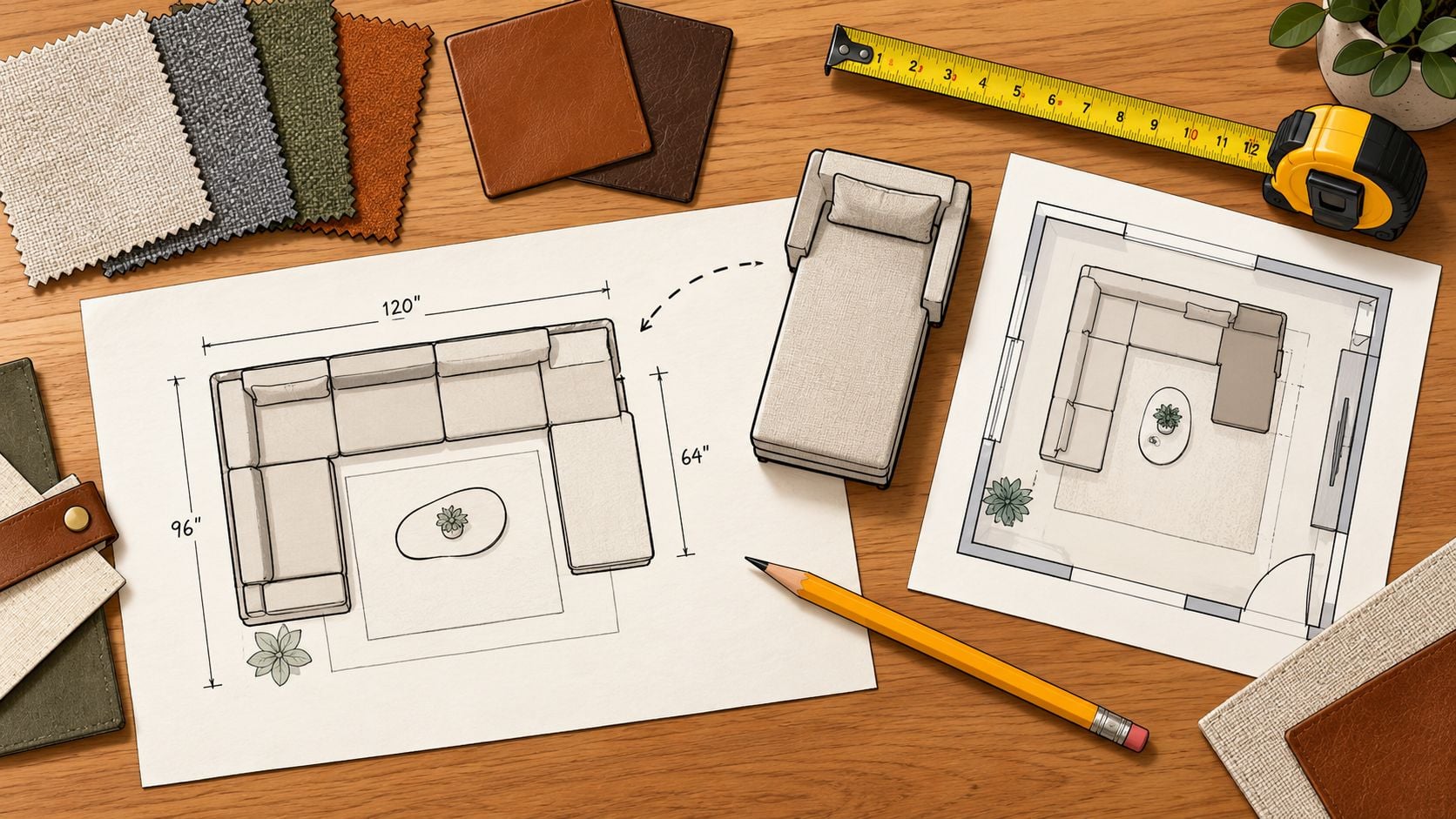
A useful worksheet starts with a simple room sketch. Mark the following before looking at configurations:
- Openings: Record doors, window swings, hallways, stair turns, and elevator routes.
- Fixed features: Mark HVAC vents, radiators, outlets, and the television or fireplace axis.
- Furniture footprint: Measure the sofa side, corner section, chaise projection, and overall depth.
- Movement: Preserve approximately 30 to 36 inches for primary circulation and about 14 to 18 inches between the seat edge and coffee table, based on sectional sofa sizing guidance.
- Delivery geometry: Compare the narrowest opening with the maximum height or diagonal depth of each sectional piece.
Tape the complete footprint on the floor. Walk the route while opening doors, checking sightlines, and confirming that vents remain accessible. For a busy household, the upper end of the circulation range is the better target. Each modular piece should be measured separately because the assembled dimensions may not show the largest angle required during delivery.
Practical rule: A chaise that technically fits can still fail if it leaves no comfortable route around it.
The buyer should bring the room sketch, doorway measurements, preferred chaise side, coffee-table dimensions, and a note about the intended sitting posture to the showroom. That information makes a sit test more useful and keeps an attractive layout from becoming a daily obstacle in a Southeast Michigan home.
Choosing the Right Leather for How You Actually Live
Leather isn't one material with one predictable aging pattern. Full-grain, top-grain, corrected-grain, protected, aniline, and bonded materials can feel and behave very differently under children, pets, sunlight, body oils, and Michigan's dry seasonal air.
Full-grain leather retains the most natural surface character. It can develop a rich patina, including variations in color and visible marks, but it demands realistic expectations about scratches and exposure. Top-grain leather has been refined for a more consistent appearance and often offers a practical balance between natural feel and household usability. Corrected-grain leather receives more surface treatment to create uniformity, which can help with visual consistency but may reduce the natural texture.
Protected leather typically has a durable surface finish that makes routine spills easier to manage. Aniline leather has a more open, natural appearance and a softer hand, but stains, sunlight, and body oils can show more readily. Bonded material is made from leather fibers combined with other materials, and its surface should not be confused with the aging behavior of a high-quality hide. Peeling is a finish failure. Patina is the gradual character that develops in a genuine hide. Those outcomes aren't interchangeable.

Match the finish to the household
A recent consumer survey reported that leather was the most desired upholstery material at 41%, while durability was the leading reason consumers selected performance materials at 65%, and pets were cited by 49% of respondents, according to consumer research on durable furniture design.
Those figures reflect a practical showroom reality. Households with pets and young children usually benefit from a protected finish, while a quieter room may justify the tactile depth of an aniline or full-grain hide. Direct sunlight can accelerate color change, and heat from a radiator or fireplace can dry the surface. Seasonal dryness in Michigan makes a written conditioning routine more useful than a vague promise that leather is naturally durable.
A leather sample should be evaluated with the hand, not just the eye. The buttery feel of top-grain leather may be appealing, but the salesperson should also provide the finish type, grain classification, colorfastness information, tear strength, care restrictions, and abrasion method. Wyzenbeek double rubs and Martindale cycles use different protocols, so their results aren't directly interchangeable.
Abrasion is only a screening input. It doesn't measure seam strength, cushion recovery, frame integrity, moisture resistance, or long-term color stability. A buyer comparing leather options for a frequently used chaise should ask whether high-contact zones are protected, whether cushions are serviceable, and which cleaners are permitted. Tyner's guidance on leather upholstery for sofas can help shoppers prepare those questions before a showroom visit.
Left, Right, Reversible, or Modular
Chaise orientation should follow the room's traffic pattern, not the position that looks most attractive in an online photograph. Stand at the sofa facing the room, then identify whether the chaise extends to the left or right from that viewpoint. Next, consider the focal point, the primary walkway, adjacent chairs, and whether the chaise will block access to a side table.
| Configuration | Typical Footprint | Flexibility | Best Fit |
|---|---|---|---|
| Left-facing | Sofa run plus chaise projection on the left | Fixed unless components can be detached | Rooms where traffic moves naturally along the right side |
| Right-facing | Sofa run plus chaise projection on the right | Fixed unless components can be detached | Rooms where the left side needs to remain open |
| Reversible | Similar overall footprint, with a chaise that changes sides | Useful for changing layouts | Renters, multipurpose rooms, and uncertain future plans |
| Modular | Varies by selected units and corner pieces | Highest, if sections can be rearranged or replaced | Open-plan rooms and long-term ownership |
Let the room decide
A left-facing chaise may work when the entry path runs along the opposite side of the sofa and the room's focal point sits ahead. A right-facing version may be better when a window, hearth, or television axis makes the other side more natural. Neither orientation is universally correct.
Corner suites can define a large room effectively, but they occupy more visual and physical territory. Rafter-style arrangements and modular units may provide more freedom, though the buyer should confirm how pieces connect and whether the hardware can be serviced later. A detachable chaise can be valuable when a household expects to move or repurpose the room.
The safest choice is often a reversible or modular layout, especially for a renter or a homeowner in an older Southeast Michigan property with an irregular room. Flexibility matters only if it is real. The retailer should explain whether the same cushions, connectors, and upholstery panels work in both orientations, or whether changing sides requires new components.
A buyer should ask for a scaled footprint of the exact configuration, not a generic collection diagram. The sectionals buying guide can help clarify the difference between a fixed chaise and an adaptable system.
Use the room's social pattern
A chaise is excellent for reclining, but it can make conversation harder if it creates a long barrier between seating positions. In a room that hosts guests often, a sofa with chaise may work better when paired with a movable chair or an ottoman. The goal is to preserve both relaxation and face-to-face seating.
A sectional should also leave space for drinks, lamps, and walking routes. If the chaise prevents anyone from reaching the coffee table comfortably, the design has solved lounging while creating a daily nuisance. The best orientation supports the way the household enters, sits, talks, watches, and moves through the room.
What Is Actually Inside the Frame
The leather covering tells only part of the story. A sectional's five-year comfort depends on the frame, joints, suspension, cushion core, platform, and connectors hidden beneath the upholstery. A soft surface can disguise weak support at first, but the chaise exposes construction problems because it carries concentrated lounging and shifting loads.
Ask for written specifications rather than accepting a general statement about craftsmanship. The frame may use solid wood, plywood, MDF, particleboard, or a combination. None of those labels alone answers every quality question, but the retailer should explain where each material appears and why.
The EPA's furniture guidance on formaldehyde standards states that regulated composite wood products used in furniture fall under Title VI of the Toxic Substances Control Act. The emission limits include 0.05 parts per million for hardwood plywood, 0.11 ppm for MDF, 0.13 ppm for thin MDF, and 0.09 ppm for particleboard, with the requirements taking effect beginning June 1, 2018.
Questions worth keeping on file
- Frame: What material forms the rails, arms, corner, and chaise platform?
- Joinery: Are the stress points reinforced, glued, screwed, stapled, or combined?
- Suspension: Does the seat use sinuous springs, webbing, or another support system?
- Cushions: What is the core, and can the cover or insert be replaced?
- Connectors: Can individual sections be separated without damaging the frame?
- Service: Can one worn chaise section, cushion, or hardware component be ordered later?
The phrase solid wood should also be used carefully. It describes a material, not automatically a complete construction standard. For homeowners comparing sectional quality with heirloom furnishings, high-end sectional sofas should be evaluated through documented materials, joinery, support, and repair options rather than exterior feel alone.
Why Customization Is the Real Value Play
An in-stock sectional is a useful starting point, not a final answer. The chaise side, depth, leather finish, cushion feel, leg style, and total footprint all affect whether the piece will remain useful after the household changes. Choosing a compromise configuration only because it is available can make the cost-per-year less attractive than a made-to-order piece that fits correctly from the start.
Customization has practical value. A shorter chaise may preserve a walkway, an armless chaise may reduce visual bulk, and a reversible arrangement may protect the layout through a future move. Upholstery selection can also change the ownership experience, from the natural variation of full-grain hide to the more protected surface preferred by a busy family.
Made-to-order decisions that matter
A custom order should focus on choices that affect daily use:
- Configuration: Select left-facing, right-facing, reversible, or modular construction based on the measured room.
- Upholstery: Compare protected, top-grain, full-grain, aniline, and other available finishes against the household's maintenance tolerance.
- Comfort: Test seat depth, cushion firmness, back height, and chaise support rather than choosing by appearance.
- Finish details: Review legs, stitching, exposed wood, and other features that determine how the piece relates to the interior design.
- Serviceability: Confirm whether cushions, connectors, covers, or individual sections can be replaced.
Tyner Furniture's made-to-order programs include upholstery, finishes, and configurations, with options associated with Canadel and Stressless. Canadel demonstrates how bespoke choices can extend across finishes and furniture details, while Stressless shows the value of ergonomic sizing and support when comfort needs to be more precise. The same principle applies to a leather chaise sectional. The shape should serve the room and the people using it.
Buyers who want to understand the broader role of precise construction can review custom furniture services as a useful reference for thinking about fit, materials, and design coordination. Customization doesn't mean every feature must be elaborate. It means the important decisions aren't surrendered to whatever configuration happens to be in stock.
The cost-per-year argument is straightforward. A sectional that fits the room, supports the preferred posture, and ages well is more likely to remain in active use. A compromise piece may look attractive on delivery day but become difficult to live with when the chaise blocks traffic or the leather finish clashes with household use. The custom-order guide can help shoppers organize those decisions before placing an order.
Care and Maintenance That Actually Works
Leather care should be simple enough to follow and specific enough to protect the finish. Dust the sectional regularly with a soft cloth or upholstery attachment, then use only a cleaner approved for the exact leather type. A product suitable for protected leather may damage aniline leather, so the care label and manufacturer's written instructions take priority.
Conditioning should follow the leather maker's guidance, with particular attention to dry winter air and rooms exposed to heat. Sunlight can change color over time, while radiators, fireplaces, and strong vents can stress the surface. Positioning the sectional away from direct heat is a more reliable protection than trying to restore damage later.
A household routine that holds up
- For spills: Blot promptly with a clean, absorbent cloth. Avoid aggressive rubbing and household solvents.
- For body oils: Pay attention to arms, headrests, and the chaise edge, where repeated contact can change the finish.
- For pets: Keep claws trimmed and avoid assuming that a high abrasion rating protects against punctures.
- For children: Use the approved cleaner, not a multipurpose spray, and deal with marks before they migrate into seams.
- For sunlight: Use window treatments or adjust the layout when direct exposure is persistent.
- For winter dryness: Follow the specified conditioning schedule instead of applying product whenever the surface merely feels different.
Technical guidance characterizes roughly 15,000 Martindale cycles as light residential use, 25,000 to 40,000 as a stronger residential range, and 50,000 to 80,000 as commercial-grade territory, according to upholstered furniture durability guidance. Those figures are screening benchmarks, not guarantees. They don't replace information about seams, cushion recovery, moisture, heat, or cleaning restrictions.
A modular sectional earns long-term value when one worn part can be addressed without replacing the entire piece. Ask whether the cushions, connectors, hardware, covers, and individual chaise sections remain available for service. The leather furniture protection guide provides a practical starting point for building a care routine that protects both appearance and repairability.
Putting It Together and Taking the Next Step
A leather sectional with chaise should pass three tests before purchase. First, the complete footprint must preserve circulation, table access, door operation, vent access, and a workable delivery route. Second, the leather and cushion construction must match the household's pets, children, sunlight, posture, and maintenance habits. Third, the configuration should offer enough repairability or flexibility to remain useful when the room changes.
That is the difference between a style purchase and an heirloom ownership decision. The buttery feel of a leather sample matters, but so do the frame specifications, suspension, chaise platform, finish, and future service options. Cost-per-year thinking rewards craftsmanship, sensible customization, and a layout that gets used comfortably every day.
Tyner Furniture has served the Southeast Michigan community since 1957. The Ann Arbor operation covers more than living rooms, with selections spanning the Home Office, bedroom, dining spaces, entertainment areas, and Outdoor Spaces, alongside made-to-order upholstery, Canadel furniture, Stressless ergonomic seating, and hand-crafted Amish solid wood pieces. For bedroom and dining furniture, that Amish construction provides a useful contrast with mass-produced alternatives through material integrity and joinery, including the weight of solid cherry wood and the precision of dovetailing or mortise-and-tenon work.
A shopper can visit the South State St. showroom with three items: accurate room and delivery measurements, a short list of household realities, and an open mind about custom sizing and orientation. Special Financing, subject to approval, and a Low Price Promise can make a long-term purchase easier to plan without treating build quality as an afterthought.
Tyner Furniture offers sectional leather sofas with chaise, made-to-order upholstery and configurations, and in-person guidance for a proper sit test in Ann Arbor. Visit Tyner Furniture on South State Street to compare leather, comfort, and chaise layouts, or browse online Quick Specs when preparing a special order.