Oak Wood Dining Tables: A Buyer’s Guide

A family in Ann Arbor can outgrow a dining table without noticing it. One child is finishing homework at the corner, a grandparent is balancing a plate near the edge, and someone is moving a serving bowl just to make room. On Saturday, that household may visit a showroom looking for more surface area, but the decision is larger: whether the next table will be replaced after a few years or become the solid, welcoming center of the home.
Oak wood dining tables earn their reputation because they combine durability, visible character, and design flexibility. The right piece can feel substantial beneath the hand, hold up to ordinary household wear, and suit both a traditional dining room and a newer Southeast Michigan interior. Buyers still need to examine construction, species, finish, sizing, and seasonal movement carefully. A handsome top doesn't compensate for weak joinery or an unsuitable configuration.
Why Oak Has Become the Go-To Hardwood for Dining Tables
Oak works particularly well in a dining room because it tolerates repeated contact with dishes, elbows, chair backs, and cleaning. White oak is commonly benchmarked at about 1,360 lbf on the Janka hardness scale, with density around 0.70–0.75 g/cm³, while European oak is reported at roughly 690–750 kg/m³ with Brinell hardness around 3.7–4.0 kN/mm². Those figures explain the practical experience: a properly built oak surface generally resists dents and abrasion better than softer furniture woods. The relationship between density, hardness, and wear resistance is summarized in this oak furniture species comparison.
A pine table can bring warmth and a rustic mood, but a household with children, pets, and heavy daily use will notice its softer surface sooner. Oak feels denser under the fingertips, carries weight confidently, and gives a table the visual authority expected from an heirloom piece. Its pronounced grain also accepts a broad range of stains, from a pale natural tone to a deeper brown, although the final color depends on the species and finish system.
Why Ann Arbor households choose oak
Southeast Michigan homes experience changing indoor conditions across the seasons. Winter heating dries the air, while warmer months can raise indoor humidity, and solid oak responds to those changes because wood is hygroscopic. Oak furniture remains a sensible choice, but the table must be constructed to accommodate movement rather than treated as an inert slab.
The market's continued commercial importance reflects this long-service appeal. One estimate places the global oak furniture market at about USD 100 billion in 2023, with a projected rise to USD 162 billion by 2032 and a projected 5.8% compound annual growth rate from 2024 to 2032; another estimate places the market at about USD 10 billion in 2018 with annual growth of roughly 5.2%. These are separate industry estimates, and the oak furniture market overview illustrates sustained demand rather than a guarantee about any individual table.
Practical rule: Oak is a strong material choice, but construction quality determines whether its strength becomes a long-term advantage.
A homeowner comparing hardwood choices for longevity and style should look beyond color. The important questions concern solid versus veneer construction, red versus white oak, movement-friendly attachments, finish durability, and the ability to order a size that fits the room. In-stock furniture is only the beginning. A made-to-order table can align the wood, proportions, edge, leaves, and finish with the household's actual routine.
Solid Oak vs Oak Veneer Dining Tables
Solid oak and oak veneer can look nearly identical when new, but they serve different ownership plans. Solid oak uses substantial wood throughout the top and base, so the surface can generally be sanded and refinished as wear accumulates. Veneer uses a thin oak layer over a substrate such as plywood or fiberboard. That construction can offer excellent appearance and useful stability, but it limits how the top can be repaired.
Weight matters during delivery and rearrangement. A large solid table feels grounded and can be difficult to move through a narrow stairway, while an engineered table may be easier for renters or households that relocate. Price also differs, but the most important comparison is cost per year, not the initial ticket. A table that serves a household for decades may justify a higher upfront investment when the alternative requires earlier replacement.
The practical comparison
| Attribute | Solid Oak | Oak Veneer |
|---|---|---|
| Longevity | Built for extended service when properly cared for and constructed well | Suitable for lighter or shorter ownership plans |
| Repairability | Can typically be sanded and refinished repeatedly | Thin surface limits deep sanding |
| Weight | Heavier, with a more substantial feel | Often lighter and easier to reposition |
| Price | Higher initial investment | Lower initial investment |
| Best fit | Forever homes, busy dining rooms, heirloom plans | Rentals, second homes, or tightly managed budgets |
A detailed comparison reports that custom solid-wood furniture with traditional joinery can last 30+ years, while mass-produced furniture is often in the 7–10 year range. The same source says solid wood can typically be sanded and refinished 5–8 times, compared with 0–1 repairs for veneer. Those figures appear in this solid wood and engineered wood comparison, and they clarify why repairability changes the ownership calculation.
Which construction deserves the budget
For a household planning to keep its dining table for 15+ years, solid oak is the clear recommendation. Veneer makes sense for a short-term rental, a lightly used second home, or a buyer who needs a controlled initial cost and understands the repair limits.
Amish hand-crafted furniture typically emphasizes solid construction, traditional joinery, and material integrity rather than a decorative oak surface over a lower-cost core. That approach reduces the importance of the solid-versus-veneer debate, because the buyer is evaluating species, dimensions, finish, and craftsmanship within a solid-wood standard.
Red Oak vs White Oak and What Their Grain Tells You
A showroom visit should involve more than viewing stain samples. Homeowners can identify much of the difference between red and white oak through color, grain, and touch before discussing the final finish with a design consultant.
Red oak tends toward a pinkish or salmon undertone. Its open grain is pronounced, and the surface can feel slightly rough when a fingernail moves across the board. White oak usually leans golden-tan, with a tighter and more uniform appearance that feels smoother or waxier under the same test.
A simple showroom test
Check the undertone. Place each sample near the room's flooring or cabinet finish. Red oak's warmer pink cast can become more visible beside cool paint, while white oak often reads as restrained golden tan.
Follow the grain. Red oak commonly shows a more open, active pattern. White oak can appear calmer and more linear, especially in a carefully selected modern top.
Use the fingernail test. Run a fingernail lightly across an unfinished or sample surface. Red oak may feel more textured; white oak generally feels more even.
Compare stain absorption. Oak doesn't accept every stain uniformly across species. A natural finish highlights the difference, while heavier pigment can shift the visual balance dramatically.
White oak is commonly benchmarked at about 1,360 lbf Janka hardness, while red oak is often identified near 1,290 lbf. The same species reference also explains that white oak's tyloses block pores, a characteristic associated with its historic use for barrels. The oak and maple furniture comparison provides useful context for evaluating hardness and grain among furniture woods.
Match the species to the room
Red oak suits a traditional farm-table profile, especially when the design includes pronounced distressing, visible character, or a warm stain. White oak pairs naturally with Mission, mid-century, and Scandinavian-inspired interiors, including the cleaner profiles often found in newer Ann Arbor homes.
Neither species is automatically superior for every room. The better choice is the one whose grain, undertone, and finish support the existing interior design rather than fighting it. Samples should be viewed under the home's actual lighting before a made-to-order selection is finalized.
Amish Joinery and What Makes a Truly Heirloom Oak Table
A table's underside often tells more truth than its showroom finish. An heirloom oak dining table should show a structural plan that connects the legs, apron, and top with durable joinery, not merely hardware hidden beneath decorative trim.
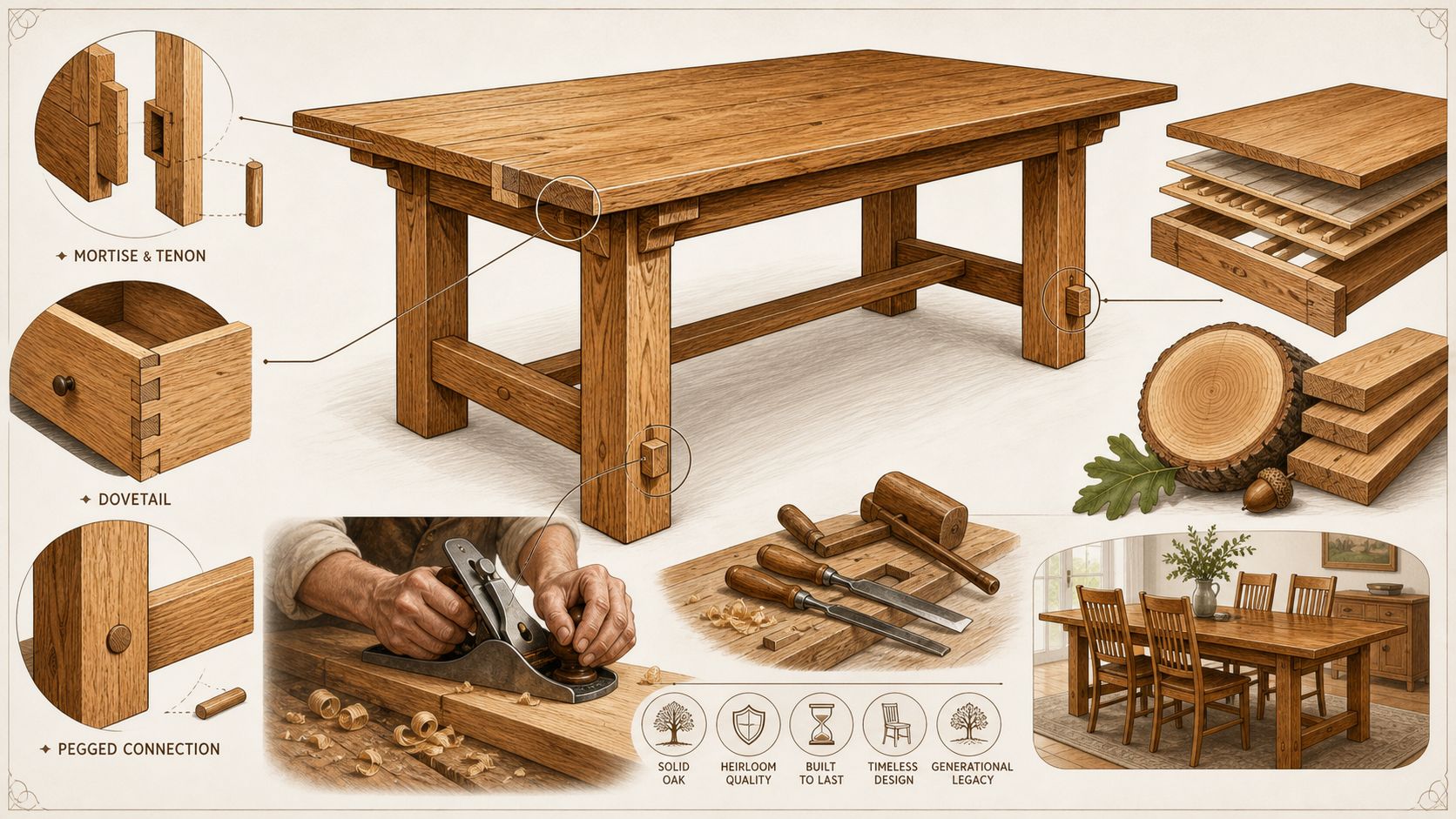
Mortise-and-tenon construction is a strong starting point. A precisely shaped tenon enters a matching mortise, creating a substantial wood-to-wood connection. Wood pegs or drawbore pins can reinforce that joint, while a carefully designed tabletop attachment allows the top to move across the grain without forcing the base to move with it. More detail on this construction appears in the guide to mortise-and-tenon construction.
Details worth inspecting
Breadboard ends: These cap the ends of a tabletop and can help manage seasonal movement when properly designed and pinned. They shouldn't be rigidly glued across the entire width.
Dovetailed aprons: Interlocking joinery adds structural integrity and signals careful workmanship.
Through-tenoned legs: A visible or structurally substantial tenon at the leg-to-apron connection is more meaningful than a decorative edge treatment.
Quarter-sawn boards: Boards cut across the growth-ring orientation can offer improved dimensional stability and a distinctive ray pattern.
Underside attachments: Slotted fasteners, figure-eight clips, or elongated screw holes let a solid top expand and contract across the grain. Rigidly fixing a wide top can stress the apron, finish, or breadboard ends.
Oak's movement is measurable. One source notes that oak can change about 1% in width for every 4% shift in moisture content, while another reports radial shrinkage around 4.5% and tangential shrinkage around 7% from green wood to 10% moisture content. The oak moisture-movement guidance explains why a quality builder must plan for movement rather than promise that a solid top will never change.
Ask which joints connect the legs to the aprons, how the top attaches to the base, and whether the underside can be inspected before purchase.
Made-to-Order Oak Tables Through Canadel and Tyner
An in-stock table solves a general problem. A made-to-order table solves the room in front of the buyer. That distinction matters when a doorway, window, radiator, built-in cabinet, or unusual traffic path limits the shape and proportions available from standard floor models.
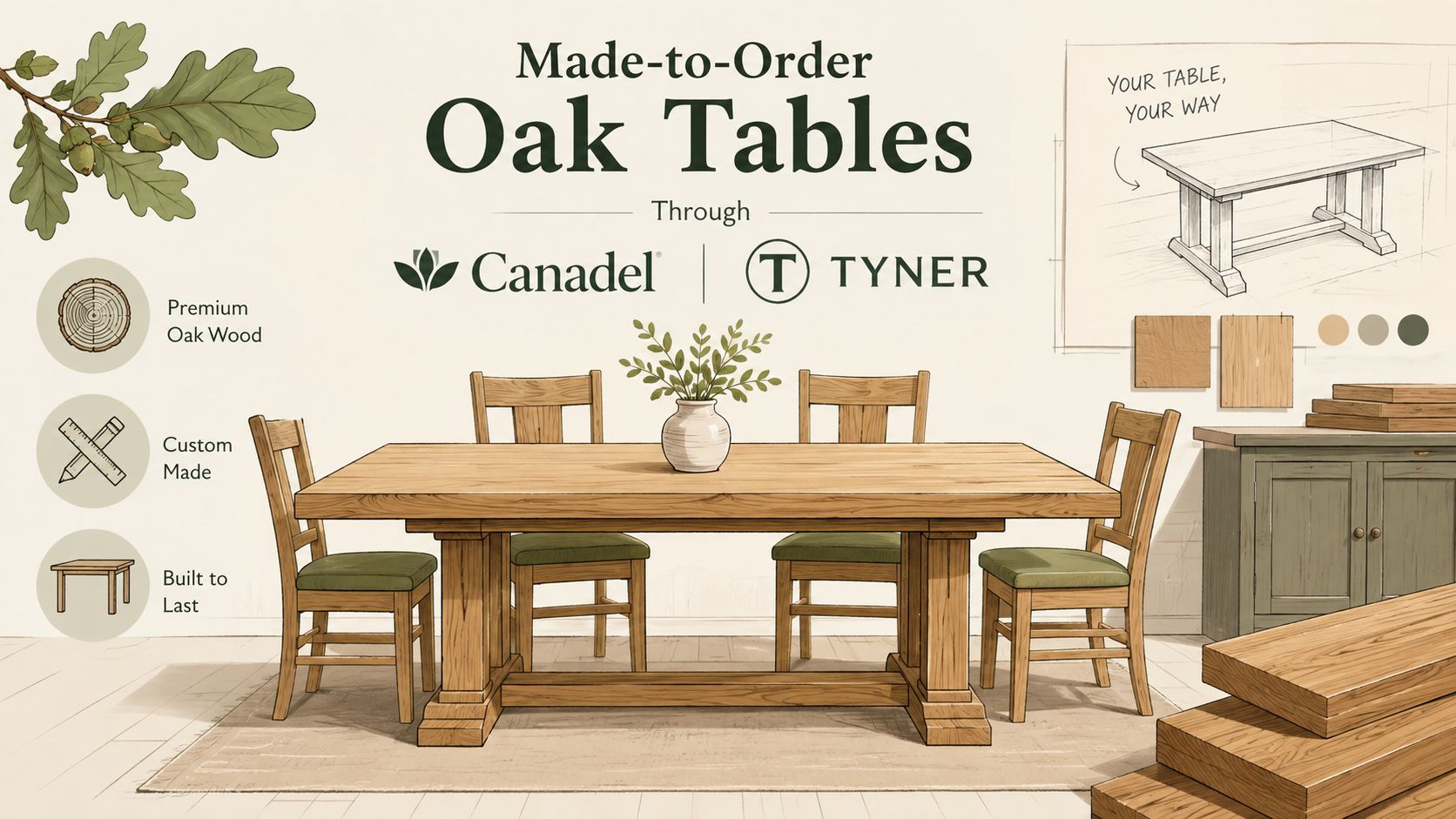
A configurable program can let a homeowner select the base style, leg shape, edge profile, top dimensions, leaf arrangement, stain, and distress level. Canadel options may include Turner, Loft, Urban, and Classic base directions, with edge profiles such as Chamfered, Beveled, and Mission. Tyner's Amish offerings add the importance of hand-crafted solid construction and finish coordination, so the final piece can feel bespoke rather than merely selected from a catalog.
Bring the room to the appointment
A useful design consultation starts with evidence. Homeowners should bring:
Room measurements: Include the wall-to-wall distance, doorway width, and locations of windows, radiators, and vents.
Cabinet photographs: Natural and artificial light can change how an oak stain reads beside existing wood.
Paint chips or flooring samples: A finish that looks balanced on a small showroom board may appear too yellow, gray, or dark against the actual room.
Seating needs: The number of regular diners matters more than the maximum number of guests.
Leaf preferences: Self-storing leaves and removable leaves create different storage and daily-use routines.
A table ordered for a specific space can also address an awkward window placement or the need for two leaves rather than one. Matching an existing hutch or sideboard becomes much easier when the wood species, stain, and sheen are selected together instead of approximated after delivery.
When customization pays off
Customization deserves the investment when the table will anchor the household, when the room has tight clearances, or when the owner wants a specific balance between rustic character and modern restraint. It also pays off when a family expects to use the table through changing stages of life, from homework and weekday meals to larger holiday gatherings.
The same design principle applies across the home. Tyner's selection extends from the Home Office to Outdoor Spaces, and its broader custom-order approach includes Canadel dining configurations and Stressless seating with ergonomic sizing. In-stock is just the beginning, especially for a homeowner building a coordinated, long-term interior design plan.
Stains, Finishes, and Custom Color Choices
Stain determines the table's color. The topcoat determines how that color handles pasta sauce, spilled drinks, warm serving dishes, and repeated wiping. Buyers should make those decisions separately, because a beautiful stain can still fail the household if the finish doesn't match the table's workload.
Conversion varnish creates a durable film through a chemical curing process and offers strong resistance to moisture and household chemicals. Lacquer sprays smoothly and can be repaired more easily, but it generally shows wear sooner under repeated abrasion. Hardwax oil penetrates the grain, supports localized repairs, and develops a softer patina, though it requires periodic refreshing.
Compare the finish systems
| Finish Type | Durability | Repairability | Best For |
|---|---|---|---|
| Conversion varnish | High resistance to moisture, chemicals, and daily wiping | More involved localized repair | Busy family dining rooms |
| Lacquer | Smooth appearance with moderate wear resistance | Relatively easy to repair | Traditional finishes and controlled use |
| Hardwax oil | Protects while preserving a tactile wood feel | Convenient spot repair | Patina-focused rooms and owners comfortable with maintenance |
Oak's open grain remains visible with natural and light stains. A painted appearance or dark espresso tone may require heavier pigment and grain filling to achieve a controlled surface. Those choices alter the tactile quality, too. A low-sheen finish can preserve the buttery, natural feel of the grain, while a film finish creates a more sealed and uniform surface.
Finish advice: Match the protection level to the household first, then choose the color. A finish that looks beautiful but demands unrealistic care won't deliver good value.
Lighting can shift the decision. Homeowners should bring a flooring sample, cabinet door, and room photograph to compare finish boards under warm and cool bulbs. A consultation about custom wood finishes can help align sheen, pigment, and grain visibility with the existing space.
Special finishes can also support a sustainable ownership plan. A solid table that can be maintained and refinished remains useful longer than a piece selected only for its initial appearance. The strongest investment combines durable construction with a finish the household can realistically live with.
Sizing and Caring for an Oak Dining Table in Daily Use
A table should be measured around chairs and people, not just around the tabletop. A homeowner who buys the largest attractive piece in a showroom may regret it once chairs block a walkway or a serving door can't open comfortably.
Start with clearance. Plan for roughly 36 inches from the table edge to the wall, about 24 inches of elbow room per person, and at least 42 inches of walkway behind seated diners. These are practical planning guidelines, not guarantees, because chair depth, armrests, base design, and room traffic can change the result.
Use the room, not the showroom
| Table Size | Seats Comfortably | Minimum Room | Best For |
|---|---|---|---|
| Compact rectangular top | Smaller everyday gatherings | A room with limited circulation | Apartments and tight dining areas |
| 72-inch rectangular top | Six diners in a conventional arrangement | Space for chairs and serving movement | Everyday family dining |
| 84-inch rectangular top | Six diners with generous room, or more with planned seating | A larger dining zone | Families hosting regularly |
| Round or oval pedestal | Flexible conversation and corner clearance | Rooms where rectangular corners interrupt traffic | Compact or open-plan layouts |
Pedestal bases often improve legroom, while four-leg tables can provide a more architectural silhouette. Leaf storage deserves equal attention. A self-storing design keeps expansion practical, but removable leaves may offer more flexibility when the household has separate storage.
Protect the solid top
Oak absorbs and releases moisture as indoor conditions change. One neutral woodworking guide notes that a 24-inch flat-sawn red oak top can shrink by more than 3/8 inch under a four-point moisture-content drop, and explains that much movement occurs during the first 12 months indoors as the table acclimates. The oak wood movement guide frames seasonal change as a construction consideration, not automatically a defect.
Control the room: Keep indoor humidity reasonably steady, commonly around the 35–50% range recommended for wood furniture care.
Reduce abrasion: Use felt pads beneath accessories and coasters beneath drinks.
Age leaves evenly: Rotate stored or inserted leaves when the design permits, so color and exposure remain more consistent.
Clean according to the finish: Avoid harsh household chemicals and follow the maker's instructions, especially on oil-finished tops.
A solid oak table should show life without being neglected. Consistent room conditions, sensible protection, and proper cleaning preserve both the surface and the investment.
How Tyner's Ann Arbor Showroom Brings an Oak Table Home
A sit test is more revealing than a product photograph. At the Ann Arbor showroom on South State St., a homeowner can pull up a chair, check knee clearance, feel the edge profile, and judge whether the table's scale supports real conversation. Oak grain, finish sheen, and distressing also look different in person than they do on a backlit screen.
Tyner Furniture has served the Southeast Michigan community since 1957, giving local buyers a long-standing place to evaluate furniture with guidance rather than relying on specifications alone. The experience extends across the home, from dining and bedroom furniture to the Home Office and Outdoor Spaces. That breadth helps a household coordinate an oak table with storage, upholstery, ergonomic seating, and adjoining rooms rather than treating the dining room as an isolated purchase.
What a design appointment should settle
A productive appointment should answer practical questions before a quote is prepared:
Species: Whether red oak or white oak better supports the room's color and style.
Proportions: Whether the top, base, and leaf configuration fit the measured dining area.
Edge and legs: Whether the profile feels traditional, Mission-inspired, modern, or transitional.
Finish: Whether the stain complements flooring, cabinetry, and the room's changing light.
Construction: How the top attaches, how movement is accommodated, and what joinery supports the base.
Delivery: How the finished table will pass through doors, hallways, and stairways.
Made-to-order programs can turn a sketch, photograph, or inspiration image into a coordinated proposal. Canadel supports configurable dining designs, while Amish hand-crafted pieces emphasize solid North American hardwood, time-honored joinery, and finish selection. Buyers can also evaluate related furniture from Stressless when ergonomic comfort matters elsewhere in the home.
Value beyond the initial price
The strongest value case is based on cost per year, repairability, and daily satisfaction. A table that fits the room, feels comfortable, and can be cared for over time has more practical value than a lower-priced piece that forces compromises in size or construction.
Tyner's Special Financing can help qualified buyers plan for a higher-quality made-to-order purchase, subject to the terms of the promotion and credit approval. A consumer-finance explanation of deferred-interest offers warns that “no interest if paid in full” may mean interest is charged retroactively from the purchase date if the promotional balance isn't fully paid by the stated deadline. Buyers should read the financing terms carefully rather than treating promotional language as automatically equivalent to true 0% APR.
The Low Price Promise adds a competitive-value checkpoint for shoppers comparing local purchase options. It doesn't remove the need to assess joinery, finish, delivery, or long-term care, but it can make the comparison more complete. The right oak dining table should be a durable, sustainable household investment, not the most attractive surface available today.
Tyner Furniture offers made-to-order oak dining tables, Amish hand-crafted solid-wood furniture, and Canadel configurations that let Ann Arbor homeowners choose species, size, edge, legs, leaves, and finish. Visit Tyner Furniture on South State St. for a sit test, bring room measurements and finish samples, or browse the online Quick Specs for special orders.