Maple Wood Dining Chairs: An Expert Buyer’s Guide


A lot of dining chair shopping starts the same way in Ann Arbor and across Southeast Michigan. A household finally finds the right table, steps back, and then realizes the chairs will decide whether that room feels welcoming or merely complete. The table holds the meal, but the chairs hold the people, the stories, the extra cup of coffee after dinner, and the holiday guest who stays longer than expected.
That's why maple wood dining chairs deserve a closer look than they usually get. For many shoppers, the choices blur together fast: side chair or arm chair, stained or painted, upholstered or wood seat, in stock or custom order. Add concerns about comfort, wobbling, finish wear, and whether the purchase will still look right years from now, and the whole process can feel heavier than it should.
A better way to shop is to think in terms of long-term value, not just the first number on the tag. A chair used day after day is really a cost-per-year decision. The right one can serve through family dinners, school projects, game nights, and routine weekday meals without losing its structure or its charm. Helpful planning also makes the process calmer, and this furniture shopping guide from Tyner gives shoppers a practical framework before they ever narrow down a style.

Table of Contents
- Your Guide to Choosing the Perfect Dining Chairs
- Why Maple is an Heirloom-Quality Choice for Dining Chairs
- Beyond the Look What Defines True Craftsmanship
- Finding Your Style Finishes and Maple Chair Designs
- Ensuring the Perfect Fit Sizing and Ergonomics are Key
- Making It Yours Customizing Your Maple Dining Chairs in Ann Arbor
- Caring for Your Investment and Our Local Promise
Your Guide to Choosing the Perfect Dining Chairs
A dining chair rarely gets bought in isolation. Most households are weighing several things at once: whether the chair matches the table, whether guests will want to sit in it for a full meal, and whether the frame will still feel solid after years of daily use. That's especially true for people furnishing a first home, updating a forever home, or replacing chairs that looked fine online but never felt quite right in person.
Why this purchase feels bigger than a chair
Dining rooms carry more jobs than they used to. In many homes, that same chair may host breakfast, homework, remote work, holiday meals, and weekend card games. A chair that looks sharp for ten minutes in a product photo can become a frustration if the seat height is off, the back is too stiff, or the construction starts to loosen.
That's one reason maple wood dining chairs appeal to practical shoppers. They sit at the intersection of beauty and use. The wood can look refined enough for a formal dining room, but it also has the substance needed for ordinary life.
A well-made dining chair should feel settled when someone sits down. Not tense, not flimsy, not precious.
What shoppers usually want to know first
The first questions are usually sensible ones, not decorative ones:
- Will it hold up: Households want a chair that won't start wobbling after regular use.
- Will it fit the room: Proportion matters, especially in tighter dining areas and open-plan homes.
- Will the finish work with existing wood tones: Maple's finish flexibility becomes important here.
- Will it still feel current later: Timeless shapes age better than trend-heavy silhouettes.
For families visiting a South State St. showroom, the fastest clarity often comes from treating the purchase like a long-term household tool with design value. That mindset changes the conversation. Instead of asking which chair is the least expensive today, shoppers start asking which one will still earn its place year after year.
A store with a local legacy since 1957 tends to understand that distinction well. The same is true across the broader home. Households often furnish dining spaces alongside a home office, bedroom, living room, or even outdoor spaces, so consistency in materials and design matters more than a one-room snapshot.
Why Maple is an Heirloom-Quality Choice for Dining Chairs
Maple earned its reputation the old-fashioned way. It performed well in real homes over a long stretch of furniture history. According to this history of wooden chair design, maple became especially practical in North American chairmaking in the 19th century as machine tools and steam-bending improved repeatability, and the Windsor chair tradition from the 1700s helped establish side chairs as household furniture for far more people. That historical staying power matters because woods that disappear from serious furniture making usually do so for a reason.
Maple has history for a reason
Maple has long been valued for strength, fine grain, and a smooth finish. In plain language, that means it gives chairmakers a hardwood that can take everyday stress while still looking polished. It doesn't need to rely on bulk alone to feel substantial.
For shoppers who want a deeper grounding in wood selection across the home, Tyner's guide to choosing hardwood furniture is a helpful companion read. It gives context for why species choice matters before style even enters the conversation.
A similar principle shows up in cabinetry as well. Homeowners comparing wood choices for built-ins or kitchens may also find MapleKing's wood cabinet advice useful because it reinforces how grain character, finish response, and durability shape long-term satisfaction.
What maple feels like in real life
Maple usually reads as clean and composed. Its grain is generally fine and uniform, which gives it a smoother visual texture than woods with bolder, more open grain. In a dining room, that can be a major advantage. The chair can support the room instead of overpowering it.
That fine grain also helps with finish versatility. Maple can suit a lighter natural look, a richer stain, or a more custom finish without losing its identity as solid wood.
Why shoppers often choose maple wood dining chairs
| Feature | Why it matters in a dining room |
|---|---|
| Fine grain | Creates a neat, furniture-grade look that works in formal and casual settings |
| Smooth finish potential | Feels pleasant to the hand on top rails, arms, and seat edges |
| Durability reputation | Supports daily family use and repeated seating |
| Refinishing potential | Gives a well-built chair a better chance at long service |
Practical rule: If a household wants a chair that can move from everyday use to holiday hosting without feeling out of place, maple is one of the safest hardwood choices.
In furniture terms, “heirloom quality” isn't a romantic phrase. It means the material gives the maker a real chance to build something worth keeping, repairing, and handing down.
Beyond the Look What Defines True Craftsmanship
A maple chair can be made well, or it can be made to merely resemble quality. The wood species matters, but construction decides whether the chair stays quiet and steady after years of scooting, leaning, and repeated loading.
What to inspect before buying
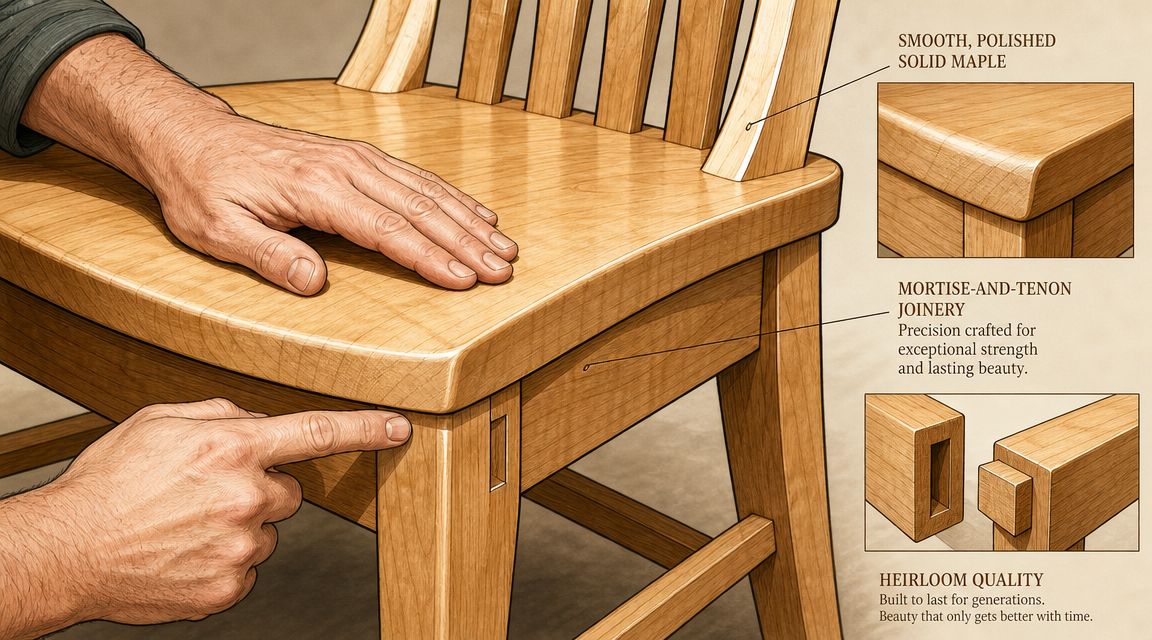
A shopper doesn't need to be a furniture maker to spot meaningful quality. A simple hands-on check tells a lot.
- Lift the chair slightly: A solid chair should feel balanced and substantial, not hollow or top-heavy.
- Grip the back and seat together: Gentle pressure can reveal early flex or weak assembly.
- Check the joints: Clean, well-fitted intersections suggest care in construction.
- Run a hand along edges: Maple should feel smooth and deliberate, not rough or hurriedly finished.
- Look underneath: The underside often tells the truth about whether a piece was built carefully or made to look finished from the front.
Shoppers in Ann Arbor often notice this quickly when comparing hand-crafted solid wood pieces against mass-produced alternatives. On a better chair, the parts look integrated. On a weaker one, the hardware often does too much of the work.
How strong wood and good joinery work together
According to hard maple chair specifications and construction notes, hard maple has a Janka hardness around 1,450 lbf, with bending strength near 15,800 psi, stiffness around 1.83 million psi, and density of about 44 lb/ft³ at 12% moisture content. In practical terms, those properties allow a chair to use slimmer parts while still resisting denting and structural fatigue.
That strength only reaches its potential when the joinery respects the material. Mortise-and-tenon construction is the classic example because it locks parts together in a way that handles real-life movement better than shortcuts.
A strong hardwood can still disappoint if the joinery is weak. Shoppers should judge the chair, not just the species tag.
Construction details worth asking about
| Detail | Why it matters |
|---|---|
| Kiln-dried maple | Helps improve stability before the chair is built |
| Mortise-and-tenon joints | Support long-term rigidity in the frame |
| Pinned joints | Add security where repeated movement occurs |
| Solid wood parts | Reduce the visual and structural compromises common in lower-grade builds |
Amish hand-crafted dining furniture often stands out here because the emphasis stays on joinery and material integrity rather than on surface-level styling alone. That's the difference between a chair that merely survives delivery day and one that still feels dependable many family meals later.
Finding Your Style Finishes and Maple Chair Designs
Maple's biggest style advantage is that it doesn't force a room into one narrow look. It has enough visual calm to blend into many interiors, yet enough character to feel intentional. That makes it useful for households trying to coordinate dining furniture with existing floors, cabinetry, trim, or mixed wood tones elsewhere in the home.
Why maple works with so many interiors
The fine, even grain gives finishers a cooperative surface. A clear finish can keep the look light and clean. A darker stain can add depth and formality. A painted or opaque finish can push the same chair shape into a more current or stylized direction.
For homeowners exploring painted or lower-contrast design directions, durable opaque finishes for home offers useful context for how opaque finishes change the visual feel of a space. That perspective helps when a shopper likes maple's construction qualities but wants a less obviously wood-toned result.
Anyone trying to coordinate dining chairs with an existing table or case piece can also benefit from Tyner's wood stain matching guide. Matching isn't always about making every surface identical. Often it's about finding undertones that live comfortably together.
Common design directions that suit maple
Instead of thinking “maple look,” it helps to think in terms of chair profile plus finish.
- Shaker-inspired forms suit households that want restraint, straight lines, and long-term versatility.
- Mission or Craftsman silhouettes feel grounded and architectural, especially when paired with a deeper stain.
- Contemporary frames benefit from maple's ability to support a cleaner, quieter surface appearance.
- Transitional designs use maple well because the wood doesn't visually crowd upholstery, curves, or mixed-material rooms.
A dining chair's personality also changes with the seat treatment. A wood seat feels crisp and easy to maintain. An upholstered seat softens the look and can make a room feel more layered.
Maple is often the quiet partner in the room. It supports the finish, the silhouette, and the surrounding pieces instead of demanding all the attention.
That flexibility is a major reason maple wood dining chairs remain relevant. They can look traditional, bespoke, or modern without asking the buyer to give up the benefits of solid hardwood.
Ensuring the Perfect Fit Sizing and Ergonomics are Key
A beautiful chair that doesn't fit the table becomes a daily nuisance. Knees bump the apron, the chair won't slide in properly, or the back feels tiring halfway through dinner. Fit gets overlooked because style is easier to shop online than comfort, but the body notices the difference immediately.
The measurement that prevents daily frustration
One of the most useful guidelines is simple. General furniture guidance for maple dining chairs recommends 10 to 12 inches between the top of the seat and the underside of the table for comfortable legroom. That single measurement helps explain why a chair can look right in a photo and still feel wrong in a home.
Shoppers measuring before they buy usually make better decisions, especially when replacing chairs but keeping the table. Tyner's furniture measuring guide can help households check clearance, walkway space, and room proportions before they commit.
Quick fit checklist
- Seat-to-table clearance: Aim for the recommended 10 to 12 inches for usable legroom.
- Push-in depth: Check whether the chair can slide under the table without hitting arms or back slats.
- Overall width: Make sure each seat has enough personal space at the table.
- Back height: Taller backs add presence, but they can visually crowd a smaller room.
What comfort looks like beyond seat height
Ergonomics is mostly about geometry, not wood species. Maple can provide the structure, but the comfort comes from how the chair is shaped.
A few details matter more than shoppers expect:
- Seat depth: Too shallow and the chair feels perch-like. Too deep and shorter users lose back support.
- Back angle: A slight, supportive recline can make long dinners more pleasant.
- Front edge shape: A gentler seat edge tends to feel kinder during longer sitting.
- Arm placement on captain's chairs: Arms that sit too high may interfere with the table.
The best dining chair is one that people stop noticing during the meal. Comfort should feel natural, not engineered for attention.
A sit test becomes valuable. In open-plan homes around Southeast Michigan, dining chairs often double as overflow seating for work or conversation. A chair that handles both uses gracefully is almost always worth stronger consideration than one chosen on appearance alone.
Making It Yours Customizing Your Maple Dining Chairs in Ann Arbor
Shoppers often assume customization is mostly decorative. In reality, custom ordering is where material, craftsmanship, finish, and fit finally line up. That's especially important with maple because the wood is versatile enough to support many directions without giving up durability.

Customization turns a good chair into the right chair
The broader furniture market continues to reflect demand for both durability and customization. This maple dining chair collection overview notes that maple dining chairs are often offered in multiple heights and with matching table collections, reflecting shoppers' focus on long-term value, repairability, and coordinated design.
That lines up with what many local households want. They don't just want a maple chair. They want a maple chair that works with their table height, their room scale, and the stain already present in the home.
A made-to-order approach can help with choices such as:
- Chair type: side chair, arm chair, or bar-height seating for connected dining spaces
- Finish: natural, darker, warmer, cooler, or more opaque looks
- Seat treatment: all wood, upholstered, or mixed-material comfort
- Dimension and proportion: options that make the chair feel balanced with the table
What made-to-order really changes
In practice, customization works best when it addresses more than color. A household in Southeast Michigan may need slimmer silhouettes for a breakfast nook, more supportive seats for long gatherings, or coordinated finishes that bridge a dining room and nearby kitchen. Those are practical design decisions, not indulgences.
For shoppers interested in hand-crafted solid wood options, Amish solid wood furniture collections show how made-to-order construction can support real personalization. That's often where maple becomes especially compelling. Its clean grain works across many stain directions, and the underlying hardwood gives the finished piece substance.
Tyner Furniture is one local option for this kind of shopping on South State St., and its broader custom programs reflect the idea that in-stock is only the starting point. Dining shoppers may also recognize the same philosophy in other parts of the showroom, from Canadel dining customization to Stressless sizing in motion furniture. Even when someone came in focused on chairs, the lesson is often the same. Better furniture fits the household, not the other way around.
Local note: In Ann Arbor homes with open sightlines, custom dining chairs often need to relate to nearby living, office, and kitchen furnishings. Finish harmony matters more than exact sameness.
That's what makes bespoke dining feel approachable rather than intimidating. The choices become easier when the household knows what to prioritize: structure first, comfort second, finish third, and trend considerations last.
Caring for Your Investment and Our Local Promise
Solid maple is durable, but durable doesn't mean carefree. Wood remains a natural material, and that's part of its appeal. It has depth, warmth, and repair potential that mass-market substitutes rarely match. It also responds to its environment.
How to help maple age well
According to guidance on wood chair behavior in changing conditions, maple is hygroscopic, which means it can expand and contract as humidity changes. The best long-term performance depends on the wood, the finish, and stable indoor conditions.
For households in Southeast Michigan, that matters during seasonal swings. Heat in winter and humidity in warmer months can affect any solid wood chair over time.
Simple care habits that support longevity
- Wipe spills promptly: Dining chairs live close to drinks, sauces, and routine cleanup.
- Use a gentle cleaning approach: Harsh cleaners can work against the finish.
- Keep indoor conditions stable when possible: Sudden shifts are harder on wood than consistency.
- Check joints occasionally: Early attention is better than waiting for a wobble to worsen.
Making heirloom quality more manageable
A well-chosen chair should feel like an investment, not a strain. That's where supportive purchase policies matter. Special financing can help households spread out the cost of better construction, and a Low Price Promise can reduce the anxiety that often comes with buying higher-quality furniture.
That support matters because furnishing often extends beyond a single area of the house. Homeowners may be balancing dining needs with updates to the bedroom, living room, home office, or outdoor spaces. When a family chooses heirloom-grade materials, thoughtful financing can make the decision more practical without changing the standard.
Tyner Furniture has served the community since 1957, and that local legacy matters when shoppers want guidance that continues after delivery. Maple wood dining chairs are a significant purchase, but they're also one of the most rewarding ones when the material, fit, and craftsmanship all line up.
For anyone comparing maple wood dining chairs in Ann Arbor or anywhere in Southeast Michigan, the next step is simple. Visit Tyner Furniture for a sit test at the South State St. showroom, or browse the online Quick Specs for special-order details, finish options, and hand-crafted dining choices that can be customized to the room, the table, and the way the household lives.