Wooden Center Tables: A Guide to Lasting Style

You’re probably looking at a living room that feels almost finished. The sofa is in place. The rug works. The lamps are doing their job. But the middle of the room still feels unresolved, or worse, filled by a table that looked fine online and now feels too flimsy, too bulky, or just out of place.
That’s where wooden center tables earn their keep. A good one does more than hold coffee cups and remotes. It sets the rhythm of the room, handles daily wear without complaint, and keeps paying you back year after year through durability, comfort, and style that doesn’t date quickly. For many homeowners in Ann Arbor and across Southeast Michigan, that’s the difference between a piece you live around and a piece you live with.
At a local store that’s been serving this community since 1957, we’ve seen the same pattern over and over. Shoppers often start by asking what looks good. They end up asking a better question. What will still look right, feel solid, and function well years from now?
Table of Contents
- Decoding Center Table Styles and Types
- Choosing Your Wood Species and Finish
- Perfecting Your Sizing and Placement
- The Unseen Value of Amish Craftsmanship
- Creating Your Bespoke Center Table
- Making an Investment for Generations
- Frequently Asked Questions About Wooden Tables
Decoding Center Table Styles and Types
A center table is the anchor of the seating area. If the sofa is the largest visual piece, the table is what tells your eye where the room begins and how it should function. That’s why choosing among wooden center tables isn’t just about shape or stain. It’s about how your household lives.
Style tells the room what to say
Some styles speak softly. Others make a statement.
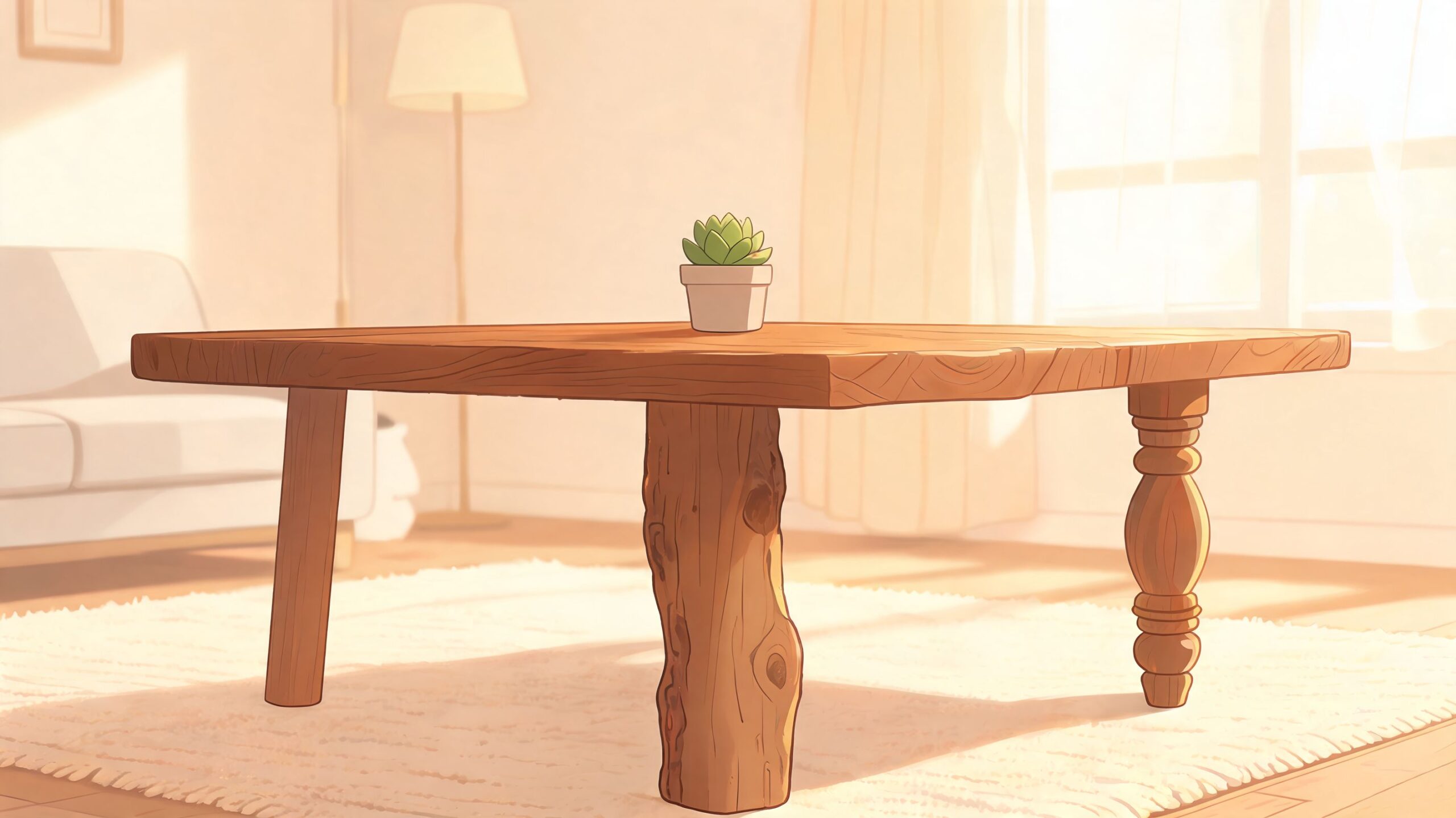
- Rustic tables bring warmth first. You’ll usually notice visible grain, a grounded profile, and a look that feels relaxed rather than polished. They pair well with woven textiles, soft neutrals, and rooms that should feel inviting instead of formal.
- Industrial designs mix wood with metal and often look a bit leaner. If your room has brick, black accents, or a cleaner urban feel, this style can add structure without feeling cold.
- Mid-century modern pieces rely on clean lines and visual lightness. Tapered legs and simple tops help a room feel open.
- Traditional tables tend to have more visual weight. Turned legs, shaped aprons, and richer finishes work well in homes with classic trim, layered textiles, or collected décor.
If you’re struggling to name your style, don’t start with labels. Start with your sofa, rug, and lighting. The table should connect those pieces, not fight them.
Practical rule: If your room already has several statement pieces, choose a quieter table. If the room feels flat, a table with stronger shape or grain can give it a focal point.
Function matters as much as appearance
A beautiful table that can’t support daily life becomes clutter fast. Think in terms of use.
| Type | Best for | What to watch for |
|---|---|---|
| Standard top | Everyday living rooms | Keeps the look simple and open |
| Lift-top | Eating, laptops, casual work | Helpful in smaller homes or multi-use spaces |
| Drawer storage | Remotes, coasters, chargers | Keeps visual clutter out of sight |
| Lower shelf | Books, baskets, magazines | Good if you want easy-access storage |
| Round or oval | Tight walkways or homes with kids | Softer edges improve movement |
One useful exercise is to list what lands on your table every evening. If it’s just a tray and two drinks, keep it simple. If it collects reading glasses, mail, a throw, and the remote, storage deserves more weight in your decision.
For more visual ideas on styling the finished surface, this guide on how to style a coffee table is a practical next step.
Choosing Your Wood Species and Finish
The most important choice isn’t the silhouette. It’s the material. A table can have a beautiful profile and still disappoint if the core construction is weak, the surface is thin, or the finish can’t age gracefully.
That’s why many experienced buyers come back to solid wood. The difference starts with touch. Solid wood has weight, temperature, grain variation, and a depth that veneers rarely match. When you run your hand across solid cherry or oak, the surface feels like a real material, not a printed idea of one.
Why species matters
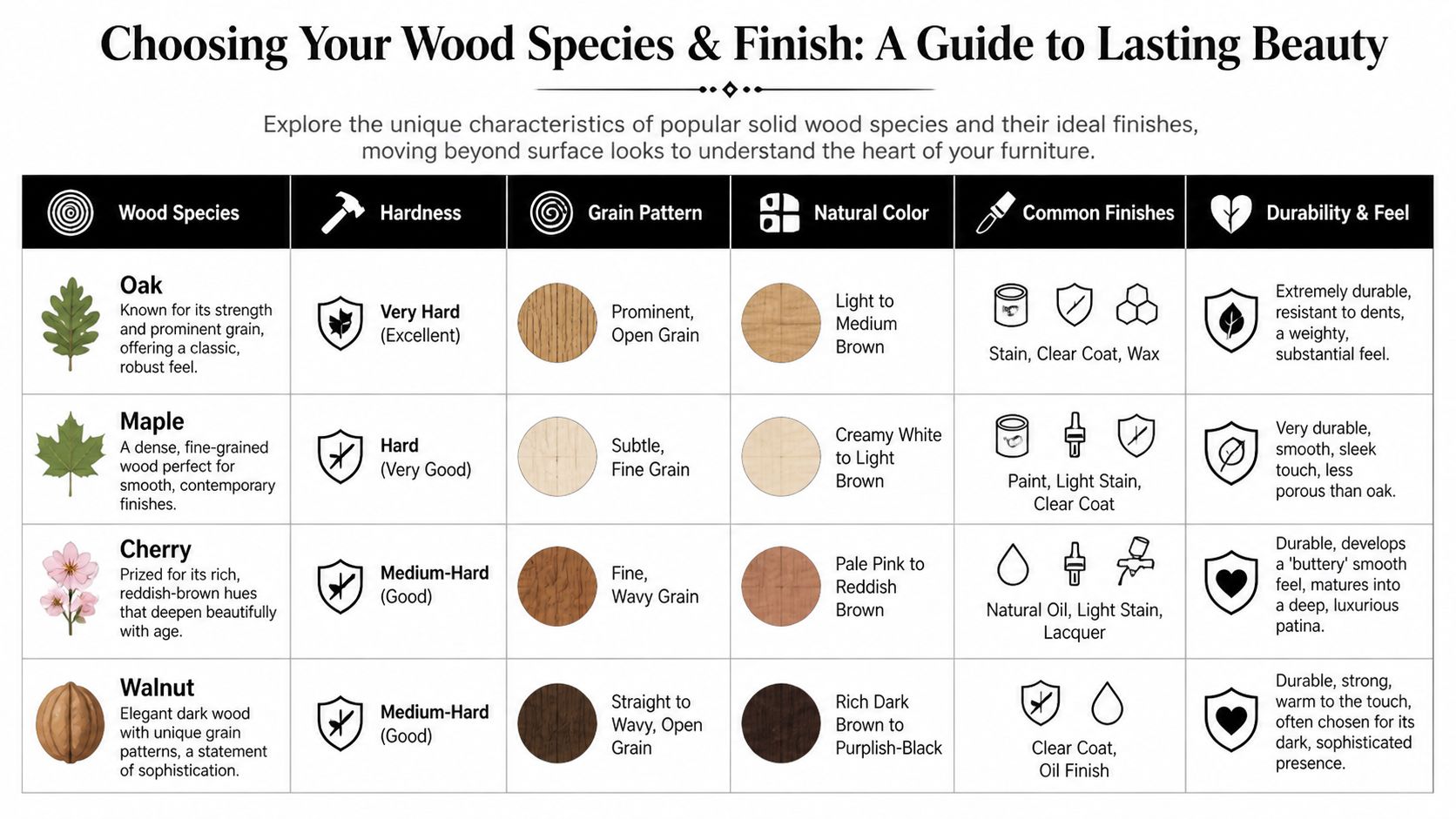
Wood species changes the table’s look, feel, and staying power.
A verified benchmark worth knowing is that North American FAS grade red oak has a Janka hardness of 1290 lbf, while teak is 1070 lbf and white oak is 1360 lbf. FAS grading also means at least 83.3% of the board surface is clear of larger defects, which reduces weak points that can lead to trouble over time, according to this overview of solid hardwood durability and FAS grading.
Here’s how that translates into real shopping decisions:
- Oak feels sturdy and classic. Its grain is more visible, which helps scratches and daily wear blend into the character of the piece.
- Maple looks cleaner and finer-grained. It works beautifully in contemporary rooms where you want a smoother visual surface.
- Cherry has warmth and a softer, richer personality. Many people love the way it develops a deeper patina with age.
- Walnut brings mood and depth. It’s often the choice when the table needs to add contrast or a more tailored look.
Finish changes more than color
Finish is where many shoppers get tripped up. They think stain is just a shade choice. It’s not. Finish affects how bold the grain looks, how formal the table feels, and how easily it blends with the rest of the room.
A few simple pairings help:
- Light, natural finishes keep rooms feeling open and casual.
- Medium brown stains are often the easiest bridge between existing wood tones.
- Dark finishes add sophistication, but they also make dust and surface texture more visible.
- Clear protective coats let the character of the wood do the talking.
If you want a better sense of how stain changes tone and grain, it helps to explore wood stain options before you commit.
Solid wood gives you room to personalize. Veneer often asks you to accept the color and move on.
For a broader look at how hardwood choice affects longevity and appearance, this article on choosing the right hardwood for longevity and style is worth reading.
The long-view comparison
Mass-produced tables often sell the look of wood, not the performance of wood. That matters most after the first season, the first move, or the first years of daily use.
Consider these differences:
- Solid hardwood can be refinished, repaired, and appreciated for its natural variation.
- Veneer over engineered core can look polished at first, but surface damage is harder to hide and repairs are more limited.
- Particleboard construction often satisfies a short-term need, but it rarely fits a long-term home plan.
If your goal is a piece for a forever room rather than a temporary setup, species and finish should come before trend.
Perfecting Your Sizing and Placement
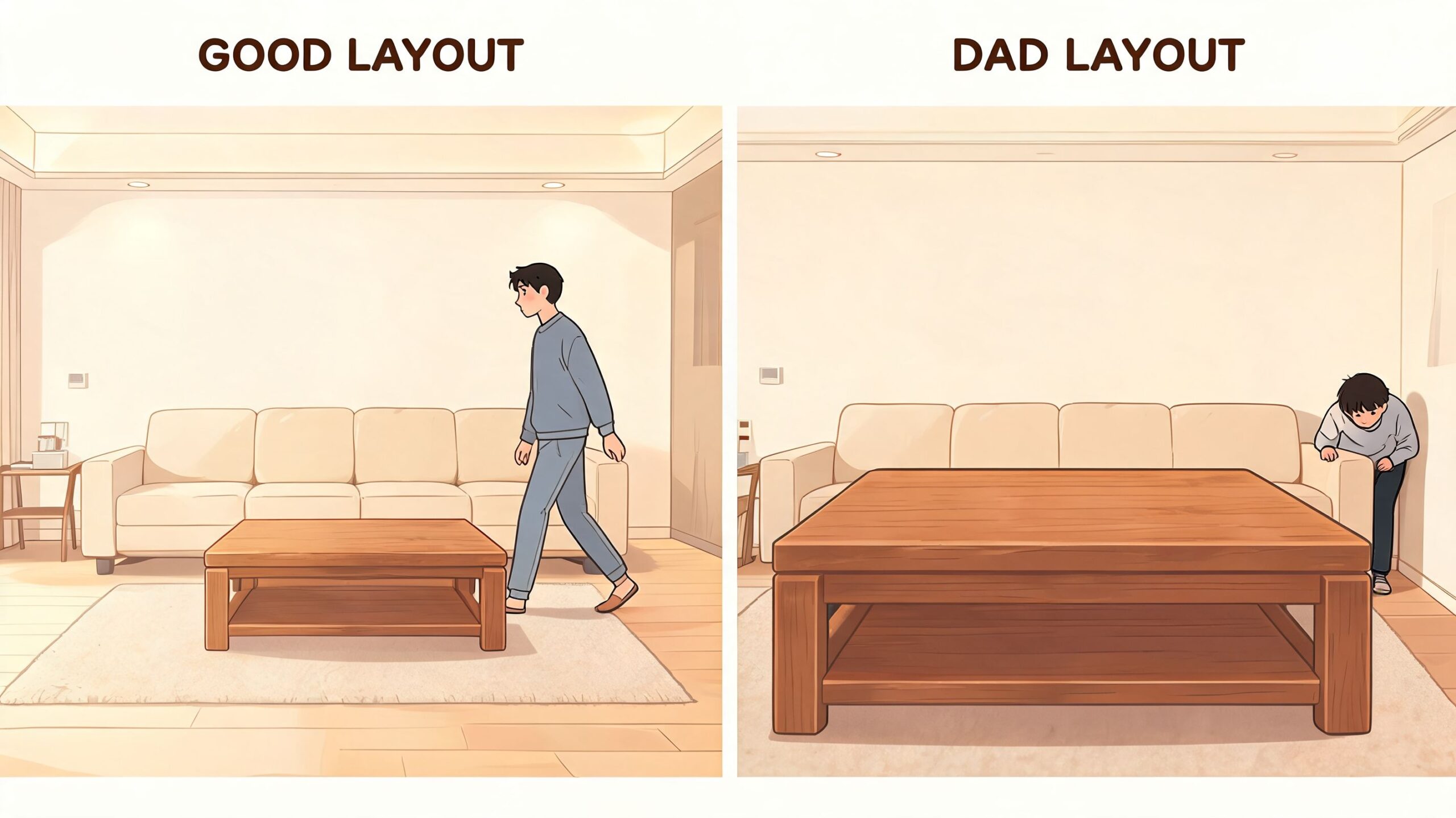
The wrong table size can make a good room feel awkward. Too large, and people start turning sideways to walk through. Too small, and the whole seating area feels disconnected.
The good news is that sizing wooden center tables follows a few dependable rules. You don’t need a design degree. You need a tape measure and a little restraint.
Start with the sofa
The most useful guideline is this one: the table should sit 2 inches lower than the adjacent sofa seats, which usually puts it around 16 to 18 inches high. Length should be about two-thirds of the sofa’s length, and you should maintain 24 to 30 inches of perimeter clearance for better flow, based on these center table ergonomic guidelines.
That sounds technical, but it feels simple in practice. If your sofa seat is at a comfortable hand-rest height, the table should sit just a touch lower so you can reach a drink or book without hunching.
Think in zones, not just inches
A center table serves two different spaces at once:
- The reach zone where seated people interact with it
- The walking zone where everyone moves around it
If one zone works and the other doesn’t, the room still fails.
A center table should feel present, not obstructive. If guests keep adjusting their path around it, the table is asking for too much room.
Here’s a quick sizing reference:
| Room element | What to aim for |
|---|---|
| Table height | About 2 inches lower than sofa seat |
| Table length | About two-thirds of sofa length |
| Perimeter clearance | 24 to 30 inches |
Shape helps with traffic flow
Shape often solves problems size alone can’t.
- Round tables soften movement and avoid sharp corners.
- Oval designs keep some of the surface area of a rectangle while easing traffic.
- Rectangular tables work well when the sofa is longer and the room has clear walkways.
- Square tables fit nicely in more symmetrical seating plans.
In many Ann Arbor homes, especially where older floorplans create narrower passages, round or oval wooden center tables can make a room feel easier to use without changing the rest of the furniture.
A simple room test
Before you buy, mark the table footprint on the floor with painter’s tape. Walk the room for a day or two. Sit down. Reach forward. Carry a laundry basket past it. That little exercise catches most sizing mistakes before they become expensive ones.
The Unseen Value of Amish Craftsmanship
Most shoppers can spot a pretty tabletop. Fewer know how to judge what’s happening underneath. That hidden structure is where heirloom furniture separates itself from furniture that only photographs well.
The story of the center table helps explain why this matters. The modern wooden center table traces back to 18th-century British “rent tables”, sturdy drum-form pieces made from oak or walnut with a pedestal base and multiple drawers for organizing weekly rent collections. They were built for function first, and that practical durability shaped the legacy we still value in solid wood furniture today, as described in this history of antique centre tables and rent tables.
What hand-crafted construction changes
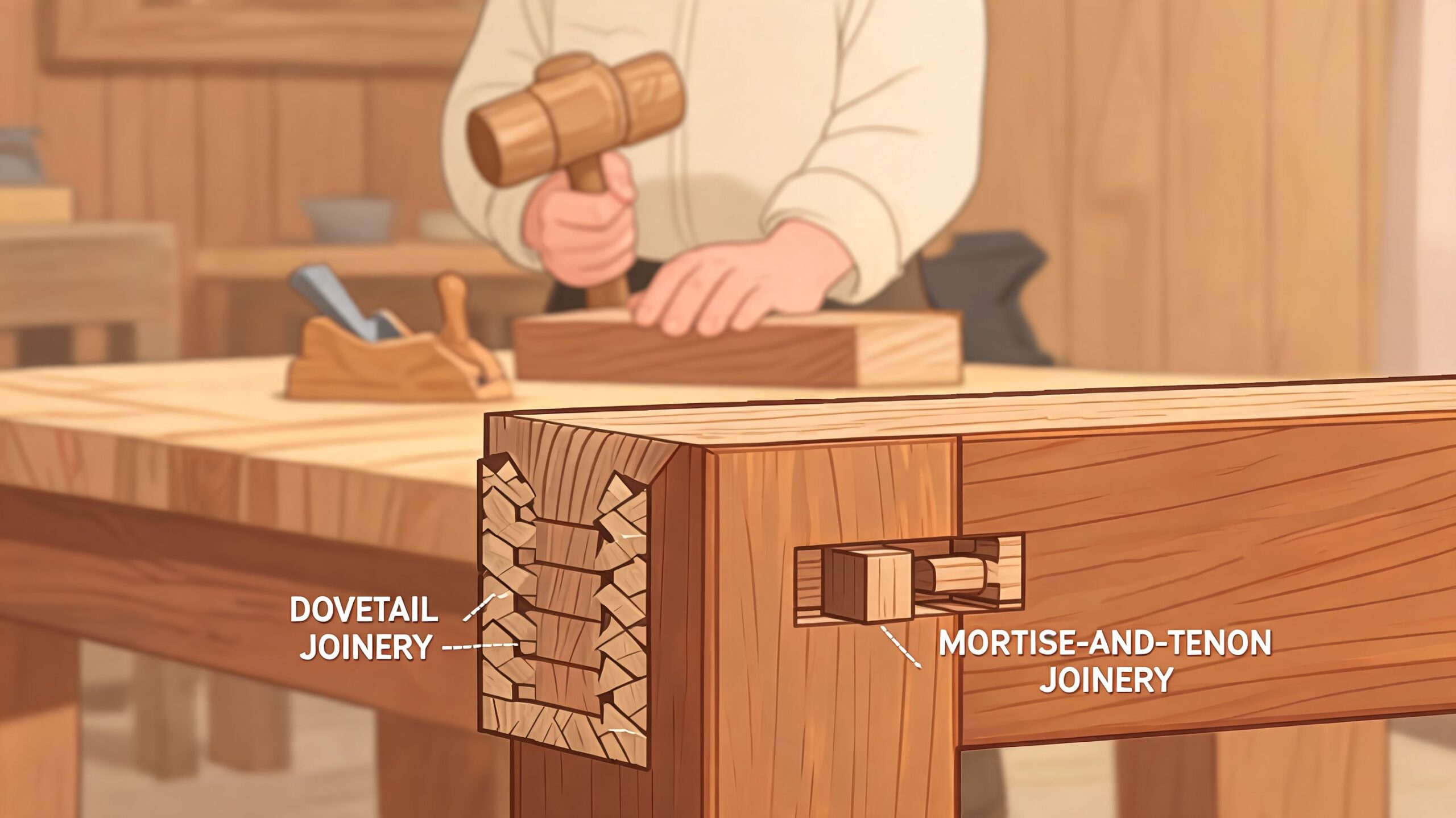
A hand-crafted table usually shows its value in quiet ways. The drawer glides with a firm, smooth feel. The base doesn’t wobble when someone leans on it. The top feels substantial rather than hollow.
That comes back to joinery.
- Mortise-and-tenon joints connect major structural parts with mechanical strength, not just adhesive.
- Dovetail drawers hold together through repeated opening and closing.
- Solid wood panels and frames respond more naturally to time than thin decorative skins over composite cores.
These details matter because living room tables take abuse. People put up their feet. Kids bump corners. Someone drags the table a few inches during a gathering. A well-built piece expects that.
The difference you can feel in a showroom
When shoppers visit a showroom on South State St., they often notice craftsmanship first through weight and stability. A solid wood table tends to stay planted. The proportions make sense. Even the underside looks considered.
By contrast, many mass-market pieces rely on shortcuts you can’t always see online. Staples, thin veneers, lightweight panels, and cosmetic finishes can all look polished in a listing photo. They’re less convincing in person.
Good craftsmanship doesn’t ask for attention. It earns trust through repetition. Open the drawer. Lift the edge. Set a hand on the top. The table tells you what it is.
For readers who want a closer look at regional hand-crafted options, this overview of Amish furniture in Michigan is a useful reference.
Why American-made still matters
For many Southeast Michigan households, American-made craftsmanship isn’t just a patriotic preference. It’s a practical one. Buyers want to know who built the piece, what species were used, and whether the construction supports long-term ownership.
That’s one reason Amish-built furniture still carries such weight in the conversation. It reflects a slower standard. Not trendy. Just accountable.
Creating Your Bespoke Center Table
One of the biggest frustrations in furniture shopping is finding something that’s almost right. The wood is good, but the finish is off. The shape works, but it’s a little too long. The storage is useful, but the hardware doesn’t fit the room.
That’s where made-to-order furniture changes the experience. Instead of adapting your room to a fixed product, you adapt the product to your room.
Where customization solves real problems
A bespoke center table isn’t only about personal taste. It often solves practical design issues that off-the-floor furniture can’t.
For example:
- A narrow room may need a shallower top to preserve movement.
- A deep sectional may call for a larger scale so the table doesn’t look stranded.
- An open-concept home may need a stain that bridges multiple wood tones nearby.
- A family room may benefit from drawers instead of an exposed shelf.
A major gap in the online market is that many retailers offer “solid wood” with very little transparency around sourcing or customization. Buyers often can’t trace wood origin or specify American-made craftsmanship, which leaves a real need for ethical, bespoke, locally produced options, as noted in this overview of the wooden center table sourcing gap.
What a custom order can include
Customization doesn’t have to mean complexity. Often it comes down to a few smart decisions:
- Wood species that match your priorities for grain, color, and feel
- Stain selection that works with your flooring or existing case goods
- Dimensions adjusted for a specific sofa or room layout
- Hardware and edge details that lean more traditional, cleaner, or more transitional
One practical route for shoppers who want that process simplified is looking at custom furniture made simple. In the same spirit, brands like Canadel help customers work through made-to-order decisions in a structured way, and Stressless shows how customization can be applied to ergonomic comfort in seating.
The real advantage
Custom furniture lets you stop compromising on the details that affect daily use. The result often feels calmer because the scale, finish, and function were chosen intentionally, not inherited from a warehouse assortment.
In-stock can be a starting point. It doesn’t have to be the finish line.
Making an Investment for Generations
The sticker price on a center table tells you what it costs today. It doesn’t tell you what it costs to live with over time.
That’s why I encourage people to think in cost per year, not just purchase price. A table that stays sturdy, remains attractive, and fits your home for the long run often delivers better value than a lower-priced piece that needs replacement after a short run of ordinary use.
Why the market often misses the real question
Many online listings focus on style, finish names, and the immediate transaction. They don’t spend much time addressing what value-minded homeowners want to know. Will this table hold up? Will it warp, crack, or loosen? Will I still want it in my room years from now?
That gap is real. Online listings often emphasize appearance and initial price while skipping the long-term durability question, according to this summary of the durability and lifecycle cost content gap.
How to think about value
A stronger buying lens looks like this:
- Material value means the table starts with solid substance, not just a decorative surface.
- Construction value means the joinery and build support long-term use.
- Design value means it won’t feel dated after one season of trend changes.
- Service value means you can ask questions, compare options, and get guidance before committing.
If you’re furnishing a forever home in Southeast Michigan, those four forms of value matter more than a flashy first impression.
The least expensive table at checkout isn’t always the least expensive table to own.
Making quality attainable
For many households, the challenge isn’t understanding quality. It’s fitting quality into a responsible budget. That’s where practical tools matter. Special Financing can spread out the purchase over time, and a Low Price Promise can reduce some of the hesitation that comes with buying better furniture once instead of replacing lesser furniture repeatedly.
If you want to compare options in that category, this page on American-made solid wood furniture provides a useful starting point.
The same long-view approach applies across the home, not just the living room. Good furniture planning often connects your center table with nearby seating, home office pieces, dining furniture, and even outdoor spaces so the house feels cohesive instead of pieced together.
Frequently Asked Questions About Wooden Tables
Shoppers in Ann Arbor often ask very practical questions, and that’s a good sign. Wooden center tables should be chosen with your eyes open. They’re used every day, and the right questions usually lead to the right purchase.
Common questions about solid wood tables
| Question | Answer |
|---|---|
| Are wooden center tables hard to maintain? | Not usually. Day-to-day care is simple if you use the table as intended, wipe spills promptly, and avoid treating it like an outdoor surface. Solid wood tends to age with character rather than looking “ruined” after ordinary life. |
| Is solid wood always better than veneer? | Better depends on your goal. If you want long-term ownership, repairability, and the feel of authentic material, solid wood usually makes more sense. Veneer can satisfy a style goal, but it doesn’t offer the same long-view flexibility. |
| What wood should I choose if I want a classic look? | Oak is often the safe answer for classic appeal. Cherry adds warmth, maple feels cleaner, and walnut brings depth. The best choice depends on the other woods and fabrics in your room. |
| Should I get storage in my center table? | If your remote, chargers, magazines, or coasters are always visible, yes. Drawers help the room stay calmer. If you prefer a lighter visual look and keep clutter elsewhere, an open design can be enough. |
| Can a wooden center table work in a smaller room? | Absolutely. Scale and shape matter more than the material alone. A round or oval profile often makes a compact room easier to move through. |
| Is custom worth considering? | It is when standard sizes keep missing the mark, or when you’re trying to match other furniture more closely. A made-to-order piece can solve fit and finish issues that stock pieces can’t. |
A few practical buying reminders
- Bring measurements: Include sofa length, seat height, and the walkway width around the table area.
- Bring photos: A few room photos help with finish and scale decisions.
- Think about touch: The table will be handled daily. Surface feel matters.
- Plan beyond today: Buy for the home you want to settle into, not just the gap you want to fill this weekend.
Since 1957, shoppers have come to local furniture stores for exactly this kind of clarity. Not because furniture is mysterious, but because good furniture decisions are easier when someone helps you slow down and notice what lasts.
If you’d like help narrowing down wooden center tables for your space, visit Tyner Furniture in Ann Arbor for a sit test and an in-person look at scale, wood feel, and finish options. You can also browse online Quick Specs for special orders, including made-to-order choices that coordinate with living rooms, dining rooms, home offices, bedrooms, and outdoor spaces.