Is Veneer Furniture Good Quality? What to Check First

When a shopper leans across a dining table and asks whether it's "real wood," what answer are they hoping for? Most want reassurance that the piece won't sag, peel or wobble in five years. The word on the label rarely delivers that reassurance, because a thin slice of walnut glued to a well-built plywood panel and the same slice glued to a crumbly core are two completely different products wearing the same name.
So, is veneer furniture good quality? Sometimes it's excellent, sometimes it's a disappointment, and the difference sits underneath the surface where nobody points. Shoppers get taught to ask "veneer or solid?" when the more useful question is what the core is made of, how the layers were bonded, and how the piece will be used at home.
What Veneer Furniture Really Is
Think of a good wool coat. The outer fabric is what catches the eye in the shop, but the lining, the stitching and the way the shoulders are set decide whether it still looks right after ten winters. Veneer furniture works the same way. The visible layer is genuine hardwood, sliced thin and bonded to a core, which is the structural panel underneath.
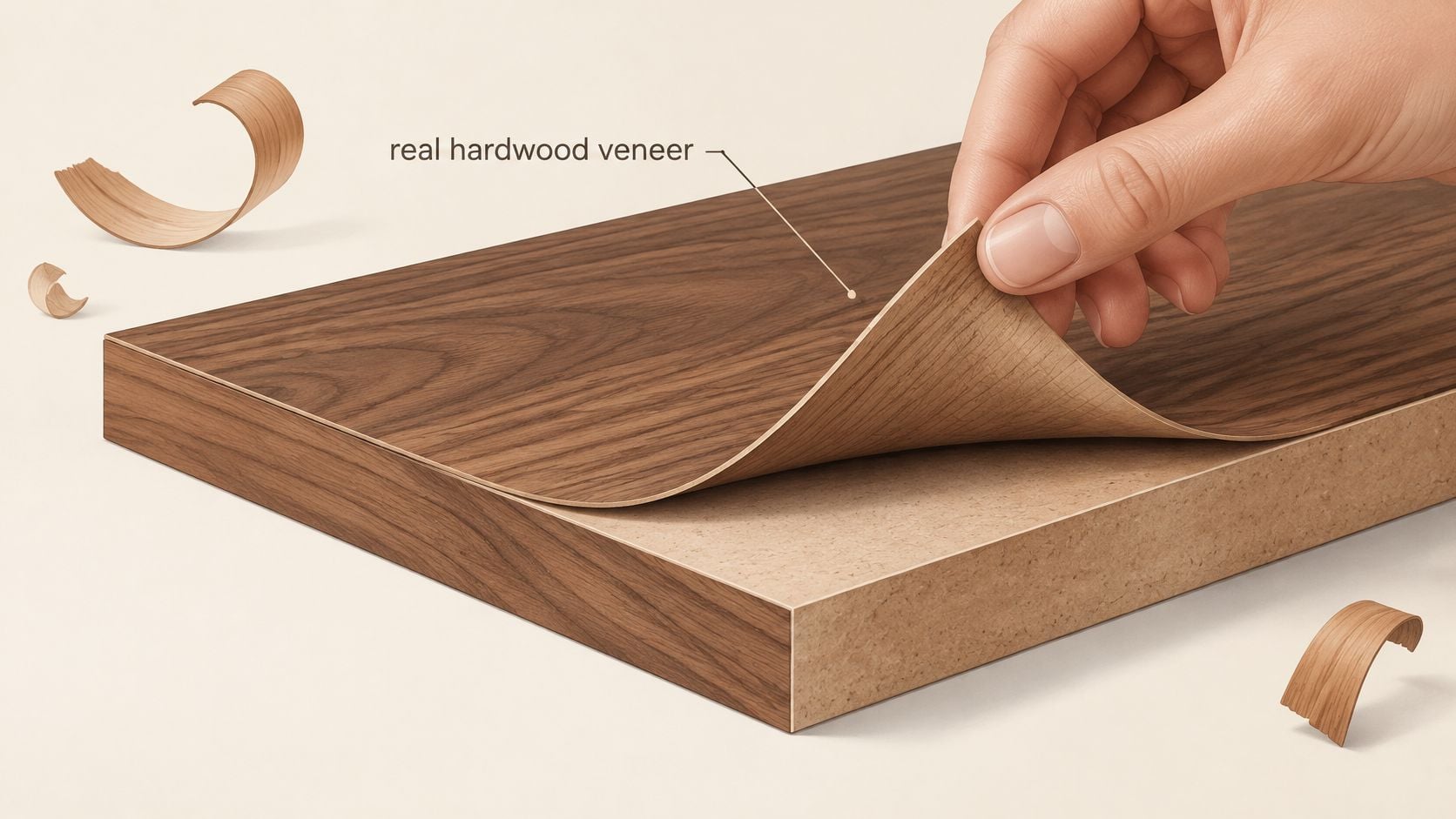
That core goes by a few names, and each behaves differently in a house:
- Plywood: thin wood layers glued with the grain of each layer running crosswise to the next, so the panel resists shrinking and swelling in any one direction.
- MDF (medium-density fiberboard): wood fibers pressed with resin into a dense, smooth, very flat panel.
- Particleboard: wood chips and particles pressed into a panel, the least moisture-tolerant of the group.
- Solid wood: lumber used as the substrate itself, common in older case pieces.
The University of Minnesota Extension guidance on furniture construction notes that veneer or plywood construction commonly forms a three-, five- or seven-layer bonded "sandwich," and that strong, properly glued and reinforced joints are key indicators of durability. A well-built veneered piece can outperform poorly joined solid wood.
Veneering isn't a modern shortcut, either. Cabinetmakers have used sliced wood for centuries to get grain patterns no thick board can produce, and the same technique still shows up in kitchen work, as this explainer on wood veneer cabinet refacing explained from RMK Contractors makes clear.
The real question: not veneer or solid, but what's underneath the veneer and how the piece was assembled.
Three things carry through everything that follows: the core, the bond, and the room the piece will live in. Tyner Furniture has served Ann Arbor and Southeast Michigan since 1957, and materials get chosen there by how a piece will live in a home, not by the label alone. Readers who want the deeper material breakdown can start with this comparison of solid wood and engineered wood.
Veneer and Solid Wood by Criterion and Room
Say a couple in Ann Arbor is furnishing their first real dining room. They want a long table that seats eight at holidays and a sideboard for dishes and linens. The table has to survive hot platters, elbows and homework. The sideboard mostly has to stay flat, look consistent and hold weight on its shelves. Those are different jobs, and the honest answer is that the two pieces may deserve different constructions.
Here's how the two approaches compare on the criteria that decide long-term use.
| Criterion | Veneer over plywood or panel core | Solid wood |
|---|---|---|
| Dimensional stability across seasons | Strong; cross-laminated layers resist warping | Moves with humidity; wide boards can cup or split |
| Standing water tolerance | Weak; edges and seams are vulnerable | Moderate; depends on finish, still needs prompt wiping |
| Refinishing | Limited; thin veneer cannot be sanded repeatedly | Good; a thick board can often be refinished several times |
| Weight and feel | Lighter, flatter and consistent | Heavier and dense; the weight of solid cherry is noticeable |
| Best-fit pieces | Tabletops, cabinet sides, large flat panels, case goods | Chairs, legs, frames and heirloom pieces |
| Expected lifespan with care | Decades when the core and bond are sound | Generations when the joinery is sound |
Three rows that surprise shoppers
Stability runs the opposite way from intuition. A wide solid board expands and contracts across its width every time indoor humidity swings, which is exactly what happens in Southeast Michigan between a dry January and a muggy July. Cross-laminated layers fight each other's movement, so a veneered panel over plywood tends to stay flatter. A U.S. Forest Service technical note on veneered panels states that veneered panels have more nearly uniform strength in different directions and that properly cared-for veneered furniture can last as long as solid furniture. For a 42-inch-wide sideboard top, that's a meaningful advantage, not a compromise.
Refinishing is where solid wood earns its reputation. A thick board can be sanded and re-coated more than once across a lifetime, so a deep water mark or a gouge is recoverable. Thin veneer doesn't offer that margin. As one comparison of veneer and solid wood points out, repairability is the key trade-off: buyers who want heirloom-level refinishing or easy recovery from deep damage should weigh that before choosing a veneered surface for a hard-working table.
Weight tells a story your hands read faster than your eyes. Pull open a drawer on a solid cherry dresser and the front feels dense, almost reluctant, and the whole case stays planted. A veneered credenza feels lighter and looks more uniform, with a crisp even sheen across matched doors, while a figured oak solid top shows the buttery glow and small irregularities that make each board individual. Neither feel is better in the abstract. They suit different pieces and different rooms.
Room by room
- Living room: a veneered coffee table or entertainment unit makes sense, since broad flat tops benefit from movement control and the frame carries little structural load.
- Bedroom: veneered dressers and nightstands stay flat and matched across doors, while a solid-wood bed frame is the heirloom investment, because joints and rails take real stress every night.
- Dining: a solid table and hand-crafted chairs, where legs, aprons and stretchers absorb years of shifting weight.
- Home office: a veneered desk gives a flat, stable writing and monitor surface that won't cup and throw a keyboard out of level.
- Outdoor spaces: neither construction suits an exposed site without weather-rated finishes and sheltered placement, so covered porches and purpose-built outdoor materials are the right call.
Where joinery and customization change the verdict
The Amish hand-crafted solid wood pieces in the showroom earn their place through construction, not marketing. Dovetail drawers interlock so the joint resists being pulled apart, and mortise-and-tenon joints seat a projecting tongue into a matching socket, glued and often reinforced, so a chair or table frame stays tight through decades of use. Mass-produced alternatives frequently lean on staples and thin fasteners, which is why a solid-wood label alone guarantees very little. Species matters too, and this guide to choosing the right hardwood for longevity and style walks through how oak, cherry and maple behave differently in daily use.
In-stock is only the beginning. Dining can be specified through Canadel, from leg style and table edge to finish and distress level, and seating through Stressless, where sizing and fabric or top-grain leather choices turn a recliner into something ergonomic rather than generic. A made-to-order piece built for the room outlasts a compromise bought to fill it.
Veneer for broad surfaces, solid wood for load-bearing frames and chairs, and a well-built veneered piece beats a poorly joined solid one every time.
Quality Checks Before You Buy Veneer
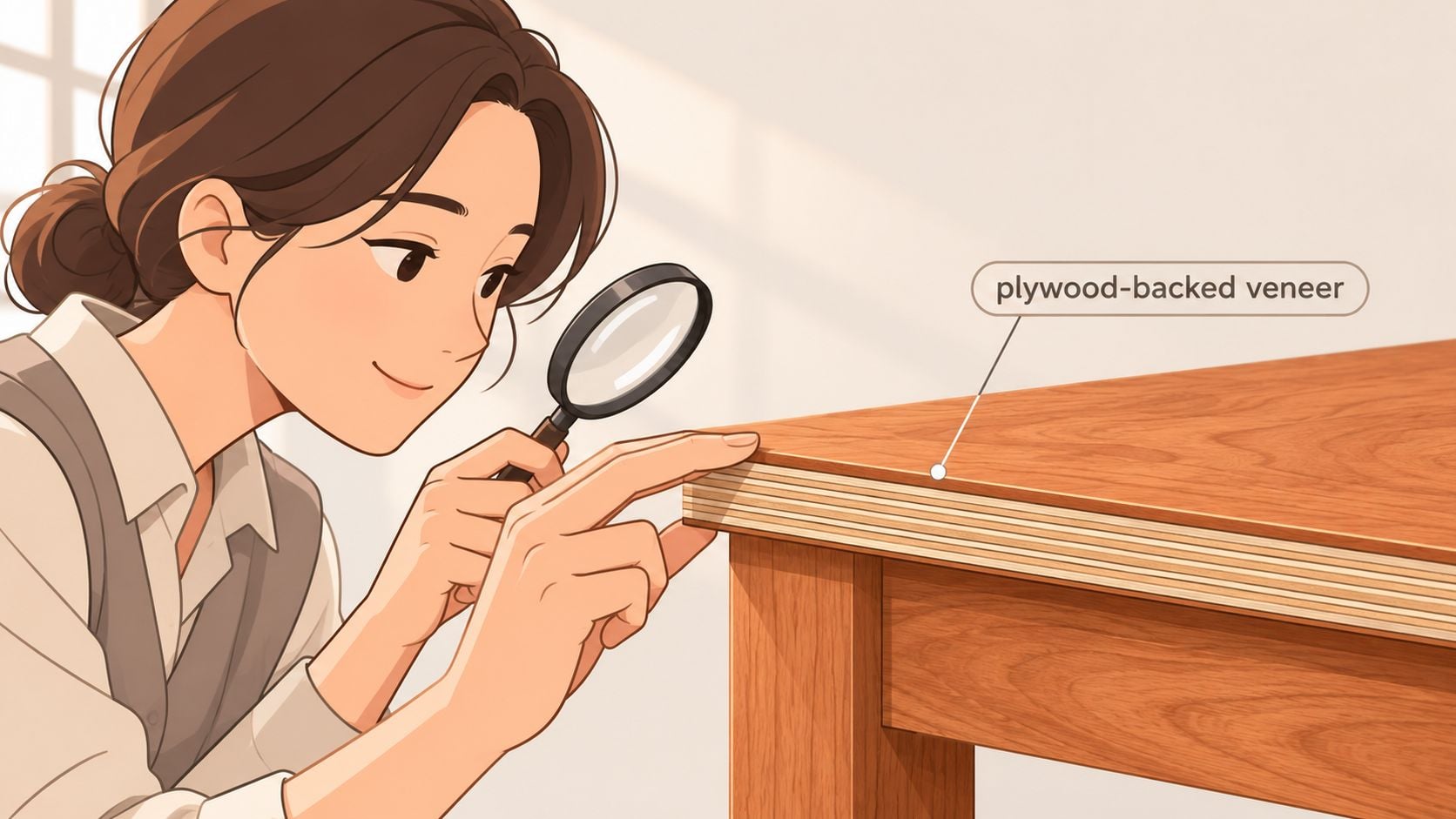
Plywood-backed veneer is a legitimate construction method, not a cosmetic cover-up. Utah State University Extension states that plywood is used in furniture to add strength and reduce warping, splitting, expansion and contraction, and that veneer plywood may be used for chair backs and aprons even when the main structural parts are solid wood. Makers reach for it where movement control matters most: broad panels, tabletops, cabinet sides and backs.
The showroom checklist
| Check | Good sign | Warning sign |
|---|---|---|
| Core material | Plywood or a quality composite with visible layered edges | Core not named, or particleboard sold as a solid substitute |
| Edge-banding | Tight, continuous seam with no gaps | Gaps, lifting corners or uneven thickness at edges |
| Veneer face | Grain matches across adjoining panels and the surface lies flat | Bubbling, hollow spots or mismatched grain |
| Joinery | Dovetails or mortise-and-tenon joints, glued and reinforced | Staples and thin fasteners carrying the load |
| Hardware | Solid runners and tight fittings | Wobbly drawers or loose hinges |
| Finish | Even sheen and a smooth, dry feel | Tacky, patchy or uneven areas |
Each row maps to something you can see or feel in about a minute. At the edge of a tabletop, look for the stacked lines of the plies, like the edge of a paperback book, then find the clean seam where the edge-banding meets the top. That banding seals the core against moisture, so a lifting corner is an open door. On a two-door cabinet, the grain should read as one continuous piece of wood across the gap, which tells you the leaves were sequenced from the same log rather than grabbed at random.
Open a drawer and look at the corners, not the front. Interlocking dovetails or a seated mortise-and-tenon joint mean the load travels through wood and glue instead of a fastener that will loosen. Run the drawer in and out: it should glide on solid runners without racking side to side. Then lay a palm flat on the finish. It should feel dry and even, never tacky or gritty.
Telling real veneer from printed laminate
Look at the edge grain. Real veneer shows wood fibers and pore structure; a printed surface shows a uniform colored strip or a repeating pattern that marches across the top in identical copies. Natural grain never repeats exactly, so identical swirls two feet apart are a giveaway.
Pro-Tips for the floor
- Name the core: ask the salesperson to say plywood, MDF or particleboard out loud, and ask whether the back face is veneered too for balance.
- Tap and listen: a light knuckle tap across the surface should sound consistent; a dull, hollow patch suggests a bubble in the bond.
- Sight down the top: crouch to eye level along the length of a tabletop and look for waviness.
- Check the underside: a well-built piece is finished where nobody looks.
Score the piece on each row. Two or more warning signs is the signal to keep shopping.
Moisture, Heat and Everyday Wear
Moisture is the weak point, and the way it attacks explains the fix. U.S. Forest Service guidance on plywood and fiberboard reports that water-induced dimensional change in the thickness direction of structural plywood is generally 5% or less, and identifies moisture as the most common cause of damage to these panel products. The same guidance notes that plywood can be as durable as solid wood when the right type is selected and properly maintained.
That small movement is the part most shoppers never hear about. A plywood or fiberboard core barely changes thickness through a humid Michigan summer and a dry, heated winter, so a well-bonded veneer face stays flat while the seasons swing. What gives way first is rarely the veneer sheet itself. It is the finish film on top and the glue line at exposed edges, which is why the core and the bond matter more than the word on the tag.
The trouble starts at seams and edges. Water sits on a walnut tabletop under a sweating glass, the finish softens and swells, and a pale ring appears where the film lost its grip. Repeated wet-dry cycles then work that edge bond until the veneer buckles or lifts.
The everyday routine
- Keep heat away: pull pieces back from radiators and heat registers, and out of prolonged direct sun.
- Wipe spills immediately: a soft dry cloth, then a second pass to catch what ran toward the edge.
- Buffer the surface: coasters, placemats and felt pads under lamps and décor prevent the small marks that add up.
- Steady the humidity: hold indoor conditions in a stable, comfortable range rather than swinging between extremes.
- Skip wet cleaning: don't spray cleaner or water directly onto the surface; dampen the cloth lightly instead.
Panel ratings explain why placement matters. Forest Service documentation separates interior, exposure and exterior durability classifications for plywood, so a panel built for indoor service was never specified for a damp room. Unless the manufacturer says otherwise, keep veneered pieces out of bathrooms and unconditioned sunrooms.
Practical rule: set a shallow tray under any plant sitting on a veneered sideboard, because overflow and condensation collect exactly where the edge-banding is thinnest.
Veneer is a durable indoor material that needs protection from standing water and direct heat. Treated that way, a well-built piece stays sound for decades, and this guide to protecting wood furniture from scratches and stains covers the rest of the routine.
Repairs, Refinishing and Long-Term Value
Thickness sets the repair ceiling. A Forestry and Forest Products industry veneer manual identifies decorative veneer as typically about 0.6 millimeters thick, with a tolerance of approximately plus or minus 0.1 millimeter, and notes another industry standard allowing roughly 0.5 to 0.7 millimeters. That's enough for genuine color, pore texture and grain depth. It isn't enough for a belt sander or repeated aggressive sanding, which will cut through to the core in seconds.
What can realistically be repaired
Minor scratches respond to a touch-up marker matched to the stain, followed by a wax fill stick leveled with a plastic scraper. Lifted edge-banding can often be re-glued, pressed flat and clamped with a caul and painter's tape protecting the face. A small bubble sometimes re-presses under a warm iron through a cloth, with a protective sheet between iron and finish. Deep gouges, burns or a patch that needs matched grain belong with a professional who can source a compatible veneer leaf, and understanding custom wood finishes helps when matching sheen and color on a repair.
Cost per year, not sticker price
Divide what a piece costs by the years it serves. A well-built sideboard kept for twenty years can cost less per year than a lower-priced replacement bought every five, and it never stops looking like the room's anchor. Longevity is also the environmental argument: a life-cycle study of furniture published in Scientific Reports found wood furniture generally compared favorably with metal and plastic, with coating choice materially affecting performance and UV lacquer the best-performing option among the coatings evaluated.
Service support matters as much as the material. If a component of a furniture item is defective, Tyner Furniture repairs or replaces that component rather than the entire product, which keeps a sound case in service instead of the landfill.
Three questions to settle before paying: what the warranty covers, who performs veneer repairs, and what the manufacturer permits for refinishing. Get the warranty terms in writing.
Book a Sit Test at Our Ann Arbor Showroom
A product listing may name the veneer species. It cannot show the core beneath it, the bond holding it down or the joinery carrying the load. On a showroom floor, the drawer box, underside of a top, edge banding and joints reveal how the piece was assembled.
In a 2025 German YouGov survey commissioned by imm cologne, 97% of 2,101 respondents considered furniture quality important or very important, and 95% considered durability important or very important, according to imm cologne's reporting on what consumers care about. A slow inspection lets a shopper test those priorities against the actual piece.
What to do with your hands on the floor
Press the arms of a chair and feel whether the frame flexes. Lift one edge of a table slightly and register the weight. Open every drawer and watch the corners, not the fronts. Run a palm across the veneer face and along the edge banding.
While standing at the piece, ask questions that move past the surface:
- What material forms the core of the top, sides and shelves?
- Where does the design use veneer, and where does it use solid wood?
- How is the veneer bonded, and where is edge banding protecting a cut edge?
- Which joints carry the weight, and can a drawer box be removed to inspect them?
- If the finish, fabric or configuration is close, what can Custom Order change?
Take all the time needed. There is no high-pressure sales experience on the showroom floor, so careful testing is welcome.
When the construction is right but the look is not, Tyner Furniture's Custom Order option lets a shopper specify details such as finish, fabric or configuration. The right piece fits the room on delivery day and keeps fitting it years later.
Tyner Furniture also offers special financing with approved credit. Before ordering a custom piece, confirm its dimensions, materials and chosen details in writing.
Tyner Furniture has served Southeast Michigan since 1957. At its Ann Arbor showroom, shoppers can compare furniture for rooms ranging from home office to outdoor spaces and examine Amish furniture that is hand-crafted from solid wood and fully customizable. Bring the room's measurements, then test the drawers, edges and finishes in person. Visit Tyner Furniture to plan the trip and review Custom Order possibilities.