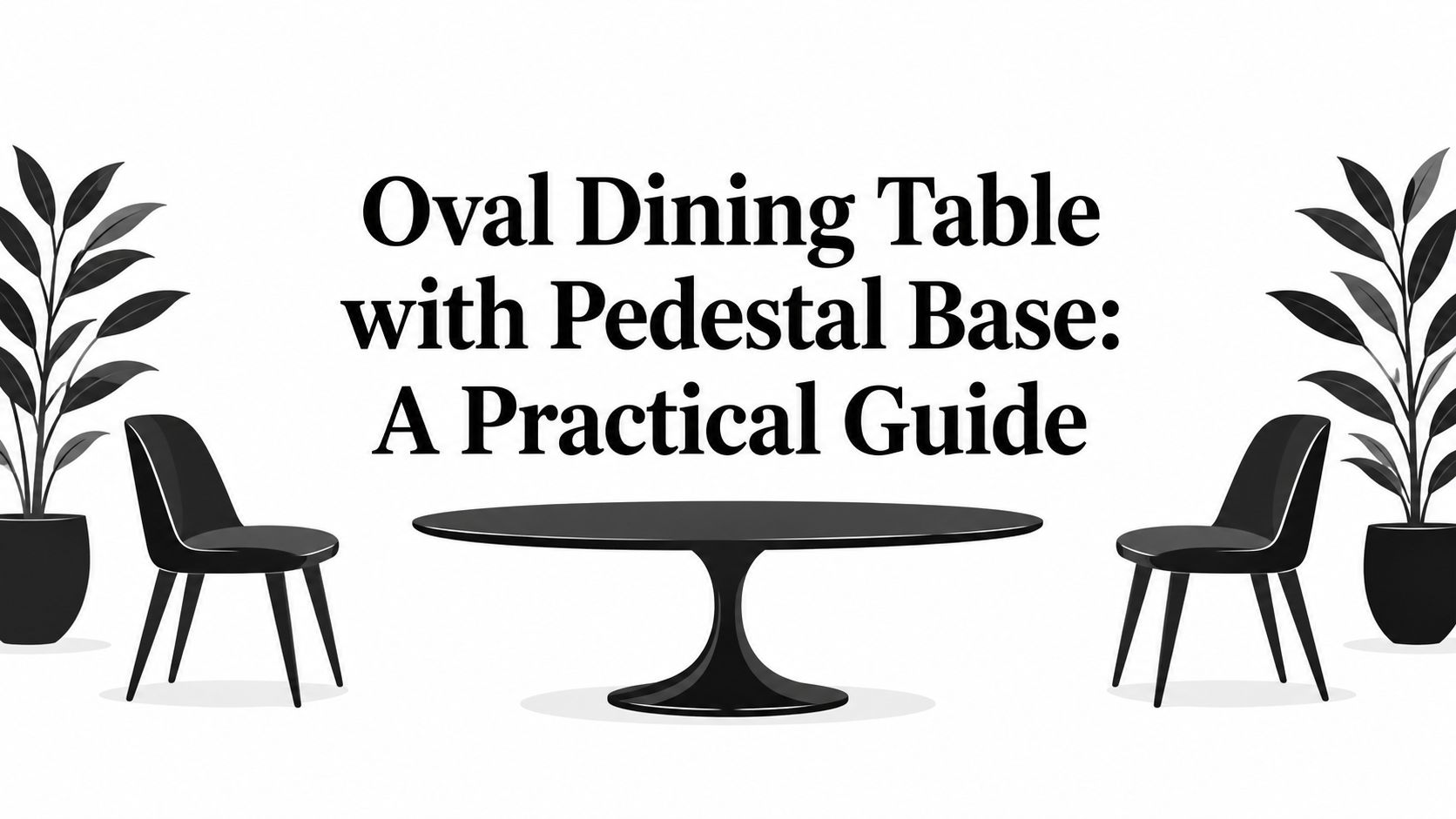
Oval Dining Table with Pedestal Base: A Practical Guide

Tuesday dinner is already underway. Six chairs are pulled tight, knees bump under the tabletop, a serving dish sits sideways, and the person at the corner has to slide in at an angle just to sit down. That familiar frustration usually isn't a chair problem. It's a table geometry problem.
An oval dining table with pedestal base changes the experience from the floor upward. The curved ends remove corner collisions, while the open underside gives chairs more freedom to move. But the pedestal isn't merely a decorative way to create legroom. Its mass, footprint, and relationship to the tabletop determine whether the table feels planted or wobbly when someone leans on the edge.
For Ann Arbor and Southeast Michigan homes, that distinction matters. A table must work through ordinary weeknight meals, holiday serving, chair movement, changing room layouts, and years of seasonal humidity. The right choice combines ergonomic clearance, sound engineering, solid hardwood, hand-crafted joinery, and made-to-order dimensions. The result can be a genuine heirloom rather than another piece that just fills a dining room.
Why an Oval Pedestal Table Earns a Place in the Dining Room
An oval table solves a specific household complaint. A family may need the seating capacity of a long table, but the dining area may not tolerate sharp corners and four legs. With a pedestal underneath, diners can shift their chairs along the curve without catching a knee on a corner leg or scraping against a stretcher.
That freedom is especially useful in an open-plan home. The rounded outline softens the path between the kitchen, dining area, and living room, so people can pass through without meeting a hard corner at hip height. A pedestal also lets an occasional guest take a seat where a four-leg design would force awkward chair placement.
The improvement isn't only visual. Four legs create fixed collision points. A central or twin-pedestal structure puts the support where the load needs it while leaving more of the underside available for knees, chair legs, and flexible seating. Anyone comparing options at a South State St. showroom should perform a real sit test, not just judge the table from across the room.
Practical rule: A pedestal earns its keep only when it improves both legroom and stability. A beautiful base with an undersized footprint is a poor choice.
The shape has a long design history
Pedestal dining tables trace back to antiquity, with design historians connecting early true pedestal forms to wealthy Roman patricians who used single-support tables called monopodia. Cabinetmakers later revived and refined the form during the 18th and 19th centuries, including Thomas Chippendale and Duncan Phyfe. Phyfe's tripod pedestal became influential because it improved seating flexibility around the table. This history of pedestal dining tables helps explain why the design still feels both formal and practical.
The strongest modern version keeps that historic logic but adds better proportions and construction. A rounded top supports conversation and circulation. A carefully engineered base keeps the piece secure. Solid wood adds the weight and tactile character that online photographs can't convey, from the weight of solid cherry wood to the grain variation across a hand-finished oak top.
Tyner Furniture has served the Southeast Michigan community since 1957, and its selection extends beyond dining rooms to the Home Office, bedroom, living spaces, entertainment areas, and Outdoor Spaces. That breadth matters when a dining table needs to coordinate with the rest of a home rather than stand alone. Guidance on designing a dining room where to start can help households define circulation, seating, and storage before choosing dimensions.
How a Pedestal Base Actually Works
Think of the base as a tree trunk and root system. The tabletop receives the load, the column carries that load downward, and the foot spreads the force across the floor. The column is visible, but the foot does much of the work when a guest leans near the edge.
A four-leg table sends loads down through separate corners. That can be stable, but the legs and connecting stretchers also create obstacles. Each leg must resist sideways movement, and the apron or stretcher can interfere with knees and chair placement. A pedestal concentrates support beneath the table and leaves the perimeter more usable.
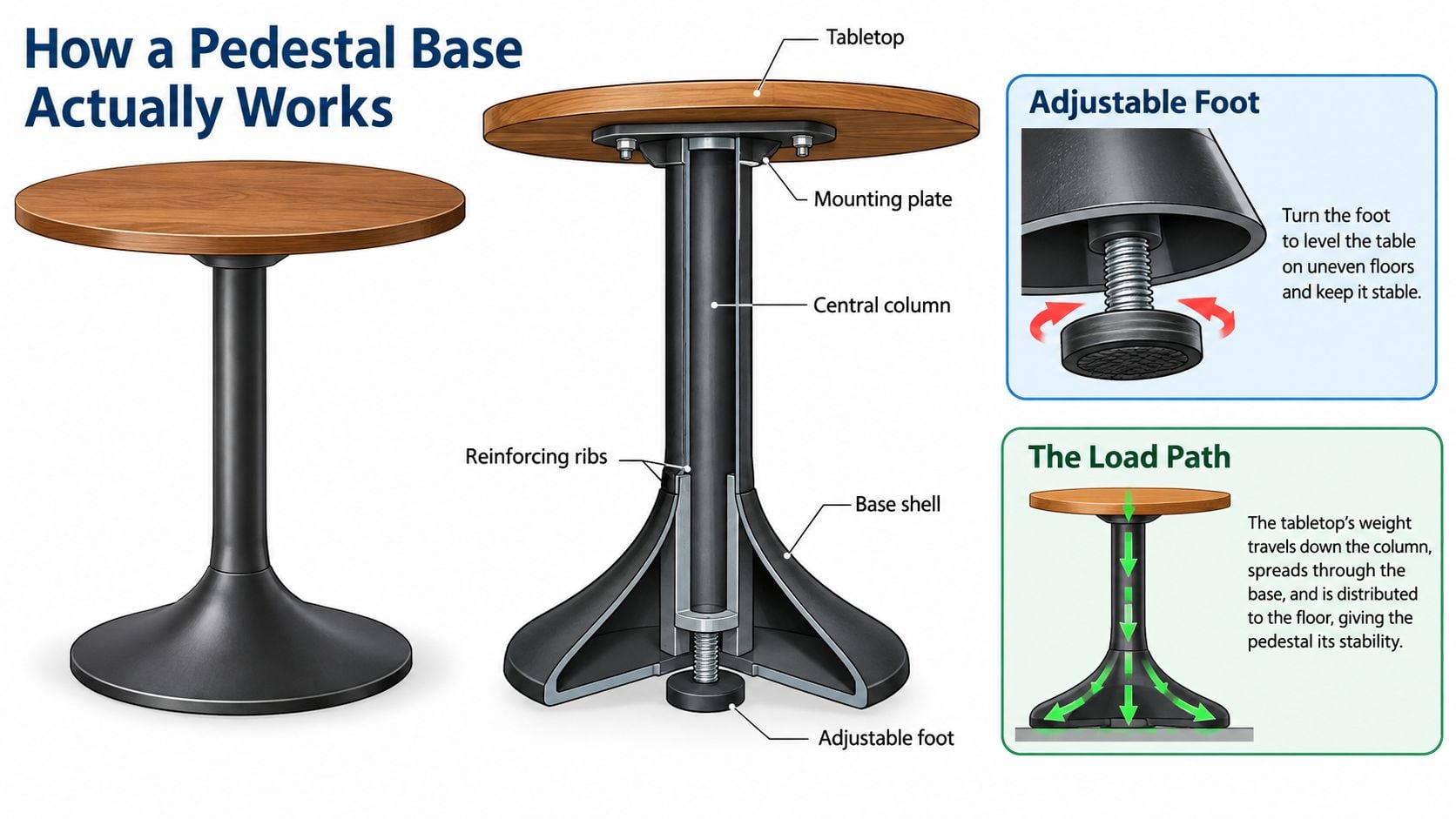
Three formats shoppers will encounter
A single round column on a tiered base suits smaller and moderate oval tops. The column transfers force into a broad lower platform, while the stepped profile adds visual weight without requiring corner legs.
A double pedestal uses two columns on separate or shared supports. This format keeps the long span from flexing as easily and gives larger tops a more dependable load path.
A sculpted trestle-style center pedestal combines a central visual statement with a wider structural spread. It can look architectural, but the base still needs enough clearance for chairs and feet.
The base's weight matters more than the column's ornament. A heavy solid wood or cast-iron base in the 40 to 60 pound range is described as significantly more stable than a hollow-formed base, particularly when guests lean on the edge or chairs move repeatedly. This pedestal table buying guide also explains why lowering the center of gravity improves resistance to tipping.
Inspect the floor contact
A sealed or weighted bottom helps keep the table planted on hardwood and carpet. Shoppers should check whether the lower foot sits flat, whether the finish protects the floor, and whether the base rocks before the tabletop is even loaded.
A useful showroom check is simple. Push lightly at several points around the oval edge, then place a hand on the base and repeat the test. The table shouldn't respond with a loose, delayed sway. For additional perspective on how support shapes affect comfort and circulation, Tyner's guide to a round dining table base offers a useful comparison.
Sizing the Base to the Oval Top
The most important sizing question isn't whether the pedestal looks substantial in a product photograph. It's whether the base footprint matches the tabletop's width and long-span load path.
A stable pedestal should have a footprint or spread roughly 50% to 70% of the tabletop's width or diameter, according to engineering guidance for pedestal dining tables. Heavier bases improve tipping resistance by lowering the center of gravity. On an oval, the base also needs to counter the torque created when plates, centerpieces, or people load one end.
A practical threshold
For an oval top larger than about 150 centimeters, a single pedestal can begin to feel unstable at the perimeter. A cross-foot, twin-pedestal, or broader support structure distributes the load and reduces flex at the ends. A pedestal table sizing guide similarly notes that a single pedestal can work up to about 150 centimeters in diameter when proportioned correctly, while larger tops benefit from broader support.
The following comparison uses the specific thresholds shoppers are most likely to evaluate in a showroom. It separates the tabletop length from the footprint question, because a long oval can look balanced while still placing too much load on a narrow foot.
Pedestal Base Sizing Thresholds by Oval Top
| Oval Top Length x Width | Recommended Base | Suggested Base Footprint | Notes |
|---|---|---|---|
| Up to about 48 x 36 inches | Single round pedestal | Broad, proportionate central foot | Works well when the base spreads across a substantial share of the tabletop width |
| About 60 inches long | Twin pedestal preferred | Two supports matched to the span | Keeps the loaded top centered between the columns |
| About 72 inches long | Twin pedestal or reinforced single base | Wider spread with strong lateral support | Better suited to regular family seating and heavier serving loads |
| Larger than about 150 centimeters | Cross-foot, twin pedestal, or broader structure | Footprint scaled to the top | A narrow single pedestal may wobble at the perimeter |
Undersizing creates lateral movement and edge-heavy flex. Oversizing creates a different problem, it takes away knee clearance and limits where chairs can tuck. The right answer is not the biggest base available. It's the smallest base that provides a dependable spread without intruding into the comfort zone.
A seasoned showroom advisor will also check the relationship between the base and chair positions. If the long axis encourages end seating, the support must leave those locations usable. A stable table that makes the end chairs uncomfortable hasn't been properly specified.
Seating Capacity and Clearance Made Practical
Seat count follows the usable edge, not the surface area printed on a product page. Curved ends can offer flexible placement, but chair width, armrests, base position, and room circulation decide whether that capacity feels comfortable.
A 48-inch oval seats four comfortably, while a 60-inch oval fits six with armless chairs, according to the specified planning guidance. An 84-inch oval can stretch to eight when the pedestal foot is wide enough to anchor the top. Those figures describe practical arrangements, not permission to crowd every inch of the perimeter.
Oval Pedestal Table Sizing at a Glance
| Oval Length | Seats, Armless Chairs | Seats, Armed Chairs | Min. Room Width |
|---|---|---|---|
| 48 inches | 4 | Fewer than the armless-chair arrangement | Size the room around chair pull-out and circulation |
| 60 inches | 6 | Fewer than the armless-chair arrangement | Leave a clear walking zone beyond the chairs |
| 72 inches | 6 or more, depending on chair width | Fewer than the armless-chair arrangement | Match the room width to the full chair and traffic pattern |
| 84 inches | Up to 8 with suitable support | Fewer than the armless-chair arrangement | Use a broad, stable base and verify end-chair clearance |
The practical comfort benchmarks are equally important. Plan for about 24 inches of chair depth, 12 inches between place settings, and 36 inches of walking room behind each seated guest, based on the provided dining-space guidance. Dining tables generally sit at 29 to 30 inches high, with about 10 to 12 inches of knee clearance for comfortable adult seating. The underside should also preserve at least 14 inches of unobstructed depth between the table edge and any pedestal column or stretcher. Ergonomic pedestal table guidance explains why these clearances protect posture and chair movement.
Room-fit check: A table can technically seat six and still fail if the chairs cannot pull back without blocking the kitchen path.
Match the table to real habits
Two adults who host occasionally can usually make good use of a 60-inch oval. A household of six should look toward a 72- to 84-inch top with a sturdy twin pedestal or reinforced single base. Armless chairs make the perimeter more flexible. Wide arms need more careful positioning, particularly at the curved ends.
A pedestal removes many apron and corner-leg conflicts, but it doesn't erase room planning. Tyner's guide to maximizing dining space with table shapes and seating arrangements provides a useful starting point before a family measures chairs and walking paths.
Wood Species, Finishes, and Joinery That Outlast Trends
A dining table earns heirloom status through its material integrity, not through a fashionable silhouette. Amish hand-crafted solid wood pieces stand apart from mass-produced alternatives because the maker can select the wood, orient the grain, shape the edge, and build the base as a complete structural system.
Quarter-sawn white oak is a strong choice when stability and visible grain matter. Its cut reveals a distinctive figure and gives the tabletop a substantial, architectural presence. Brown maple has a softer grain that accepts painted finishes cleanly, making it suitable for a room where the table should support the color scheme rather than dominate it. Rustic cherry brings deeper color and develops more character with sunlight.
The right species depends on the room's light, the household's maintenance habits, and the desired interior design language. A shopper comparing cabinet wood species tags can use the same broader vocabulary of grain, color, hardness, and finish behavior when evaluating dining furniture.
Finish is part of the construction
A catalyzed conversion varnish seals wood fibers against everyday moisture rings and spills. An Amish hand-rubbed stain keeps more of the grain texture tactile, so the surface feels like wood rather than a sealed sheet. In the showroom, the difference is sensory. A hand-finished top has visual depth and the warm touch of a material that hasn't been reduced to a printed surface.
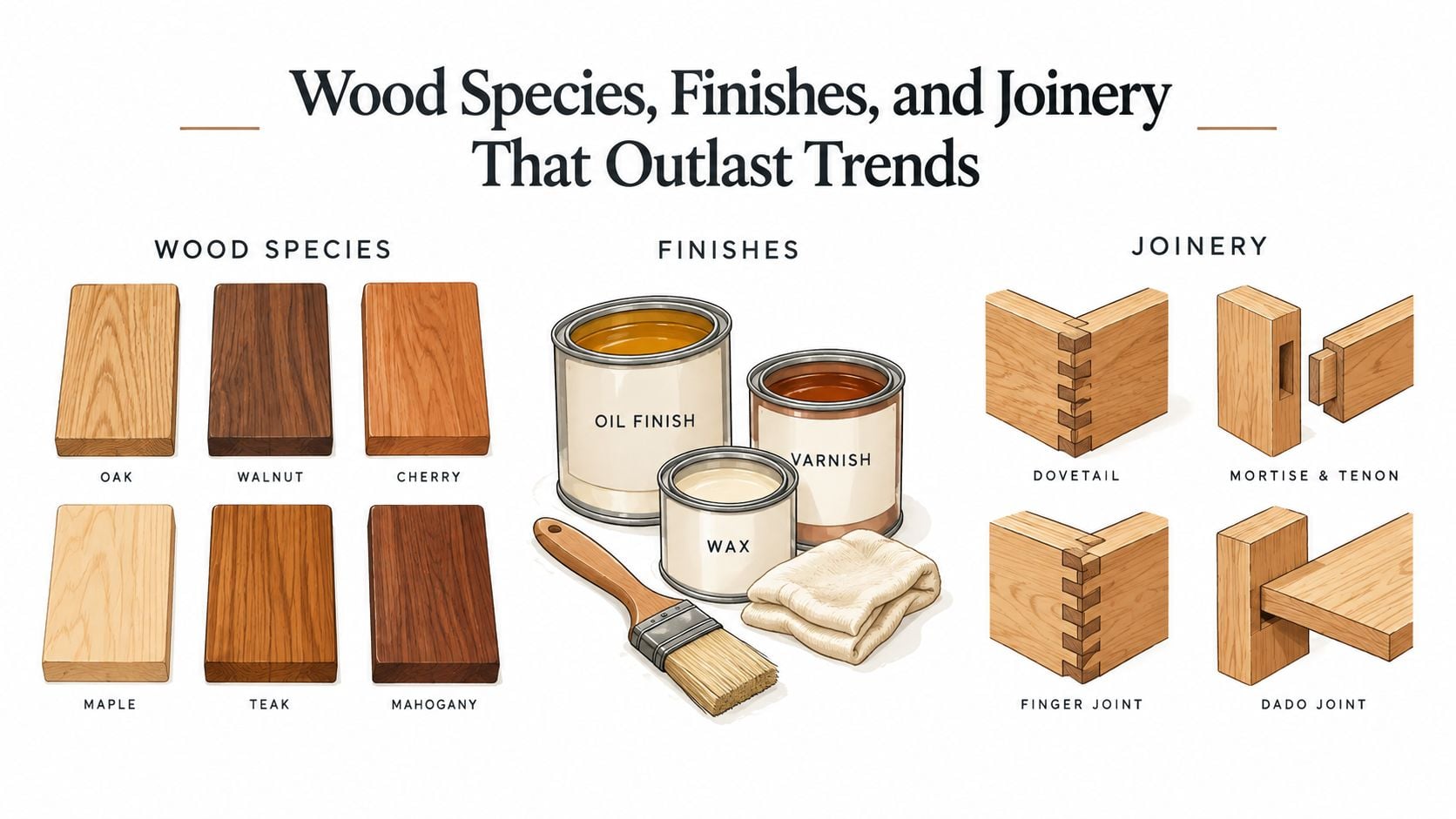
Joinery reveals the maker's priorities
Mortise-and-tenon joinery connects the pedestal and structural members with a strong mechanical joint. Dovetailed aprons resist separation, while continuous-grain tabletops and well-matched leaves preserve a coherent appearance when the table expands. Corner blocks can add stability where the apron and support meet.
Mass-produced tables often rely on staples, dowels, and veneers. Those methods can produce a presentable table, but seasonal movement and daily loading expose weak connections over time. An heirloom table is designed to be serviced and refinished rather than replaced. A solid wood dining table can last 20 to 50 or more years, and some pieces continue beyond 100 years. Refinishing is often needed around every 15 to 20 years, according to solid wood dining table longevity guidance.
Tyner's discussion of choosing the right hardwood for longevity and style reinforces the useful showroom habit of judging the whole piece, not only the stain color. The goal is a sustainable purchase with a long cost-per-year value.
Styling and Room Planning Around an Oval Pedestal
The room should be planned as a traffic pattern before it becomes a decorating exercise. An oval table already softens a rectangular dining zone, and the pedestal removes corner legs, so the surrounding furniture should preserve that openness rather than crowd it with competing shapes.
Start with painter's tape on the floor. Mark the complete tabletop, then add the pulled-back chair positions and walking routes. Neutral buying guidance recommends leaving about 36 inches of clearance around the table, while delivery planning should account for doorways, hallway turns, ceiling fixtures, and the table's longest diagonal. This oval dining table room-planning guide emphasizes the delivery path as well as the finished room.
Build the room around movement
A rug should be large enough that chairs remain on the rug when pulled back. A rug that ends beneath the rear chair legs creates a constant rocking point and makes the dining area feel smaller. The table edge should sit about 48 inches from a wall for serving clearance, according to the specified styling guidance.
A pendant or linear fixture should be centered over the oval and hung 30 to 36 inches above the tabletop. The fixture's length should follow the table's long axis, while its visual weight should complement the pedestal rather than compete with it. Seat height must also match the table edge and underside so chairs don't look too low or force diners to lift their shoulders.
Let the pedestal remain visible
A low centerpiece keeps sightlines open and lets the base read as part of the design. A runner-free tablescape showcases continuous grain and the tactile character of a hand-crafted top. A bench on one side can give families flexible seating, provided the bench doesn't block the pedestal or the room's main walking path.
The table's silhouette should connect with nearby pieces without making the dining zone feel staged. Readers exploring choosing a hospitality design partner may find the same principle useful: strong design begins with circulation, service access, and how people occupy a room.
Custom Orders, Delivery, and Payment Flexibility
A made-to-order dining table should follow the household's measurements, not force the household to adapt to a stock footprint. The process becomes manageable when decisions happen in a practical order.
Set the top dimensions. Start with the room, chair count, and preferred seating pattern. Decide whether the daily arrangement needs four, six, or more places, then test the taped footprint.
Choose the support structure. Match a single pedestal, twin pedestal, cross-foot, or trestle-style base to the oval's span. Longer tops need more attention to edge stability and end-chair clearance.
Select the material and finish. Compare quarter-sawn white oak, brown maple, rustic cherry, and other solid hardwood options. Review edge profiles, stain samples, and painted finishes under the home's actual lighting.
Complete the seating. Armless chairs maximize flexibility. A bench can add adaptable family seating. Upholstered options bring comfort, including the buttery feel of top-grain leather, while the right seat height protects ergonomic posture.

Delivery deserves its own measurement
The finished dining room is only one part of the project. Measure the front door, interior doors, stair turns, elevator clearance, and the longest diagonal required to rotate the tabletop. A large oval can clear the doorway yet fail at a hallway turn.
White-glove delivery crews may disassemble and reassemble the pedestal when the design allows it. That service should be confirmed before ordering, particularly in older Ann Arbor homes, apartments, and narrow Southeast Michigan entries. The guide to getting started with a custom order offers a useful framework for organizing these decisions.
Make quality financially workable
Special Financing can spread a major solid-wood purchase across manageable terms, subject to credit approval. Tyner Furniture also offers a Low Price Promise, giving local shoppers a way to evaluate competitive value without reducing the conversation to the initial ticket.
Customization includes more than dining tables. Canadel allows shoppers to configure finishes, fabrics, edges, and arrangements, while Stressless brings personalized ergonomic sizing to comfort seating. In-stock is just the beginning. A coordinated home can include made-to-order dining, customized upholstery, and seating selected for the body rather than chosen only from a photograph.
Choosing Your Oval Pedestal Table With Confidence
An oval dining table with pedestal base is a daily-use decision disguised as a style decision. The curved top can improve traffic flow, but the pedestal must carry the load without stealing the knee space that makes the design worthwhile. A single central support can be excellent for a moderate oval. As the top gets longer, twin pedestals or a broader structure become the more responsible choice.
The buying sequence should stay simple:
- Measure the room and delivery path: Tape the tabletop, chair positions, circulation lanes, doorways, and turns before ordering.
- Match support to span: Use the base footprint, not the ornament, as the stability test.
- Choose solid hardwood intentionally: Select oak for pronounced grain and stability, brown maple for painted finishes, or cherry for depth that develops with light.
- Inspect joinery: Look for mortise-and-tenon construction, dovetailed aprons, sound pedestal connections, and leaves that relate visually to the host top.
- Plan for longevity: A table that can be refinished and used for decades offers stronger cost-per-year value than a piece chosen only for immediate appearance.
See the difference in person
The best showroom test is physical. Sit at the ends, shift the chairs, lean lightly against the edge, and check whether the base remains quiet. Run a hand over the finish. Compare the buttery feel of top-grain leather on nearby seating with the weight and grain of solid cherry, oak, or maple. Those details are difficult to judge online and central to a lasting purchase.
Customization also prevents the most common compromise, forcing a stock table into a real room. Tyner's selection includes oval dining furniture and pedestal configurations, along with options across the Home Office, bedroom, living areas, and Outdoor Spaces. The South State St. showroom gives Ann Arbor shoppers a place to compare edge profiles, finishes, chair heights, and base stability before committing.
A well-built table becomes part of a local legacy. It hosts ordinary Tuesday dinners, celebrations, homework, and future gatherings. The right solid-wood Amish piece can carry those moments for a generation, which is why craftsmanship, bespoke dimensions, and ergonomic comfort deserve more attention than a passing trend.
Tyner Furniture offers made-to-order dining guidance, Amish hand-crafted solid wood options, Canadel customization, Stressless ergonomic seating, Special Financing, and a Low Price Promise. Visit Tyner Furniture in Ann Arbor for a proper sit test and finish comparison, or browse the online Quick Specs to begin narrowing a special-order oval pedestal table.