Dining Room Chairs with Leather Seats: A 2026 Buying Guide

Tuesday night in an Ann Arbor home rarely looks like a formal dining-room photograph. Four chairs get pulled into service for homework, a quick dinner leaves a sauce mark on one seat, and someone drags a chair across the floor to reach a charging cable. Two months later, those same seats host Thanksgiving. That ordinary pattern is exactly why dining room chairs with leather seats deserve more scrutiny than a quick style decision.
A chair handles constant contact, shifting weight, spills, and repeated movement. A table mostly holds objects. A sofa receives lounging, but dining chairs take concentrated pressure on a smaller frame, often several times a day. Flaws that remain invisible under showroom lighting, such as weak corner blocks, thin cushioning, or a finish that marks easily, become obvious once a family lives with the chairs.
A fifteen-to-thirty-year ownership decision comes down to three practical choices: leather grade, frame joinery, and seat geometry. The right combination creates an heirloom rather than a chair that merely looks polished at delivery.
Why a Leather-Seated Chair Deserves the Same Attention as the Table
Daily use reveals the real construction
The first week, almost any well-photographed chair can feel comfortable. The better question is how it will feel after repeated meals, homework sessions, holiday gatherings, and casual conversations. A leather seat needs resilient cushioning beneath it, a frame that resists racking, and a height that lets the body sit naturally at the table.
Leather has a long history in dining furniture. The National Trust Collections records a dining chair dated circa 1750, made from red walnut with a seat covered in embossed eighteenth-century calfskin, part of a set of Chippendale-style chairs. That surviving example shows that leather served as both a refined surface and a durable seating material more than 270 years ago. The National Trust Collections record documents the chair's construction and historic leather seat.
That heritage still matters, but modern households place different demands on furniture. Ann Arbor families need chairs that can manage everyday meals, children, pets, and entertaining without requiring museum-level treatment.
Practical rule: A dining chair should be judged by the forces it handles every day, not by how impressive it looks beside an untouched table.
The hidden cost of a weak chair
A loose joint rarely announces itself in the showroom. Foam compression can take time to appear. A surface finish may look flawless until armrests, rings, and repeated contact expose its limitations. Replacing a full set because the frames wobble or the seats flatten turns a seemingly sensible purchase into a recurring expense.
Leather remains a commercially important upholstery material rather than a niche choice. One industry report estimated the global furniture upholstery leather market at USD 5.2 billion in 2024, with a projection of USD 9.8 billion by 2034 at a 6.5% CAGR. The same report attributed 35.4% of the 2024 market to North America, with residential demand representing 55% globally and residential furniture 60%. Furniture Upholstery Leather Market data places leather within the larger home-furnishing market that includes dining seating.
That scale supports a straightforward conclusion. Leather seating remains a serious option for households seeking a premium, lasting finish. The material choice matters, but it can't rescue a poorly engineered chair.
Understanding the Different Types of Leather Used in Dining Seating
“Leather” isn't a complete specification. On a showroom floor, buyers may encounter full-grain, top-grain, split, bonded, and faux or PU leather, and each label describes a different material structure.
The five labels that matter
Full-grain leather keeps the dense outer surface of the hide. It tends to breathe, develop a visible patina, and reward careful ownership. High-quality full-grain seating can last roughly 15 to 20 years or more with care, according to independent furniture guidance. Leather chair lifespan guidance explains why construction quality and care affect the ownership period.
Top-grain leather also comes from the hide's stronger outer portion, but manufacturers sand or buff the surface for a smoother, more uniform appearance. That treatment improves visual consistency and everyday usability while giving up some of full-grain leather's natural toughness. Industry guidance commonly places well-maintained top-grain seating in the 10-to-20-year range. Top-grain leather quality and durability describes the balance between appearance, comfort, and resilience.
Split leather comes from the lower layer of the hide. It may be finished to resemble a smoother leather or used with a suede-like surface, but it doesn't retain the same dense outer fiber structure.
Bonded leather uses leather fibers or scraps combined with adhesive and a backing. It can provide a leather-like appearance at a lower initial commitment, but its surface may eventually crack or peel rather than develop a graceful patina.
Faux or PU leather is a polymer surface designed to imitate leather. It can be practical for a particular budget or aesthetic, but the face coat eventually flexes, abrades, and loses its finish.
The phrase “genuine leather” is not a grade. It confirms a leather content claim, but it doesn't tell a shopper whether the material is full-grain, top-grain, split, or bonded.
Surface finish changes the experience
Aniline leather shows more natural variation and usually develops character more visibly. Semi-aniline leather adds limited protective finishing while retaining some natural appearance. Pigmented leather uses more uniform color and surface protection, making it easier to specify for active dining rooms.
| Leather Type | Typical Lifespan | Surface Character | Best Fit |
|---|---|---|---|
| Full-grain | Qualitatively long-lasting with care | Natural markings and patina | Heirloom dining rooms |
| Top-grain | 10 to 20 years with proper care | Smooth, consistent, refined | Daily-use premium seating |
| Split | Qualitatively shorter than top-grain | Finished or suede-like | Selective, lower-demand use |
| Bonded | Qualitatively limited | Leather-like coating | Shorter-term style needs |
| Faux or PU | Depends heavily on face coat | Uniform polymer surface | Budget-conscious or specific design use |
For a practical explanation of the distinction, the top-grain leather versus bonded leather guide gives buyers useful terminology before they compare swatches.
Frame Construction, Seat Geometry, and What Makes a Chair Last
A dining chair is engineered furniture, not a decorative prop. Its longevity depends on how the frame distributes weight, how the seat meets the table, and how the joints respond to years of side-to-side movement.
Four measurements shape comfort
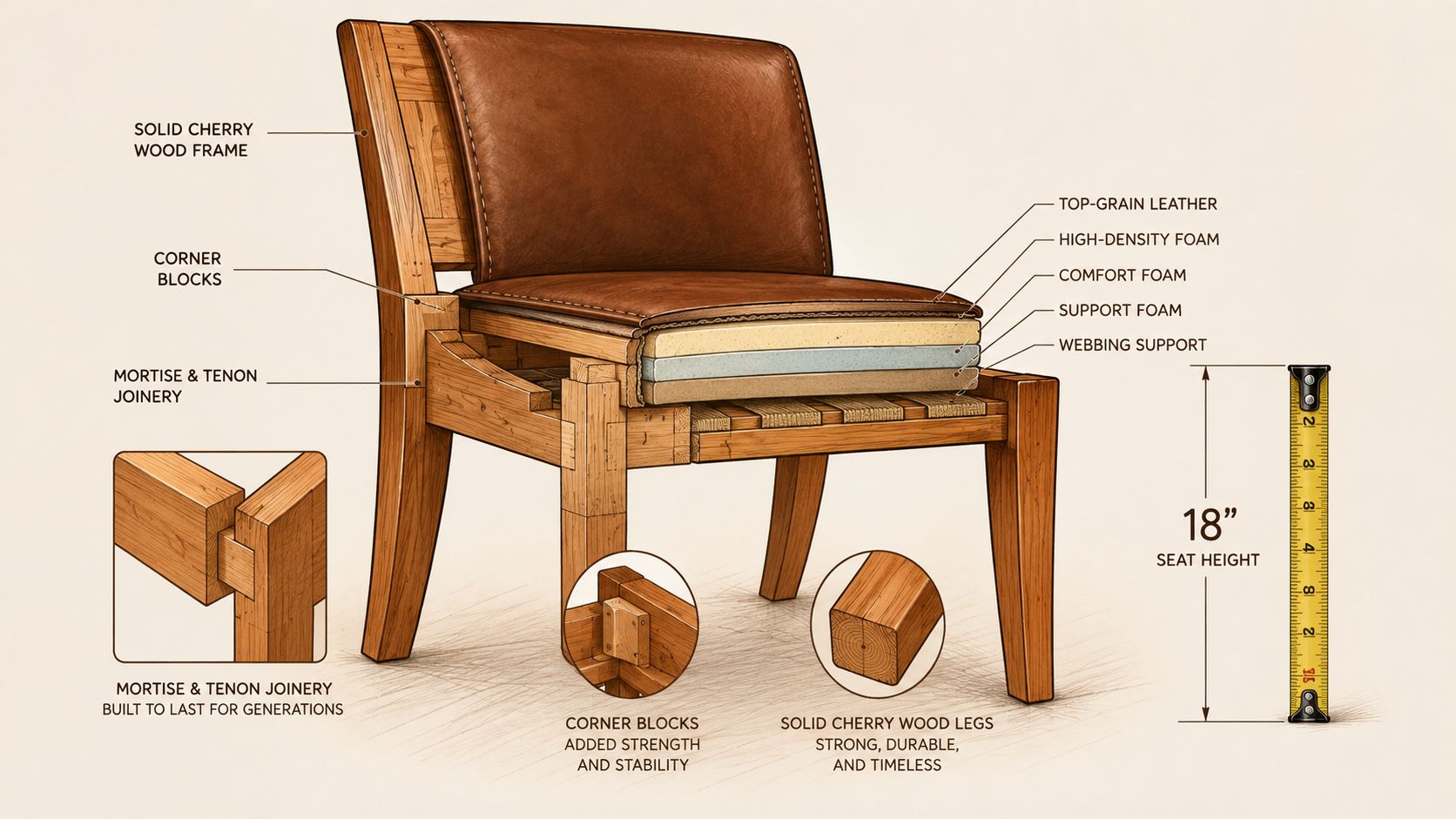
A seat height of roughly 17 to 20 inches suits standard dining tables measuring about 28 to 30 inches, leaving approximately 10 to 12 inches between the seat and tabletop. Dining chair selection guidance connects that clearance with thigh comfort, knee freedom, and a more natural posture.
Seat depth needs equal attention. A moderate depth supports the lower back without pushing into the backs of the knees. The back should offer a slight recline and enough contour to prevent the familiar forward hunch that makes long meals tiring.
Before ordering, a shopper should check:
- Seat height: Compare the finished seat to the table apron, not only the tabletop.
- Knee clearance: Sit fully back and confirm that thighs aren't pressed upward.
- Back support: Look for a supportive contour rather than a rigid, flat panel.
- Seat resilience: Press the cushion and notice whether it rebounds or remains compressed.
Joinery determines structural confidence
Mortise-and-tenon construction creates a broad glue surface and mechanically resists racking and tension. Traditional furniture joinery guidance identifies mortise-and-tenon as one of the strongest traditional wood joints for furniture.
A well-built hardwood frame with corner blocks and strong mechanical joinery should rank ahead of a frame held together mainly by staples or particleboard. Cushion specifications matter too. High-resilience foam wrapped in a protective topper generally holds its shape better than commodity foam, but shoppers should ask the manufacturer for actual specifications rather than assume every upholstered seat uses the same interior.
The useful calculation is simple: divide the purchase cost by the years the chair is expected to serve. A chair that remains supportive and stable for decades can carry a higher annual value than a lower-priced chair that needs early replacement. Leather furniture longevity guidance supports evaluating well-built leather seating as a long-term investment rather than a short-term purchase.
For a practical measurement checklist, the dining chair selection guide helps shoppers prepare before a showroom visit.
Leather vs Performance Fabric vs Mixed-Material Dining Chairs
Three upholstery approaches appear often in Southeast Michigan dining rooms, and none wins every household. The right choice depends on how the chairs are used, how spills are handled, and whether the room needs a formal or relaxed presence.
All-leather chairs suit formal dining rooms that still see daily use. Top-grain leather offers a smooth, buttery feel and a quick wipe-down after ordinary spills. It can show scratches, especially in homes with pets or active children, but those marks may become part of the surface character when the leather is well made.
Performance fabric makes more sense in a casual eat-in kitchen with toddlers or frequent craft projects. It can resist stains effectively, but fabric may hold odors and usually requires more involved spot-cleaning. The exact result depends on the textile construction and care instructions.
Mixed-material seating offers a useful middle ground. A leather seat takes the concentrated wear while a fabric back introduces softness, texture, and a more breathable visual silhouette. This format works well for homeowners who want leather's practical seat surface without an entirely formal chair.
| Criteria | All-Leather | Performance Fabric | Mixed-Material |
|---|---|---|---|
| Daily wear | Strong choice with appropriate leather grade | Depends on textile construction | Durable seat with softer back |
| Spill response | Usually quick to wipe | Stain resistance varies | Leather seat simplifies cleanup |
| Warm-weather feel | Can feel warm in a sunny kitchen | Often feels more breathable | Fabric back improves airflow perception |
| Pets and kids | Scratches may show | Stains and odors need attention | Balanced approach |
| Design character | Polished and tailored | Relaxed and varied | Textured, transitional silhouette |
Abrasion testing provides a useful technical comparison. North American suppliers commonly use the Wyzenbeek rub test, while European and UK suppliers often use Martindale. Both measure resistance through repeated rubbing under controlled conditions, and higher cycle or rub counts indicate stronger wear resistance. Upholstery abrasion testing guidance explains why test results can help assess high-use dining applications.
A showroom advisor should also ask whether a household values quick cleaning more than a softer hand. The upholstery materials guide gives a broader framework for weighing those trade-offs.
Styling Leather Seating With Your Dining Table and Room
Leather chairs work best when the frame, back, and seat shape respond to the table rather than compete with it. A thick reclaimed-wood top benefits from the clean authority of a Parsons-style chair. A pedestal table often looks better with an open spindle-back that keeps the sightline light. A fully upholstered Parsons chair can soften a glass table without making the room feel cold.
Match visual weight and finish temperature
Warm chestnut or walnut frames complement cognac and chestnut leather because both materials carry golden or red undertones. Black or weathered-oak frames pair naturally with cooler gray and black leathers, creating a more restrained modern composition.
The same rule applies to solid wood dining furniture. Tyner's Amish hand-crafted pieces use material integrity and traditional joinery as a clear contrast to mass-produced alternatives. The weight of solid cherry, oak, or maple feels different from a thin decorative surface, and the finish should be selected with the leather rather than treated as an afterthought.
| Table Type | Recommended Chair Style | Why It Works |
|---|---|---|
| Reclaimed wood | Parsons-style leather chair | Strong upholstery contrasts with rustic grain |
| Pedestal base | Spindle-back or open-back chair | Preserves open sightlines around the base |
| Canadel made-to-order table | Coordinated leather side chair | Lets finish, leg style, and upholstery feel intentional |
| Amish solid-wood table | Hand-crafted framed leather chair | Extends the heirloom character through the seating |
| Glass-top table | Fully upholstered Parsons chair | Adds warmth and visual softness |
Homeowners developing a mid-century room can use the Vizcraft mid-century interior reference to study proportions, wood tones, and open visual lines before selecting a chair.
Room scale matters as much as color. Measure the table's usable edge, leave comfortable passage around occupied chairs, and avoid filling a small room with deep arms that interrupt traffic. A rug should extend far enough that chair legs remain supported when people pull back from the table.
For a broader review of silhouettes, the guide to dining chair styles can help narrow the field before comparing leather samples.
Caring for Leather Dining Chairs So They Age Well
Leather lasts longer when care matches the material. Full-grain and top-grain surfaces benefit from a simple routine, while coated lower-grade materials don't respond to conditioning in the same way.
A practical maintenance rhythm
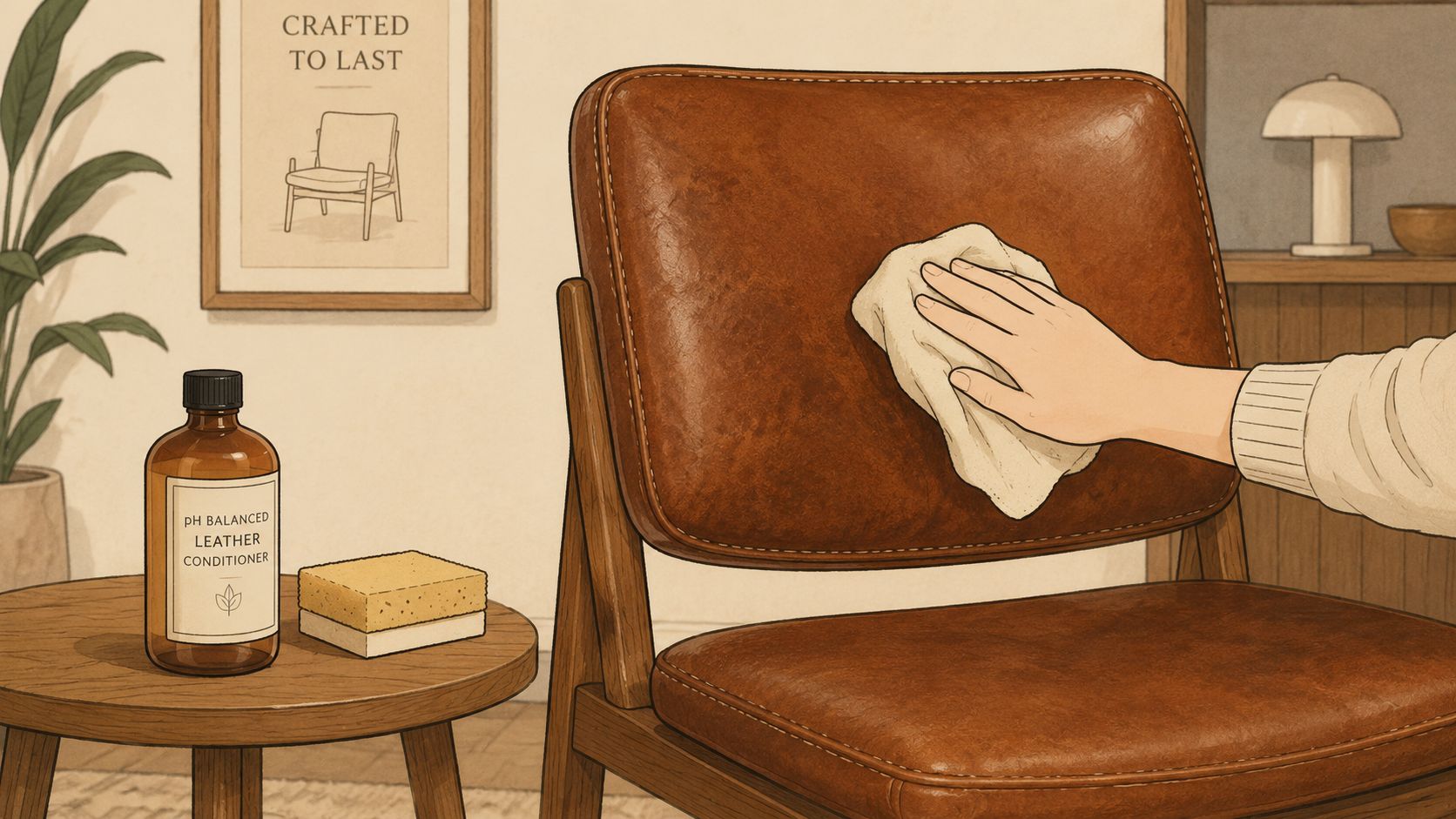
Dust premium leather weekly with a dry, soft cloth. Wipe a fresh spill promptly with a damp microfiber cloth, using gentle pressure rather than rubbing the mark deeper into the surface. Apply a pH-balanced leather conditioner every six to twelve months to full-grain and top-grain upholstery, following the product's instructions and testing an inconspicuous area first. Leather furniture protection guidance provides additional care direction.
Split and bonded leather deserve a different expectation. A surface coating can prevent conditioner from absorbing meaningfully, so conditioning won't restore peeling or a failing finish. Once the coating has deteriorated, replacement is usually more realistic than restoration.
Small mistakes create avoidable wear
- Harsh cleaners: All-purpose chemicals can strip or dull the finish.
- Paper towels: Rough fibers may leave fine scratches on a smooth surface.
- Direct sunlight: Strong exposure can fade pigmented leather over time.
- Overnight spills: Food oils and liquids become harder to remove after they sit.
- Ignored contact points: Arm caps and seat fronts usually reveal wear before protected areas.
During heating season, households should inspect dry-looking surfaces and clean dust from seams. Keep chairs away from intense direct sunlight where possible, and rotate removable cushions or reversible components when the design allows. A consistent routine protects the material's feel and keeps a premium chair looking lived-in rather than neglected.
Why a Custom Order Changes the Value Equation
In-stock is just the beginning. A made-to-order program gives a homeowner the ability to solve the problems that stock furniture often leaves behind, especially when the existing table, floor, and room proportions already impose requirements.
Canadel customization can address three common regrets. A homeowner can specify a seat height that works with the table, choose a wood finish that relates to new flooring, and select a leather grade suited to the household's actual use. Those choices matter more than selecting a chair because its showroom color happens to look attractive under display lighting.
Sit testing replaces guesswork
A showroom sit test reveals details that product photography can't. The shopper can check knee clearance, posture, back support, seat firmness, and whether the leather encourages comfortable movement. Custom sizing is also familiar in ergonomic seating. Stressless offers Small, Medium, and Large sizing in its seating programs, a useful reminder that body fit shouldn't be treated as a minor detail.
| Factor | Custom Order, Canadel | In-Stock Chair |
|---|---|---|
| Seat fit | Can be selected around the existing table | Must be accepted as specified |
| Finish | Chosen to coordinate with room materials | Limited to available combinations |
| Leather selection | Can align grade and finish with household habits | May offer fewer material choices |
| Configuration | Made-to-order options support a bespoke result | Immediate selection, less flexibility |
| Ownership value | Higher fit potential over a long service period | Works when dimensions and materials already suit the room |
A cost-per-year comparison makes the decision clearer. A USD 1,400 custom chair used daily for 20 years equals USD 70 per year, while a USD 600 stock chair replaced twice represents USD 60 per year across the same twenty-year span. Those figures are an editorial example, not a market statistic, but they demonstrate why purchase price alone doesn't define value.
Tyner Furniture can connect shoppers with customizable dining options, including Canadel programs and upholstered seating, while its broader selection extends from the Home Office to Outdoor Spaces. Special Financing, subject to approval and program terms, can make a long-term purchase easier to plan, and a Low Price Promise gives local shoppers a practical value check.
Choosing Your Leather Dining Chairs in Ann Arbor
The strongest purchase follows a sequence rather than an impulse. Start with household habits, then verify the materials and construction before committing to a finish.
A useful decision checklist includes:
- Leather grade: Select full-grain or top-grain when long ownership and a genuine patina matter. Consider the surface finish in relation to spills, pets, and sunlight.
- Frame construction: Inspect the underside, joints, corner support, and overall stability in person. A chair shouldn't flex or wobble when someone shifts position.
- Seat geometry: Match seat height to the table and confirm thigh, knee, and lumbar comfort during a real sit test.
- Room coordination: Compare leather and wood swatches with existing flooring, table finishes, wall color, and nearby upholstery.
- Care expectations: Choose a maintenance routine before purchase, not after the first spill.
- Future flexibility: Ask whether finishes, fabrics, leather options, and configurations can be customized through a made-to-order program.

Ann Arbor shoppers can compare leather swatches under showroom lighting, sit in several frame shapes, and review Canadel or other made-to-order configurations with a design consultant. Qualifying buyers can also ask about Special Financing, while the Low Price Promise helps keep the comparison grounded in competitive value.
Tyner Furniture has served Southeast Michigan since 1957, building a local legacy around guidance and craftsmanship. A dining-room consultation can also connect the project to coordinated pieces across the home, from the Home Office to Outdoor Spaces, instead of treating the dining room as an isolated purchase.
Visit Tyner Furniture in the South State St. showroom for a proper sit test, leather comparison, and made-to-order review for dining room chairs with leather seats. The team can also help Ann Arbor households browse Quick Specs for special orders and plan a purchase around available financing and the Low Price Promise.