Aniline vs Semi Aniline Leather: Which Finish to Choose

You're standing in a showroom, or scrolling a product page at eleven at night, and the leather description reads "semi-aniline" as though that settles the matter. It doesn't. Two sofas can share the same full-grain hide quality and behave completely differently in a family room, because the label describes the finish sitting on top of the leather, not the leather underneath it.
That finish decides how fast a spilled glass of wine soaks in, how evenly the seat cushions hold their colour, and whether the armrest darkens where a hand rests every evening. The choice isn't good leather versus lesser leather. It's a trade between visible aging and everyday maintenance, and once you see it that way, the decision gets a lot calmer.
Aniline and Semi-Aniline Side by Side
Here's the short answer: aniline is the most natural finish, with little or no protective coating, while semi-aniline keeps the same visible grain and adds a light pigmented topcoat for daily protection. Both are full-grain materials. The Leather Working Group's list of definitions sets aniline leather as retaining clearly visible natural grain either without a surface coating or with a non-pigmented coating usually no thicker than 0.01 millimetres (10 microns), while semi-aniline preserves visible grain but receives a light finish containing a small amount of pigment that improves colour uniformity and resistance to everyday soiling.
Aniline vs semi-aniline leather at a glance
| Criterion | Aniline | Semi-Aniline |
|---|---|---|
| Surface finish | Minimal or non-pigmented coating | Light coating with a small amount of pigment |
| Measured coating thickness | Roughly 2.7 microns in an uncoated test sample | Roughly 22.3 microns in a lightly finished sample |
| Visible grain | Fully exposed, with pores and natural markings | Still visible, slightly more even |
| Colour evenness | Varies from hide to hide | More uniform |
| Spill resistance | Low, liquids absorb quickly | Moderate, forgiving of everyday spills |
| Sun resistance | Fades more under direct light | Better resistance to light exposure |
| Patina over time | Develops strongly with use | Develops more slowly and predictably |
| Best fit | Low-traffic, carefully kept rooms | Family rooms, sofas and sectionals |
The coating-thickness figures come from a 2003 study in Materials Science (Medžiagotyra), which measured 2.7 microns on an uncoated aniline sample and 22.3 microns on a lightly finished semi-aniline sample. Those two numbers explain every other row in the table. Roughly eight times more finishing sits between the semi-aniline surface and whatever lands on it, which is why a splash of coffee gives you seconds to blot on semi-aniline and almost none on aniline.
Every row where aniline looks weaker is the price of keeping the hide's surface exposed, and that exposure is exactly what aniline buyers are paying for. The pores stay open, the markings stay visible, and the leather darkens and softens where life touches it. Semi-aniline is a lightly protected natural surface, and it sits close enough to the aniline end of the scale that the grain still reads clearly at arm's length. Fully pigmented leather sits at the far end of that scale and conceals much more of the grain in exchange for even stronger protection. If you're still sorting out grade versus finish, the comparison of top-grain leather and bonded leather clears up the other half of the label confusion.
A shortlist test you can run today
- Pets, children, meals on the sofa or direct sun: shortlist semi-aniline and stop worrying about it.
- A calm, carefully kept room with adults who blot spills straight away: aniline stays in contention.
- Unsure who'll use the piece most: specify by the seat that gets touched, not by the room's name. A formal sitting room used nightly by two teenagers behaves like a family room, whatever the floor plan calls it.
What the Finish Layer Really Changes
The difference between these finishes is physical and measurable, not a marketing adjective. In a 2003 study published in Materials Science (Medžiagotyra), the uncoated aniline sample labelled Nappa 0 carried a coating thickness of 2.7 microns, while the lightly finished semi-aniline sample labelled Nappa 1 measured a combined coating thickness of 22.3 microns, roughly 19.6 microns more finishing on an otherwise comparable natural surface.
Those were two real hides, not two coatings on the same skin. The study reported leather thicknesses of 0.45 millimetres for the aniline sample and 0.59 millimetres for the semi-aniline sample, and characterised Nappa 1 as more durable while retaining natural appearance and grain imperfections. A more heavily finished sample in the same work, Nappa 2, carried a 62.5-micron coating, which shows how much room sits between a light semi-aniline finish and an opaque one.
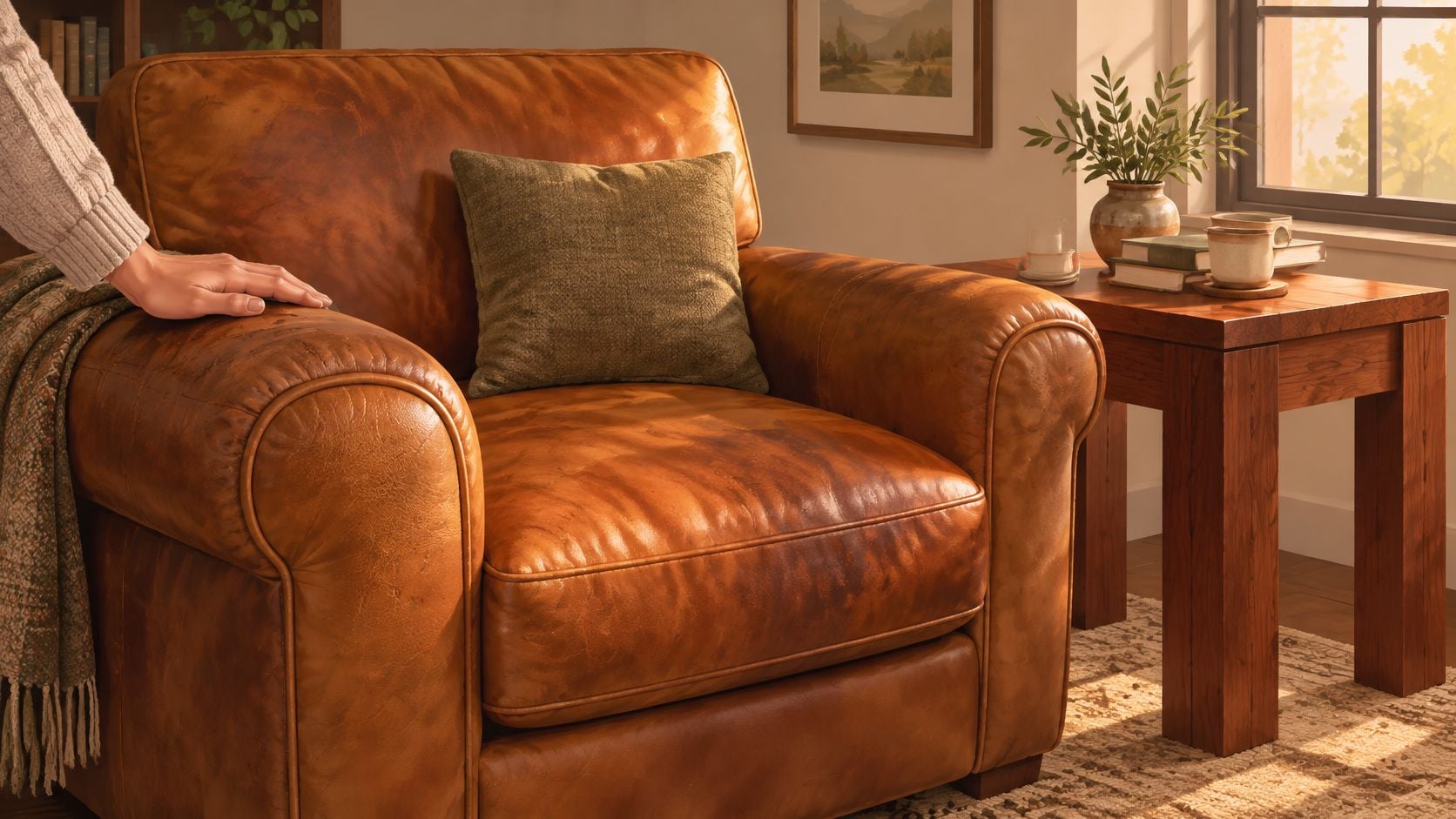
Semi-aniline adds a thin barrier that improves serviceability without hiding the grain.
Where the scale ends
A separate technical reference cited in that paper gives the broader ISO-aligned limit for ordinary leather surface coating as no more than 0.15 millimetres, or 150 microns, before the material is classified as coated leather. A semi-aniline finish in the low tens of microns is nowhere near that boundary, which is why the pores and grain still read clearly under your hand.
In a living room, that thin film does three useful things. It evens out tone from hide to hide, so a sectional's panels match more closely. It slows liquid absorption, buying you minutes instead of seconds. And it reduces the soiling that hands, denim and hair products leave on headrests and arms.
The sensory difference is real but subtle. Aniline feels closest to the hide, with the buttery give of top-grain leather and a warmth that shifts with the room. Semi-aniline feels slightly more finished under the palm, a touch smoother, still supple, still visibly grained. Neither feels plasticky, and anyone who tells you semi-aniline feels like vinyl is describing a heavily pigmented leather instead. For a wider view of how these surfaces sit alongside fabric and other coverings, the guide to upholstery materials is worth ten minutes.
Pro-Tip: A layer of about 22 microns is still thin. Blot spills within minutes on either finish, and treat the coating as protection rather than a guarantee.
Finish names don't disclose coating thickness, and thickness varies by tannery, so the number is something to request rather than assume.
How Each Finish Looks, Feels and Ages
Aniline wears its history openly. Pores, healed scars, growth marks and shifts in tone across the hide all stay visible, and the Leather Naturally guide to modern leather making notes that aniline leaves pores and natural markings visible and generally develops a stronger patina, while its open surface is more vulnerable to moisture, staining, scratches and ultraviolet fading. Semi-aniline uses a small amount of pigment in the coating, which improves colour uniformity and resistance while reducing transparency and muting some of that variation.
A year of ordinary use
An aniline chair placed beside a bright window and used daily shows its first real changes within months. The arm where a hand rests darkens to a deeper, glossier tone. The headrest picks up a slight richness from hair and skin contact. By the end of the first year the seat looks warmer than it did on delivery day, and the variation is part of the appeal. The same timeline on a semi-aniline chair reads differently: the surface darkens more slowly and more evenly, so the piece stays closer to its original colour, with wear spread across the surface rather than concentrated in one glossy patch.
Neither outcome is damage. One is a record, the other is consistency, and households differ on which they'd rather live with.
Sunlight accelerates both paths but hits aniline harder. A south-facing seat in full aniline can fade noticeably while its shaded back stays deep, producing the two-tone drift that some owners love and others can't accept. Semi-aniline fades too, just less dramatically, because the pigment in the finish absorbs part of the ultraviolet exposure before it reaches the dye in the hide.
Two ownership models for different households
The same leather guide frames the choice as two ownership models: aniline suits buyers who value tactile softness and evolving character and are willing to manage placement and spills, while semi-aniline suits households wanting visible grain with a more predictable appearance and easier daily care. That's the honest question to sit with. Does the leather tell its story, or look much the same on day one and year five?
Physical context matters too. Soft leather over a hand-crafted solid cherry frame carries a different presence than the same hide over a light boxed frame, the weight of solid cherry wood underneath settling the whole piece into the room. A dining chair back gathers warmth from the afternoon light and from the people leaning on it, and that contact is where the finish earns its keep.
One caution on maintenance advice: the widely repeated instruction to condition every six to twelve months isn't universally safe, because products and finishes differ, and general leather guidance stresses using products intended for the specific leather and avoiding harsh household chemicals. Aniline responds to conditioning by darkening slightly, which some owners treat as a feature and others as a flaw. Semi-aniline, with pigment already sitting in the finish layer, tends to show less change from the same product. Ask for the finish-specific care sheet, confirm the ultraviolet exposure limits, and patch-test any cleaner somewhere hidden before it goes near an armrest.
Durability, Care and Cost per Year
"Semi-aniline is the durable one" is the most common half-truth in leather shopping. Industry definitions allow real variation in pigment quantity and finish-film thickness, and the performance floor is lower than most shoppers assume. Under EN 13336, as set out in Leather Magazine's review of definitions and standards, pigmented leather is required to pass 250 wet rubs, while semi-aniline leather is required to pass only 80 wet rubs.
That gap matters. Semi-aniline isn't stain-proof, child-proof, or equivalent to a heavily protected pigmented leather, and it isn't one standardised middle category. Two sofas both labelled semi-aniline can carry quite different finish systems. Aniline has no comparable published minimum in that standard, which is another reason to ask for test results rather than infer performance from a word on a tag.
Judge it by cost per year
Leather is an heirloom purchase, so price it the way you'd price a roof or a good mattress.
Cost-per-year rule: purchase price divided by expected years of service, plus the likely spend on professional cleaning and repairs across those years.
Take an illustrative case. Two sofas at a similar purchase price, both expected to serve ten years. One sits in a busy household and needs professional attention after heavy staining every couple of years. The other rarely needs more than dusting and prompt blotting. The second delivers a lower cost per year even though the ticket price matched, and the difference comes from the finish being matched to the household rather than from either hide being better.
Southeast Michigan homes add their own pressures: active households, pets, radiant heat, winter dryness and strong window sun all pull on a leather surface. The FIRA guidance on leather types, characteristics and maintenance makes the point plainly, that neither finish is maintenance-free, though semi-aniline generally offers a more forgiving balance for everyday seating.
Care routine by finish
| Care Task | Aniline | Semi-Aniline |
|---|---|---|
| Spill response | Blot within minutes; expect some staining | Blot promptly; more forgiving |
| Routine cleaning | Dust weekly; damp cloth only after a patch test | Dust weekly; damp cloth after a patch test |
| Professional cleaning | Often needed after heavy stains | Less often needed for everyday marks |
| Sunlight | Shade or move away from direct window light | Shade near windows; still limit direct sun |
| Wet rub benchmark (EN 13336) | No minimum published for aniline in this standard | 80 wet rubs minimum (pigmented leather: 250) |
Practical habits do most of the work. Keep a white cotton cloth near the sofa and blot, never rub, working from the outside of a spill inward so the ring doesn't spread. Dust with a dry microfibre cloth or a soft brush attachment on low suction, because grit in the grain acts like fine abrasive every time someone sits down. Skip household sprays, wipes and anything with solvent in it.
When a mark has already set, a specialist is usually the better call than experimentation. The walkthrough on how to remove stains from leather furniture from J.G. Carpet Cleaning LLC is a sensible read before anyone tries a home remedy on an aniline cushion. For placement, conditioning intervals and seasonal habits, the advice on how to protect leather furniture covers the routine side in more depth.
Choosing by Household and Room
Start with the most common situation, because it decides most purchases. A household with young children or pets faces spills, scuffs, sticky fingers and the occasional claw as routine events, not accidents. Semi-aniline is the practical specification there, and the reasoning is straightforward: the technical comparison of aniline and semi-aniline leather explains that aniline is finished primarily with transparent, soluble dyes and has little or no protective surface coating, so liquids can penetrate quickly, body oils can darken high-contact areas and direct sunlight can accelerate fading, while semi-aniline adds a thin protective topcoat that improves resistance to casual spills, scuffing and light exposure.
Which finish suits which household
| Household Situation | Better-Suited Finish | Why |
|---|---|---|
| Young children or pets | Semi-aniline | Spills and scuffs are routine |
| Formal living room used on weekends | Aniline | Visible character suits a lightly used room |
| Sunny room with large windows | Semi-aniline | Better resistance to fading |
| Home office or reading chair for one person | Aniline | Light, careful use keeps the natural feel |
| Dining chairs used every day | Semi-aniline | Frequent handling and spills |
| Owner who wants the leather to age visibly | Aniline | Patina develops strongly |
A formal living room or a guest sofa used at weekends is where aniline shines, because visible character is an asset in a lightly used room and nobody's eating dinner on it. A reading chair or home office seat used by one careful person is similar territory. Dining chairs are the opposite: hands on the backs, plates near the seats, daily handling, so semi-aniline earns its place.
Specify by seat rather than by room. Sectionals take more contact than a sofa's back, and a recliner's headrest and arm pads wear faster than its outer panels. Households weighing coverage and cleanability across a whole room will find the guidance on choosing kid-friendly and pet-friendly furniture useful alongside the finish decision.
At-home sun check: walk the room at midday and again in late afternoon, note which windows face south or west, and mark where direct light lands on the seating. Do that before assuming a room is shaded, because a bright room and a sun-struck seat aren't the same thing.
Placement then follows the map. Pull the piece out of the direct beam, use a sheer or a blind during the strongest hours, and rotate loose cushions so exposure spreads.
Weigh the frame with the finish
Dining seating deserves a second look underneath the leather. Tyner Furniture's Amish hand-crafted chairs are built from solid cherry or oak with traditional joinery, which is a different structure from mass-produced chairs leaning on fasteners and glue, and a leather seat only lasts as long as the frame carrying it. Run a hand under the seat rail, feel the weight of solid cherry wood, and check that joints are tight rather than filled.
Style-wise, leather seating has a long tail of associations, and shoppers who like the rolled-arm club look sometimes end up down rabbit holes such as Chesterfield gifts for Spireites fans from Striped Circle. The useful takeaway is that the silhouette and the finish are separate decisions, so pick the shape you love and then specify the surface for the life it'll lead.
The decision question is simple: how often will this piece be touched, and who'll look after it?
Buying Custom Leather Furniture Wisely
In-stock pieces are the beginning, not the whole menu. Made-to-order programmes cover hundreds of premium fabrics and top-grain leathers for sofas, sectionals and recliners, which means the finish gets chosen before a hide is cut rather than accepted as whatever arrived on the floor. That is the main advantage of bespoke ordering: you match the surface to the household instead of adjusting your household to the surface.
Work through these steps in order, and the label stops being a gamble.
- Ask for the technical data sheet. You want the finish system and coating thickness in writing, because two leathers sharing a name can sit at different points on the protection scale.
- Request wet-rub and lightfastness results where they exist. These are the numbers that predict how the arm and headrest will hold up, and a supplier with nothing to share is telling you something.
- Get the approved cleaning method in writing. A finish-specific care sheet prevents the most common damage, which comes from the wrong product rather than from use.
- Patch-test any cleaner in an inconspicuous spot. Under the seat deck or behind a skirt, wait for it to dry fully, and check for tone change before touching a visible panel.
- Confirm the finish by seat. Arms, headrests and the middle cushion of a sectional take the most contact, so ask whether a more protected leather can be specified where wear concentrates.
Ergonomic seating adds a sizing decision on top of the finish. Stressless recliners can be ordered in Small, Medium and Large, so the fit matches the person rather than the average, and the finish choice then follows how that recliner will be used. On the dining side, the Canadel bespoke programme at Tyner Furniture combines into thousands of custom combinations, where leg style, edge profile, finish and distress level all sit alongside the seating material. The Amish solid wood collection is hand-crafted and fully customisable too, which lets the wood species and stain carry through the room.
Budget shouldn't force a lesser specification. Special Financing, subject to credit approval, spreads the cost of a made-to-order piece, and the Low Price Promise keeps the value competitive from the first conversation. Anyone weighing a bigger project, whether that's a home addition or move as discussed by Aureli Construction, will recognise the same logic: decide the specification before committing, not after. The customer order process explains how a special order moves from swatch to delivery.
Treat the finish as a specification to confirm, never as a label to accept.
Choose Your Finish at the Ann Arbor Showroom
Descriptions can only take you so far. Grain, tone and hand are physical qualities, and the fastest way to settle aniline vs semi aniline leather is to hold two samples side by side under the same light at the Ann Arbor showroom. Tilt them toward the window. Watch how the aniline sample shifts tone as the angle changes while the semi-aniline holds steadier, then run a palm across both and notice which feel you'd want under your hands every evening.
Bring your household numbers with you. If the earlier sections put the sofa in direct afternoon sun, or put kids and a dog on the middle cushion, the protected finish wins on cost per year even if the aniline feels better in the hand. That trade is easier to judge in person, where you can see how much grain the coating hides and decide whether the easier wipe-down is worth the slight loss of depth.
Tyner Furniture has served Southeast Michigan since 1957, and that local legacy shows in an unhurried approach with no high pressure sales experience. Design guidance is available for anyone who'd rather talk the choice through, and the shopping guides help identify a design style in a few questions, which is useful when a room's direction is still forming. Coverage runs from living room seating to outdoor furniture, so a finish decision made for the sofa can carry through the whole home.
For special orders, ask the staff about finish options across the hundreds of premium fabrics and top-grain leathers in the made-to-order programme, then compare them against the notes on room, household and sun exposure gathered from the buying steps. That combination makes a sit test decisive, and it's a comfortable way to buy something meant to last decades.
Tyner Furniture pairs made-to-order upholstery in hundreds of premium fabrics and top-grain leathers with hand-crafted Amish solid wood, Stressless ergonomic sizing and Canadel bespoke dining, so the aniline or semi-aniline finish you choose can be specified rather than settled for. Bring your room notes and shortlist to the Ann Arbor showroom for a side-by-side sit test, and ask about Special Financing (subject to credit approval) and the Low Price Promise while you're there. Start with Tyner Furniture to browse the collections and plan your visit.