Best Mattress for Back Pain Relief: Expert Picks


You wake up, swing your legs over the side of the bed, and feel that familiar warning shot in your lower back. Not sharp enough to send you to urgent care. Not mild enough to ignore. Just enough to make the morning feel older than it should.
That’s where many mattress searches begin. Not with décor. Not with brand names. With a simple question: why am I going to bed tired and waking up sore?
Most online “best” lists make this harder than it needs to be. They throw around buzzwords, rank beds like gadgets, and skip the core issue. Your mattress isn’t just a bedroom purchase. It’s part of your recovery routine. For many people, it’s one of the biggest daily influences on how their back feels.
At a local business that’s served Southeast Michigan since 1957, we’ve seen the same pattern for generations. People often chase quick fixes first, then realize their sleep surface may be part of the problem. If you’re also looking at broader ways to ease discomfort during the day, this guide to best pain relief for back pain adds helpful context. For the morning side of the equation, these proven tips for springing out of bed in the morning can help you build a gentler routine.
A better bed won’t solve every kind of back pain. But the right sleep system can make a meaningful difference in how supported, aligned, and restored you feel by morning.
Table of Contents
- Your Journey to a Pain-Free Morning Starts Here
- The Science of Spine-Friendly Sleep
- Decoding Mattress Features for Back Health
- Matching Your Mattress to Your Body and Sleep Style
- Building Your Complete Ergonomic Sleep System
- Your Ann Arbor Mattress Shopping Checklist
- Invest in a Lifetime of Better Sleep with Tyner Furniture
Your Journey to a Pain-Free Morning Starts Here
A mattress search usually starts after a stretch of disappointing mornings. You shift all night, wake up stiff, and tell yourself maybe you slept wrong. Then it happens again. And again. After a while, your body starts sending a clearer message: the surface under you may not be doing its job.
The good news is that the best mattress for back pain relief usually isn’t the hardest bed in the room or the most expensive model online. It’s the one that keeps your spine in a more natural position while easing pressure at the places that bear the most load, especially the shoulders, hips, and lower back.
Think of your mattress like a pair of well-made shoes. A flimsy pair can leave your whole body compensating. A supportive pair helps everything stack the way it should. Sleep works much the same way. If your mattress sags, pushes too hard, or lets your midsection drop, your back has to manage that strain for hours at a time.
The right bed should help your body settle, not force your muscles to stay on guard all night.
That’s why long-term value matters more than quick showroom impressions. A mattress can feel soft and pleasant for five minutes, then prove unsupportive after a full night. A better approach is to look for durability, ergonomic support, and a setup that fits how you sleep.
In Ann Arbor and across Southeast Michigan, shoppers often arrive feeling overwhelmed by too many options. That’s understandable. Mattress shopping sits right at the intersection of health, comfort, and budget. It deserves a calmer, more practical approach than a flashy ranking list.
The Science of Spine-Friendly Sleep
Back pain during sleep usually comes down to one problem. Your body is spending six to eight hours in a position it cannot comfortably maintain.
What neutral alignment actually means
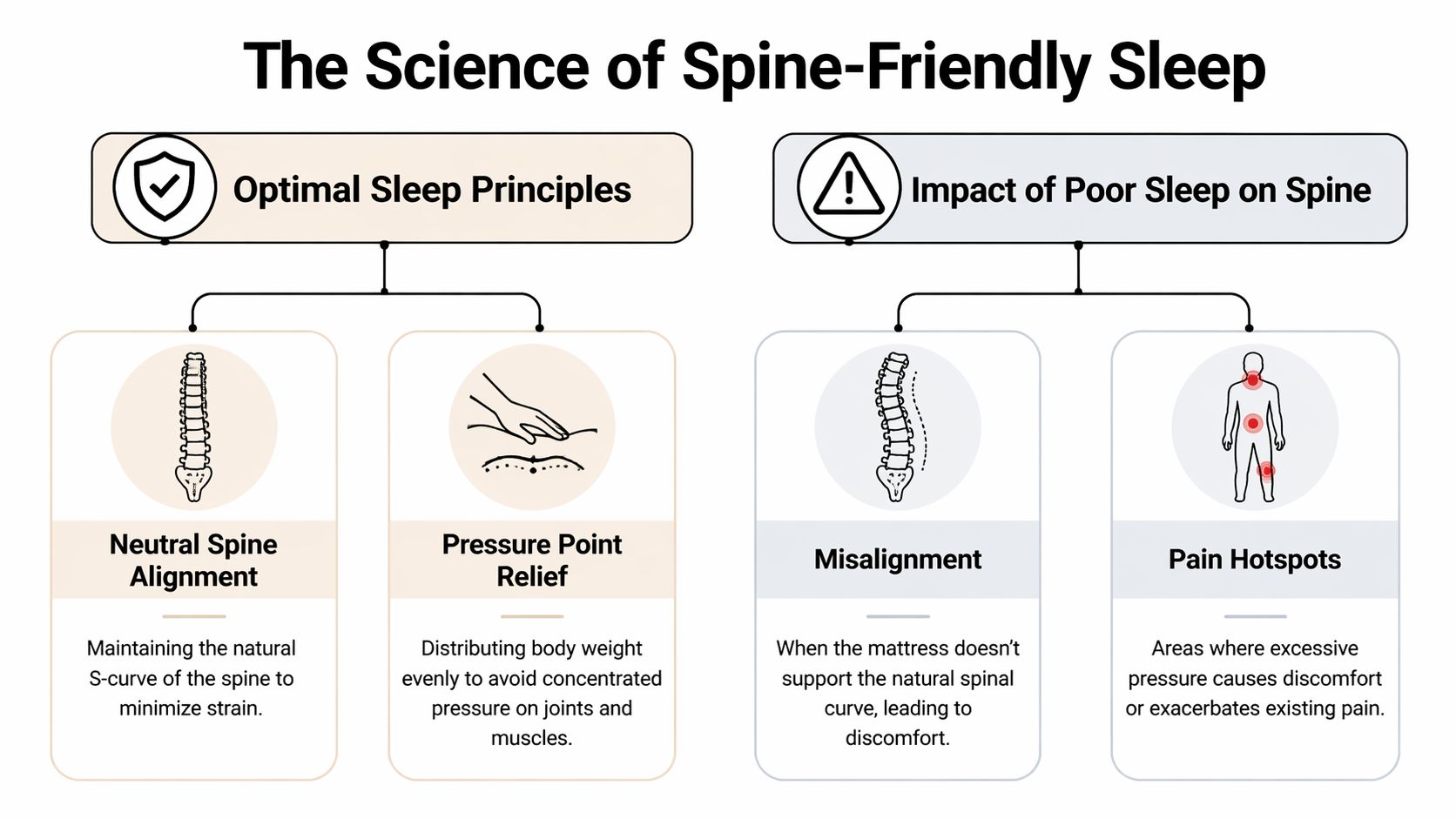
Your spine is not straight like a board. It has gentle curves at the neck, mid-back, and lower back. A spine-friendly mattress supports those curves in a resting position that is close to healthy standing posture. That is what sleep specialists mean by neutral alignment.
Here is where many shoppers get tripped up. They hear the word “support” and assume the bed should feel hard from edge to edge. In practice, support is more precise than that. A good mattress holds up the heavier parts of your body, especially the hips and torso, without forcing lighter areas into awkward angles.
A simple way to check this is to picture your body as a line from head to tailbone. For a side sleeper, that line should stay fairly level instead of dipping at the waist or bending upward at the shoulders. For a back sleeper, the lower back should feel supported without the pelvis dropping too far. The goal is not stiffness. The goal is balance.
That balance matters for more than comfort. If your muscles have to keep correcting your posture all night, they never fully settle. Sleep quality suffers, and so does recovery. Tyner’s guide to what REM sleep is and why it matters explains why deeper, steadier sleep plays such an important role in how the body restores itself overnight.
Neck alignment is part of the same chain. If your head sits too high or too low, the strain can travel down into the shoulders and upper back. This guide on optimizing your sleep position and pillow setup for neck pain is a helpful companion if neck pain is showing up alongside back pain.
Why pressure points matter
Alignment is only half the job. The other half is pressure relief.
A mattress that feels fine for a few minutes can still create trouble over a full night if too much force collects at the shoulders, hips, or rib cage. That pressure often shows up as tossing, numb arms, a sore hip, or the urge to keep changing positions. Your body is trying to escape the buildup.
Here is the simplest way to separate the two ideas:
- Support keeps your spine from sagging out of position.
- Pressure relief spreads body weight so one area is not carrying too much load.
- Comfort for back pain usually requires both at the same time.
If your hips sink much deeper than the rest of you, the lower back can arch and tighten. If your shoulders sit on top of the mattress instead of settling into it, the upper spine can rotate slightly, especially for side sleepers. Those are small positioning problems, but over many hours they can leave you feeling older in the morning than you did the night before.
This is why a mattress should be judged as part of a full sleep system, not as a single slab you buy and forget. Mattress support, pillow height, sleep position, and the durability of the materials all work together. That is also where local testing and customization can help Ann Arbor shoppers make a more informed choice, especially if the goal is long-term back health rather than a quick showroom win.
Decoding Mattress Features for Back Health
Mattress shopping gets confusing fast because the labels often describe a feel, not a function. “Plush,” “luxury firm,” and “Euro top” can be helpful shorthand, but they do not tell you whether a mattress will keep your spine in a healthy position for eight hours. For back pain, the more useful question is simpler. What is this layer doing to your body over the course of a full night?
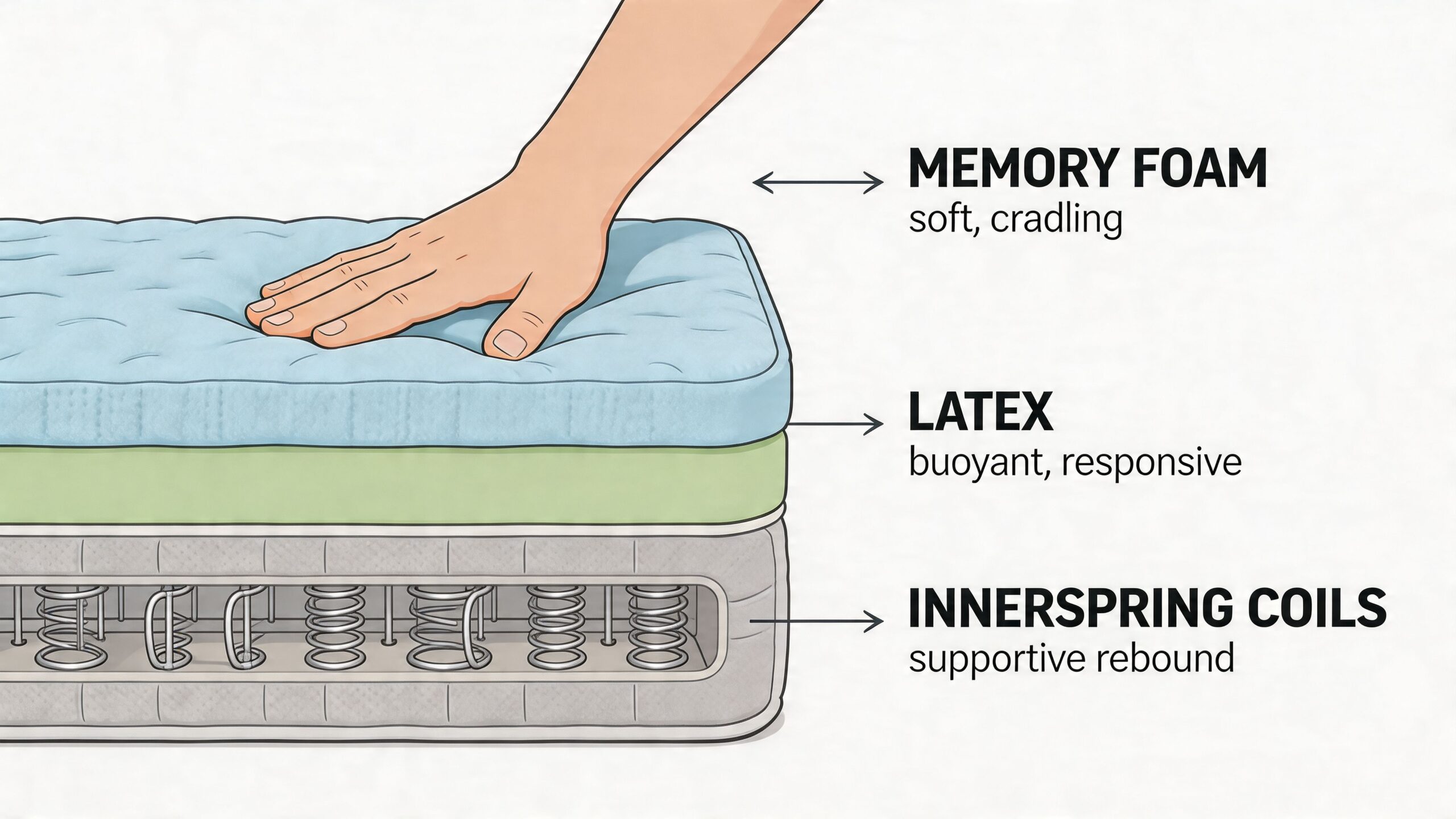
A well-built mattress works like a small support system. The top layers cushion sharper joints such as shoulders and hips. The middle layers manage weight transfer. The base keeps the whole structure from sagging, tilting, or breaking down too soon. If one part is weak, the rest of the bed has to compensate.
Why medium-firm works for many sleepers
Many back-pain shoppers still assume firmer is always better. In practice, medium-firm often gives a better balance of support and pressure relief, as noted earlier in the article’s research discussion. A surface that is too hard can push the body up instead of allowing the heavier areas to settle into alignment.
That is why showroom feel can be misleading.
An extra-firm mattress may seem supportive in the first minute because it resists your weight. After several hours, that same flat resistance can leave the lower back tense or the shoulders irritated. Good support is not about hardness alone. It is about keeping the spine steady while allowing enough give for the body’s curves.
What the main mattress materials are really doing
Materials matter because they change how a mattress responds to weight, movement, and time. If you are building a sleep system for long-term back health, you want to know how each one behaves, not just how it feels in a store.
| Material | What it tends to do well | Where shoppers should be careful |
|---|---|---|
| Memory foam | Shapes closely around the body and can reduce concentrated pressure | Lower-quality foam may let the midsection sink too far or trap heat |
| Latex | Offers springy support, quick response, and strong durability | The feel is more buoyant than hugging, which some sleepers do not prefer |
| Innerspring | Provides airflow and a familiar lifted feel | Basic models may feel uneven or too shallow at the comfort layer |
| Hybrid | Combines cushioning on top with coil support underneath | Performance depends heavily on coil quality, zoning, and foam density |
For a closer look at how these constructions differ, this guide to mattress types pros and cons can help clarify what you are testing in the showroom. For readers comparing comfort layers with pressure relief in mind, DME Superstore offers a practical article on how to choose the best pressure relief mattress.
Why hybrids get so much attention for back pain
Hybrid mattresses get attention for a simple reason. They try to solve two problems at once. The comfort layers help cushion pressure points, while the coil unit underneath acts more like the frame under a house, holding the heavier parts of the body on a steadier plane.
That structure can be especially useful for shoppers whose pain is worse in the lower back or around the hips. A good hybrid often feels less “stuck” than all-foam, with more airflow and easier movement during the night. For many people, that makes it easier to change positions without fighting the bed.
Zoned support is one feature worth understanding. In a zoned mattress, the center third is often firmer than the shoulder area. The idea is straightforward. Your torso and hips usually carry more weight than your head or lower legs, so the mattress gives extra reinforcement where the body needs it most. It is the same reason a quality shoe uses different materials at the heel, arch, and forefoot instead of one uniform slab.
That does not mean every sleeper needs zoning, or that every hybrid is a wise long-term buy. Construction quality still matters. Coil count by itself does not tell the whole story. Foam density, edge stability, cover quilting, and how well the layers are assembled all affect whether a mattress holds its shape for years or starts feeling uneven after a short honeymoon period.
For many Ann Arbor shoppers, local testing has a real advantage. You can compare how different builds respond under your shoulders, waist, and hips instead of choosing from a generic online list. That hands-on process often leads to a better result because you are not just buying a mattress. You are building a personalized sleep system designed to support your back now and to keep doing its job over time.
Matching Your Mattress to Your Body and Sleep Style
You wake up with a sore back, shift to your side for relief, then end up on your stomach before morning. That pattern is common, and it explains why a generic “best mattress” pick often misses the mark. The right fit depends on how your body carries weight, where you feel pressure first, and how you move through the night.
A mattress should hold your spine in a neutral line the same way a well-built pair of shoes supports your stride. The goal is not to feel rigid. The goal is to keep your body from folding out of alignment while still cushioning the parts that press in more.
Back sleepers and side sleepers
Back sleepers usually need even support under the lower back and hips. If the pelvis sinks more than the upper body, the midsection can dip and leave the lumbar area strained by morning. A surface with moderate contouring often works well because it fills in the natural curve without letting the torso settle too far.
Side sleepers need more room at the shoulders and hips. Those joints act like the heavier corners of the body in this position, so a mattress that feels comfortable at first can still push the spine off line if it stays too firm at the surface. Good pressure relief helps the shoulder sink enough for the neck and lower back to stay in better balance.
Stomach sleepers and combination sleepers
Stomach sleepers usually feel best on a flatter, steadier surface. Too much softness under the abdomen can tip the pelvis downward and increase the arch in the lower back.
Combination sleepers need a mattress that responds quickly when they change position. If the bed is slow to recover, turning can feel like climbing out of a hollow. That extra effort may not wake you fully, but it can still break up sleep over the course of the night.
A simple way to sort it out:
- Back sleeper: choose steady support through the waist and hips
- Side sleeper: look for cushioning at the shoulders and hips
- Stomach sleeper: keep the midsection from dipping too far
- Combination sleeper: favor easier movement and a more responsive feel
Body type changes the feel
Body type changes firmness more than many shoppers expect. A mattress does not feel “medium” in the same way to every person. Lighter sleepers often rest closer to the surface, so they may experience the bed as firmer. Heavier sleepers compress farther into the materials, which can make that same mattress feel softer and less supportive over time.
That is why body type, sleep position, and construction need to be matched together, not picked one at a time. A side sleeper with a lighter build may need softer comfort layers than a side sleeper with a broader frame. A back sleeper carrying more weight through the midsection may need stronger support through the center third to stay level. If you want a clearer starting point before visiting the showroom, this guide on which mattress is right for your body type can help narrow the field.
If two people share a bed and describe the same mattress differently, both can be right. Their bodies are pressing into the same materials in different ways.
Local mattress shopping in Ann Arbor gives you an advantage here. You can test how a mattress behaves under your own shoulders, waist, and hips instead of guessing from a broad online ranking. That is how you move from buying a mattress to building a sleep system that fits your body, your habits, and the kind of support you want to keep for years.
Building Your Complete Ergonomic Sleep System
A mattress can do a lot. It can’t do everything alone. If the base under it flexes poorly, if the frame shifts, or if the whole setup lacks structural integrity, even a well-built mattress may not perform the way it should.
The base under the mattress matters
The phrase sleep system is useful because it reminds people to think beyond the top comfort layer. Mattress, foundation, frame, and pillow all work together. If one piece is off, the rest has to compensate.
Verified analysis from Mattress Clarity notes that hybrid mattresses with zoned coil systems and lumbar-specific foam layers can reduce peak interface pressures by 25-35%, correlating with a 30% lower pain score after 30 nights compared to uniform foam beds (Mattress Clarity review). That matters most when the mattress is paired with a base that lets those support features function properly instead of fighting them.
Adjustable bases can also be useful for some sleepers because they allow small changes in position. Raising the head and legs slightly can help some people reduce tension and settle into a more comfortable posture. The idea is similar to the ergonomic precision people appreciate in Stressless seating, where small changes in angle can affect how pressure travels through the back.
Why the bed frame should be part of the conversation
The frame doesn’t usually get the spotlight, but it should. A sturdy bed frame helps keep the mattress level and consistent over time. That’s one reason many shoppers who care about longevity prefer hand-crafted solid wood over lighter, mass-produced alternatives. You can feel the difference in the weight, the stability, and the way the structure resists wobble.
For bedroom furniture, that’s where Amish craftsmanship stands apart. Time-honored joinery and solid hardwoods don’t just look warm and substantial in a room. They support the practical goal of creating a sleep setup built for years of use, not a few hurried seasons.
In one place, shoppers can pair a mattress with an adjustable base, then consider a solid wood bed that better matches the long-term nature of the investment. Tyner Furniture also carries products well beyond the bedroom, from the Home Office to Outdoor Spaces, which is helpful when people are furnishing a whole home with the same value-first mindset.
Your Ann Arbor Mattress Shopping Checklist
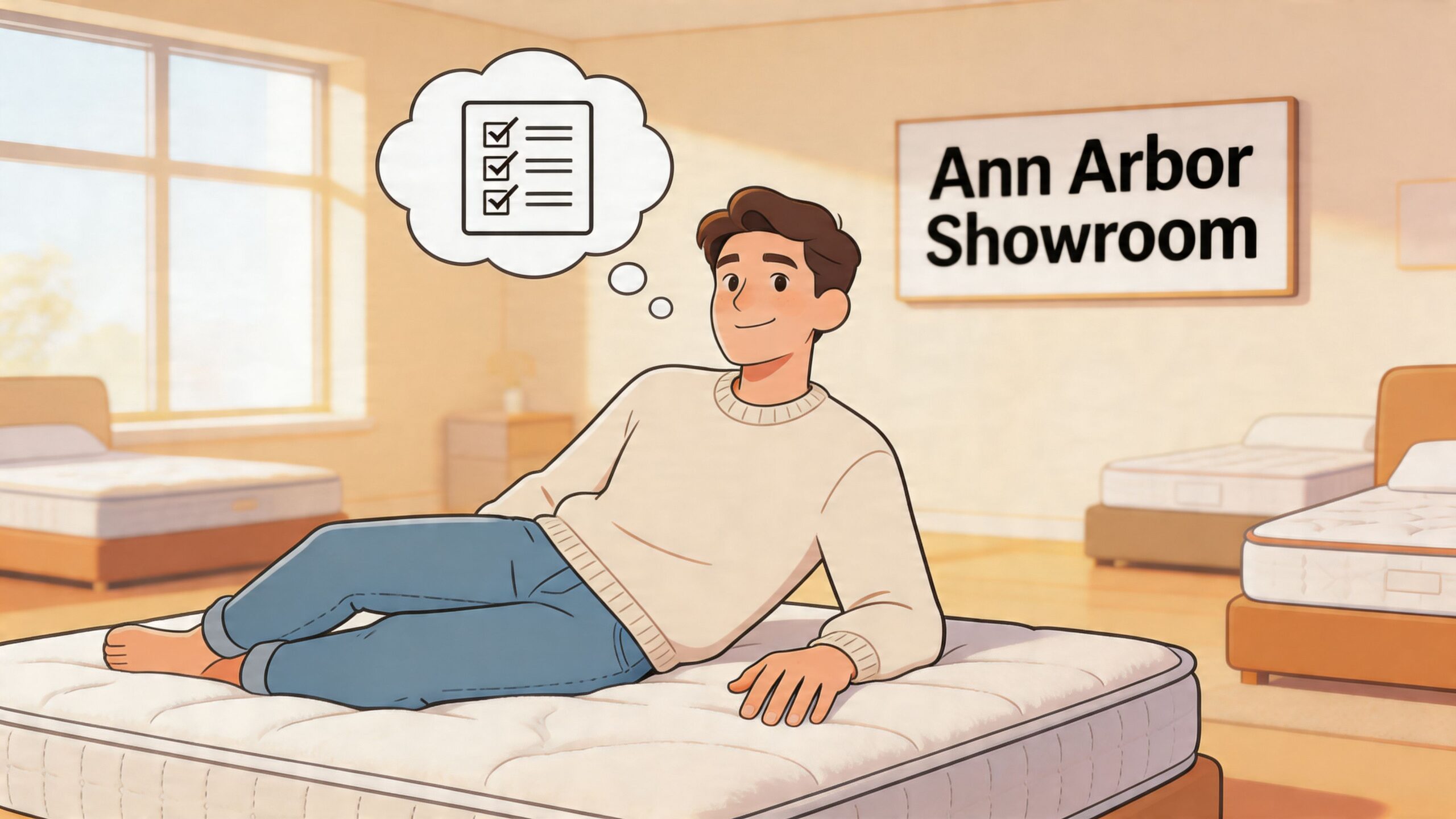
A showroom visit goes better when you know what you’re testing for. Don’t shop for a mattress the way you’d shop for a lamp. You’re not checking color and moving on. You’re checking alignment, pressure relief, ease of movement, and how your body settles over several minutes.
What to do in the showroom
Use this checklist when you visit a mattress store in Ann Arbor, especially if you’re comparing several support levels on South State St.
- Lie down in your real sleep position: Don’t just sit on the edge. Spend time on your back, side, or stomach, whichever reflects your normal habit.
- Stay put long enough to notice pressure: A mattress can feel fine in the first minute and wrong by minute six.
- Roll and reposition: This tells you whether the surface traps movement or lets you change posture comfortably.
- Notice your lower back: If there’s a gap or an over-arched feeling, support may be off.
- Check edge stability: Sit and lie near the side to see whether the perimeter feels dependable.
A practical companion before you shop is this article with tips for buying a new mattress, especially if you want a quick refresher on what to compare.
Questions worth asking
Ask the salesperson questions that tie back to your body, not just the product tag.
- How does this model support the midsection?
- Is the feel closer to true medium-firm or firmer than that?
- What kind of foundation works best with this mattress?
- Does this construction suit side sleeping, back sleeping, or mixed positions?
- What custom or made-to-order options are available if the floor sample is only the starting point?
That last question matters. In-stock is often just the beginning. Across a well-rounded furniture showroom, customization may extend beyond mattresses to dining and seating too, including Canadel finishes and configurations and Stressless sizing choices for ergonomic fit.
Bring your usual pillow if you can. Your head position changes what you feel in your shoulders and lower back.
Finally, pay attention to warning signs from your current mattress. Deep body impressions, inconsistent support, or waking up better anywhere other than your own bed are all clues worth taking seriously.
Invest in a Lifetime of Better Sleep with Tyner Furniture
A mattress for back pain isn’t just about softness or firmness. It’s about fit. The right fit for your spine, your sleep style, your body, and the support system underneath it. That’s why the best mattress for back pain relief is rarely a one-word answer.
For many shoppers, the strongest direction is a medium-firm hybrid with thoughtful lumbar support. From there, the smarter decision often becomes broader: choose a complete sleep system, a stable foundation, and bedroom pieces built with the same long-view mindset you’d bring to any other health investment.
Affordability matters in that conversation too. Verified guidance tied to Consumer Reports notes that many mattress guides ignore access and budgeting, while special financing and promotional no-interest plans can help health-focused buyers in the Ann Arbor area bridge the gap on long-term back pain relief purchases (Consumer Reports-connected summary). That matters because a durable mattress, a strong foundation, and an heirloom-quality frame often make better sense when you think in terms of value over years of use, not just the number on the tag today.
This is also where local legacy still counts. Since 1957, families across Southeast Michigan have shopped with businesses that can talk through comfort, craftsmanship, and customization in plain language. That same approach applies whether you’re comparing mattresses, choosing the buttery feel of top-grain leather in a recliner, or selecting the weight and grain of solid cherry or maple for a hand-crafted bedroom set.
A made-to-order mindset helps here. The floor sample gives you a starting point. Then you look at the whole room, the bed height, the base, the frame, and the long-term plan. That’s the difference between buying a mattress and building a sleep setup that serves you well for years.
If you’re ready to compare comfort levels in person, visit Tyner Furniture in Ann Arbor for a proper sit test and mattress tryout. If you’d rather start from home, browse the online Quick Specs for special orders, customization options, and planning ideas for everything from bedroom furniture to dining, home office, and outdoor spaces.