Mattress Types Pros and Cons: Expert Buying Guide

Mattress shopping often begins in a familiar way. One open browser tab turns into twelve. Every mattress sounds “supportive,” every review claims “life-changing sleep,” and every sale seems to end tonight.
Then you walk into a store, sit on two beds for less than a minute each, and somehow you’re supposed to make a decision you’ll live with for years.
That’s why mattress types pros and cons matter so much. The essential question usually isn’t “Which mattress is trendy?” It’s “Which one will still feel supportive, comfortable, and worth the money after years of real use?” For families in Ann Arbor and across Southeast Michigan, that’s a health decision as much as a shopping decision.
Since 1957, local shoppers have learned that the smartest furniture purchases aren’t always the ones with the lowest sticker price. They’re the ones that hold up, fit the body well, and keep delivering value over time. That same thinking applies to a mattress. A bed isn’t just another home item. It’s part of your daily well-being, right alongside the chair in your home office, the recliner where you unwind, and even the dining set where your household gathers.
If you’re also comparing online-only options, the Ultimate Buyer's Guide to Mattress in a Box gives useful context on what changes when a mattress is compressed, shipped, and opened at home.
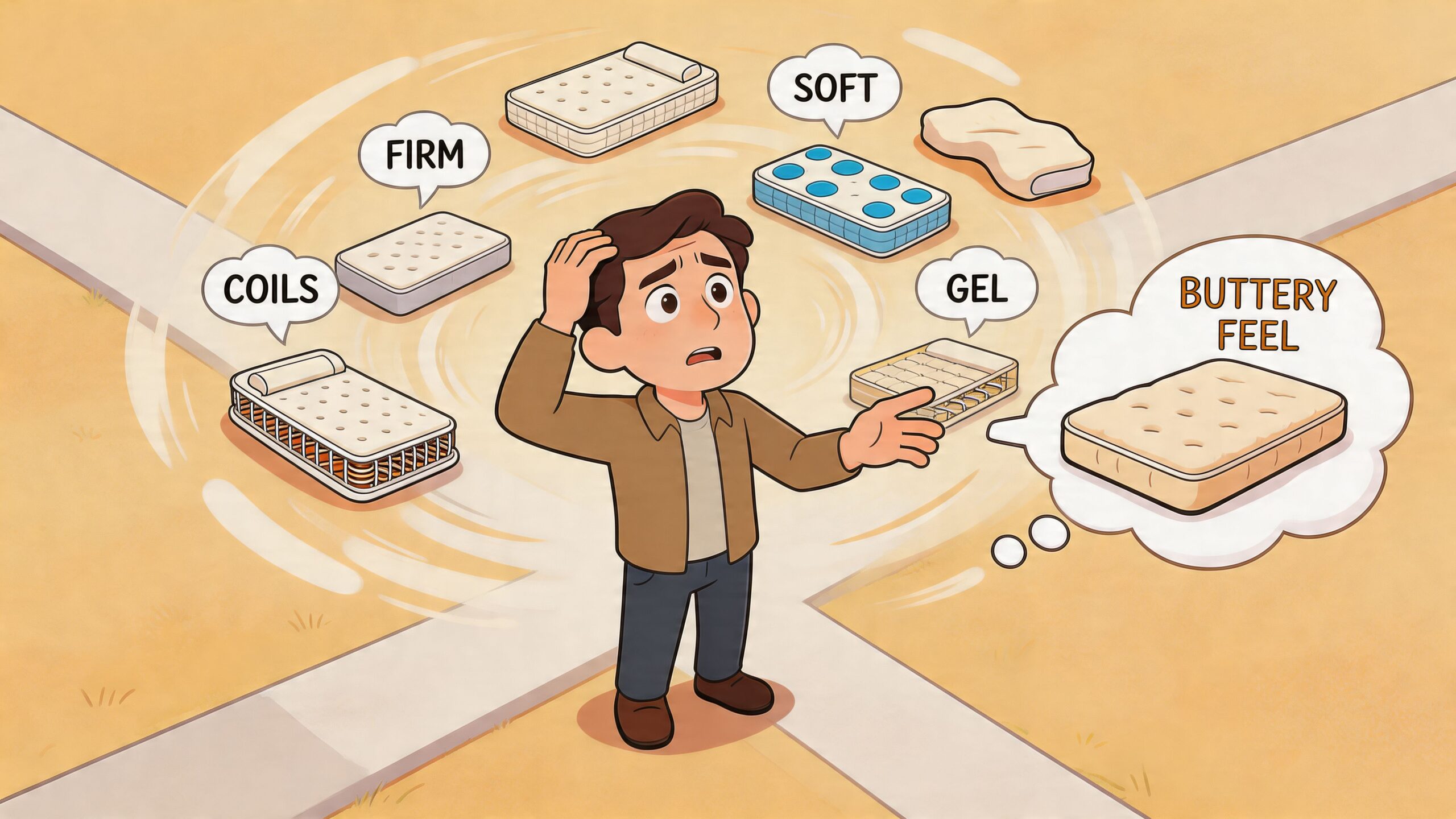
Table of Contents
- Finding Rest in a World of Choices
- Understanding the Core Mattress Categories
- A Detailed Comparison of Mattress Performance
- Matching Your Mattress to Your Sleep Needs
- Building a Complete Heirloom-Quality Sleep System
- Your Guide to Shopping Smart in Southeast Michigan
Finding Rest in a World of Choices
A mattress purchase often starts with back pain, bad sleep, or a simple realization that your current bed just isn’t working anymore. You wake up tired. Your shoulder tingles. The edge caves in when you sit down to put on socks. Suddenly, what felt “good enough” feels like a nightly compromise.
That’s where people get stuck. They compare innerspring, foam, latex, and hybrid models, but many guides talk as if comfort exists in a vacuum. It doesn’t. Comfort changes with your body, your sleeping position, your partner, and how long the mattress can maintain its structure.
A mattress can feel pleasant for five minutes and still be the wrong long-term fit.
In Southeast Michigan, that matters because many households aren’t furnishing for a short stop. They’re building a home that should work well year after year. The same shopper who values the weight of solid cherry wood, hand-crafted joinery, or a made-to-order Canadel dining set usually values durability in the bedroom too. A mattress belongs in that same conversation.
A better way to judge mattress types pros and cons is to think in cost per year, not just purchase price. A lower upfront price can look attractive until a mattress loses support early and needs replacing sooner. A better-built mattress often asks for more at the beginning, then pays you back in comfort, stability, and fewer regrets.
The shopping mindset that helps most
When readers tell me they feel overwhelmed, I suggest narrowing the decision to a few plain-language questions:
- How do you sleep now: Side, back, stomach, or constantly changing position?
- What bothers you most: Heat, motion from a partner, pressure at the shoulder and hip, or sagging support?
- How long do you want this purchase to last: Is this a short-term fix or part of a long-term bedroom plan?
- What surrounds the mattress: A flimsy base can undermine a good mattress, while a sturdy frame protects the investment.
That framework keeps you grounded. It turns the search from a sales pitch into a practical decision about health, value, and everyday comfort.
Understanding the Core Mattress Categories
The easiest way to make sense of mattress types pros and cons is to start with what’s inside the bed. Once you understand the core build, the feel makes more sense.
For a broader outside perspective, Sienna Living has a helpful guide to the different types of mattresses. If you want a closer look at the coil-and-comfort-layer combination many shoppers ask about, this explanation of what a hybrid mattress is is useful.
Mattress types at a glance
| Mattress Type | Primary Feel | Typical Lifespan | Best For |
|---|---|---|---|
| Innerspring | Bouncy, lifted, more “on top” of the bed | 6-8 years | Shoppers who want airflow, bounce, and lower upfront cost |
| Memory Foam | Deep contouring, slow response, more body-hugging | 8-10 years | Pressure relief and quieter sleep surfaces |
| Latex | Responsive, buoyant, gently contouring without deep sink | 12-15 years | Durability-minded shoppers who want resilience |
| Hybrid | Balanced feel with coil support plus foam or latex comfort | 10-12 years | Many sleep styles, couples, and shoppers seeking versatility |
How each category feels in real life
Innerspring mattresses rely on coils as the main support system. They tend to feel springy and breathable. When people say a mattress feels “traditional,” this is usually what they mean. The tradeoff is that many innersprings don’t conform closely to the body, so pressure can build around hips and shoulders.
Memory foam uses foam layers that compress and contour under body weight. If you’ve ever laid down and felt the bed slowly shape around you, that’s the classic foam sensation. Many people love that cradled feeling. Others feel too “stuck” in it, especially if they change position a lot overnight.
Latex sits in a middle ground. It cushions the body, but with a more buoyant, floating sensation than memory foam. You get support and responsiveness without as much deep sink. That’s why shoppers who dislike the quicksand feeling of some foams often gravitate toward latex.
Hybrid mattresses combine a coil support core with a comfort layer made from foam or latex. In practice, that often means more edge strength and bounce than all-foam, plus more pressure relief and quieter performance than a simple innerspring.
Practical rule: If a mattress type sounds abstract, translate it into feel. Ask yourself whether you want to sleep more “in” the mattress, “on” the mattress, or somewhere in between.
The biggest misconception is thinking one category is universally right. It isn’t. Each one solves a different problem, and each comes with tradeoffs.
A Detailed Comparison of Mattress Performance
Category labels help, but performance is where the decision gets real. Couples care about motion. Hot sleepers care about airflow. People with aging joints care about pressure relief. Someone who sits on the edge every morning cares about perimeter stability.
Extensive testing gives hybrids a strong case in this comparison. Hybrid mattresses achieved an average score of 8.66 out of 10 across support, cooling, and durability, with a typical lifespan of 10-12 years, while traditional innersprings often need replacement in 6-8 years due to sagging according to NapLab’s mattress type testing.
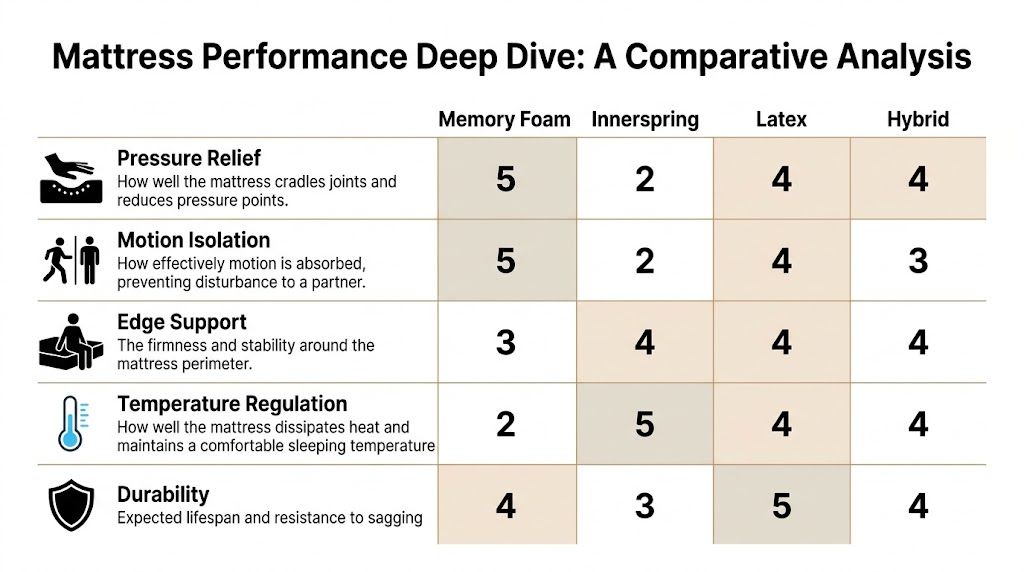
If back discomfort is part of your search, it also helps to review how the right mattress can help back pain.
Innerspring
An innerspring mattress is the simplest to picture. Steel coils provide the main support, with thinner comfort materials on top.
Pros
- Breathable feel: Air moves through the coil core more easily than through dense foam.
- Responsive surface: It’s easier to roll, turn, and get out of bed.
- Lower upfront cost: Innersprings are often the most affordable category, commonly in the $500-$1,500 range based on the verified clinical review summary.
Cons
- Less motion isolation: If your partner shifts, you’re more likely to feel it.
- Weaker pressure relief: Shoulders and hips may not get enough cushioning.
- Shorter working life: Sagging and middle dips are common over time, and verified data places their lifespan at 6-8 years.
In plain language, innerspring works well when someone wants bounce, airflow, and a simpler feel. It’s less ideal when a couple shares the bed or when pressure relief is the top concern.
Memory foam
Memory foam has a slower, more enveloping response. It compresses where your body presses into it and can create that “hugged” sensation many people either love or reject immediately.
Pros
- Excellent pressure relief: Foam cradles joints and can feel gentle at the shoulder and hip.
- Quiet surface: No squeaking, no spring noise.
- Strong motion control: Movement tends to stay localized better than in a traditional innerspring.
Cons
- Heat retention: Foam is more likely to sleep warm.
- Less bounce: Some sleepers feel trapped or slowed down when changing position.
- Moderate lifespan: Verified data places memory foam around 8-10 years, with an average price of $1,291.
A simple example helps here. If you lie down on memory foam after a long day, the mattress may feel wonderfully calming at first because it reduces sharp pressure points. But if you’re someone who flips from side to side, that same contouring can become frustrating because it resists quick movement.
Latex
Latex tends to surprise shoppers who assume it will feel like foam. It usually doesn’t. It’s more buoyant and springy, often giving a gentle floating sensation rather than a deep cradle.
Pros
- Long durability: Verified data places latex at 12-15 years, making it one of the longest-lasting categories.
- Responsive support: You get contouring without the stuck feeling common in softer foams.
- Even weight distribution: Many sleepers describe it as supportive without harshness.
Cons
- Higher initial cost: Verified data lists an average price of $2,027 for latex.
- Allergy consideration: Latex can be allergenic for 1-2% of users.
- Heavier handling: Latex beds can be harder to move or rotate.
For shoppers focused on long-term value, latex often earns attention because it tends to hold its character for years. The challenge is the initial price. If you’re judging purely by purchase day cost, latex can feel expensive. If you’re judging by years of service, it often looks more reasonable.
Hybrid
Hybrid mattresses combine two ideas. A coil system brings structure, edge support, and airflow. Foam or latex comfort layers add pressure relief and more refined comfort.
Pros
- Balanced performance: Hybrids combine support, contouring, and responsiveness in one design.
- Strong edge support: Verified testing notes 15-25% enhanced edge support through reinforced perimeter coils.
- Better partner performance: Verified testing notes 20-30% better motion isolation than standard innersprings.
- Useful for larger sleepers and couples: Pocketed coils and layered comfort materials create a more stable, less disruptive shared surface.
- Cooler than all-foam: Verified testing notes surface temperatures can run 5-10°F cooler due to airflow through the coil system.
Cons
- Heavier to move: Queen-size hybrids often weigh 100-150 lbs.
- Higher cost than basic innerspring: Premium versions with gel or latex can exceed $1500.
- Construction matters: Not every hybrid is equal. Coil quality, foam density, and edge reinforcement all affect results.
Another practical detail matters here. Verified testing notes a hybrid should deliver a hug factor of 8.5/10 compared with 6.2/10 for innerspring, while responsiveness averages 9.2/10 versus 9.8/10 for innerspring and 7.5/10 for foam. That tells you why many shoppers experience a hybrid as the middle path. It cushions without going flat and responds without becoming harsh.
For many households, hybrid is the easiest category to live with because it doesn’t force an all-or-nothing choice between bounce and contour.
If you’re shopping for a shared bed in Ann Arbor and want one mattress that can satisfy two different sleep preferences, hybrid usually deserves serious attention.
Matching Your Mattress to Your Sleep Needs
The “best” mattress on paper can still be the wrong mattress for your body. Sleep position changes everything. So do back discomfort, heat sensitivity, and whether another person shares the bed.
A clinical review gives one point unusual clarity. A 2021 systematic review found that medium-firm mattresses, often hybrid or latex models, were better for reducing non-specific low back pain, improving sleep quality, and supporting spinal alignment than overly soft or firm options in the reviewed studies, as summarized in this clinical review on mattress firmness and sleep outcomes.
For a practical local buying companion, this guide on choosing the right mattress for your sleeping style helps connect sleep position to mattress feel.
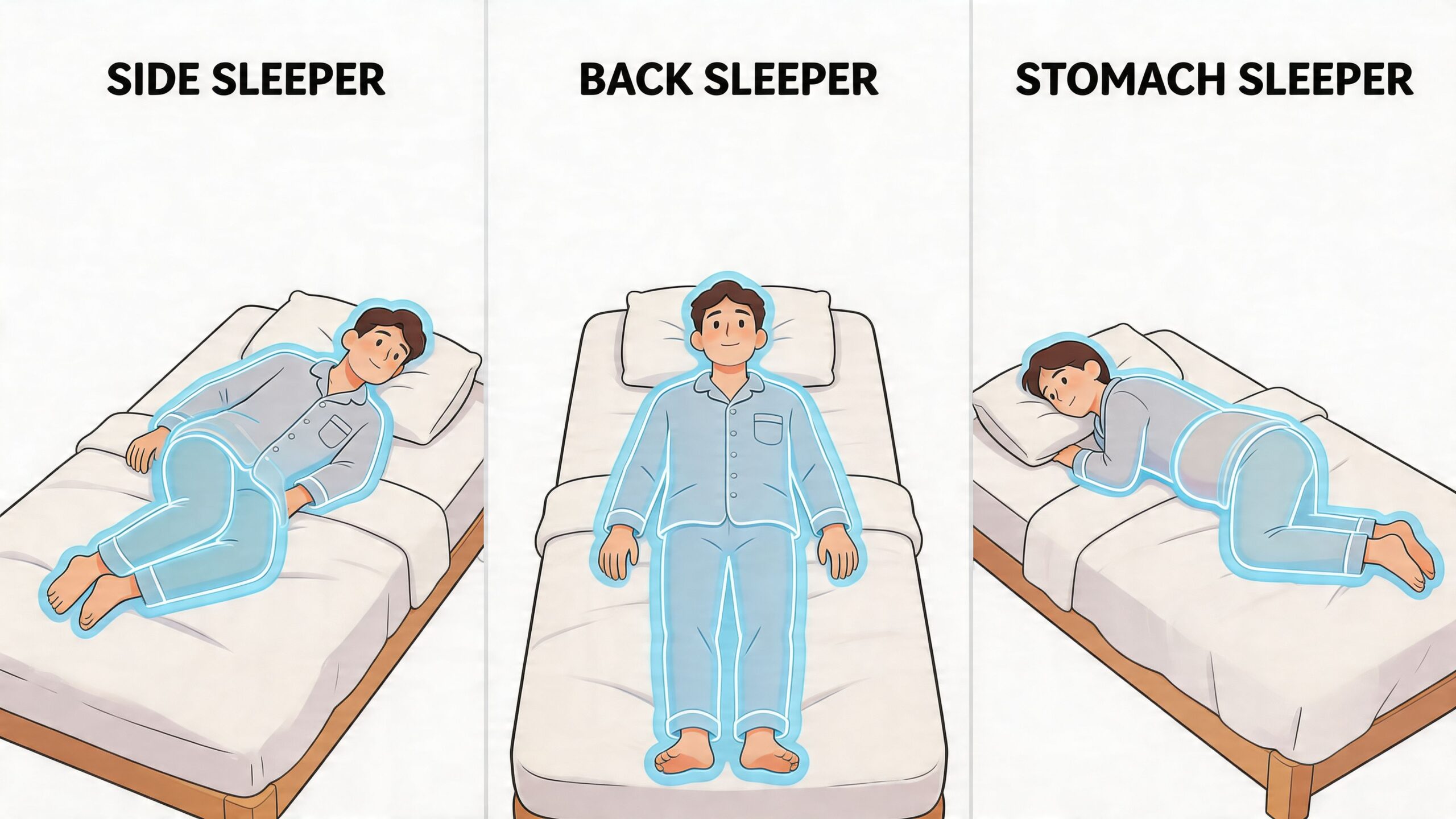
By sleeping position
Side sleepers usually need enough give at the shoulders and hips to avoid pressure buildup. Mattresses that are too firm can feel sharp and unforgiving. Many side sleepers do well with memory foam, latex, or a hybrid that has a more accommodating top layer.
Back sleepers often need a more even balance. Too soft, and the pelvis can drop. Too firm, and the lower back may feel unsupported. Medium-firm tends to be the safest starting point because it supports alignment without feeling board-like.
Stomach sleepers usually need stronger support to keep the midsection from sinking too far. A mattress that feels plush in the showroom can become a problem after several hours if the hips settle lower than the shoulders.
By common sleep complaint
When people tell me what’s wrong with their current bed, the answer often becomes clearer fast.
- If your lower back aches: Start with medium-firm support. That’s the clearest evidence-backed direction from the clinical review.
- If you sleep hot: Look toward coil-based designs or latex. They tend to feel less heat-trapping than dense all-foam builds.
- If your partner wakes you up: Prioritize motion control. Foam and many hybrids usually outperform a traditional innerspring here.
- If you struggle getting in and out of bed: Focus on edge support and surface responsiveness, not just softness.
Softness isn’t the same as support. Many backs feel better on a mattress that holds the spine steady, even if it feels firmer than expected at first.
There’s also a comfort lesson many shoppers miss. The first thirty seconds on a bed mostly tell you surface feel. The next several minutes tell you support. That’s why a mattress can feel plush and still leave you with a tired lower back.
Ergonomic products like Stressless seating have taught many Southeast Michigan shoppers the same principle. Personal fit matters. A mattress should meet your body where it is, not force your body to adapt to the bed.
Building a Complete Heirloom-Quality Sleep System
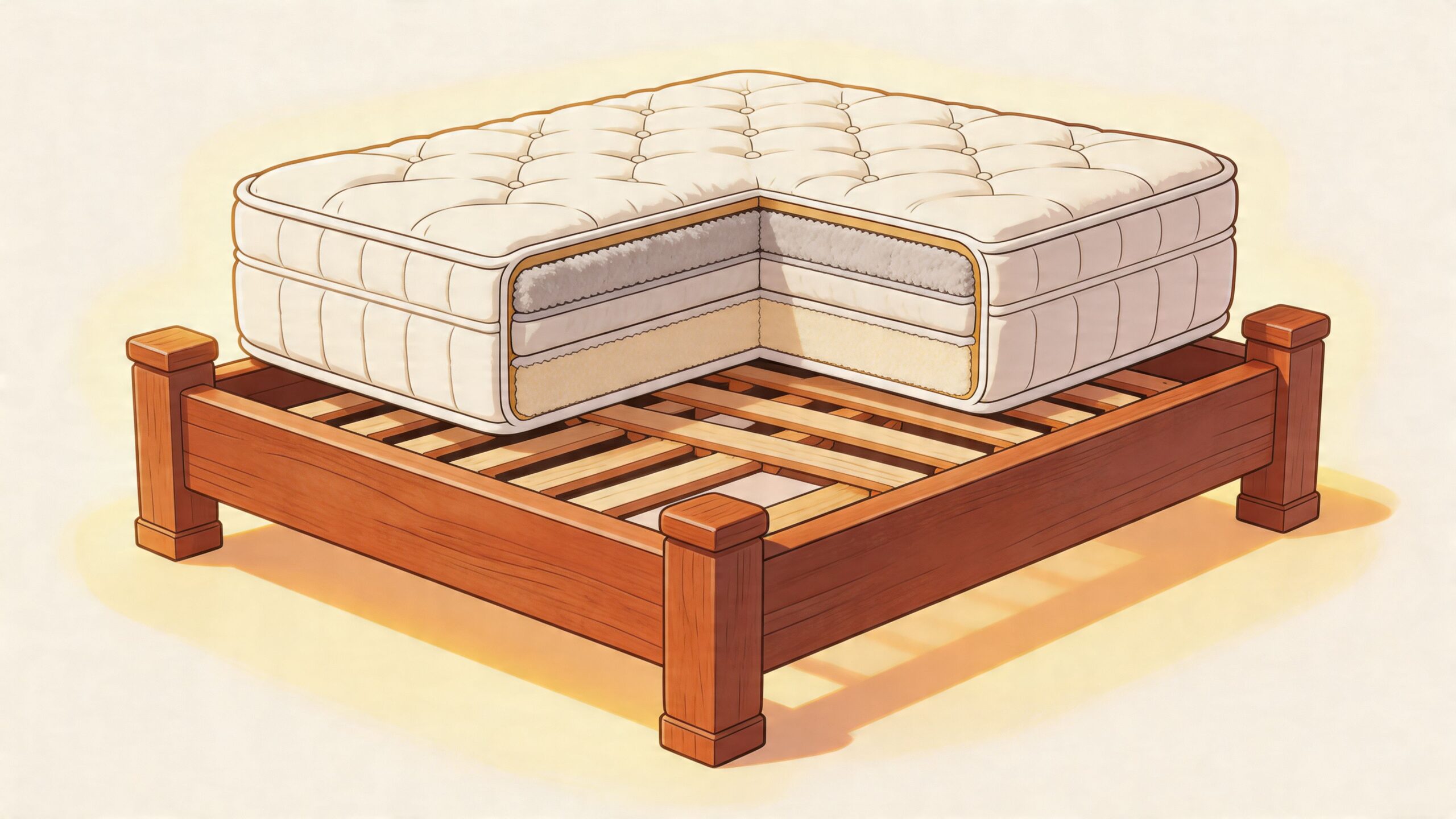
A mattress doesn’t work alone. It works as part of a system. If the base underneath flexes, bows, or fails to support evenly, even a strong mattress can start performing like a weak one.
That’s why shoppers who care about long-term value should think beyond the top layer and the showroom comfort test.
Why the base matters more than most shoppers think
Verified guidance from Purple’s mattress type overview notes that premium hybrid or latex mattresses can last 10-15 years, but that lifespan depends on a supportive frame, and a solid wood frame can nearly double the effective lifespan of the full sleep system compared with a low-quality base that accelerates sag in the cited foundation and mattress lifespan discussion.
That idea lines up with what careful furniture shoppers already know. Structure matters. If the support underneath is weak, the material above it has to compensate. Over time, it can’t.
A supportive foundation becomes even more important if you’re adding features like an adjustable base for comfort and well-being. Flexibility is valuable, but only when the components are built to work together.
What an heirloom approach looks like
Bedroom furniture and mattress performance intersect. A mass-produced frame made with lighter materials may hold a mattress off the floor. That isn’t the same as preserving alignment and extending mattress life. A sturdier build does more.
For shoppers who value craftsmanship, an heirloom mindset usually includes:
- Solid wood integrity: A sturdier frame resists shifting and gives the mattress a more dependable platform.
- Better joinery: Hand-crafted construction tends to hold up differently than quick assembly furniture.
- Long-term planning: A quality frame can outlast multiple mattresses and make each one perform better.
- Visual permanence: The bedroom feels anchored, not temporary. You notice it in the steadiness, the weight, and the quiet.
At Tyner Furniture, that broader sleep-system idea fits naturally alongside Amish hand-crafted bedroom pieces and the same made-to-order thinking shoppers already know from Canadel dining and customized upholstery. The mattress isn’t separate from the room. It’s part of a complete, durable environment.
Your Guide to Shopping Smart in Southeast Michigan
Once you know the major mattress types pros and cons, the final step is testing them the right way. Many shoppers make their most expensive mistake here. They rush the feel test and ignore the performance clues.
In a local showroom, your body gives you better information than any ad can. That’s especially true when you compare models side by side in the same visit.
If you’re also evaluating broader furnishing options while planning your space, this look at home interior companies can help place the bedroom purchase into the larger design picture.
What to test in person
Verified guidance from Woodstock Outlet notes that a high-quality hybrid should offer 20-30% better motion isolation than a standard innerspring and prevent edge sinkage by up to 40% more than an all-foam mattress, and those are differences you can feel during testing in the cited mattress testing comparison.
Use that information in practical ways:
- Sit on the edge first: If the perimeter collapses, daily use will feel less stable.
- Roll once or twice: You’re checking whether the surface helps or fights movement.
- Lie in your real sleep position: Don’t just sit upright. A mattress that feels fine seated may fail once your shoulder or lower back loads into it.
- If you shop as a couple, test as a couple: Have one person move while the other stays still.
Questions worth asking before you buy
Bring a short list. It helps cut through showroom overload.
- What kind of support core is inside? Pocketed coils, basic coils, foam, or latex all behave differently.
- How should this mattress be supported? A good mattress needs the right base.
- How will it feel over time? Ask about likely softening, settling, and expected use patterns.
- What are the special-order options? In-stock can be the beginning, not the limit. Many shoppers furnishing a long-term home also want the flexibility to coordinate nearby pieces, finishes, or bedroom furniture selections.
- What purchase protections matter? Ask about warranty details, return terms, delivery, special financing, and a Low Price Promise so you understand value beyond the sticker.
For Ann Arbor shoppers, the most useful test still happens in person. Spend time on the bed. Notice whether your lower back relaxes, whether the edge feels steady, and whether your shoulders settle naturally. Those small details often decide whether you’ll love the mattress after a week, not just after a minute.
If you’d like help narrowing down the right sleep setup, visit Tyner Furniture on South State St. in Ann Arbor for a proper sit test, or browse the online Quick Specs to explore special-order options. Since 1957, the showroom has served Southeast Michigan with guidance that goes beyond mattresses alone, from the bedroom and home office to dining, living, and outdoor spaces, with hand-crafted, ergonomic, and made-to-order solutions designed for long-term value.