Cherry Wood Stain Colors: A Complete Guide

You're standing in a showroom with several cherry stain samples in front of you. One looks warm and traditional, another appears almost russet, and a darker option seems wonderfully dramatic. Then someone mentions that cherry wood changes color with light, and suddenly the decision feels less like choosing a finish and more like predicting the future of the room.
That uncertainty is understandable. Cherry wood stain colors describe both a finish family and, sometimes, the appearance of the wood species itself. The same name can look different across furniture makers because the wood, cut, finish system, lighting, and surrounding colors all influence the result. The good news is that shoppers don't need to memorize every catalog name. A few principles make the choice much easier, especially when the furniture is a bespoke, made-to-order investment intended to become an heirloom.
Why Cherry Wood Stain Colors Feel Overwhelming at First
A couple entering a furniture showroom may ask for “something cherry, but not too red.” The request sounds clear until the samples are placed side by side. One may look warm and traditional, another russet, and a darker option may appear dramatic. The challenge is that these names describe a range, not a single recipe. A widely referenced finish catalog lists more than 30 named cherry-related stain and finish options, showing how thoroughly cherry has become a standardized furniture color family.
The word “cherry” can also describe two different things:
- Cherry wood species, a North American hardwood with naturally shifting red and reddish-brown tones.
- Cherry color family, a finish category that may be applied to cherry, oak, maple, or another wood.
Those two meanings should not be treated as interchangeable. A cherry finish on another species will not necessarily age or display grain like stained cherry wood. The wood beneath the finish acts like the paper beneath watercolor. Its grain, base tone, and undertone influence whether the result feels warm, cool, muted, or strongly contrasted. Natural cherry also continues developing after finishing, so a stain that looks balanced at delivery can read richer and warmer later.
The showroom sample isn't the whole story
A small sample board gives you a useful starting point, but it cannot show every room interaction. A broad dining table may display more variation than the sample, while soft bedroom lighting may make the same finish appear deeper. Daylight from a South State St. area home can shift the impression again. Existing flooring, upholstery, and hardware join the conversation.
Warm oak flooring may make reddish cherry feel fuller. Gray upholstery or cool metal hardware can make that same finish appear more orange. The goal is not to find a color that looks attractive alone. It is to choose a finish whose undertone and natural aging will still suit the room years later.
For additional visual context, Flacks Flooring's overview of cherry hardwood helps shoppers compare cherry-related tones with existing floors. Online buyers can also use guidance on avoiding color mismatch when ordering online before relying on a screen image.
Practical rule: Choose the undertone and aging direction first. Choose the stain name second.
Three questions keep the decision manageable: Does the room need more warmth or restraint? Should the grain remain prominent or recede into a deeper color? Will the piece look comfortable after natural aging, rather than only attractive on delivery day?
How Cherry Wood Changes Color Over Time
A cherry table delivered in spring may look different by its fifth year. Fresh cherry often carries a pale salmon or pinkish-brown cast. As oxygen and light reach the surface, that base gradually deepens into warmer reddish-brown, with richer orange-red character developing over months and years, as described in Swaner Hardwood's technical overview.
The first change can be surprisingly quick. Natural cherry under a clear topcoat may mature to a rich warm tone in about six to eight months, according to Mission Furnishings' stain color guide. Thomas Moser's discussion of cherry's aging explains that about 80% of the total color shift occurs during the first few months to a year. These observations describe natural cherry, while stain still affects how that aging reads. A finish that looks balanced on a new sample may appear deeper, warmer, or more orange-red after repeated daylight exposure.
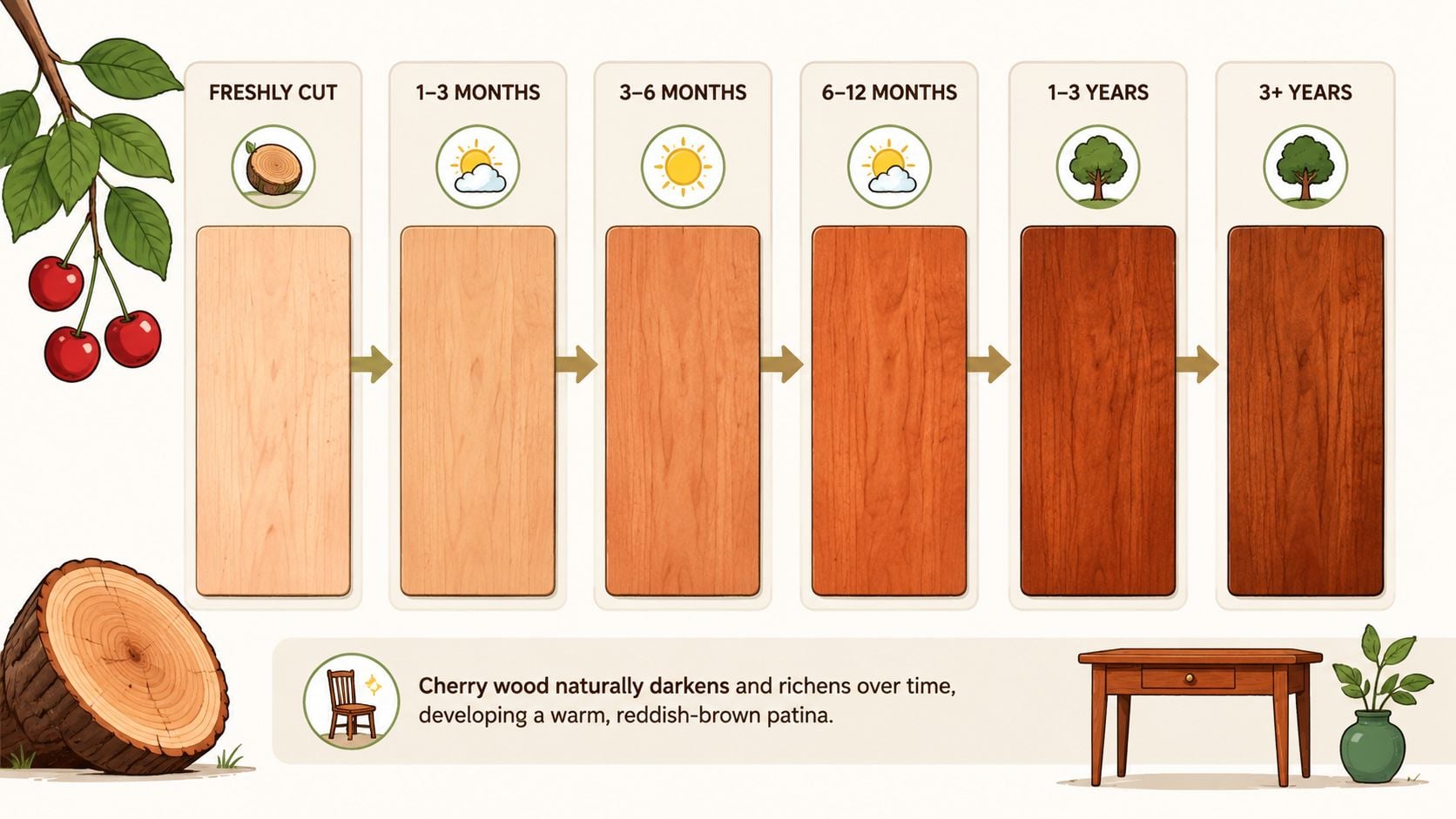
A better way to evaluate the timeline
Judge a sample through three stages rather than asking whether it looks perfect on day one.
- Fresh appearance: Study the balance between the applied color and the wood's pink, red, orange, or brown undertones.
- Early maturation: Ask whether added warmth will improve the finish or make it feel too saturated.
- Long-term character: Consider whether the grain, figure, and nearby furnishings will still have visual room as the cherry deepens.
A clear finish lets the wood's natural change remain visible. A light stain guides the starting tone while leaving more of that evolution on display. A medium stain establishes a stronger brown-red foundation. A deep stain creates greater immediate drama, yet gives the wood less visual space to develop its own color.
Cherry typically accepts stain more evenly than blotch-prone woods such as maple. Medium-to-dark finishes can also appear especially deep and glowing on cherry, as noted in the stain color guide. Even with that consistency, a sample remains necessary. The same stain can emphasize different undertones across boards, grain patterns, and lighting conditions.
A table beside a bright window may mature differently from a nightstand in a shaded corner. The finish formula and protective topcoat shape the starting result, while the room's light continues influencing its color. Choose a finish with enough restraint to become more appealing as the cherry ages, not one that depends entirely on its first impression.
Popular Cherry Wood Stain Color Families Explained
Cherry finish catalogs can feel crowded, but most choices fall into a few practical families. The goal isn't to select a name that sounds traditional. The goal is to decide how much of cherry's natural red, orange, brown, and violet movement should remain visible.
Natural and light cherry tones
Natural Cherry and similarly light finishes keep the wood close to its original personality. They work well when grain visibility, a softer palette, and gradual patina matter more than immediate color depth. In a traditional dining room, a light cherry finish can feel warm without competing with patterned rugs or upholstered seating. In a contemporary room, it can add organic color without turning the furniture into the visual centerpiece.
These finishes are especially appropriate when the surrounding room already contains warm materials. They may be less suitable when the goal is to conceal strong variation or create a dark contrast against pale walls.
Medium and traditional cherry tones
Medium Cherry, Boston Cherry, Provincial Cherry, and Harvest Cherry sit in the most adaptable portion of the spectrum. They usually provide enough brown to temper cherry's pink and red undertones while leaving the grain and figure legible. As the wood matures, the developing warmth tends to reinforce the finish instead of competing with it.
This family suits transitional interiors, classic dining rooms, and bedrooms that need a grounded wood presence. It's also a sensible starting point for shoppers who want cherry to feel substantial but not overly formal. Because the finish has room to deepen, a medium tone can look more settled over time than an immediately dark stain.
Dark and espresso-style cherry finishes
Antique Slate Cherry, Onyx Cherry, and espresso-style finishes create stronger contrast and a more dramatic silhouette. They can anchor modern interiors, complement light upholstery, and give a large dining table a formal presence. Their tradeoff is visual density. A very dark color may obscure figure and make later reddish warmth harder to appreciate.
Color-planning advice: A darker starting point isn't automatically more timeless. Cherry already brings depth as it ages, so the finish should leave some visual space for that development.
For readers comparing broader woodstain categories, Neasden Hardware's woodstain collection offers a useful way to observe how finish families are organized by tone and effect. The samples still need to be judged on the actual furniture wood.
| Stain Family | Dominant Undertones | How It Ages | Best-Fit Styles |
|---|---|---|---|
| Natural and light cherry | Pink, soft red, gentle brown | Becomes warmer and richer while retaining visible grain | Light traditional, organic, relaxed contemporary |
| Medium and traditional cherry | Balanced red, orange, and brown | Deepens into a settled brown-red with warmth | Transitional, classic, heritage-inspired |
| Dark and espresso-style cherry | Deep brown with red, orange, or violet influence | Can become dense or muddy if the starting tone is too heavy | Modern contrast, formal, dramatic interiors |
Wood choice remains just as important as stain choice. A guide to North American hardwoods helps shoppers distinguish the character of cherry from the behavior of oak and maple. For a custom piece, the finish should be selected with the species, room, and intended cost-per-year value considered together.
The Case Against Always Choosing the Darkest Stain
Under showroom lighting, a dark cherry finish can make a table or dresser look immediately impressive. It brings authority to pale walls, light upholstery, and black hardware. Five years later, however, the same choice may feel heavier. As cherry warms and deepens, the dark surface can leave less contrast for the grain and figure to show.
Cherry's natural aging makes very dark stains a higher-commitment choice. Light and oxygen deepen the wood's salmon and pinkish-brown undertones, so a heavy brown or espresso layer may eventually look dense. The finish might remain attractive, yet some of the glow and dimensional character that drew you to cherry can become harder to see.
Why a stain chart can mislead
A stain chart shows a starting point, not the full life of the finish. It cannot fully show how color will respond in a sunny dining area, how a clear top coat will shift the tone, or how cherry's red and orange undertones will develop. The cut and board also affect the result, so two pieces finished with the same formula may not match exactly.
A timeless choice often starts one family lighter than your first instinct. Natural and medium finishes preserve more figure while giving the wood room to mature into greater richness. That extra visual space matters on a solid dining table, where broad, uninterrupted surfaces make concentrated color easier to notice than on a smaller occasional piece.
Choose the finish effect with the wood's future appearance in mind:
- Light or natural finish: Keeps grain and figure visible while allowing a gradual patina.
- Medium pigment stain: Creates a balanced brown-red foundation with enough depth for everyday settings.
- Toner or dye approach: Guides the overall color while retaining greater visual clarity when handled by an experienced finisher.
- Very dark pigment stain: Provides strong contrast, though it may conceal figure and compress several undertones into a flatter surface.
Toner, dye, and standard pigment stain do not behave identically. Each interacts with cherry in its own way. A knowledgeable custom furniture maker can review the actual sample, the intended top coat, and the room before recommending an approach. You do not need to manage those technical distinctions alone.
For a dining purchase, protection and appearance belong in the same conversation. Tyner's resource on table-top finishes can help you discuss maintenance, surface protection, and how the tabletop should look as it serves the household.
The strongest long-term choice is the finish that supports the room now, preserves cherry's character, and leaves enough tonal capacity for natural aging to become an asset rather than a surprise.
How to Test Cherry Stain Colors Before You Commit
A sample helps turn an uncertain color choice into a decision you can evaluate at home. Cherry usually accepts stain consistently, yet the wood itself matters more than any color shown on a screen. The sample reveals how the finish works with cherry's natural red, orange, and brown undertones, including how that relationship may change as the wood matures.
A practical sampling routine
Request real cherry samples. Ask for the exact wood species, finish family, and protective top coat planned for your furniture. A sample on another hardwood cannot show the same result.
Compare two or three families. Include a natural or light choice and a medium traditional choice. Add a darker option only when the room calls for more contrast. A crowded sample board can bring back the confusion you are trying to avoid.
View samples in the room. Place them near windows, under warm lamps, beside flooring, and next to upholstery. Surrounding colors can make cherry appear redder, more orange, browner, or quieter.
Study the grain at two distances. Look closely, then step across the room. A dark finish may seem refined from a distance while hiding cherry's figure up close. That difference matters on a broad tabletop.
Account for aging. Ask how the sample represents cherry's early color shift. A finish that looks strongly red from the start may become more assertive as the wood develops. A restrained family can therefore offer a better year-five result than a dramatic day-one color.
Use photographs only as supporting evidence. Phone cameras and indoor white balance can distort warm wood. Photos help place samples side by side, but physical viewing should guide the final choice.
Sampling rule: Judge the finish where the furniture will live, not only where the sample was chosen.
Preparation, surface condition, and light exposure also affect wood color in professional staining work. A deck staining specialist can offer general context, while indoor cherry furniture still requires finish specifications suited to its surface and aging pattern.
Compare nearby woods as carefully as the stain itself. The table does not need to match every floorboard or cabinet. Its undertone should relate to the room, with enough contrast to keep the furniture distinct. Tyner's guide to how to match wood stains provides a useful way to assess warmth, contrast, and visual rhythm before a made-to-order piece is finalized.
Pairing Cherry Furniture With Your Home Style and Other Woods
A cherry dining table can look perfectly suited to a traditional room on the showroom floor, then feel too heavy once it sits beside dark floors and full upholstery. The same table may become warmer and more balanced in a room with pale walls, woven textures, or cooler metal. Choose the finish with the whole room in view, including how cherry's natural red and brown undertones will develop over time.
Traditional rooms usually work well with medium or warm cherry. Its brown-red base supports woven rugs, upholstered dining chairs, brass-toned details, and classic silhouettes. Transitional rooms benefit from a restrained medium finish, cleaner furniture lines, pale walls, and textured fabrics. The result feels established without making the room seem crowded.
Modern rooms can use lighter cherry or a controlled dark finish. Light cherry brings warmth to white, gray, and mineral-colored surfaces, while dark cherry creates contrast against light upholstery and matte metal. Open space, pale textiles, or a rug with tonal variation can keep a dark finish from dominating. Remember that cherry often grows warmer and redder as it ages, so a restrained finish may look more balanced later than a strongly red choice made for immediate impact.
Coordinating mixed woods
Rooms with several wood species do not need identical finishes. They need a clear relationship between differences. A cherry dining table can sit near oak flooring when wall color or textiles connect their warm undertones. Cherry and maple can work together when cherry supplies warmth and maple provides a lighter counterpoint. Walnut adds depth, especially when the cherry finish is kept from becoming overly red.
A few design principles make the combination easier:
- Repeat a bridge color. Bring a shared brown, cream, rust, or charcoal tone into the rug, upholstery, or artwork.
- Control the number of dominant woods. Let one substantial finish lead while the others provide support.
- Use finish contrast deliberately. Similar warm woods may look accidental if their differences are too slight. Clearer contrast feels more intentional when related colors appear elsewhere in the room.
- Match visual weight. A substantial solid cherry table suits grounded seating or a substantial rug. A lighter cherry nightstand can sit comfortably with slimmer furnishings.
- Consider metal temperature. Warm metal reinforces cherry's glow. Cooler metal creates a sharper counterpoint.
Applying the principle across the home
In a bedroom, medium cherry can give the room a settled, restful quality alongside soft linens and low-contrast walls. In a home office, natural cherry keeps the space inviting while books, artwork, and technology remain visible. In a living area, a cherry occasional table can connect leather, fabric, and metal without requiring every piece to match.
Use also matters. Solid cherry feels at home beside a dining table designed for gatherings, while the buttery feel of top-grain leather on a nearby chair adds tactile contrast. Good interior design connects these sensations, rather than treating color as an isolated choice.
Tyner Furniture's selection extends from the Home Office to Outdoor Spaces, allowing a cherry piece to relate to a broader furnishing plan. The in-stock floor is a starting point. Custom finishes, fabrics, and configurations, including made-to-order options and ergonomic seating, let Southeast Michigan households build a setting that remains cohesive as cherry's color matures.
Investing in Hand-Crafted Cherry Furniture That Lasts Generations
A custom cherry finish earns its value when the furniture beneath it is built for long ownership. Solid hardwood, carefully selected materials, and time-honored joinery give an heirloom piece a dependable foundation. As cherry deepens and warms with age, sound construction ensures the furniture remains worth living with year after year.
Mortise-and-tenon and dovetail joints are established methods for strength. A peer-reviewed study found dovetail joints stronger than mortise-and-tenon joints in the tested leg-and-rail construction, showing how joint selection can affect durability (peer-reviewed joinery study). Traditional mortise-and-tenon construction is also recognized for handling substantial shear loads in solid hardwood applications (furniture joinery overview).
Serving Southeast Michigan since 1957, Tyner Furniture offers Amish hand-crafted solid wood furniture with custom wood and stain options. Choosing a finish that complements cherry's changing undertones can make the piece feel more natural in year five than it did on day one. The American-made solid wood furniture collection reflects this focus on material integrity and American craftsmanship.
Evaluate a substantial purchase by its cost over the years. Durable construction, repairable materials, responsible material choices, and an appealing aging finish can strengthen long-term value. Special financing may include promotional no-interest-if-paid-in-full terms, subject to credit approval and minimum purchase requirements. Tyner also offers a Low Price Promise.
Tyner Furniture offers custom cherry finishes, Amish hand-crafted solid wood pieces, made-to-order upholstery, and coordinated furnishings from the Home Office to Outdoor Spaces. Visit the Ann Arbor showroom on South State Street to sit-test furniture and compare cherry samples, or browse the online Tyner Furniture Quick Specs for special orders.