Fabric Sectional Sofas: How to Choose the Right One

A shopper can stand in an Ann Arbor showroom surrounded by fabric swatches and still feel no closer to an answer. One sample looks beautiful, another feels softer, and a third appears practical for pets and children, but the difficult question remains: which fabric will still feel right after years of everyday living?
Fabric sectional sofas deserve that careful consideration. Upholstery affects the sectional's color, texture, comfort, cleaning routine, and visible aging, while the frame, cushions, and suspension remain largely hidden beneath it. A thoughtful choice treats the sectional as a cost-per-year investment, not merely as a purchase made for today's living room.
Why Choosing the Right Fabric Matters
Fabric is often the first thing a household notices, but it's also the part that interacts most directly with daily life. A smooth, cool textile may suit a formal sitting room, while a tightly woven performance blend may better match a family room where children climb onto the cushions and pets claim the chaise. Color and pattern create the first impression. Fiber content, weave, and finish determine much of the long-term experience.
Fabric also has a larger role in the upholstered-sofa market than many first-time buyers realize. Mordor Intelligence reports that fabric represented 59.33% of the global upholstered-furniture market in 2025, while sofas represented 31.37%. The same analysis places residential use at 72.33% in 2025 and projects the overall upholstered-furniture market to grow from $65.72 billion in 2025 to $89.36 billion by 2031, a 5.25% compound annual growth rate. Those figures describe upholstered furniture overall, not sales of a particular sectional or retailer, but they show why fabric seating remains a mainstream residential furnishing decision.
The fabric choice changes the ownership experience
Consider two households choosing similar configurations. One selects a fabric mainly because the color works with the current rug. The other evaluates the room's traffic, the household's cleaning habits, sunlight, pets, and preferred hand-feel before narrowing the palette. The second household isn't necessarily choosing the most technical textile. It's choosing the textile whose compromises fit real life.
A higher fabric upgrade can make sense when it supports longer use, easier maintenance, or better comfort. The useful comparison isn't just the purchase price. A more durable, repairable sectional may deliver better cost per year than a less suitable option that needs replacement sooner, even when the initial price is higher.
Practical rule: A fabric sectional should be judged by how well it matches the room's routine, not by the swatch's appearance alone.
For households beginning the research process, this guide to the best fabric for sofa upholstery offers a useful way to compare feel, appearance, and practical performance. A separate fabric couch stain guide can help clarify the difference between routine care and responding to a serious spill. Those details matter because a stain-resistant finish doesn't eliminate the need to follow the manufacturer's cleaning code.
Fabric is part of a broader furnishing decision
A sectional's fabric should work with its configuration, cushion comfort, leg finish, and room proportions. In-stock is just the beginning for a made-to-order purchase. Households may be able to customize fabrics, finishes, and configurations, including options associated with Canadel and Stressless, depending on the collection and product category.
That same design mindset extends beyond living rooms. Tyner's selection covers spaces from the Home Office to Outdoor Spaces, allowing a broader interior design plan to develop around comfort, material integrity, and lasting value. The company's local legacy began in 1957, giving Southeast Michigan shoppers a showroom relationship grounded in long-term community service rather than a single online transaction.
The Main Fabric Families Explained
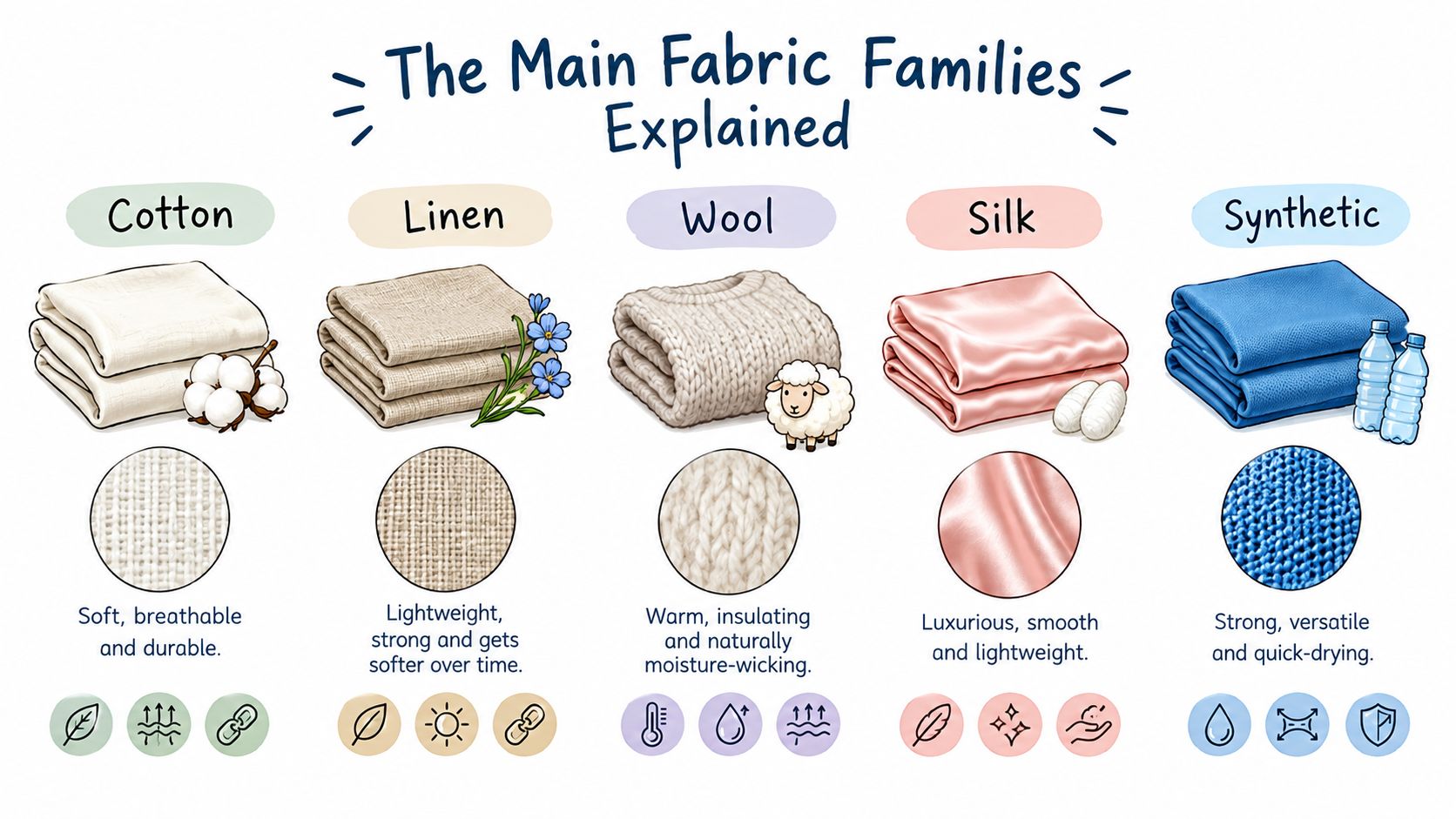
A fabric swatch communicates more through the hand than through its label. Cotton can feel soft and breathable between the fingers. Linen often has a dry, relaxed texture. A dense synthetic may feel smooth and consistent, while a nubby performance weave adds visual depth and a more substantial touch.
Natural fibers bring character
Cotton offers a familiar softness and breathability. It can work well in a quieter living room or for shoppers who value a natural hand, but it may show spills more readily than a treated synthetic. Cleaning requirements vary, so the fabric's care code should guide expectations.
Linen brings visible slubs, a relaxed appearance, and a texture that can soften with use. Its tendency to wrinkle is part of its character, not necessarily a defect. Linen may suit a formal or lightly used room better than a household seeking a consistently smooth, even surface.
Wool contributes warmth and resilience, though some wool fabrics can feel coarse without a blend. It can create a rich, tactile atmosphere, especially when the sectional serves as a refined gathering point rather than a constant snack station.
Synthetic fibers prioritize practical performance
Polyester and microfiber are common choices for everyday seating because they can offer consistent color, a smooth or suede-like hand, and practical spill management when the construction and finish are appropriate. Nylon is valued for abrasion strength and often appears within a blend rather than as the only fiber. Olefin can be useful in rooms where moisture and bright light are concerns, subject to the specific care instructions.
A performance weave usually refers to an engineered textile or blend designed around active use. The label alone isn't enough. The seller should provide the abrasion method, cleaning code, pilling information, and colorfastness details.
Fiber content is only one clue
A 2022 textile study found that a plain-weave fabric containing 87% polyester and 13% cotton showed better rubbing resistance than the other samples tested, but the result doesn't mean every blend with those percentages will outperform every alternative. Yarn quality, weave density, finishes, and testing conditions also matter. The Fabric Company's bolt guide provides helpful background on how upholstery materials are specified and handled.
| Fabric family | Typical feel | Where it can work well | Main consideration |
|---|---|---|---|
| Cotton | Soft and breathable | Quiet rooms and natural-fiber interiors | Spills may require prompt care |
| Linen | Textured and relaxed | Formal rooms and layered interior design | Wrinkling is part of the look |
| Wool | Warm and resilient | Refined rooms and cool-season comfort | Some weaves may feel coarse |
| Polyester or microfiber | Smooth and consistent | Daily family use | Cleaning performance depends on the finish |
| Blends and performance weaves | Varies by construction | Active homes needing balanced performance | Specifications matter more than the label |
For a fuller material overview, shoppers can review this upholstery-material guide before handling samples. The showroom sit test remains important because two fabrics with similar labels can feel entirely different against the hand and arm.
Understanding Durability Ratings
A rub count is useful, but it isn't a lifetime promise. It measures resistance to a particular type of repeated rubbing, while a sectional also has to contend with seams, sunlight, spills, pilling, cushion compression, moisture, and household behavior.
Two tests use different scales
The Wyzenbeek test, common in North America, uses an oscillating cotton-duck abradant and reports double rubs. The Martindale test, common in European and international markets, rubs the fabric in a figure-eight motion against worsted wool and reports cycles. The machines, materials, pressures, and failure criteria differ, so the figures must not be converted directly.
The Association for Contract Textiles identifies 15,000 Wyzenbeek double rubs or 20,000 Martindale cycles as a benchmark for general-use woven upholstery. For high-traffic or public applications, its benchmark rises to 30,000 double rubs or 40,000 cycles in the respective systems, as shown in its abrasion testing guidance.
| Rating range, double rubs | Martindale reference, not a conversion | Recommended use | Typical household |
|---|---|---|---|
| Below 15,000 | Below 20,000 cycles | Decorative or light-use seating | Formal room used occasionally |
| 15,000 to below 30,000 | 20,000 to below 40,000 cycles | Regular residential use | Living room with ordinary daily seating |
| 30,000 and above | 40,000 cycles and above | Heavy residential traffic | Active family room with children, pets, or daily gatherings |
These ranges are decision points, not guarantees of a particular service life. A practical specification for a household sectional used daily by adults, children, or pets is roughly 30,000 Wyzenbeek double rubs or 40,000 Martindale cycles, alongside suitable seam, pilling, colorfastness, and cleaning results.
What the number leaves out
Abrasion testing doesn't measure whether a fabric stains easily, fades in sunlight, pills, stretches at the seams, or withstands claws. It also says nothing about the frame, suspension, cushion recovery, comfort, or repairability. A high rating can coexist with a fabric that requires careful cleaning or a frame that doesn't suit the room's use.
Pilling resistance concerns small fiber balls. Seam slippage concerns how the weave behaves under tension near stitching. Tear strength concerns punctures and pulling. For a large sectional, all three can matter at seat edges, inside arms, corners, and removable-cover seams.
A buyer comparing specifications should ask for the exact test standard and report, then compare Wyzenbeek results only with Wyzenbeek results and Martindale results only with Martindale results. The living-room sofa buying guide can support that broader conversation by placing fabric beside comfort, construction, and configuration.
Matching Fabric to Your Household
The right fabric depends less on a marketing label than on what happens in the room. A toddler's snack, a dog's claws, a guest's drink, and an afternoon reading session each create different demands. The strongest choice starts with those routines, then narrows the options by texture, color, weave, and care.
Four common household profiles
Kid-heavy homes often benefit from tightly woven microfiber or performance blends, especially when removable cushion covers are available. Mid-tone colors and subtle patterns can make everyday marks less conspicuous than a perfectly uniform pale surface. The care code still matters, because “easy to clean” never means every household cleaner is safe.
Pet households generally need a stable weave with limited loose loops. Smooth, dense textures can reduce snagging opportunities, while a mid-tone pattern may disguise fur between cleanings. Boucle and chenille can hide hair because of their texture, but their raised surfaces may catch claws more easily.
Frequent entertainers may want a fabric that combines polished appearance with a substantial abrasion specification. A woven pattern can add visual interest and help camouflage small signs of use, while a performance finish may make prompt spot treatment more manageable.
Formal living rooms can prioritize linen, cotton, wool, or a refined blend when the room receives lighter traffic. A lower abrasion specification may be appropriate for occasional use, but the household should still review fading, pilling, and cleaning information before ordering.
| Household type | Best fabric families | Weave and pattern tips | Stain resistance |
|---|---|---|---|
| Children and toddlers | Microfiber, polyester blends, performance weaves | Dense weave, mid-tone pattern, removable covers | Favor documented cleaning instructions |
| Pets | Tightly woven synthetics and stable blends | Avoid loose loops; select a forgiving pattern | Choose treatments only with care details |
| Frequent entertainers | Performance blends and durable woven fabrics | Refined texture with visual variation | Prompt spot care remains important |
| Formal living room | Linen, cotton, wool, and tailored blends | Texture and color can lead the design | Match care demands to actual use |
A household that uses its sectional as the primary television, reading, and gathering space should generally look toward the higher residential range discussed earlier, roughly 30,000 double rubs or 40,000 Martindale cycles, while a lightly used room may not need the same specification. This guide to durable furniture for pets can help pet owners consider upholstery alongside frame and cushion construction.
For maintenance planning, this resource on choosing a fabric sofa cleaner offers useful context about matching cleaning methods to upholstery types. The practical sequence is simple: identify the likely mess, choose a textile that tolerates the household's routine, and confirm the manufacturer's approved care method before purchase.
Construction Details That Affect Longevity
Fabric receives the attention because it's visible, but the sectional's longevity also depends on what sits beneath the upholstery. A durable textile cannot compensate for a frame that flexes excessively, weak joinery, tired suspension, or cushions that lose their shape quickly.
The frame and joinery carry the load
A kiln-dried hardwood frame is one construction approach buyers may encounter. Engineered wood can also be used effectively when properly designed, but the seller should explain where each material appears and how the frame is reinforced. Joinery matters as well. Mortise-and-tenon or doweled connections generally communicate a different construction approach from staples used alone.
The goal isn't to memorize a single “best” specification. It's to ask how the frame handles repeated movement, where stress points are reinforced, and what the warranty covers. A loose fabric weave can appear distorted when the underlying structure moves too much, while reinforced seams become especially important when covers are removed for cleaning.
Suspension and cushions shape the sit
Suspension may use eight-way hand-tied springs, sinuous springs, or webbing. Each system creates a different balance of support, flexibility, and maintenance expectations. The sit test reveals more than a label. Shoppers can notice whether the seat feels buoyant, firm, relaxed, or overly soft, then compare that sensation with the intended household use.
Cushions also deserve a close look. High-resilience foam can provide structured support and recovery, while down-wrapped cushions can add a softer, more enveloping feel. Neither choice is automatically right for every household. A family that wants a custom seat may prefer a different cushion experience from a reader seeking a deep, relaxed perch.
Repairability belongs in the purchase conversation
A sectional is more sustainable when the household can maintain, clean, or repair its high-wear components instead of treating one damaged cushion or cover as a reason to replace the entire piece. A 2025 government analysis of furniture ecodesign notes that synthetic upholstery fibers such as polyester and acrylic can improve wear resistance and lifespan but may be difficult to separate and recycle after use. It also recommends replaceable, interchangeable high-wear components.
The same analysis supports asking whether covers are removable, whether cushion cores are accessible, whether seams are reinforced, and whether matching fabric can be ordered for future repairs. A 2025 repair-impact study reported that cleaning a stained sofa or chair generated 24 to 33 times less climate impact than replacement, while re-upholstering damage generated 3 to 4 times less impact. The finding reinforces a simple ownership principle: care and repair can be part of the sectional's value.
Finding the Right Configuration for Your Space
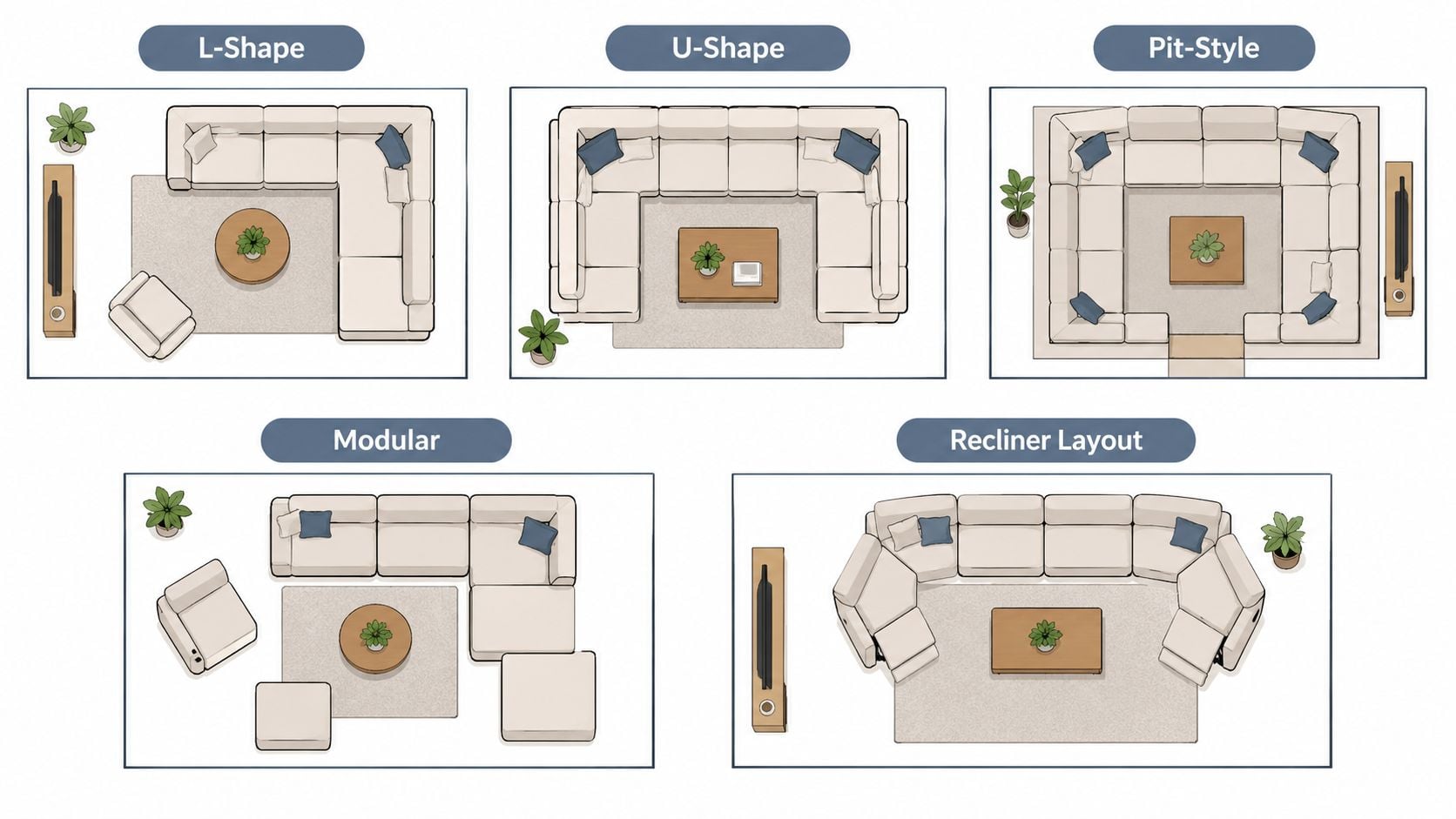
A sectional's shape should follow the room's movement pattern, not just the dimensions of an attractive showroom display. The best configuration leaves clear paths, faces the room's focal point, and supports the way household members sit.
Five layouts with distinct strengths
An L-shaped sectional usually works well in a corner or standard living room. It can face a television, fireplace, or window while creating a natural boundary between the seating area and the rest of the room.
A U-shaped or pit-style layout creates a more enclosed gathering zone. It can suit a larger open floor plan or family that wants several people facing one another, but it requires generous clearance around the outside edges.
A chaise-end sectional gives one person a place to stretch out without requiring a separate footstool. The chaise can orient toward natural light, a view, or a focal point, provided it doesn't block a doorway or primary walkway.
Modular pieces support changing households, renters, and rooms that may be rearranged after a move. Separate components can offer more flexibility, though each module still has to clear the delivery route.
A sleeper sectional combines everyday seating with guest accommodation. The room needs enough open floor area for the bed mechanism, and the delivery path must accommodate each component.
Measure the room and the route
Before fabric selection, shoppers should measure the usable walls, doors, hallways, stairways, tight turns, windows, vents, built-ins, and outlets. The narrowest doorway or hallway point can determine whether a seemingly suitable sectional is practical.
Painter's tape can mark the proposed footprint on the floor. Walking around the outline reveals whether the coffee table leaves enough circulation, whether a door can open fully, and whether the chaise interrupts the household's normal route.
- Room footprint: Record usable wall lengths rather than assuming every inch is available.
- Delivery route: Measure the narrowest opening and the tightest turn.
- Focal point: Decide whether the sectional should face the television, fireplace, window, or conversation center.
- Traffic flow: Keep the route between entrances, seating, and adjacent rooms clear.
- Orientation: Confirm whether left and right are described from the front view, especially for a fixed chaise.
The configuration can also affect delivery and future flexibility. A made-to-order plan should confirm module dimensions, doorway requirements, and whether the chaise is fixed or reversible before the order is finalized.
Making Your Custom Selection at Tyner
A successful custom sectional appointment turns scattered preferences into a written specification. The process begins with the room, not with a favorite swatch. Ann Arbor and Southeast Michigan households can bring room measurements, doorway details, photographs, and a short description of how the sectional will be used.
A practical showroom sequence
The consultation can follow a clear order:
- Review the room. The shopper and advisor identify walls, openings, focal points, and circulation paths.
- Choose a base configuration. L-shaped, U-shaped, chaise, modular, and sleeper arrangements can be considered against the available footprint.
- Set the performance threshold. The household matches the intended traffic with a documented abrasion method and checks pilling, seam slippage, colorfastness, and cleaning information.
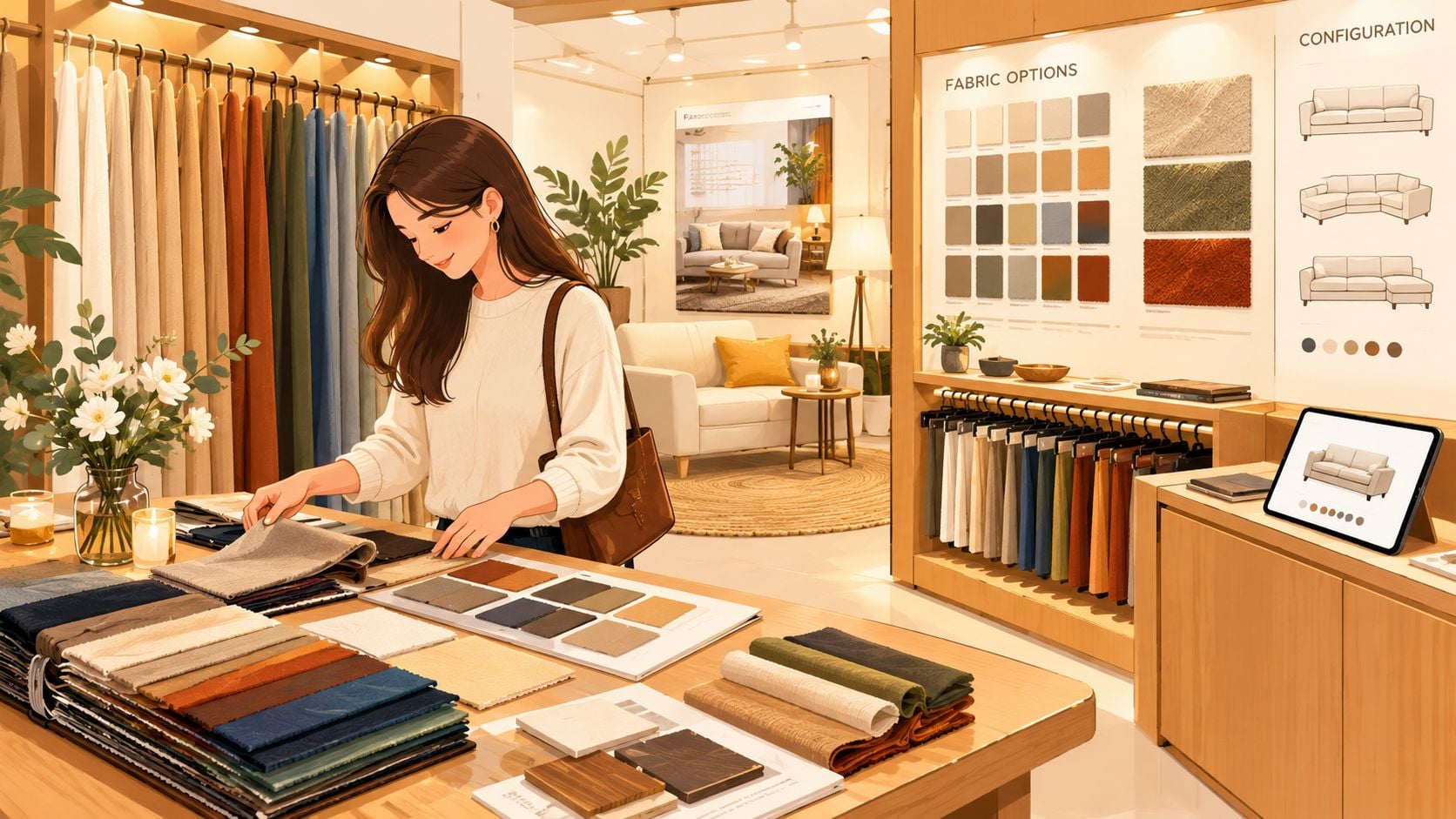
- Handle fabric samples. Texture, softness, pattern scale, and color should be evaluated under showroom lighting and beside other finish choices.
- Confirm comfort details. Seat depth, cushion fill, back support, arm height, and leg finish all affect the final sit.
- Review the order. Orientation, modules, upholstery, dimensions, features, and delivery details should appear clearly before approval.
The in-store sit test adds information a photograph can't provide. A shopper can sit upright, lean back, stretch out, compare cushion recovery, and feel whether a fabric is buttery, crisp, nubby, or structured. Pattern scale also becomes easier to judge on a larger display than on a small sample.
Customization supports lasting value
Made-to-order upholstery allows the sectional to respond to the room instead of forcing the room to respond to a fixed product. Tyner's custom upholstery services provide a starting point for discussing fabrics, configurations, and finishes. The available selection can include specific upholstery choices for sofas, sectionals, and related seating, with the final options determined by the collection.
The customization edge isn't limited to fabric. Canadel supports bespoke dining choices, while Stressless provides ergonomic seating options with custom sizing across Small, Medium, and Large, subject to product availability. For bedroom or dining furniture, Tyner's Amish hand-crafted solid wood pieces offer a clear contrast with mass-produced alternatives through material integrity and joinery such as dovetailing and mortise-and-tenon construction. Solid North American hardwoods, including cherry, oak, and maple, bring the weight and tactile presence of heirloom furniture.
Special Financing, subject to credit approval, can help households plan for a higher-quality made-to-order piece, and the Low Price Promise supports competitive value. The key question remains practical: whether the selected construction, fabric, comfort, and layout justify the investment over the years of use.

Ann Arbor and Southeast Michigan shoppers can visit the Tyner Furniture showroom for a fabric, comfort, and configuration sit test, or review online Quick Specs when planning a special order. A prepared visit with room measurements and household-use details makes it easier to select a bespoke fabric sectional built around real comfort, durability, and long-term value.