Buy Now Pay Later Furniture No Deposit Guide 2026

A couple in Ann Arbor can recognize the right dining table immediately. The solid cherry has weight in the hand, the joinery feels deliberate, and the surface looks capable of hosting holidays for years. Then the practical numbers arrive: daycare, a car repair, utilities, groceries, and the regular bills spread across the kitchen counter.
Paying cash would empty the household buffer. Waiting could mean another year with a cramped table the children have already outgrown. A no-deposit financing plan might bring the better table home now, but only if the repayment fits comfortably beside everything else.
That's the useful way to think about buy now pay later furniture with no deposit. It isn't a shortcut to furniture someone can't afford. Used carefully, it can spread the cost of an heirloom piece across manageable payments. Used casually, especially alongside other installment plans, it can turn household essentials into a stack of obligations.
When Monthly Cash Flow Meets a Dining Table You Love
The couple's decision isn't really about whether the table is attractive. It's about whether the table's long service life justifies changing the timing of the payment.
A hand-crafted solid wood dining set can become part of a home's rhythm. It may hold birthday dinners, homework, holiday meals, and everyday breakfasts. That's different from choosing a trend-driven piece whose finish, hardware, or construction may not withstand years of regular family use. Furniture that lasts longer gives financing a stronger foundation because the household continues using the item after the repayment schedule ends.
The right starting point is the table itself. Shoppers can review practical guidance on choosing the right dining room table by considering room dimensions, seating needs, traffic flow, and the way the family eats.
The three choices on the kitchen counter
The couple generally faces three paths:
- Pay cash: Keep the purchase simple, but reduce the emergency reserve.
- Wait: Preserve cash flow, while accepting another season with furniture that no longer suits the household.
- Finance without a deposit: Take the table home under a payment agreement, preserving cash while adding a recurring obligation.
None of these options is automatically right. A no-deposit plan makes sense only when the payment fits the existing household budget, not when the household needs an optimistic future raise or an uncertain bonus to cover it.
Local advisor rule: A long-life piece can justify spreading the cost. A short-life piece rarely justifies carrying the payment after the furniture has already worn out.
Ann Arbor and Southeast Michigan households also need to account for delivery timing, custom finishes, and room planning. “In-stock” is only the beginning. Made-to-order options can change the fabric, finish, dimensions, and configuration, whether the shopper is considering bespoke Canadel dining furniture or ergonomic Stressless seating.
The useful question is therefore not, “Can the family get furniture with no money down?” It's, “Will the household still feel comfortable making the payment after the excitement of delivery has passed?”
What Buy Now Pay Later Furniture No Deposit Actually Means
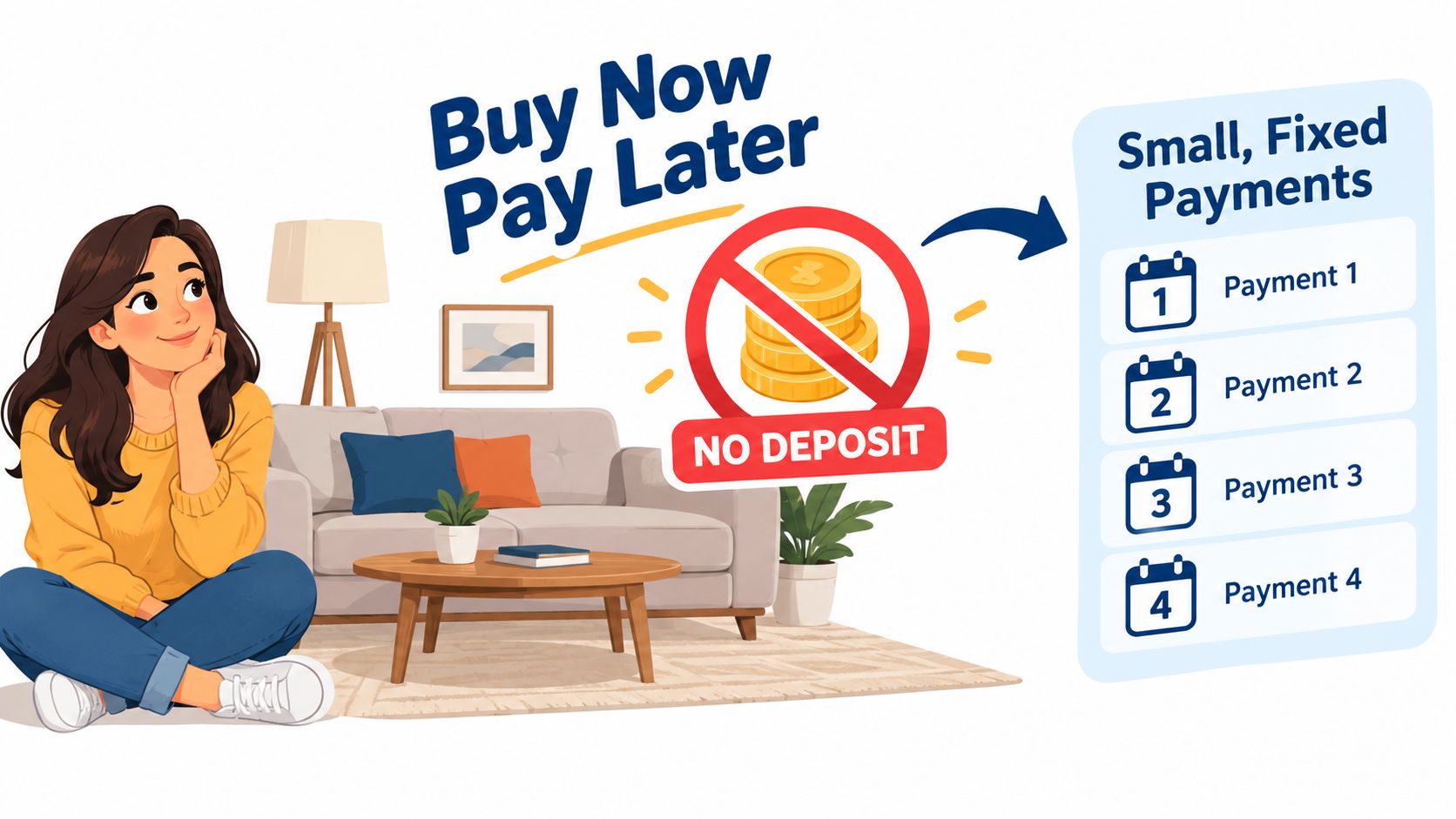
Buy now pay later, or BNPL, is an installment payment arrangement. The shopper receives the furniture under the agreement's delivery terms and repays the purchase through scheduled installments. “No deposit” means no upfront percentage is required before the plan begins, although the first payment may still be scheduled soon after approval.
The phrase can describe very different contracts. One plan may divide the balance into short, interest-free installments when payments arrive on time. Another may postpone payments but apply interest if the balance isn't cleared by a stated deadline. A third may include fees, a disclosed annual percentage rate, or late-payment consequences.
Why furniture has become a major BNPL use case
BNPL has moved beyond a niche credit alternative. The Federal Reserve's 2025 SHED-based consumer report says 16% of U.S. adults used BNPL in 2025, a sign that installment checkout has entered ordinary household purchasing (Federal Reserve data summarized here).
Furniture fits the model naturally. It's often a planned, higher-ticket purchase, and shoppers may prefer to spread the cost instead of paying the complete amount at once. Independent market research summarized by Numerator found that furniture and home décor represented 26% of BNPL purchases, while Capital One Shopping research reported home and furniture as the most popular category among 42% of users (industry summary and source links).
A separate industry analysis found BNPL orders had an 85% higher average order value than purchases using other payment methods (furniture BNPL analysis). That doesn't mean every financed purchase is wise. It does explain why retailers place financing information near the product page, cart, or checkout.
The phrase needs a closer reading
Before agreeing, the shopper should identify:
- Payment timing: Is the first installment due immediately, after delivery, or after a promotional window?
- Interest method: Is the plan interest-free, or does interest accrue and become payable later?
- Fees: Are there origination, service, late, or returned-payment charges?
- Approval terms: Does the advertised plan apply to the full order, custom merchandise, delivery, or only selected items?
For readers comparing arrangements, a plain-language explanation of no-fee payment plans can help clarify how short installment products differ from deferred-interest financing. The contract at the furniture checkout remains the controlling document.
How No Deposit Plans Are Structured at the Checkout
Furniture shoppers usually encounter one of three structures. The first is a short biweekly arrangement. The second is a longer promotional account. The third is an equal-payment plan with a clearly disclosed interest rate or genuine zero-interest structure.
A short plan may divide the purchase into four payments over roughly six weeks. PayPal's furniture financing information describes four interest-free payments every two weeks, alongside longer monthly terms of 3, 6, 12, or 24 months, subject to approval.
A longer promotional plan works differently. The customer may have no payment due during a stated window, but the agreement can apply interest if the balance isn't paid by the deadline. A furniture retailer's financing disclosure, for example, describes “No Interest If Paid In Full Within 12 Months” on qualifying purchases of $1,299 or more. If the balance isn't cleared, the disclosure states that interest is charged retroactively from the purchase date at 28.99% APR, with a $1.00 minimum interest charge (retailer financing disclosure).
A third structure uses equal installments under a disclosed interest rate or a genuine promotional zero-interest agreement. The shopper should never infer the terms from a “no deposit” label alone.
Common No-Deposit BNPL Plan Structures for Furniture
| Plan Type | Term Length | When First Payment Is Due | Interest Behavior | Late Payment |
|---|---|---|---|---|
| Short installment plan | Short, often biweekly | Usually soon after purchase | May be interest-free when paid as agreed | May trigger fees, account restrictions, or other consequences |
| Promotional financing | Longer stated promotional window | May be delayed under the agreement | Interest may accrue or become retroactive if the balance isn't cleared | Can activate interest, fees, or adverse account treatment |
| Equal-payment financing | Set monthly schedule | Follows the signed payment calendar | May be zero-interest or carry a disclosed APR | Consequences depend on the lender agreement |
The practical task is to read the schedule, not the headline. Shoppers can also review Tyner's financing checkout information before visiting the South State St. showroom so questions are ready before an order is placed.
Eligibility, Credit Checks, and the Retro Interest Trap
Approval isn't guaranteed because a plan advertises no deposit. The provider can review identity, payment details, affordability signals, and the requested term before showing an offer.
Many installment providers begin with a soft credit inquiry when a shopper checks eligibility. A soft inquiry generally doesn't affect the credit score. The provider may use a harder inquiry when the shopper accepts a particular product, chooses extended financing, or applies for an account that reports differently. The exact process varies, so the application screen and agreement should state which inquiry will occur.
Applicants commonly need to meet basic identity and payment requirements, such as being at least 18, providing a checking account or debit card for short installment products, and supplying a verifiable income signal. A lender may consider employment details and overall affordability rather than relying on one minimum credit-score rule.

The retroactive-interest problem
Deferred interest deserves special attention. A promotional offer can look like a zero-interest arrangement while requiring the customer to clear the entire balance by a hard deadline. If the balance remains, the agreement may charge interest back to the original purchase date.
That's why a shopper comparing payment policy for premium orders should focus on payment timing, deposit language, cancellation terms, and the consequences of missing the stated conditions. The same discipline applies to every furniture finance agreement.
Before signing, the shopper should verify the following in writing:
- Inquiry type: Confirm whether the application begins with a soft inquiry and when a hard inquiry might occur.
- Total repayment: Compare the full amount payable with the cash purchase price.
- Interest trigger: Identify the exact event that activates interest.
- First due date: Confirm whether the first payment precedes delivery.
- Late consequences: Check fees, grace periods, reporting, and account restrictions.
- Order treatment: Ask what happens if a custom item is delayed, changed, returned, or canceled.
Traditional store credit can make the APR and repayment period easier to see, but it can still contain promotional conditions. The label matters less than the signed disclosure. Tyner's no-interest furniture financing information can help shoppers prepare questions, but the lender's final agreement controls the transaction.
The Real Upside and the Real Risk of Spreading the Cost
No-deposit financing can protect a household's cash reserve. That matters when a family needs to furnish a home but also wants room for an unexpected repair, medical expense, or employment interruption.
Consider a $4,000 solid wood dining set spread across twelve interest-free biweekly payments. The family keeps its cash available and receives a table built for the home's long-term use. That example is financially coherent only when the payment schedule fits the existing budget and every installment can be made on time.
The furniture's expected life matters. Construction guidance describes mortise-and-tenon and dovetail joints as premium methods associated with expected lifespans of 20+ years, while simpler pocket-screw, staple, or nail construction is associated with service lives of roughly 1 to 10 years (furniture construction guidance).
The risk is payment fatigue
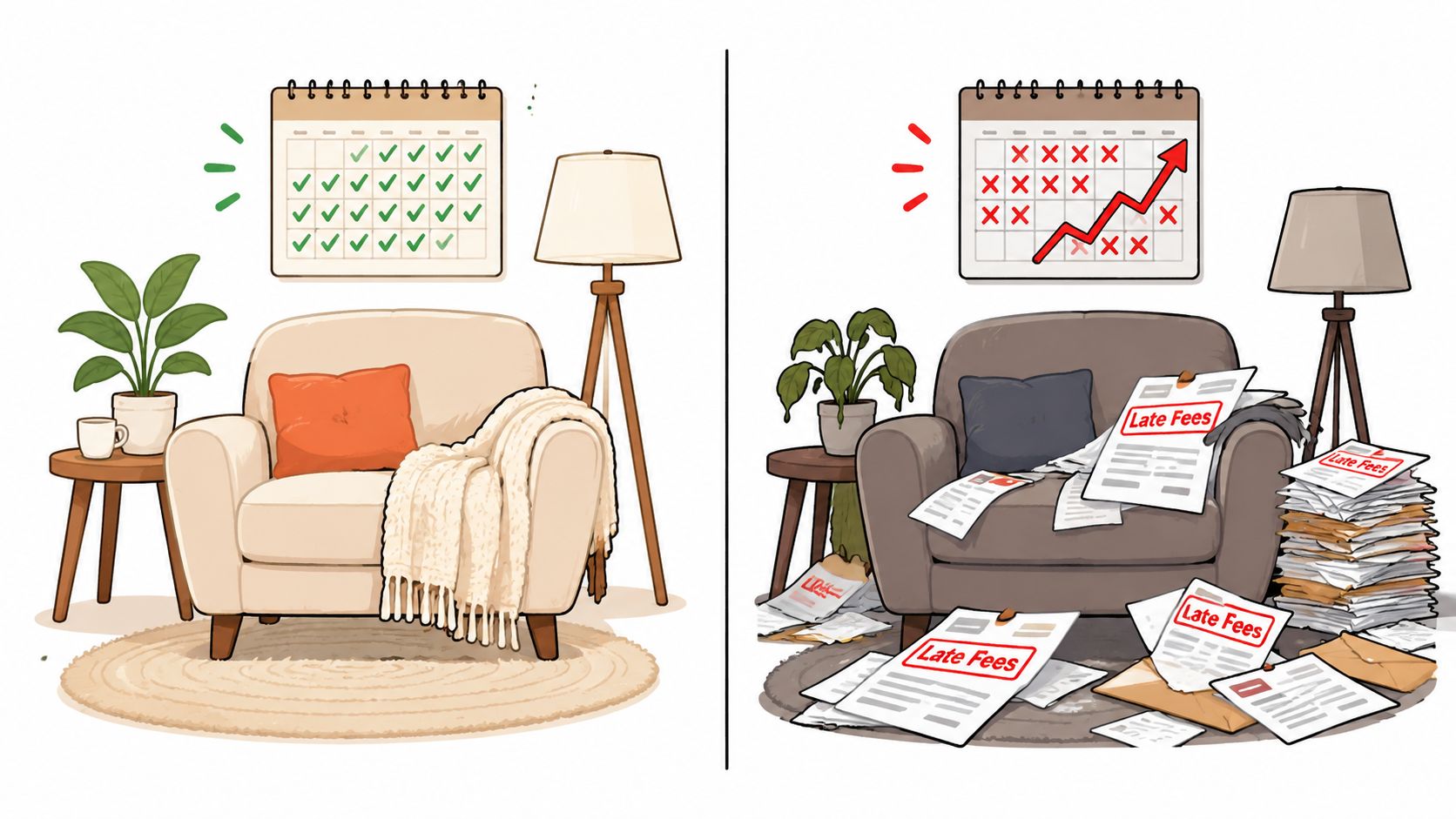
A household can manage one well-planned installment schedule and struggle with several. Furniture, appliances, groceries, clothing, and seasonal purchases may each look manageable alone, but the combined due dates can create payment fatigue.
Late payments aren't a theoretical concern. A 2026 LendingTree survey reported that 47% of BNPL users were late during the previous year (LendingTree BNPL statistics). The practical lesson is direct: a plan that depends on perfect timing and no unexpected expenses has little safety margin.
A household should ask three questions:
- Can the payment be made from current income, without relying on future overtime?
- Does the budget still work after groceries, housing, transportation, childcare, and existing debt?
- Is there a cash buffer left after the purchase?
Budget test: If a missed paycheck would make the next installment uncertain, the purchase needs a smaller scope, a later date, or a different payment structure.
A shopper comparing options through a furniture financing guide should evaluate total repayment and durability together. Financing heirloom furniture can be sensible. Financing a short-life piece at a high total cost usually isn't.
How Tyner Furniture Pairs No Deposit Plans With Heirloom Quality
Tyner Furniture, founded in 1957, offers furniture across the home, from Home Office settings to Outdoor Spaces, along with living rooms, bedrooms, dining rooms, entertainment areas, mattresses, and sleep systems. Its Ann Arbor showroom gives shoppers a physical way to evaluate the buttery feel of top-grain leather, the support of ergonomic seating, and the weight of solid cherry wood before choosing a payment plan.
The financing decision changes according to the purchase category.
- In-stock pieces: These may be ready for delivery or pickup, so the shopper should match the repayment period to a purchase that begins serving the household immediately.
- Custom orders: Made-to-order upholstery, finishes, fabrics, and configurations require closer attention to cancellation and delivery terms.
- Amish built-to-order furniture: Production scheduling can extend beyond the showroom visit, and the agreement should state how deposits, progress payments, and financed balances are handled.
Construction changes the value calculation
Tyner's Amish hand-crafted solid wood pieces use hardwood construction and time-honored joinery such as dovetailing and mortise-and-tenon work. That contrasts with mass-produced alternatives that may rely more heavily on veneer or simpler fasteners.
A dovetailed drawer, a firm mortise-and-tenon frame, and the weight of hardwood aren't decorative details. They influence how a piece handles repeated use, repairs, moves, and changing rooms. The household should calculate cost per year of use, not just the monthly installment.
| Purchase Type | Typical Lead Time | No-Deposit Plan Availability | Recommended Plan Length |
|---|---|---|---|
| In-stock furniture | Ready for the retailer's delivery schedule | Often the simplest category for immediate financing review | Keep the term aligned with comfortable cash flow |
| Custom upholstery or dining | Depends on specifications and production | Confirm whether the full made-to-order amount qualifies | Avoid a term longer than the expected practical benefit |
| Amish built-to-order | May require an extended production schedule | Confirm whether a progress deposit applies before production | Choose a schedule that remains manageable during the wait |
Tyner's heirloom custom Amish furniture illustrates the distinction between financing a durable investment and financing a passing trend. The showroom also supports customization through Canadel finishes, fabrics, and configurations, and through Stressless ergonomic sizing. Special Financing and a Low Price Promise can reduce the upfront barrier, but neither replaces careful review of the agreement.
Walking Through the Application Step by Step at the Showroom
At the Ann Arbor showroom on South State St., the application should feel like a documented purchase decision, not a race to approve the shopper. The process begins after the household has selected the furniture, confirmed dimensions, and decided that the payment belongs in the monthly budget.
The showroom workflow
Select the piece. The shopper reviews the frame, finish, fabric, configuration, delivery details, and order status. For custom upholstery, shoppers can also learn why it can matter to choose custom from Lewis and Sheron Textiles rather than defaulting to a fixed retail configuration.
Submit the application. The shopper uses the financing terminal and provides the requested identification and payment information.
Review the decision. The lender presents available terms, payment amounts, due dates, and any required deposit or first payment. The shopper should ask whether the inquiry is soft or hard and whether the account reports to credit bureaus.
Inspect the agreement. The associate can print the amortization schedule. It should show the total repayment, interest treatment, late-payment rules, first payment date, autopay details, and any promotional deadline.
Confirm production and delivery. In-stock furniture moves toward delivery scheduling. Custom and Amish pieces move into production planning under their stated lead times and payment conditions.
Bring a valid ID and a recent pay stub if available. A pay stub may help answer income-verification questions, while the signed contract remains the authority on approval and payment obligations.
Before signing: The shopper should circle the first payment date, the final payment date, and the sentence explaining when interest begins.
The retailer should also explain when the first payment is processed, especially if the plan serves as the deposit equivalent. Approval, delivery, and production are related but separate events. A clear schedule prevents surprises after the order leaves the showroom.
Smart Questions Southeast Michigan Shoppers Ask Before Signing
The most important question is often not whether one new payment fits. It's whether the household already has too many scheduled payments.
A family furnishing a Southeast Michigan home may be paying for appliances, a mattress, seasonal purchases, or other essentials through separate agreements. The Federal Reserve's broader reporting shows BNPL use has expanded into everyday categories such as groceries and food delivery, which makes overlapping obligations a household-budget issue rather than only a furniture issue (Federal Reserve BNPL reporting).
A simple cash-flow test helps. List every installment due in the same pay cycle, subtract housing, utilities, food, transportation, childcare, insurance, and existing debt, then leave room for ordinary surprises. If the remaining amount barely covers the new furniture payment, the plan is too aggressive.
Questions worth asking at the showroom
- Interest: Does interest accrue from the purchase date, or is the plan zero-interest?
- Deadlines: What exact balance must be paid by the promotional end date?
- Late payments: What fee, reporting, or interest consequence follows a missed installment?
- Credit reporting: Will on-time or late payments appear on a credit report?
- Mortgage timing: Should a mortgage professional review the new obligation before an application or closing?
- Returns: How are financed custom orders, cancellations, and returned merchandise handled?
- Prepayment: Can the balance be paid early without a penalty?
- Delivery: Does the first payment begin before delivery or production completion?
Paying off an existing plan early may reduce monthly obligations, but households preparing for a mortgage should ask their mortgage professional before opening, closing, or changing credit accounts. Lenders can review outstanding obligations and payment history as part of their decision.
The central question remains sustainability. Financing several household essentials at once may solve immediate needs, but it can also create a crowded repayment calendar. A durable, hand-crafted piece deserves a payment plan that leaves the household comfortable long after the initial excitement fades.
Tyner Furniture offers special financing for qualifying purchases, custom furniture guidance, and a Low Price Promise across selections for living, dining, bedroom, Home Office, and Outdoor Spaces. Southeast Michigan shoppers can visit Tyner Furniture in Ann Arbor for a proper sit test, a close look at solid wood joinery and upholstery, or online browsing through Quick Specs for special orders.